

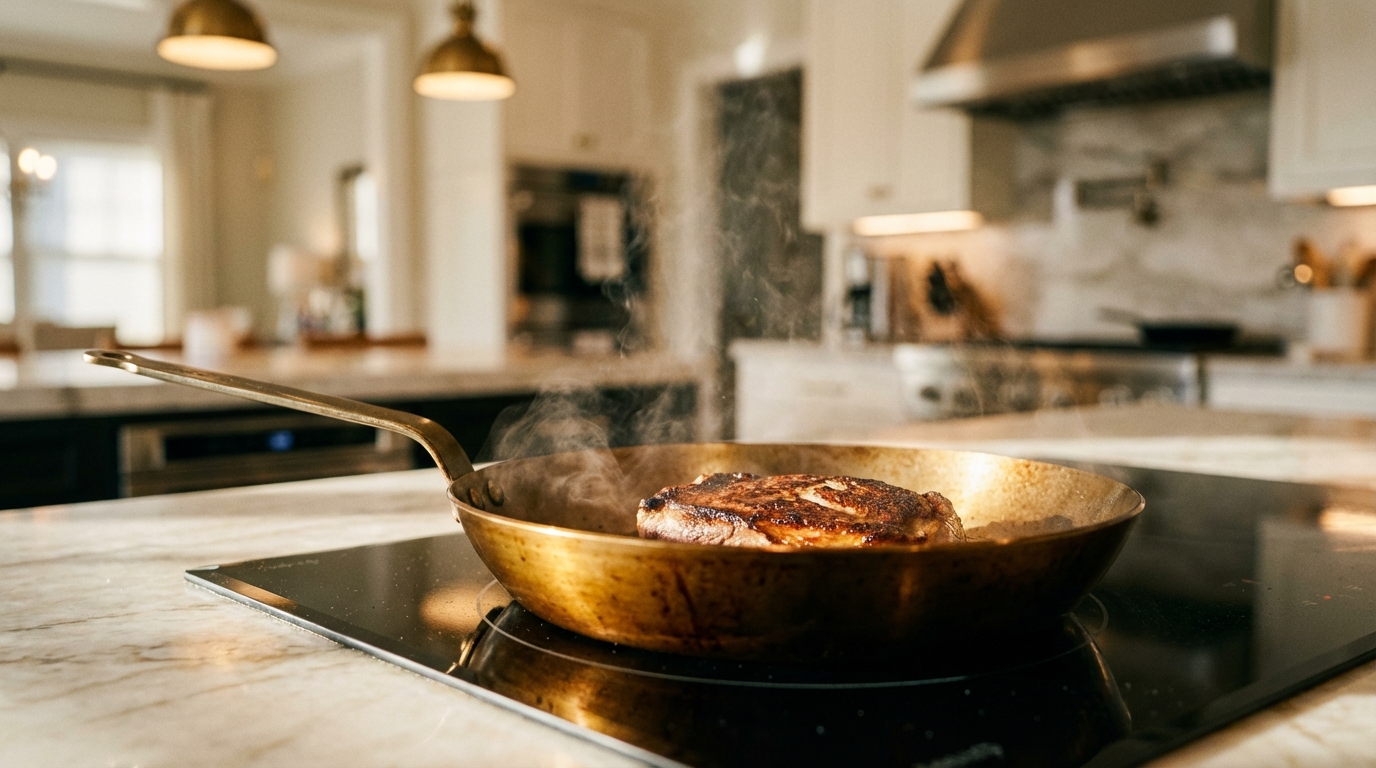
Switching from PFAS-coated nonstick to carbon steel cookware on induction burners delivers a triple win: it protects your health by eliminating toxic "forever chemicals," slashes lifetime cookware costs by replacing a decade of throwaway pans with one $65-$175 heirloom piece, and pairs perfectly with induction's instant, energy-efficient heat for restaurant-grade sears. The article walks readers through the science--how carbon steel's 99 % iron makeup creates ideal magnetic conductivity, why gradual preheating on settings 2-3 prevents induction's concentrated coils from hot-spotting, and how 3-5 thin-oil seasoning cycles build a natural, ever-improving nonstick surface that soap can't harm. You'll learn pro tricks like shifting oversized pans to even out heat, using medium (4-6) power for the best crust, and reviving uneven seasoning with targeted stovetop re-oiling instead of a full strip-down. Along the way it exposes the environmental toll of scratched PFAS pans contaminating landfills and drinking water, quantifies the waste of replacing nonstick every 2-3 years, and provides a simple maintenance routine--coarse-salt scrub, thin grapeseed wipe, occasional polymerizing heat--that keeps the pan bulletproof for generations while cutting kitchen waste, packaging, and chemical exposure to zero.
Why PFAS-Free Carbon Steel Pans Are a Game Changer
Swap your chemical-coated nonstick for a single carbon-steel pan and you'll banish forever-chemicals from your kitchen, your body, and the water supply while gaining a pan that outlasts generations and outperforms on induction.
Health and Environmental Benefits
Here's what you need to know about PFAS: they're synthetic chemicals in traditional nonstick pans that never break down--that's why they're called "forever chemicals" [1]. These compounds build up in your body over time, with PFAS detected in most Americans' blood, even in newborns and breast milk [2]. Research links PFAS exposure to thyroid disorders, cardiovascular disease, reduced fertility, and cancer [2][3]. The environmental impact hits close to home too.
Every scratched nonstick pan you toss releases PFAS into landfills and waterways. Testing shows PFAS contamination in drinking water across all 50 states [2]. While you'll replace nonstick pans every few years, a single carbon steel pan can last generations--significantly reducing waste [1]. Carbon steel offers a refreshingly simple alternative.
With just 99% iron and 1% carbon, these pans develop their own natural nonstick surface through proper seasoning--no synthetic coatings needed [3]. Even pans labeled "PFOA-free" often swap one harmful chemical for another, but carbon steel eliminates that guessing game entirely [3]. If you're among the 65% of Americans concerned about cookware chemicals, carbon steel delivers the performance you want without the health worries [1].
Performance Edge on Induction Cooktops
Carbon steel and induction cooktops are a perfect match.
The 99% iron composition creates ideal magnetic conductivity, giving you instant heat response that gas ranges can't match [4].
Your

Getting the Perfect Sear on Induction with Carbon Steel
Master induction-carbon-steel searing by starting low (2-3), waiting 5-10 min until the pan's edges feel hot, then nudging the pan off-center so the whole surface heats evenly and food releases with pro-level browning.
Preheating Techniques for Restaurant-Grade Speed
Achieving professional results with carbon steel on induction requires strategic preheating. Unlike gas cooktops that spread heat through open flames, induction heats only the specific area in contact with its electromagnetic coils, which are often smaller than their visible markings suggest [6]. Start with a gradual approach--begin at low settings (2-3) and allow 5-10 minutes for heat to distribute throughout the entire cooking surface [7].
This patience pays off with even cooking temperatures that prevent food from sticking at the edges. Test pan readiness by carefully touching the sides with your fingertips; when the edges feel warm to hot, you've achieved proper heat distribution [7]. For larger pans, occasionally shifting the pan slightly off-center helps season and heat the entire surface uniformly [7].
Many professional cooks find medium settings (4-6) provide ideal cooking temperatures for most techniques without the scorching that maximum power can cause [7]. This controlled approach creates the perfect environment for food to release naturally from your properly seasoned surface while developing restaurant-quality browning [7]. If you consistently struggle with uneven heating, consider pans specifically designed for induction--some manufacturers now offer carbon steel with construction that spreads induction heat more effectively [7].
Mastering Temperature Control Without PFAS Coatings
Mastering temperature control with carbon steel on induction requires understanding the fundamental differences from cooking with PFAS-coated pans. Unlike traditional nonstick cookware that relies on synthetic chemicals, carbon steel creates its own naturally non-toxic cooking surface through proper seasoning [1]. The key to success lies in gradual heating--induction cooktops transfer heat more intensely than gas ranges, so start at lower settings (2-3) and gradually increase as needed [8].
This patience prevents the extreme hot spots that cause food to stick or burn. Carbon steel responds instantly to temperature adjustments on induction, unlike coated pans that retain heat longer, giving you precise control when shifting between techniques [8]. For delicate cooking that would typically require non-stick properties, rely on your pan's seasoning rather than chemicals.
A properly seasoned carbon steel pan provides natural food release without the health concerns of PFAS [1]. Remember that induction's power means you rarely need high settings--most professional cooks achieve ideal searing temperatures at medium settings (4-6), preserving energy while still developing perfect crusts [8]. If you experience uneven heating, consider the match between your pan's base and the induction burner size; a flat-bottomed pan that covers the full diameter of the heating element will distribute heat more effectively [9].
Caring for Your PFAS-Free Carbon Steel Pan
Season your carbon-steel pan with whisper-thin oil layers, heat them to the smoke point, and watch the metal evolve from silver to black while each meal you cook reinforces the naturally slick, ever-improving surface.
Seasoning Basics and Ongoing Maintenance
Carbon steel pans need seasoning to develop their signature cooking surface. Think of it as building up protective layers that prevent rust while creating that naturally slick finish you'll love [10]. For new pans, start by removing the protective coating with hot water and dish soap, then dry thoroughly on a warm burner to prevent rust [11]. Apply an incredibly thin layer of neutral oil like canola, grapeseed, or vegetable oil. Here's the secret: buff it until the pan looks almost dry. Too much oil leads to sticky spots instead of that smooth finish you're after [10][12].
Heat the oiled pan to its smoke point either in a 450-500 degreesF oven or on a stovetop until the surface darkens, indicating the oil has polymerized [10]. Repeat this process 3-5 times to build durable protection [12].Once seasoned, maintaining your pan becomes part of your cooking routine. Watch as your pan transforms from silver to golden brown and eventually develops that beautiful black patina--each color change shows your seasoning getting stronger [11]. Always preheat your pan before adding cooking fat, which helps reinforce the seasoning with each use [11]. For routine cleaning, let the pan cool until warm, then use coarse salt as a gentle abrasive, scrubbing with a paper towel to remove residue without damaging the surface [11]. Contrary to outdated advice, modern dish soap won't harm properly seasoned carbon steel--the polymer bonds are much stronger than what soap can break down [12].
If food sticks or you notice uneven coloring, simply add another seasoning layer. For stubborn rust spots, scrub with a metal scouring pad or salt-detergent paste, then re-season immediately [11]. The best part? Your carbon steel pan actually gets better with every meal you cook, developing a surface that releases food beautifully--all through simple care rather than synthetic coatings.
Cleaning Hacks That Preserve Longevity and Performance
Cleaning carbon steel takes a different approach than other pans, especially on induction where the concentrated heating can create distinct zones in your seasoning. After cooking, give your pan a quick wipe with a paper towel. See some dark residue? That's perfectly normal--it's carbon buildup, not dirt [13].
For everyday care, wipe your warm pan clean and add the thinnest possible layer of high-smoke-point oil. Pro tip: grapeseed oil works better than flaxseed on induction, which can turn sticky [13]. For deeper maintenance, Got stubborn bits stuck on? Skip the harsh cleaners.
Instead, try coarse salt as a gentle scrub or simply boil water in the pan to loosen residue before wiping clean [13]. For pans with uneven seasoning common with induction use (mirror-smooth in the center with rougher edges), perform targeted reseasoning rather than starting over completely [13]. If your pan's handle isn't oven-proof for high temperatures, concentrate on stovetop seasoning maintenance--heat the pan on medium induction settings and apply thin oil layers, allowing each to polymerize before adding another [13]. This method preserves your seasoning while working with induction's unique heating patterns [13].


Real-World Savings and Sustainability
Buy one $65-175 carbon steel pan, keep 10-15 landfill-bound nonstick pans out of your kitchen and hundreds of dollars in your pocket for life.
Cost Comparison: Durable Steel vs. Disposable Alternatives
Let's talk real numbers--a quality carbon steel pan runs $65-175, but here's the catch: it's the last pan you'll ever need to buy. With proper care, these workhorses last decades, even generations [1]. Compare that to nonstick pans that need replacing every 2-3 years when their coatings start peeling, and the math becomes clear [1]. Over your cooking lifetime, you might burn through 10-11 nonstick pans while a single carbon steel keeps going strong [14].
Even those pricey 3-ply or 5-ply nonstick pans become useless once their coating fails--no amount of money spent changes that fact [4]. But carbon steel? It's practically indestructible. Got some rust or a few dents?
A little maintenance brings it right back to life [4]. This durability means you're not just saving money--you're keeping all those discarded pans out of landfills. Plus, you get consistent cooking performance without worrying about deteriorating coatings or PFAS exposure [1]. When shopping, look for quality construction in the mid-price range--you'll get excellent cooking properties without breaking the bank [14].
Reducing Kitchen Waste: A Long-Term Impact Checklist
Making the switch to carbon steel creates a ripple effect of positive changes in your kitchen.
Here's your sustainability checklist: Waste Reduction Wins: - Say goodbye to the replacement cycle--one carbon steel pan prevents 10-15 nonstick pans from hitting the landfill - No more packaging waste from constant replacements - Skip the worry about disposing of pans with damaged coatings [15] Environmental Impact: - Your one-time purchase eliminates years of manufacturing demands and raw material extraction [16] - Pair your carbon steel with glass storage containers for a plastic-free kitchen [16] - Better cooking results mean less food waste--when your sears come out perfect, nothing goes in the trash [16] Track Your Progress: - Note each time you would have replaced a nonstick pan (usually annually for many households) - Calculate packaging saved from avoided purchases - Monitor your food waste reduction as your cooking improves Financial Benefits: - One quality investment saves thousands in replacements over time - Support sustainable manufacturing with your purchasing power [15] The best part?
As discussed in our maintenance section, keeping your carbon steel in top shape requires just simple cleaning and occasional seasoning--no special products or complicated care routines needed.
- Carbon steel pans are PFAS-free and last generations, unlike 2-3 year nonstick replacements.
- PFAS in nonstick pans are linked to thyroid disease, cancer, and contaminate water nationwide.
- Induction heats only the coil contact zone; preheat 5-10 min on low (2-3) for even heat.
- Season carbon steel with ultra-thin oil layers, 450 degreesF to smoke point, repeat 3-5 times.
- Use medium induction settings (4-6) for pro sears; high power causes hot spots and sticking.
- Clean with coarse salt while warm; modern dish soap won't harm the polymerized seasoning.
- One $65-175 carbon steel pan can replace 10-11 nonstick pans, cutting landfill waste and cost.
- https://www.consumerreports.org/home-garden/cookware/best-frying-pans-if-you-want-to-avoid-pfas-chemicals-a1006253549/
- https://www.leafscore.com/eco-friendly-kitchen-products/pfas-pfoa-and-ptfe-everything-you-need-to-know/
- https://thepaleodiet.com/choosing-the-right-non-toxic-cookware/
- https://gastrotools.com/blogs/guides/carbon-steel-vs-non-stick-pans-8-differences
- https://cooksofcrocushill.com/blog/guide-to-pfas-free-cookware/
- https://matferbourgeatusa.com/education/black-steel-guide/
- https://www.reddit.com/r/carbonsteel/comments/1qafqws/struggling_with_induction_cooktop/
- https://www.reddit.com/r/carbonsteel/comments/16mss1o/carbon_steel_and_induction/
- https://www.debuyer-usa.com/blogs/news/best-carbon-steel-pans-for-glass-cooktop?srsltid=AfmBOoqfbn7sLovOVoRxenp-tj3NNPTrcPSArSy9h7i3lQkJVgMId1hx
- https://www.seriouseats.com/how-to-season-carbon-steel-pans
- https://www.vollrathfoodservice.com/culinary-experience-inspiration/vollrath-food-service-blog/how-to-season-and-maintain-carbon-steel-cookware
- https://www.reddit.com/r/carbonsteel/comments/nzv92d/the_ultimate_seasoning_guide_with_waaaay_more/
- https://www.reddit.com/r/carbonsteel/comments/wk8yxq/seasoning_on_induction/
- https://www.bonappetit.com/story/how-much-should-you-spend-on-a-good-pan?srsltid=AfmBOopT8iWknoezOR9krwZf3hnjS8bLkvX0qerLgqTghzsaqYSpWS50
- https://playitgreen.com/sustainable-pans-saute-the-eco-way/
- https://worldchefs.org/the-future-of-sustainable-cooking-eco-friendly-kitchens/