

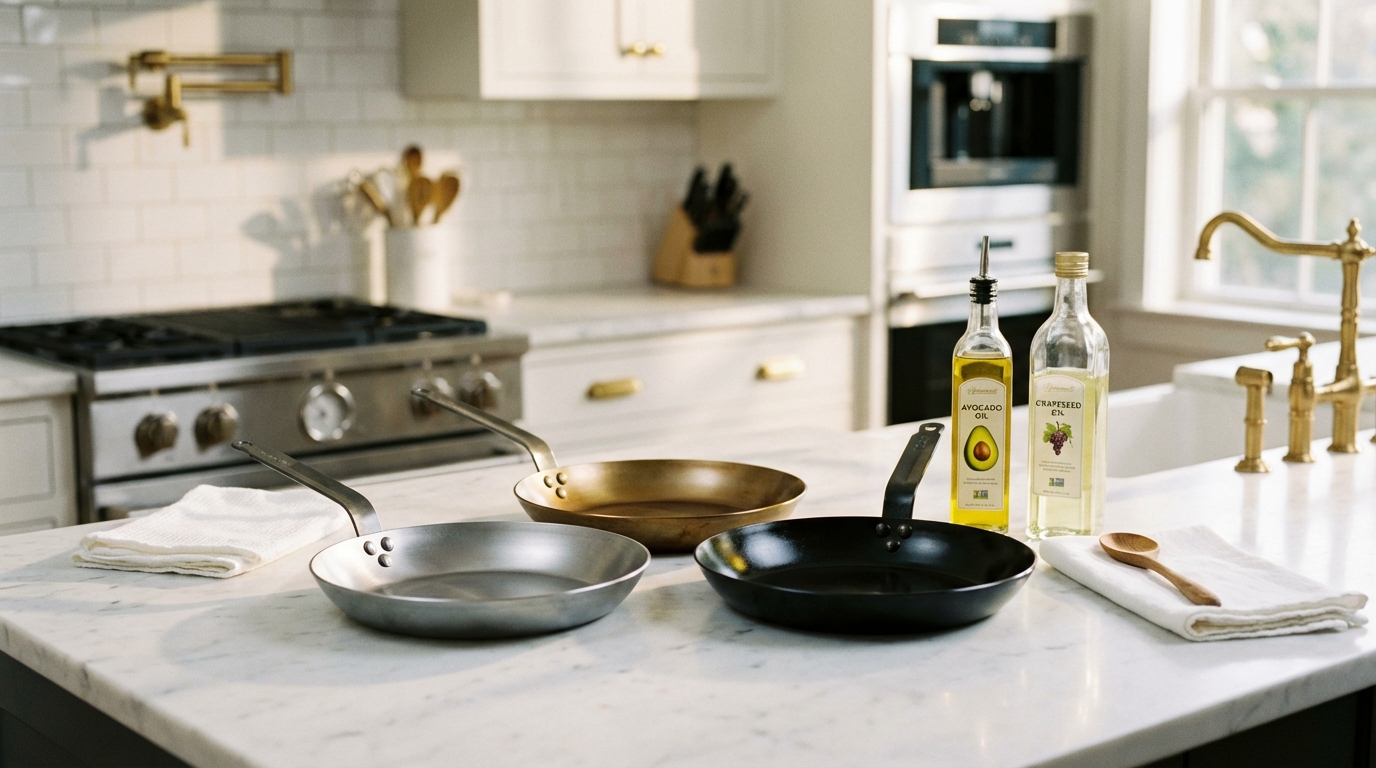
Seasoning carbon steel cookware with high-smoke-point oils like avocado or peanut replaces PFAS-laden non-stick pans with a natural, polymerized carbon layer that only gets slicker and more durable the more you cook, sear and bake. The article walks you through every critical step--stripping the factory coating with hot water and soap, choosing the right oil, applying whisper-thin layers via stovetop or oven methods, and repeating the process until an even bronze patina forms--so you can achieve professional-level release without forever chemicals linked to cancer and immune suppression. Maintenance is equally low-fuss: skip soap, rinse with hot water, dry on the burner, wipe on a trace of oil, and store the pan dry and separated to prevent rust and scratching. Along the way you'll learn why carbon steel outperforms ceramic at high heat, how microscopic pores grab oil for a fast, cast-iron-beating seasoning, and how simple habits like deglazing with salt or limiting acidic foods extend the life of your PFAS-free, endlessly versatile kitchen workhorse.
Why Seasoning Matters for PFAS-Free Carbon Steel
Seasoning carbon steel once creates a natural, high-heat non-stick surface that banishes forever-chemical PFAS while outperforming traditional and ceramic pans.
Health and Performance Benefits
Making the switch to properly seasoned carbon steel cookware means you're done with PFAS exposure from traditional nonstick coatings. PFOA and other PFAS compounds have been linked to serious health concerns including decreased fertility, developmental delays in children, increased cancer risk, and reduced immune response [2]. These "forever chemicals" persist in the environment and human tissue for generations, accumulating in fatty tissues over time [2].
But here's the good news: seasoned carbon steel delivers impressive cooking performance that rivals traditional nonstick options. These pans offer excellent food release while bringing superior versatility--you can move seamlessly between stovetop and oven for any cooking method [1]. You'll enjoy excellent cooking evenness, easy cleaning, and sturdy handles that stay relatively cool during use [1].
Unlike ceramic alternatives that struggle with high heat, properly seasoned carbon steel actually performs better at higher temperatures. This makes carbon steel pans ideal for high-heat cooking techniques like searing and stir-frying.
How Seasoning Creates a Natural Non-Stick Surface
Seasoning creates a natural non-stick surface through polymerization--a fascinating process that transforms ordinary cooking oil into a durable carbon layer bonded to your pan. When you heat oil past its smoke point on carbon steel, the fat molecules undergo a chemical transformation, linking together and adhering to the metal surface [5]. During this process, volatile compounds burn off while the remaining solid particles form a polymerized carbon matrix [4]. This molecular change creates that characteristic black patina that gets more non-stick with every use. The science works because carbon steel contains microscopic surface pores.
During seasoning, oil penetrates and fills these tiny cavities [5]. What makes carbon steel special? Its relatively shallow pores compared to cast iron mean you can achieve a solid non-stick foundation after just one proper seasoning session [5]. As you continue cooking, additional fats and oils from your food contribute to this layer, making it perform even better over time. The completed seasoning forms a stable carbon barrier that prevents food from directly contacting the metal while providing excellent release properties.
Unlike synthetic PTFE coatings containing PFAS, this natural seasoning layer is completely chemical-free. The polymerized surface is entirely food-safe, with no oil residue or substances that could transfer to your meals [4]. While chemical non-stick surfaces deteriorate over time and can release potentially harmful compounds, a properly maintained carbon steel patina actually improves with use [5]. This natural approach delivers the non-stick performance you want without any exposure to PFAS chemicals--those same chemicals linked to cancer risk and developmental issues [5]. Now that's cooking with confidence.

Preparing Your New Carbon Steel Pan for First Seasoning
Strip off every trace of the factory coating with boiling water and diligent scrubbing, then dry the pan on low heat before bonding a high-smoke-point oil like avocado or peanut to the bare metal for a bulletproof seasoning foundation.
Removing Factory Wax and Cleaning
Your new carbon steel pan comes with a protective coating--usually vegetable oil, beeswax, or a combination--that keeps it rust-free during shipping and storage. Before you can start building that perfect seasoning layer, you'll need to remove this coating completely [6][7]. Here's the most effective approach: Bring a kettle of water to a boil and carefully pour it over your pan's surface. You'll see gray residue appear as the coating loosens [8].
Using hot water, dish soap, and a non-abrasive scrubber, give the pan a thorough cleaning [8]. Don't worry if it takes a few rounds--stubborn coatings sometimes need extra attention. Just keep at it with very hot water until the coating releases [7]. Pro tip: Use tongs or a towel to handle the pan during this process to protect your hands from the heat [8].
You'll know you've succeeded when the pan's surface looks uniformly matte and dull--no more shiny or sticky spots. This clean slate is essential because it allows the seasoning oil to bond directly with the metal, creating that durable non-stick surface you're after. Once clean, pop your pan on the stovetop over low heat to dry it completely. This quick drying step prevents any rust from forming before you begin seasoning.
Choosing the Right High-Smoke-Point Oil
Choosing the right oil makes all the difference in creating a strong, lasting seasoning on your carbon steel pan. You'll want an oil with a high smoke point--that's the temperature where oil starts to burn and smoke. Going beyond an oil's smoke point not only creates unpleasant flavors but can also produce harmful compounds [9]. Your best bets for seasoning?
Avocado oil leads the pack at 519 degreesF, followed by soybean oil (453 degreesF), peanut oil (449 degreesF), and grapeseed oil (420 degreesF) [9]. These high-temperature champions create the most durable seasoning layers. If you're looking for budget-friendly options, vegetable and canola oils both work well at 399 degreesF and won't add any competing flavors to your cooking [9]. Some traditional cooks swear by pork lard (374 degreesF) for the subtle flavor it adds to the pan's seasoning [9].
Just steer clear of extra virgin olive oil--its low smoke point (228-323 degreesF) won't get hot enough for proper seasoning [9]. A word about trendy options: While some people recommend flaxseed oil, its quality varies wildly, with smoke points anywhere from 224 degreesF to 449 degreesF [9]. Coconut oil might seem appealing with its high smoke point, but its strong flavor and tendency to solidify at room temperature make it less than ideal for this job [9]. Keep it simple with a neutral, high-smoke-point oil, and you'll set yourself up for seasoning success.
Step-by-Step Seasoning Process
Buff your pan until it looks bone-dry, crank the heat until the smoking stops, and repeat 3-4 times to build a slick, non-stick seasoning faster than any oven method.
Stovetop Method: Quick Build-Up
The stovetop method gets you cooking faster by building up layers quickly. Start by heating your clean, dry pan over medium heat for 5-10 minutes--this opens up the surface to accept the oil better [10]. Using the high-smoke-point oil you chose earlier, apply just a whisper of oil. Here's the key: pour a few drops on a paper towel and wipe the pan, then buff it with a clean cloth until it looks practically dry [10]. Trust us on this--too much oil leads to sticky spots instead of that smooth finish you want [11].
Turn up to medium-high heat and watch the magic happen. The oil will start smoking and transform into a light brown coating [11]. Keep rotating your pan to hit all the surfaces evenly, including the sides [10]. Yes, it'll smoke quite a bit--open those windows and turn on your fan [11]. When the smoking stops (usually after 5-10 minutes), you'll know that first layer is done [10].
Let your pan cool completely, then check out your handiwork--you should see a nice light brown patina forming [11]. For best results, repeat this whole process 3-4 times, letting the pan cool between rounds [10]. While this method requires you to babysit the pan a bit more than the oven method, you'll build up those non-stick layers faster [10].
Oven Method: Even Polymerization
The oven method takes a more hands-off approach, perfect if you'd rather set it and forget it. Line a baking sheet with foil and place it on your oven's bottom rack, then preheat to 475-500 degreesF [10]. While that's heating up, give your pan a quick 2-3 minute warm-up on the stovetop to dry any lingering moisture [10]. Now for the oil application--and this is where many folks go wrong. Using a paper towel, apply the thinnest possible layer of oil all over the pan, inside and out [11].
Here's the crucial part: buff that pan until it looks like there's no oil on it at all [11]. We know it seems counterintuitive, but trust the process--any visible oil will turn into sticky gunk instead of seasoning [11]. Place your pan upside down over the foil-lined sheet (it'll catch any drips) and let it bake for a full hour [10]. When time's up, turn off the oven but resist the urge to peek--let the pan cool completely inside [10]. This method produces way less smoke than the stovetop approach and doesn't need constant monitoring [11].
You'll know you've succeeded when you see an even brown coating across the whole surface. Want an even better non-stick surface? Run through this process a few more times [10]. If you end up with sticky spots, don't worry--it just means you used too much oil or didn't get the temperature quite high enough [10]. (If you want to skip some of these steps, this pre-seasoned carbon steel pan comes ready to use right out of the box.)

Maintaining the Seasoned Surface for Longevity
A few quick habits--skip soap, dry on heat, shield from moisture and scratches--keep your carbon steel's seasoning intact for months without re-seasoning.
Everyday Cleaning and Re-Seasoning Routine
Here's the good news: maintaining your carbon steel's nonstick surface is simpler than you might think. You won't need to re-season frequently--with proper care, your pan only needs this treatment a few times yearly [12]. Daily cleaning is straightforward: skip the soap when possible and instead rinse with hot water while the pan's still warm, using a soft sponge for any stuck bits [14]. Remember, carbon steel's seasoning sits only on the surface (unlike cast iron), so steel wool and abrasive scrubbers are off-limits--they'll strip away your hard-earned patina [13].
After each wash, dry your pan thoroughly over low heat and apply the thinnest possible layer of oil before storing [14]. Got stubborn residue? Coarse salt works as a gentle scrubber, or try deglazing with hot water while the pan's warm [12]. Rust spots or uneven seasoning aren't disasters--just scrub the affected area smooth with a Scotch-Brite pad and re-season following the earlier steps [14].
One tip: go easy on acidic ingredients like tomatoes or vinegar, as extended cooking with acids breaks down your seasoning faster [14]. With these simple habits, your carbon steel pan will develop an increasingly better nonstick surface with every use.
Storage Tips to Prevent Rust
Smart storage is just as important as proper cleaning for keeping your carbon steel rust-free. After drying your pan completely on low heat, apply that microscopically thin oil layer--it's your moisture barrier against oxidation [15]. Choose storage spots away from humidity traps like dishwashers or under sinks [16]. Here's what many cooks don't realize: carbon steel pans can scratch each other when stacked, creating weak spots where rust sneaks in [17].
If you must stack, slip paper towels or soft cloths between each pan [17]. Better yet, hang them on hooks or use a dedicated rack where they won't touch [15]. Professional kitchens often use pot protectors for this exact reason [15]. Two absolute rules: never put pans away damp, and always clean off food residue first--both fast-track rust formation [16].
Notice moisture in your cabinet? A simple desiccant packet helps absorb excess humidity [17]. Follow these storage basics and your seasoning layers stay intact, ready for your next cooking session.
Putting It All Together: Enjoying Your PFAS-Free Carbon Steel Pan
Season your carbon steel pan with a thin layer of oil, heat until it smokes, and enjoy a naturally non-stick, PFAS-free cooking surface that only gets better with use.
- Seasoned carbon steel delivers PFAS-free non-stick performance rivaling Teflon.
- Heat oil past its smoke point to polymerize a food-safe carbon layer.
- Remove factory coating with boiling water and soap before first seasoning.
- Use high-smoke-point oils like avocado or peanut for durable seasoning.
- Apply ultra-thin oil layers to avoid sticky spots during seasoning.
- Clean with hot water only; skip soap and abrasives to preserve seasoning.
- Dry pan on low heat, oil lightly, and store in a dry place to prevent rust.
- https://www.consumerreports.org/home-garden/cookware/best-frying-pans-if-you-want-to-avoid-pfas-chemicals-a1006253549/
- https://www.nbcnews.com/select/shopping/best-nonstick-cookware-alternatives-rcna233182
- https://gastrotools.com/blogs/guides/carbon-steel-guide-how-to-build-natural-nonstick-seasoning
- https://www.skottsberg.com/en/knowledge-center/information/natural-non-stick-layer/
- https://foodprint.org/blog/what-to-know-about-nonstick-cookware/
- https://www.marquettecastings.com/blogs/blog-2/how-to-season-carbon-steel-pans
- https://matferbourgeatusa.com/education/black-steel-guide/
- https://www.vietworldkitchen.com/blog/2016/12/seasoning-a-carbon-steel-pan-or-wok-how-to.html
- https://www.woklove.com/best-oils-for-seasoning-your-carbon-steel-wok/
- https://www.notanothercookingshow.tv/post/how-to-season-carbon-steel-pans
- https://www.seriouseats.com/how-to-season-carbon-steel-pans
- https://www.debuyer-usa.com/blogs/how-to/the-art-of-maintenance-how-to-clean-carbon-steel-pans?srsltid=AfmBOorTk644j0wT4VDjtM3VrNWRwETuhxFTmYh52tJyVcULX_uGQqlH
- https://www.bonappetit.com/test-kitchen/tools-test-kitchen/article/clean-carbon-steel-pan?srsltid=AfmBOorGNNSzgHnGReOxhCo8tSpmTcH9jLB_OXREpu6L-6geCg5KJCy3
- https://blanccreatives.com/pages/seasoning?srsltid=AfmBOopwnTh--xkL-SGBDUEx-lE6FSXaO_0hMbh2ElV8ScE9lsjfRrLw
- https://www.debuyer-usa.com/blogs/how-to/the-art-of-maintenance-how-to-clean-carbon-steel-pans?srsltid=AfmBOorkrYYT1FMVRO9xVbV2il_Sx0o06zo_XJ6-JeVZT4JMZsmE-6lh
- https://www.vollrathfoodservice.com/culinary-experience-inspiration/vollrath-food-service-blog/how-to-season-and-maintain-carbon-steel-cookware
- https://www.debuyer-usa.com/blogs/how-to/boost-longevity-how-to-care-for-carbon-steel-pans?srsltid=AfmBOooBrUNEKR3yo57LVEBvfIjQq8H4q_wvzS6EXdL0xR38q8Y40WK0