

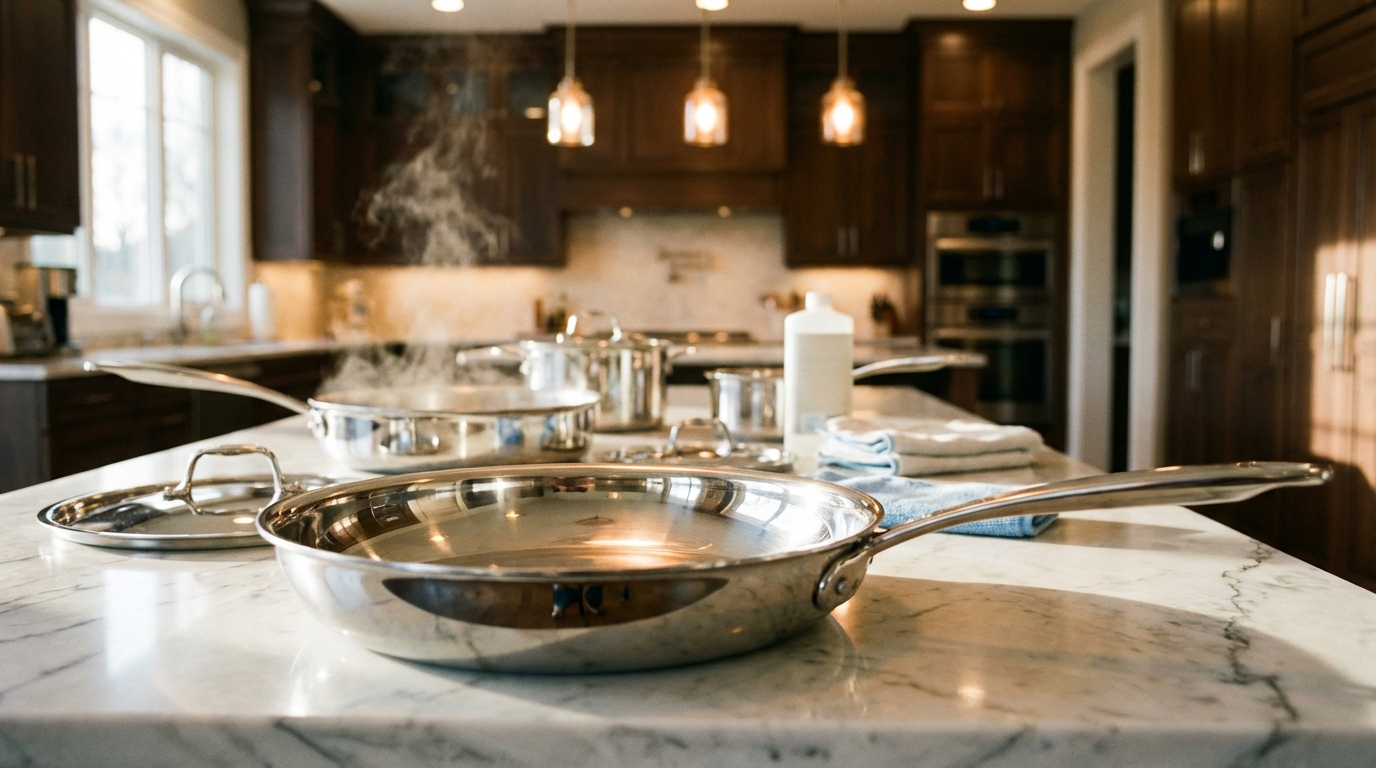
Switching to PFAS-free stainless steel cookware protects your health by eliminating forever chemicals that can linger for years, while its lifetime durability saves money and handles any stovetop or high-heat task--provided you clean it correctly. This article teaches you when a mild dish-soap wash and soft sponge are enough for everyday grease and when to deploy Bar Keeper's Friend's oxalic acid to dissolve burnt-on carbon, rainbow heat tints, and mineral deposits without scratching. You'll learn the science behind each method, the critical mistakes to avoid--no metal scrubbers, cold-water shocks, or pre-boil salt--and simple habits like room-temperature ingredients and immediate drying that keep pans pristine. By matching cleaning intensity to the mess and scheduling weekly deep cleans, you'll turn stainless steel into an heirloom that performs better decade after decade.
Why proper cleaning matters for cleaning PFAS-free stainless steel
Mastering a few simple cleaning rules--cool the pan before water touches it, skip the steel wool, salt only after the boil--keeps your PFAS-free stainless steel cookware flawless for decades and your food free of forever chemicals.
Understanding PFAS‑free stainless steel benefits
Stainless steel cookware eliminates PFAS chemicals entirely from your cooking surface, offering significant health advantages. These "forever chemicals" persist in both the environment and human bodies for years. Some have been linked to cancers, liver disease, and developmental delays in children [1][3].
Unlike nonstick pans that need replacing every few years when their coatings scratch and potentially flake into food, quality stainless steel maintains its integrity for decades [2]. This durability means you'll save money over time, even with the higher upfront cost. Plus, stainless steel pans work on every stovetop type--including induction--and handle high heat that would damage coated cookware [1][2].
Yes, you'll need some oil or butter to prevent sticking. But this small change eliminates the risk of toxic fumes that release when PTFE coatings overheat beyond 500 degreesF [3]. With proper cleaning techniques, you'll preserve your pan's performance and safety benefits for years to come.
Common cleaning pitfalls to avoid
Metal scrubbers and abrasive cleaners permanently scratch stainless steel surfaces. These scratches create spots where food sticks, making every future meal harder to clean [4]. Temperature shock is another cookware killer. Adding cold water to a hot pan causes warping you can't fix [5]. Let your pan cool naturally before cleaning.
Here's a crucial tip: always wait to add salt until water boils. Salt plus cold water creates a chemical reaction that pits stainless steel, leaving permanent pockmarks on your cookware's surface [5][6]. Your cooking technique affects cleanup too. Food sticks when cold ingredients hit a hot pan--the steel contracts and literally grabs your food [5]. Let refrigerated items reach room temperature first.
Those rainbow patterns or chalky white spots from overheating? They're purely cosmetic and won't affect cooking performance [6]. But water spots are preventable. Simply dry your pans immediately after washing to maintain that pristine finish [4][5].
Bar Keeper's Friend: Performance and best‑practice guide
Discovered in 1882 when a rhubarb-cooked pot emerged spotless, Bar Keeper's Friend uses oxalic acid to dissolve rust, burns, and mineral stains on stainless steel without scratching--just wet, sprinkle, wait a minute, and scrub to make even years-old scorched pans look new.
How Bar Keeper's Friend works on stainless steel
Bar Keeper's Friend's effectiveness on stainless steel stems from its active ingredient: oxalic acid. This organic compound, which makes up less than 10% of the product, naturally occurs in vegetables like rhubarb, spinach, and beet leaves [7].
When applied to stainless steel, oxalic acid chemically breaks down rust, hard water stains, and mineral deposits like calcium and lime that ordinary cleaners can't remove [7]. The product was discovered in 1882 when chemist George William Hoffman noticed his cooking pot became unusually clean after preparing rhubarb--the vegetable's natural oxalic acid had reacted with the metal surface [7].
Unlike abrasive cleaners that can scratch cookware, BKF's chemical reaction works to dissolve stubborn discoloration without damaging the steel's surface. This makes it particularly effective at restoring stainless pans that have been scorched during cooking, removing stains many users assumed were permanent [8].
Step‑by‑step cleaning routine with Bar Keeper's Friend
For everyday cleaning of stainless steel, wet the pan completely, sprinkle a generous amount of Bar Keeper's Friend directly onto the surface, then scrub with the soft side of a sponge [9]. For stubborn stains or scorched spots, create a paste by mixing Bar Keeper's Friend with a small amount of water, apply it to the affected areas, and let it sit for approximately one minute before scrubbing [9]. This brief waiting period allows the oxalic acid to react with the burned-on residue.
After scrubbing, thoroughly rinse the pan and dry it immediately to prevent water spots [9]. For particularly challenging burns or discoloration that's persisted for months or years, consider using Bar Keeper's Friend Cookware Cleanser & Polish (silver can) instead of the original formula, as it contains 50% more grease-cutting detergents specifically formulated for tough cookware stains [9]. While cleaning will require some effort, even three-year-old scorch marks can be removed with this specialized formulation [9].
The cleaner works effectively on multiple cookware surfaces beyond stainless steel, including copper bottoms, glass, ceramic dishes, and enamel-coated cast iron [9].
Dish soap: When it's enough and when it falls short
Dish soap handles everyday grease on your stainless-steel pan, but when you're facing burnt-on carbon, rainbow heat stains, or mineral deposits, it's time to call in specialized cleaners that chemically dissolve what soap can't touch.
Effective dish‑soap techniques for everyday cleaning
Most nights, dish soap is all you need. After cooking basics like sautéing vegetables or searing chicken in your stainless steel pan, a quick wash with warm water and a few drops of mild dish soap does the job perfectly [4]. Here's the key: use a soft sponge (never the scratchy side) and work in circular motions to lift away oil and food particles.
Got something stuck? Don't panic. Add warm soapy water directly to the pan and simmer it on low heat for a few minutes--this trick loosens even stubborn bits without aggressive scrubbing.
A wooden spoon or silicone spatula helps nudge away any remaining residue without harming your cookware's surface [4]. This everyday approach keeps your pans performing well for years while saving the heavy-duty cleaners for when you actually need them.
Limitations of dish soap on tough stains
But let's be honest--dish soap has its limits. You know those times when you accidentally let the pan get too hot and now there's a dark, carbonized layer that won't budge? Or when your stainless steel develops those rainbow heat stains from cooking at high temperatures?
Regular dish soap simply can't tackle these challenges [4]. The science is straightforward: dish soap breaks down grease and loosens food particles, but it can't chemically react with burnt-on carbon or mineral deposits. Those stubborn water spots from hard water?
The rainbow discoloration from overheating? These require something stronger because they're not just surface dirt--they're chemical changes in the metal itself [4]. That's when specialized cleaners earn their place in your kitchen, using ingredients like oxalic acid to dissolve what soap alone can't touch [4].
Choosing the right method for your cookware care routine
Match your stainless-steel pan's cleaning to its workload--dish-soap wipe-downs after gentle sautés, a weekly Bar Keeper's Friend polish after high-heat sears, and a quick vinegar simmer to erase rainbow stains--so it seasons into a lifetime tool instead of scratching into retirement.
Matching cleaning method to cooking frequency
Knowing which cleaning method to reach for depends on how you use your cookware day to day. If you're doing light cooking--think boiling pasta or gentle sautéing--dish soap and a soft cloth will handle the job perfectly [10]. When food starts sticking (but hasn't burned), a warm soapy soak works wonders and keeps you from reaching for anything abrasive [10].
Save Bar Keeper's Friend for the bigger challenges: those weekly deep cleans or right after you've pushed the heat a bit too high and ended up with discoloration or stubborn residue [11]. This strategic approach keeps your cookware's surface pristine while tackling each cleaning challenge appropriately. If you're reaching for your favorite stainless steel pan multiple times a day, try this rotation: quick dish soap cleanings after most uses, then a scheduled Bar Keeper's Friend session once a week to prevent any buildup [11].
You'll avoid the aggressive scrubbing that can damage even the best cookware over time.
Maintaining shine and extending pan life
With the right care routine, your stainless steel cookware becomes a lifetime investment that actually gets better with use. While we've covered the basics of avoiding water spots and temperature shock in earlier sections, here's how to build these practices into a sustainable maintenance routine. Never let acidic or salty foods sit in your pans--tomato sauce left overnight or that forgotten pasta water can accelerate corrosion, even in premium cookware [5]. When you notice rainbow discoloration from high heat (it happens to all of us), skip the harsh cleaners.
Instead, simmer something tomato-based or boil a simple water-vinegar solution to restore that original finish [5]. Those chalky mineral deposits? A one-part-vinegar-to-three-parts-water boil followed by your normal wash makes them disappear [5]. As mentioned earlier, choosing the right utensils matters just as much as your cleaning routine.
And here's a pro tip: if your pan handles are oven-safe, occasional roasting at temperatures under 500 degreesF actually benefits the cookware by evenly distributing heat stress across the entire pan [4]. When you treat stainless steel right, it truly becomes an heirloom piece. We regularly hear from home cooks whose pans look and perform beautifully after three decades of daily use--proof that quality cookware paired with proper care creates tools that serve generations [4].
Conclusion
- Stainless steel eliminates PFAS exposure and lasts decades longer than nonstick pans.
- Salt in cold water pits stainless; add salt only after water boils.
- Bar Keeper's Friend dissolves burnt-on stains with oxalic acid without scratching steel.
- Dish soap suffices for routine grease, but can't remove carbonized or mineral stains.
- Dry pans immediately after washing to prevent permanent water spots.
- Simmer vinegar-water to lift chalky mineral deposits and rainbow heat discoloration.
- Schedule a weekly deep clean with BKF to prevent buildup instead of aggressive scrubbing.
- https://www.chancescook.com/stainless-steel-cookware-health-guide/
- https://www.consumerreports.org/home-garden/cookware/best-frying-pans-if-you-want-to-avoid-pfas-chemicals-a1006253549/
- https://www.nytimes.com/2025/10/27/well/live/nontoxic-cookware-pfas-safe.html
- https://www.blackmoorhome.co.uk/blog/the-ultimate-guide-to-cleaning-stainless-steel-cookware/
- https://traditionalcookingschool.com/food-preparation/the-scoop-on-stainless-steel-cookware/
- https://www.foodnetwork.com/how-to/packages/help-around-the-kitchen/photos/solutions-for-common-issues-with-stainless-steel-cookware
- https://barkeepersfriend.com/oxalic-acid-magic-of-bkf/
- https://barkeepersfriend.com/how-to-clean-stainless-steel-pans/
- https://barkeepersfriend.com/how-to-clean-a-scorched-pan/
- https://americankitchen.com/blogs/table-talk/stainless-steel-pots-and-pans-quick-easy-how-to-guide?srsltid=AfmBOoo5NV-i5krcq8nmfjzq9gR1by4BgGGg3w6KQItjybdORJMdmeOc
- https://www.quora.com/How-do-you-clean-and-maintain-stainless-steel-pans-that-are-used-often