

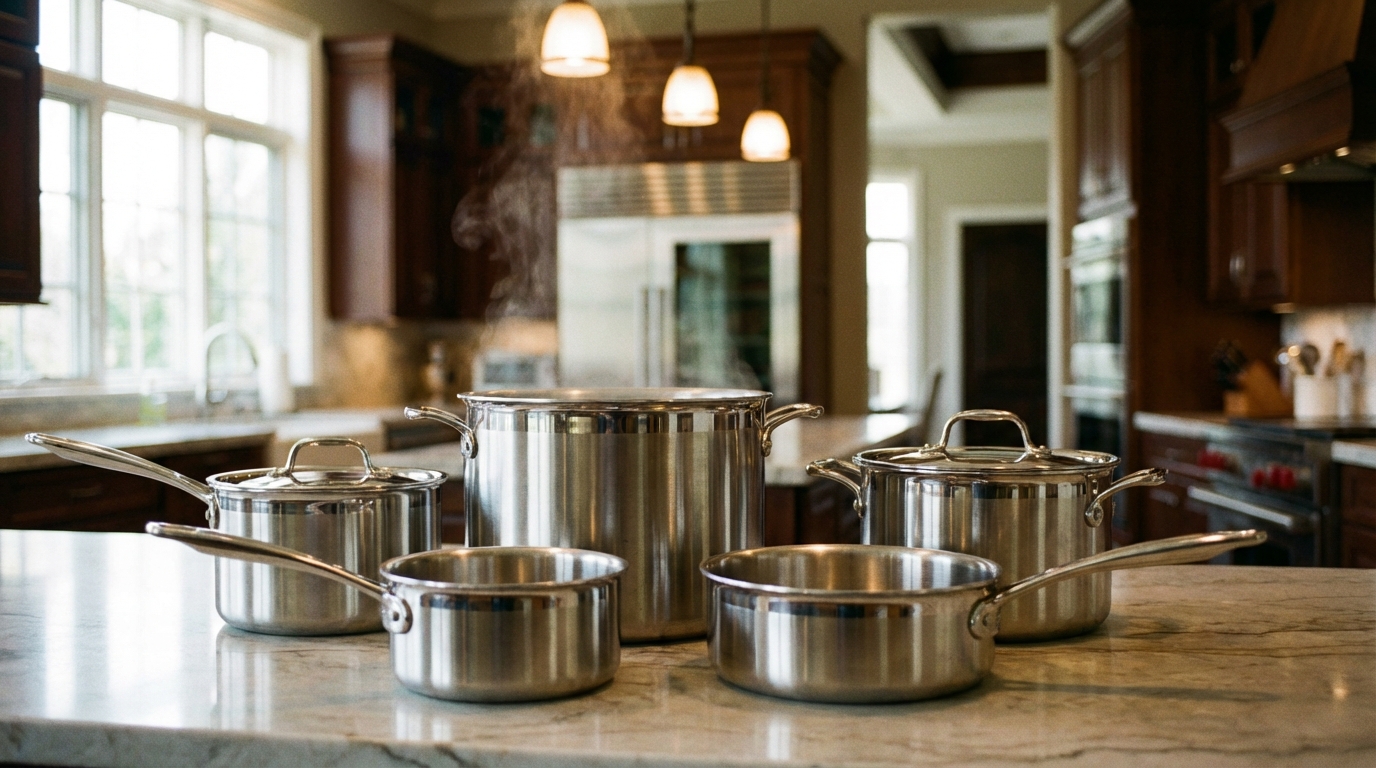
If you've ever worried that your stainless-steel pots might be sneaking nickel or chromium into your marinara, this deep-dive shows you exactly how to choose cookware that passes the "nickel test" while still delivering pro-level performance. You'll learn why 18/10 multi-ply sets like Misen's 5-ply seal aluminum cores safely away from food, release negligible metals for most cooks, and heat so evenly that you can sear, simmer, or boil on any stovetop--induction included--without hot spots or chemical coatings. The article walks you through sizing (8 qt saucepot for weeknight chili, 12 qt stockpot for bone broth), induction-ready construction, stay-cool hollow handles, and the simple preheat-and-fat trick that creates a natural non-stick surface on stainless. It also arms nickel-sensitive readers with the knowledge to pick 18/0 grade pans and gives everyone a low-maintenance care playbook: cool-before-washing, baking-soda scrubs, vinegar shines, and salt-only-after-boiling to prevent pitting. By the end you'll know how to invest once in durable, non-toxic cookware that can blast to 800 degreesF, slide into the dishwasher, and keep delivering flawless, healthy meals for decades.
Why Stainless Steel Passes the Nickel Test
If nickel sensitivity affects you, switch to 18/0 stainless steel; if not, a well-seasoned 18/10 pan like Misen's 5-ply keeps nickel release low while sealing aluminum away from your food.
Understanding Nickel Leaching and Safety
Let's talk about what happens when stainless steel meets your food. Yes, stainless steel can release tiny amounts of nickel and chromium, especially when you're simmering that Sunday sauce for hours. Research shows that cooking acidic foods like tomato sauce for six hours can increase nickel levels significantly [2]. But before you worry, let's put this in perspective. Here's what you need to know: common stainless steel grades (18/8 and 18/10) contain 8-10% nickel [1].
For most of us, this isn't an issue at all. However, about 10% of people have nickel sensitivities that can trigger reactions from surprisingly small amounts [2]. Think of it like a food allergy--it matters for some folks but not everyone. A few things influence how much metal might transfer to your food. Brand new pans tend to release more than well-used ones (another reason to love that trusty pan you've had for years).
Acidic ingredients and marathon cooking sessions also play a role [3]. If you're sensitive to nickel, 18/0 stainless steel is your friend--it's nickel-free. For everyone else, 18/10 and 304-grade options offer the best balance of durability and performance [1].
How Misen's 18/10 Stainless Meets Non‑Toxic Standards
Misen's stainless steel cookware uses premium 18/10 stainless steel (304-grade)--that's 18% chromium and 10% nickel for those keeping track. This grade earns the "Better" rating for non-toxic cookware for most home cooks [4]. What makes Misen's construction special? It's all about those five layers.
The 5-ply design does more than just distribute heat evenly (though it does that beautifully). Those multiple layers completely seal the aluminum core between protective stainless steel, so there's zero chance of aluminum touching your food [4]. It's like having a safety vault for your cooking surface. Fair warning: if you're among those with nickel sensitivities, you'll want to look for nickel-free options (430-grade/18/0 stainless).
But for everyone else, Misen's 18/10 grade delivers the perfect combination of durability and cooking performance [4]. These pans handle extreme temperatures up to 800 degreesF without breaking a sweat--or warping [5]. The following sections dive deeper into the specifics of Misen's 5-ply construction and individual products.

Key Features to Look for in the Best Non Toxic Stainless Steel Pots
Choose fully-clad, multi-ply stainless--3- or 5-layer with an aluminum core sealed inside stainless--so your pan heats edge-to-edge without hot spots, keeps aluminum safely off your food, sears evenly at lower heat, and works on any stove (just confirm a magnet clings to the base).
Multi‑Ply Construction and Heat Distribution
Multi-ply cookware features layers of different metals bonded together, creating superior performance compared to single-layer stainless steel. Most high-quality stainless cookware uses a three or five-layer construction with aluminum or copper cores sandwiched between stainless steel layers. This design solves stainless steel's inherent weakness--poor heat conductivity--while maintaining its non-reactive cooking surface. In 3-ply construction, you get a stainless steel exterior and interior sandwiching an aluminum core.
It's a solid choice that provides even heat distribution while staying lightweight and budget-friendly. The more premium 5-ply versions (like those in Misen's cookware line) add two additional layers--typically three aluminum and two stainless steel--for superior heat retention and distribution. This layered design eliminates hot spots that cause scorching and uneven cooking, allowing food to cook uniformly regardless of where it sits in the pan [8]. Here's what makes multi-ply construction particularly safe: the fully encapsulated design prevents aluminum in the core from ever contacting your food, while the stainless steel cooking surface remains non-reactive--even when you're simmering tomato sauce for hours [8].
This construction gives you remarkable control in the kitchen. Your pan heats rapidly and responds quickly to temperature changes, perfect for those delicate sauces or precise searing techniques [8]. You'll also find you can cook at lower temperatures while still getting excellent browning and searing--a win for both energy efficiency and nutrient preservation. Unlike regular stainless steel that often develops hot spots, quality multi-ply cookware heats uniformly from base to rim [9].
Induction Compatibility and Ergonomic Design
For induction cooking, stainless steel cookware must contain magnetic metal to generate heat. The simplest compatibility test: if a magnet sticks firmly to the bottom, it works [10]. Three main construction types accommodate induction: pans with magnetic bottoms (often labeled as "cladded" or "disk" bottoms), cookware made entirely of magnetic metal, and fully-clad pieces with multiple metal layers [10]. Fully-clad construction, where the 5-ply design extends throughout the entire cookware rather than just the bottom, creates superior heat distribution on all sides--not just the base [12].
Premium stainless sets include a magnetic layer made from 400-series stainless steel with higher iron content specifically engineered for induction efficiency [12]. Practical ergonomics matter just as much as heating capability. Well-designed hollow handles stay cool during stovetop use and fit comfortably in hand [12], while balanced weight distribution prevents wrist strain during cooking tasks. Look for handles that feel substantial yet comfortable--you'll appreciate this when transferring a full pot from stovetop to oven.
A quick heads-up: fully-clad cookware often produces clicking or whining sounds on induction cooktops as the different metals expand and contract--perfectly normal but worth knowing if you're sensitive to kitchen sounds [10]. Interestingly, cookware with magnetic bottoms typically delivers more even heat on induction than pans made entirely of magnetic metal, which can develop cooler spots around their edges [10].
Top Misen Stainless Sets That Meet the Nickel Test
Misen's stainless 12-quart and 8-quart pots pair 5-ply, nickel-safe steel with stay-cool handles and balanced weight so you can crank out everything from holiday stock to weeknight risotto--on any burner--without hot spots, wrist strain, or cabinet-hogging bulk.
Misen 12‑qt Stockpot - Everyday Workhorse
The 12-quart stockpot brings the same thoughtful engineering you'd expect from any Misen piece to your biggest cooking projects. With the 5-ply construction we discussed earlier, this workhorse heats your Sunday soup or holiday stock evenly from bottom to sides - no scorching, no hot spots [13][14]. What really sets it apart is the practical design: those wide, flat handles stay comfortable even when you're hauling a full pot of pasta water, and the balanced weight distribution means less strain on your wrists [15].
At 12 quarts, you've got room for a proper bone broth session or feeding a crowd, yet it still fits comfortably on standard burners. The construction handles serious heat (up to 800 degreesF) and transitions seamlessly from stovetop to oven [13]. Professional reviewers consistently note this size hits the sweet spot - spacious enough for batch cooking your meal prep favorites, but not so massive it monopolizes your cabinet space [15].
Whether you're using gas, electric, or induction, this stockpot delivers the consistent results that make cooking more enjoyable and less stressful [13].
Misen 8‑qt Saucepot & Lid Set - Versatile Batch Cooking
The 8-quart saucepot fills that perfect middle ground in your cookware collection - large enough for a hearty batch of chili but nimble enough for weeknight pasta sauce. The proportions just make sense: you can easily reach in with a spoon for stirring, and the rounded edges let you pour without the inevitable drips down the side [16]. Those flat handles feel secure in your grip, even when you're moving a full pot from stove to sink [16].
At 5.2 pounds empty, it's got enough heft to feel quality-made without being a workout to use [16]. The real magic happens during cooking - thanks to the multi-ply construction covered earlier, your risotto won't stick in spots or your soup simmer unevenly [18]. That tight-fitting lid locks in moisture during long braises, keeping flavors where they belong [16].
Like all quality stainless steel (as discussed in our safety section), you're cooking chemical-free while enjoying the same heat tolerance and cooktop versatility [17][18]. Cleanup stays simple whether you prefer the dishwasher or a quick hand wash - the stainless steel handles both beautifully [16][17].


Caring for Your Non‑Toxic Stainless Cookware
Master the mercury-bead water test, heat your stainless to medium, then let proteins release themselves for effortless, non-toxic cooking that lasts a lifetime.
Seasoning, Pre‑heating, and Sticking Prevention
Stainless steel doesn't need traditional seasoning like cast iron, though some cooks create a natural non-stick surface by heating oil in the pan [19]. The secret to preventing sticking? Proper preheating. Here's the simple technique: heat your empty pan on medium for 2-3 minutes until you can feel warmth when holding your hand a few inches above it [19].
Test if it's ready by flicking a few water droplets onto the surface--when they form perfect beads that roll around like mercury, you're good to go [21]. If the water instantly evaporates or just sits and sizzles, keep heating. Once ready, add your cooking fat to create that essential barrier between food and metal [19]. Keep your heat at medium (around 300 degreesF-375 degreesF) for most cooking--remember, quality stainless steel like Misen's 5-ply construction holds heat incredibly well, so you rarely need high temperatures [19].
Give your ingredients room to breathe by avoiding overcrowding, which turns a good sear into a steam bath [20]. Here's a pro tip for proteins: patience pays off. Let that chicken breast or salmon fillet cook undisturbed until it releases naturally--if you have to force it, it's not ready to flip [21]. Stick with silicone, wooden, or nylon utensils to keep your pans pristine [19][20].
Cleaning, Maintenance, and Longevity Tips
Proper cleaning begins with allowing your pan to cool completely before washing--adding cold water to hot stainless can cause warping that permanently damages your cookware [22]. For everyday cleaning, warm soapy water and a soft sponge work perfectly--no harsh chemicals needed [22]. Got stubborn stuck-on food? Try this trick: sprinkle baking soda directly onto the dry pan and scrub with a barely-damp sponge. The gentle grit lifts residue without scratching [23].
Those rainbow-colored heat stains that sometimes appear? They're harmless but easy to remove--just add a splash of white vinegar after your baking soda scrub, or simmer a solution of one part vinegar to three parts water for a few minutes [22][23]. White chalky water spots disappear with the same vinegar treatment [22]. Here's a simple rule that prevents pitting: always wait until water boils before adding salt. Adding salt to cold water can cause tiny pits in your stainless steel over time [22].
Skip the steel wool and abrasive scrubbers--they create microscopic scratches where food loves to stick. Instead, reach for wooden, silicone, or nylon tools that treat your cookware gently [22]. One last tip: dry your pans immediately after washing to keep them spotless and shiny. With this simple care routine, your stainless steel cookware will perform beautifully for decades--a true kitchen investment that pays dividends in healthier, more enjoyable cooking. For specific care instructions for your Misen cookware, we've got you covered with detailed guides for each product line.


Putting It All Together: Choose Safe, Lasting Stainless Cookware
Pick 18/10 stainless cookware with an aluminum or copper core, riveted handles, and a lifetime warranty, and you'll have pans that sear evenly, clean up fast, and never warp.
- 18/0 stainless steel is nickel-free and safe for nickel-sensitive users.
- 5-ply fully-clad pans seal aluminum core so no metal contacts food.
- Heat empty pan 2-3 min until water beads; medium heat prevents sticking.
- Cool pan before washing; use baking soda and vinegar to remove stains.
- Add salt only after water boils to stop stainless steel pitting.
- Induction needs magnetic base--check with a magnet for compatibility.
- 18/10 (304-grade) balances durability and performance for most cooks.
- https://www.xometry.com/resources/materials/18-8-vs-18-10-vs-18-0-stainless-steel/
- https://pmc.ncbi.nlm.nih.gov/articles/PMC4284091/
- https://alva-cookware.us/blogs/news/is-stainless-steel-cookware-safe?srsltid=AfmBOopHvSyy45yYhiLYcrHrPjRizZBEK8_dr9lWj9lFqRuKhR8tBeiG
- https://mamavation.com/product-investigations/safest-cookware-stainless-steel-cast-iron-ceramic-bakeware.html
- https://www.amazon.com/Misen-Stainless-Steel-Frying-Pan/dp/B08WRWNGZQ
- https://www.consumerreports.org/home-garden/cookware/misen-stainless-steel/m410741/
- https://www.vikingculinaryproducts.com/blogs/articles/the-science-behind-the-benefits-of-stainless-steel-cookware?srsltid=AfmBOopTm0Ibd5Hg5ctoiZIqJIqecJs-JQGz6SBBpPomctV2AzcTuE3i
- https://shop.ttkprestige.com/blog/post/tips-and-tricks/why-are-triply-cookwares-the-healthiest-choice?srsltid=AfmBOoq-11BXU0qlaFUWRV3zh3Cjc9YtEFjy9oSWW4zB7TCLeCFAYc4X
- https://stahlkitchens.com/blogs/news/triply-vs-stainless-steel?srsltid=AfmBOooUtkqg-ZqigaMkaO2lW8Aa3qAT2EQToJuJVqK7qzKsg0xdn7li
- https://www.nytimes.com/wirecutter/reviews/best-induction-cookware/
- https://www.heritagesteel.us/products/hsc-17305?srsltid=AfmBOoq7Grz9P3AEZuSVOoq5C7haTbH8Wj6tUQaURYAW4L0PakpykPsW
- https://www.amazon.com/Misen-Stainless-Steel-Frying-Pan/dp/B08WRPBS6H
- https://www.reddit.com/r/UsefulThingsOnly/comments/1kdlykz/the_misen_12inch_stainless_steel_pan_reviewed/
- https://www.seriouseats.com/the-best-stockpots
- https://www.foodandwine.com/best-stockpots-8399266
- https://www.seriouseats.com/non-toxic-kitchen-basics-editor-favorite-11795308
- https://www.amazon.com/Misen-Stainless-Steel-Stock-Pot/dp/B09V1QJ2TN
- https://algaecookingclub.com/zine/cooking-with-stainless-steel?srsltid=AfmBOooNmyk9gIopD4wzhf_P2E_I_JRSr-vLmlF68ZH8afyRnvA8iOaj
- https://americankitchen.com/blogs/table-talk/beginners-guide-to-using-stainless-steel-pans?srsltid=AfmBOopUrpQGEsFQRH5QetVFnFmigtpnvWZcVYh3fLWueCrSWwE3ecZI
- https://www.reddit.com/r/Cooking/comments/96jgqh/how_do_people_cook_in_stainless_steel_pans/
- https://traditionalcookingschool.com/food-preparation/the-scoop-on-stainless-steel-cookware/
- https://www.yahoo.com/lifestyle/articles/woman-reveals-simple-hack-keep-163000122.html
- Summary
- Why Stainless Steel Passes the Nickel Test
- Key Features to Look for in the Best Non Toxic Stainless Steel Pots
- Top Misen Stainless Sets That Meet the Nickel Test
- Caring for Your Non‑Toxic Stainless Cookware
- Putting It All Together: Choose Safe, Lasting Stainless Cookware
- Key Takeaways
- References