

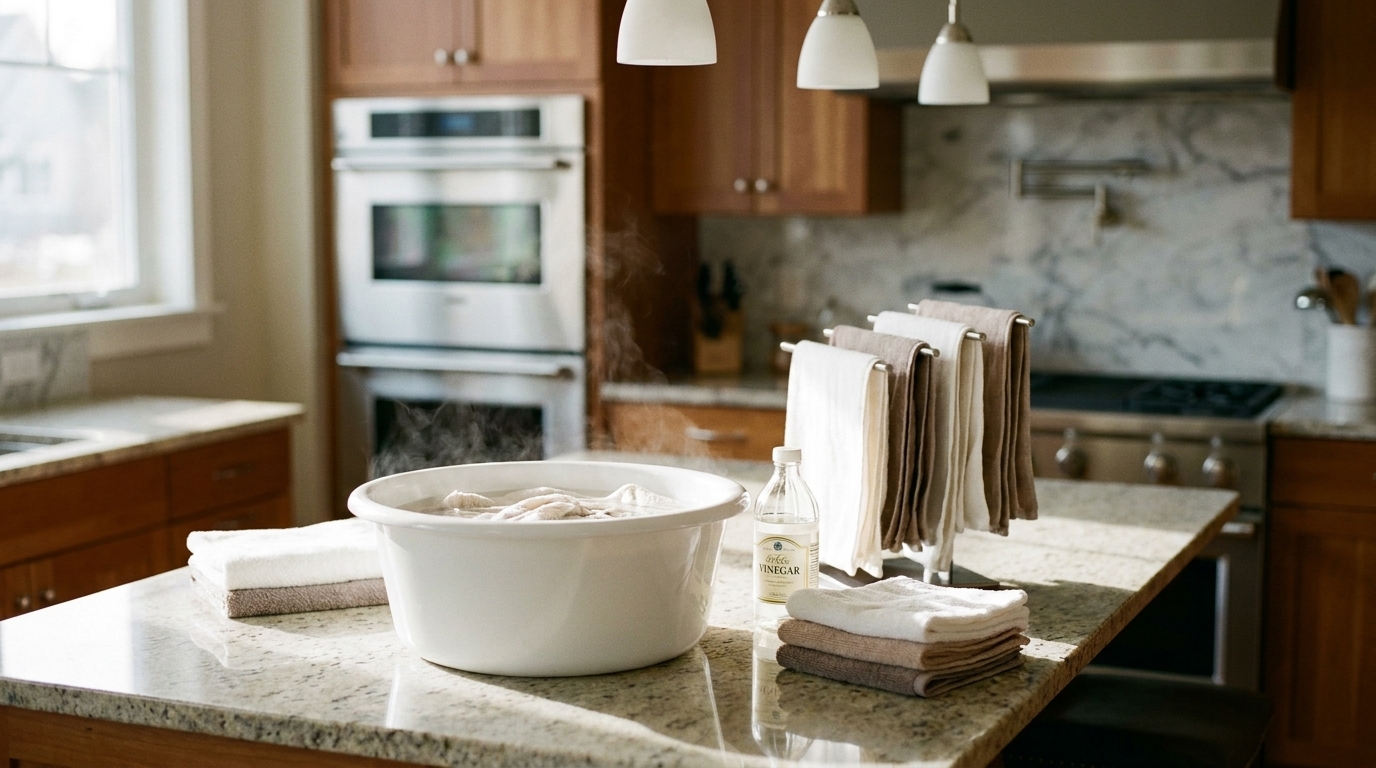
Learn to safely disinfect kitchen towels with a simple white vinegar soak, a clear step by step routine, and proper drying techniques that prevent recontamination. Vinegar kills common bacteria, neutralizes odors, protects cotton and microfiber fibers, and avoids the fabric damage and toxic fumes associated with bleach.
Yes, Vinegar Can Disinfect Dishcloths - How It Works and When It's Best
The science of acetic acid: killing bacteria, mold, and odors in fabric
Acetic acid -- the active compound in white vinegar -- disrupts bacterial cell function at concentrations as low as 0.16%, making it effective against common pathogens including E. coli, Staphylococcus aureus, and Klebsiella pneumoniae. [1] Research published in PLOS ONE tested 29 isolates of common pathogens and found that acetic acid inhibited bacterial growth, prevented biofilm formation, and eradicated existing biofilms after three hours of exposure. [2] Biofilms are the dense bacterial colonies that cling to damp fabric -- they're what makes kitchen towels smell sour even after a quick rinse.
Standard white vinegar contains around 5% acetic acid, well above the 0.16-0.31% antibacterial threshold, giving a diluted soak enough strength to tackle bacteria, mold, and odors in cotton and microfiber towels.
Choosing vinegar over bleach or commercial cleaners: safety, scent, and material compatibility
Bleach is effective for occasional deep sanitizing, but frequent use weakens cotton fibers over time, leading to thinning and rough texture -- and it can cause yellowing when residue reacts with body oils or hard water minerals. [3] Vinegar doesn't carry those risks: its mild acidity won't degrade cotton or microfiber with regular use, and it neutralizes odors at the source rather than masking them. [3] There's also a safety issue worth knowing -- mixing bleach and vinegar produces toxic chlorine gas, so if you keep both in your kitchen, towels must be fully rinsed before switching between treatments. [3] For everyday kitchen towel care, vinegar is the more practical and fabric-friendly choice.

DIY Vinegar Disinfection Routine: Step‑by‑Step Instructions
Mixing the solution and timing the soak (e.g., 1 cup white vinegar per gallon water, 30‑minute soak) Fill a basin with one gallon of very hot water and add 1 cup of distilled white vinegar -- the heat loosens grease while the acidity works on bacteria and odor-causing buildup. [4] Submerge your towels fully and let them soak for at least 30 minutes; for heavily soiled or foul-smelling towels, extend that to one hour. [4] The water will likely discolor as the soak progresses -- that's grease and residue releasing from the fabric, which is normal and a sign the soak is working. [4] After soaking, wring the towels out and transfer them directly to the washing machine, or follow with a baking soda soak if odors persist. [4]
Using Misen tools - silicone scrub brush, drying rack, and microfiber towel set for optimal results
The tools you use between wash cycles matter as much as the soak itself -- a silicone scrub brush lets you work the vinegar solution directly into stained or crusted sections without the cross-contamination risk of a sponge, since silicone doesn't trap moisture or develop odor. [5] Drying is where most routines fall short: towels left even briefly damp can rebuild the bacterial load you just eliminated, making airflow after every use non-negotiable. [5] A drying rack that keeps towels fully extended -- rather than folded or bunched over a hook -- removes that risk entirely.
Our microfiber towel set dries faster than standard cotton weaves, which narrows the window for mildew growth between uses. [6]
Common Mistakes & Materials to Avoid When Using Vinegar
Fabric and surface types that degrade with acid (natural stone, certain metal finishes)
While vinegar is safe for cotton and microfiber, the same acidity that kills bacteria can damage several kitchen surfaces it contacts during a soak. Natural stone countertops -- marble, granite, limestone, and travertine -- are particularly vulnerable: the acid etches and dulls the surface, and on granite, it breaks down the protective sealant that guards against stains [7].
Aluminum and copper corrode with prolonged exposure, and cast iron loses its seasoning if the solution makes contact [8]. Carbon steel and ceramic knives are also at risk -- vinegar can discolor or corrode them, so it's worth keeping cutlery well clear of any vinegar solution during your towel routine [9].
Why mixing vinegar with Dawn dish soap can reduce effectiveness and safer alternatives
Mixing vinegar with dish soap -- even a common option like Dawn -- reduces the effectiveness of both ingredients because the reaction works against you, not with you.
Vinegar is acidic; most dish soaps, including synthetic detergents, are alkaline, and combining the two triggers an acid-base neutralization that cancels out each ingredient's cleaning power. [10] The David Suzuki Foundation notes this type of reaction is harmless but counterproductive, often producing a weakened, curdled solution that neither disinfects nor removes grease effectively. [11] A better routine keeps each step intact: use the vinegar soak to disinfect, then launder separately with your regular detergent -- so both products do the job they're actually formulated for. [10]


Unique Resource: Printable Disinfection Checklist & Method Comparison Table
Downloadable "Vinegar Dishcloth Sanitizer" checklist for weekly kitchen hygiene
Comparison table: Vinegar soak vs. boiling vs. washing‑machine cycle - cost, time, and recommended Misen product pairings
| Method | Cost | Time | Effectiveness | Misen pairing |
|---|---|---|---|---|
| Vinegar soak | Low | 30-60 min (passive) | Kills common bacteria, neutralizes odor; mild overall [16] | Microfiber towel set |
| Boiling | Minimal | 10-15 min (active) | Kills bacteria; won't remove residue or odor without detergent [15] | -- |
| Washing machine (hot cycle) | Low-moderate | 45-60 min | Most consistent; removes bacteria and food residue in one pass [15] | Microfiber towel set |
A vinegar soak is passive and low-cost, handling everyday bacterial loads without damaging fabric -- pair it with our microfiber towel set, which dries fast enough to limit recontamination between wash days. [16] Boiling costs almost nothing but demands 10-15 minutes of active supervision and can shorten towel lifespan with repeated use, so it's better reserved as an occasional last step for stubborn stains rather than a weekly method. [15] A washing machine cycle using hot water around 140 degreesF with detergent removes both bacteria and food residue in a single pass, making it the most efficient option for consistent kitchen hygiene. [15]
- Acetic acid in white vinegar (5%) exceeds the 0.16‑0.31% threshold, killing E. coli, S. aureus, K. pneumoniae and disrupting biofilms.
- Soak towels in 1 cup white vinegar per gallon hot water for 30-60 min, then machine‑wash; this sanitizes without weakening cotton or microfiber.
- Bleach deep‑sanitizes but degrades cotton fibers and can yellow fabrics; vinegar offers safe, regular disinfection without fabric damage.
- Dry towels fully after each use on a rack that keeps them extended; any dampness can quickly restore bacterial load.
- Do not soak towels near natural stone, aluminum, copper, cast iron, carbon steel, or ceramic knives; vinegar can etch or corrode these surfaces.
- Never mix vinegar with bleach (produces toxic chlorine gas) or with dish soap (neutralizes cleaning power); rinse towels before switching agents.
- https://www.sciencedaily.com/releases/2015/09/150915105208.htm
- https://research-portal.uea.ac.uk/en/publications/the-antibacterial-activity-of-acetic-acid-against-biofilm-produci/
- https://www.aol.com/articles/bleach-vinegar-best-keeping-white-120000360.html
- https://www.southernliving.com/how-to-wash-dish-towels-11885055?srsltid=AfmBOopSPo2E9pv7YuxgKXDZdIA6gzLsvOaDy0CANumYI2aBTJbgj_Jf
- https://thecinnamonhollow.com/how-to-clean-kitchen-towels/
- https://www.southernliving.com/how-to-wash-towels-with-vinegar-11851497?srsltid=AfmBOooazJTh31Dbm9ph8QGz2ZXTMme88-Jf-5zcI2QCINXSp89mxfNf
- https://www.consumerreports.org/home-garden/cleaning/things-you-should-never-clean-with-vinegar-distilled-white-vinegar-a3336471803/
- https://www.familyhandyman.com/list/what-you-cant-clean-with-vinegar/
- https://merrymaids.com/blog/dont-clean-these-10-items-vinegar
- https://www.lisabronner.com/chemistry-happens-when-common-cleaning-chemicals-form-bad-reactions/
- https://davidsuzuki.org/living-green/does-vinegar-kill-germs/
- https://www.homeaglow.com/hub/content/kitchen-cleaning-checklist
- https://www.dearcreatives.com/kitchen-cleaning-checklist/?srsltid=AfmBOopbS-YpQDszwbJFUoPKLGVpD1_lX_lctUoYUEVkTiURHWWhKRHT
- https://www.ishouldbemoppingthefloor.com/2015/02/kitchen-cleaning-routines-printable.html
- https://www.bhg.com/boil-kitchen-towels-cleaning-11951532
- https://draintroughs.com/sanitize-laundry/