

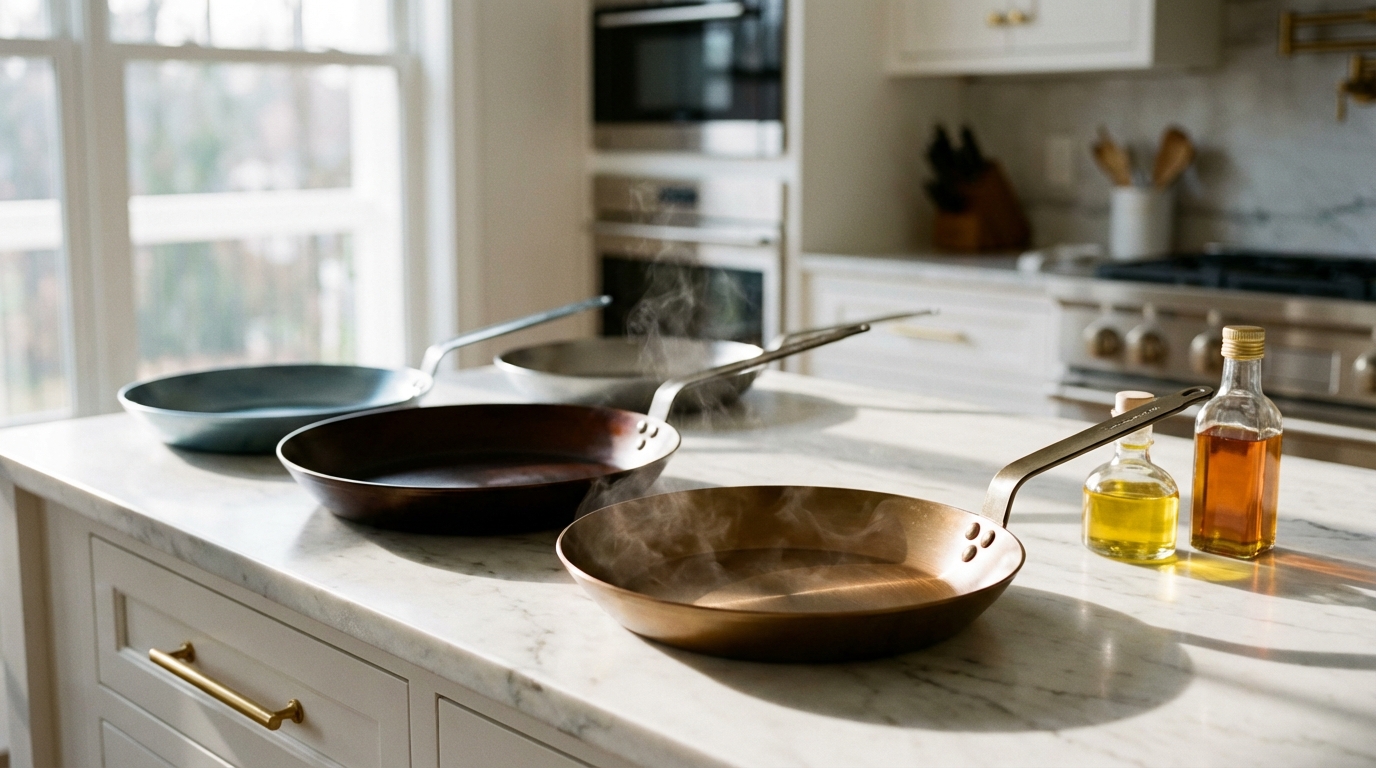
Seasoned carbon steel pans give you a lifetime of non-toxic cooking by forging a natural, plastic-like shield from nothing more than oil and heat: when oil is heated past its smoke point its fatty acids bond to the pan's iron, creating a slick, stable polymer layer that grows tougher with every meal, unlike synthetic coatings that can degrade and leach chemicals. The article walks you through scrubbing off the factory coating, applying whisper-thin layers of a high-smoke-point oil, and baking or stovetop-heating the pan until it darkens into an even, glossy surface, then maintaining that finish by washing with hot water, drying over heat, and wiping on a film of oil before storage. Daily best practices--choosing canola or grapeseed for high-heat sears, avoiding long acidic simmers, and starting bacon in a cold pan--steadily reinforce the seasoning, while quick touch-ups or full restarts with steel wool and fresh oil erase stickiness or flakes, keeping the pan out of landfills and saving money. Master these simple habits and your carbon steel becomes a responsive, naturally non-stick workhorse that improves with age, sparing your food from PFAS and your kitchen from waste for decades.
Understanding Why Seasoned Carbon Steel Is Non‑Toxic
Seasoning carbon steel creates a naturally non-toxic, polymerized oil surface that bonds permanently to the iron--no synthetic chemicals, just pure iron and carbon that get better with every use.
The Chemistry Behind a Non‑Toxic Surface
Here's what makes carbon steel cookware naturally non-toxic: it's just iron and carbon--about 99% iron and 1% carbon to be exact [2]. No synthetic chemicals like PFAS, PFOA, or PTFE that you'll find in conventional non-stick pans [1].
That's it. Simple as that.
The real magic happens when you season your
How Seasoning Forms a Protective Polymer Layer
So how exactly does seasoning create this protective layer? Let's break it down. When you heat oil beyond its smoke point (around 200-250 degreesC works best), it literally transforms [6]. The oil splits into two parts: glycerol, which burns off as smoke, and fatty acids, which do the real work [5]. Those fatty acids don't just coat the pan--they chemically bond with the iron atoms to form polymers, which are basically long molecular chains [6].
Think of it like this: your pan's surface has tiny pores that open up when heated. The polymer chains fill these pores and lock onto the iron surface [6]. It's not a coating that can peel off--it's a chemical bond that becomes part of the pan itself [4]. This is completely different from synthetic non-stick pans. While those coatings can break down and release harmful compounds at high heat, your polymerized oil layer stays stable even during high-temperature searing [4].
You're essentially creating a natural bioplastic that's permanently attached to your pan [5]. The best part? Every time you cook, you're adding more polymer layers. Each layer makes the surface harder, slicker, and more protective [6]. It's the cooking equivalent of compound interest--your pan literally improves with use.

Building a Long‑Lasting Seasoned Layer
Build a bulletproof, naturally non-stick surface on your carbon-steel pan by repeating 3-5 cycles of ultra-thin oil, high-heat polymerization, and gentle post-cook rinses--no lye-heavy soap required.
Step‑by‑Step First Seasoning Process
First, remove the manufacturer's protective coating by washing with hot water and dish soap, then dry immediately with a towel followed by heating on a stovetop to evaporate remaining moisture [7]. Choose between two effective seasoning methods. For stovetop seasoning, warm the clean pan over medium heat, apply a high smoke-point oil (canola, grapeseed, or avocado work well), then buff with a paper towel until the surface appears nearly dry [7][8].
This minimal application is crucial--too much oil creates sticky, uneven coating [7]. Heat the pan until it smokes, indicating polymerization is occurring, while the surface gradually transforms from silvery blue to bronze to brown [8]. Alternatively, for larger pans, use the oven method: preheat to 450 degreesF (230 degreesC), apply a microscopically thin oil layer to the entire pan (including handle), place it upside down over a drip tray, and bake for 30-60 minutes [7][9].
With either method, repeat 3-5 times, allowing complete cooling between applications [9]. The pan gradually darkens with each layer--this color change represents the non-toxic polymer barrier forming [8]. Your pan is ready when it develops an even dark color with a slight sheen, though it will continue darkening with use [8].
Ongoing Maintenance to Keep It Non‑Toxic
Daily cooking naturally reinforces your carbon steel's non-toxic surface as each use adds polymer layers through cooking oils [10]. After cooking, clean with hot water and a soft sponge rather than harsh detergents or abrasives that might strip the seasoning [12]. Despite popular misconceptions, modern dish soap won't damage properly seasoned carbon steel--it lacks the lye content that affected traditional seasoning [10]. Brief soaking (under an hour) to loosen stuck food is acceptable, though salt with oil often works better for stubborn residue [10].
Always dry pans thoroughly after cleaning to prevent rust formation, then apply a microscopically thin layer of oil before storage [12]. Avoid thermal shock by never plunging a hot pan into cold water, as this breaks the bond between the polymer layer and metal, potentially causing flaking [10]. For regular maintenance, cooking fatty foods periodically helps refresh the seasoning naturally. When acidic ingredients have worn away some seasoning, simply re-season using your preferred method [12].
Expect your pan's appearance to change over time--blotchiness and color variations are normal as the seasoning develops [11]. Remember that carbon steel improves with consistent use; each cooking session transforms it into a more effective and non-toxic cooking surface [11].
Everyday Cooking Practices That Preserve Safety
Use canola or grapeseed oil, ventilate above 400 degreesF, skip the tomatoes, and your carbon steel pan will stay non-stick, responsive, and safe through every high-heat sear.
Choosing Oils and Temperatures for Safe Cooking
Choose high smoke point oils to maintain your carbon steel's safe cooking surface. Canola, vegetable, and grapeseed oils work best for both cooking and seasoning maintenance [7]. Skip lard, shortening, butter, olive oil, and flaxseed oil for everyday cooking--they'll leave residue or compromise your non-stick surface [7]. As we covered earlier, each cooking session strengthens your pan's protective polymer barrier.
This makes carbon steel perfect for high-heat cooking like searing and stir-frying, where synthetic coatings would break down [13]. Above 400 degreesF, keep your kitchen ventilated--you might see some smoke as the seasoning continues developing [13]. Carbon steel heats and cools faster than cast iron, giving you precise temperature control [13]. You can go from a blazing hot sear to gentle simmering without burning your food.
This responsiveness makes it ideal for temperature-sensitive foods like eggs, pancakes, and fish [7]. Pro tip: start bacon in a cold pan to prevent sticking and protect your seasoning [13].
Handling Acidic Foods and Rust Prevention
Acidic ingredients like vinegar, tomatoes, and lemon juice gradually strip away carbon steel's protective seasoning layer. This isn't just cosmetic--it can compromise your pan's non-stick properties and expose food to bare metal [14].
For dishes with high acid content or long cooking times, reach for stainless steel or enameled cookware instead [14]. When you do cook acidic foods in


Extending the Life of Your Pan for Sustainability
Refresh, don't replace--strip rust with steel wool, season whisper-thin layers of canola at 500 degreesF, dry-store with a micro-oil coat, and your carbon steel pan will outlive its warranty.
Re‑Seasoning When Performance Declines
When food starts sticking or you notice seasoning flaking off, don't worry--your pan just needs a refresh, not a replacement. Start by figuring out what's happening: sticky residue usually means too much oil, not enough heat, or rushing the process [10]. Flaking? That's typically from poor bonding between seasoning layers [10]. For minor touch-ups, clean your pan well and add one more seasoning layer using the method we covered earlier. But if things look rough--maybe there's rust or large bare spots--it's time for a full reset.
Grab some steel wool to get down to bare metal [16], then start fresh with super thin oil layers. Canola oil works great and won't break the bank [10]. Here's the biggest mistake people make: using too much oil. Your pan should look almost dry before heating, with just a matte sheen rather than a glossy coating [10]. Heat it to 500 degreesF (260 degreesC) for at least 30 minutes per layer, letting it cool completely between rounds [10]. Had trouble with flaxseed oil?
You're not alone--many cooks find it flakes off [17]. Switch to a neutral oil instead. Remember, carbon steel takes its sweet time compared to cast iron. We're talking months of regular cooking to build that perfect surface [17]. Just keep cooking--consistency beats perfection every time [16].
Storing and Transporting Without Damage
Keeping your carbon steel pan in top shape between uses is simpler than you might think. As we mentioned in the maintenance section, always heat your pan briefly after washing to drive off every bit of moisture [7]. Then add that whisper-thin layer of oil before storage--think of it as tucking your pan in for the night [18].
Got multiple pans? Pot protectors are your best friend. They prevent scratches when stacking and keep that hard-earned seasoning intact [18].
Your storage spot matters too--aim for somewhere dry with steady temperatures. Humidity below 50% works wonders for preventing rust, and avoiding temperature swings prevents condensation from forming [18]. When moving your
Putting It All Together: A Non‑Toxic Carbon Steel Kitchen
Season, heat, and a quick swipe of oil turn bare carbon steel into the only non-toxic, forever-renewable kitchen workhorse you'll ever need.
- Carbon steel is 99% iron and 1% carbon--no PFAS, PFOA, or PTFE chemicals.
- Seasoning bonds oil polymers to iron, creating a stable, non-toxic surface.
- Apply micro-thin oil layers; heat to 450-500 degreesF, repeat 3-5 times for durable seasoning.
- Clean with hot water and soft sponge; dry and lightly oil after each use.
- Avoid acidic foods; they strip seasoning and expose bare metal.
- Use high smoke-point oils like canola or grapeseed for cooking and maintenance.
- Too much oil causes sticky residue; surface should look nearly dry before heating.
- https://metalzenith.com/blogs/articles/is-carbon-steel-non-toxic
- https://mammafong.com/blogs/mammas-cooking-diary/unraveling-the-scientific-marvel-of-carbon-steels-non-stick-quality?srsltid=AfmBOorfT0neFfg_Oh6HFyL7mJW36jvfeg5YU0TrNPf0j1XaiUrg44ee
- https://hotwok.com/en-ie/blogs/faq/what-does-nonstick-in-carbon-steel-really-mean
- https://sherylcanter.com/wordpress/2010/01/a-science-based-technique-for-seasoning-cast-iron/
- https://mammafong.com/blogs/mammas-cooking-diary/unraveling-the-scientific-marvel-of-carbon-steels-non-stick-quality?srsltid=AfmBOoo-n8_Jd08ltJgYsBtjbGoiWt9I-NCGjs4lpX26fHYDTe5PzCeH
- https://www.seriouseats.com/how-to-season-carbon-steel-pans
- https://blanccreatives.com/pages/seasoning?srsltid=AfmBOornYH7KmbU1WE6DEz3NtlyH_xdHPcjXWse3srp4HHl0omuEJgd2
- https://www.vollrathfoodservice.com/culinary-experience-inspiration/vollrath-food-service-blog/how-to-season-and-maintain-carbon-steel-cookware
- https://www.reddit.com/r/carbonsteel/comments/nzv92d/the_ultimate_seasoning_guide_with_waaaay_more/
- https://santabarbaraforge.com/blogs/the-blacksmiths-journal/how-to-season-care-for-a-carbon-steel-pan?srsltid=AfmBOoo2OzEuPMqtYWoDkJEITmWPXKW38u6kXsNxS0TsgzAFwuUfkPdN
- https://blanccreatives.com/pages/seasoning?srsltid=AfmBOoqE8hXmY8mgPymKFDmbI_h9bxG5ENf4_Seh5QWmTh-4josvaK5j
- https://santabarbaraforge.com/blogs/the-blacksmiths-journal/how-to-season-care-for-a-carbon-steel-pan?srsltid=AfmBOorNs8Nz1kL83MHmWBmD64tKke5qi_PMXKLbC4WuK3N4M9KoiNDC
- https://www.reddit.com/r/carbonsteel/comments/1oj913j/keep_having_to_start_over_with_acidic_foods_any/
- https://www.debuyer-usa.com/blogs/how-to/the-art-of-maintenance-how-to-clean-carbon-steel-pans?srsltid=AfmBOoq3tqmHVYmVRNdospojj2pltqEcToYPnVXD1jEYhg8BNqbEz7k5
- https://santabarbaraforge.com/blogs/the-blacksmiths-journal/how-to-season-care-for-a-carbon-steel-pan?srsltid=AfmBOopRbocU_gR24kPKiDB9gEeNT-nFHfrWYz8yr_l8__bq6WRp2ENK
- https://cooking.stackexchange.com/questions/74205/seasoning-refuses-to-stick-to-carbon-steel-pan-tried-various-techniques
- https://alloy-materials.com/carbon-steel-rust/