

Switching to PFAS-free stainless steel cookware lets you banish "forever chemicals" from your kitchen while still achieving golden, restaurant-quality browning that rivals any coated non-stick pan. The article explains how quality stainless steel is inherently free of PFAS because the extreme heat of steel production destroys organic chemicals, then teaches the simple physics-based techniques--proper preheating, the right oil temperature, and patient searing--that create a natural, temporary non-stick surface for flawless Maillard reactions. Readers learn why this matters: PFAS accumulate in bodies and ecosystems for decades, are linked to cancer and thyroid disease, and already contaminate the tap water of nearly half of Americans, so every scratched Teflon pan replaced with stainless steel immediately cuts exposure. Beyond health, the piece covers economical, planet-friendly care--hand-washing, baking-soda scrubs, and no harsh detergents--that keeps a $100-150 stainless pan performing for decades, saving hundreds versus replacing flaking non-stick every few years. It also guides shoppers to prioritize multi-ply 18/10 construction, induction-ready bases, and smart design details like helper handles and curved rims, while building a budget-conscious, PFAS-free arsenal starting with a skillet, saucepan, and Dutch oven. Master these insights and you'll cook safer, sear better, spend less, and send zero chemical coatings to the landfill.
What Makes PFAS-Free Stainless Steel Cookware Different
Ditch the "forever chemicals": premium stainless steel cookware is forged at temperatures that obliterate PFAS, giving you a naturally non-toxic, scratch-proof pan that keeps carcinogens out of your food, your body, and the water supply.
Defining PFAS-Free Steel and Its Benefits
If you've been wondering about those "forever chemicals" in cookware, here's what you need to know. PFAS (per- and polyfluoroalkyl substances) are synthetic chemicals used in non-stick coatings that stick around in your body and the environment for years--hence the nickname [1]. Research links them to cancer, thyroid disease, and developmental problems, making them something you definitely want to avoid in your kitchen [2]. The good news?
Stainless steel is naturally PFAS-free. Thanks to the extreme heat used in steel production, organic chemicals simply can't survive the manufacturing process [2]. When you choose quality stainless steel made from iron, chromium, and nickel, you're getting a cooking surface that's inherently non-toxic--no chemical additives needed [2]. Just watch out for coated stainless steel options, which might contain PFAS.
Always check the manufacturer's specifications to be sure [2]. Beyond keeping your family safe, PFAS-free stainless steel delivers practical benefits that make cooking better. The scratch-resistant surface means no harmful substances flaking into your food over time [2]. While PTFE-coated pans (like Teflon) can release toxic fumes when overheated,
Health and Environmental Impact of PFAS Elimination
Switching to PFAS-free cookware is one of the most impactful changes you can make for your family's health. These chemicals have been linked to serious conditions including cancer, thyroid disease, liver damage, and weakened immune systems [4]. What makes them especially concerning is how they build up--once PFAS leach from your cookware into food, they accumulate in your body and stay there, since they don't naturally break down [4]. The environmental impact hits closer to home than you might think. PFAS contaminate our water, soil, and air throughout the entire lifecycle of coated cookware--from factory to landfill [1].
Here's a sobering fact: about 143 million Americans already have detectable PFAS in their tap water. That's nearly half the country [5]. If you're still using scratched or worn nonstick pans, you're likely increasing your exposure with every meal [4]. Recent research from UNC Chapel Hill shows just how pervasive these chemicals have become. While ultra-processed foods showed higher PFAS levels, even people eating mostly whole foods had elevated levels of certain PFAS compounds [5].
The takeaway? Your cookware choices matter, but we need bigger changes too. Fortunately, the market is moving in the right direction--major retailers like REI and Target are already ditching PFAS-containing cookware, getting ahead of state bans coming between 2025 and 2028 [5]. By choosing PFAS-free options now, you're protecting your family while supporting this important shift.

How PFAS-Free Steel Browns Without Sticking
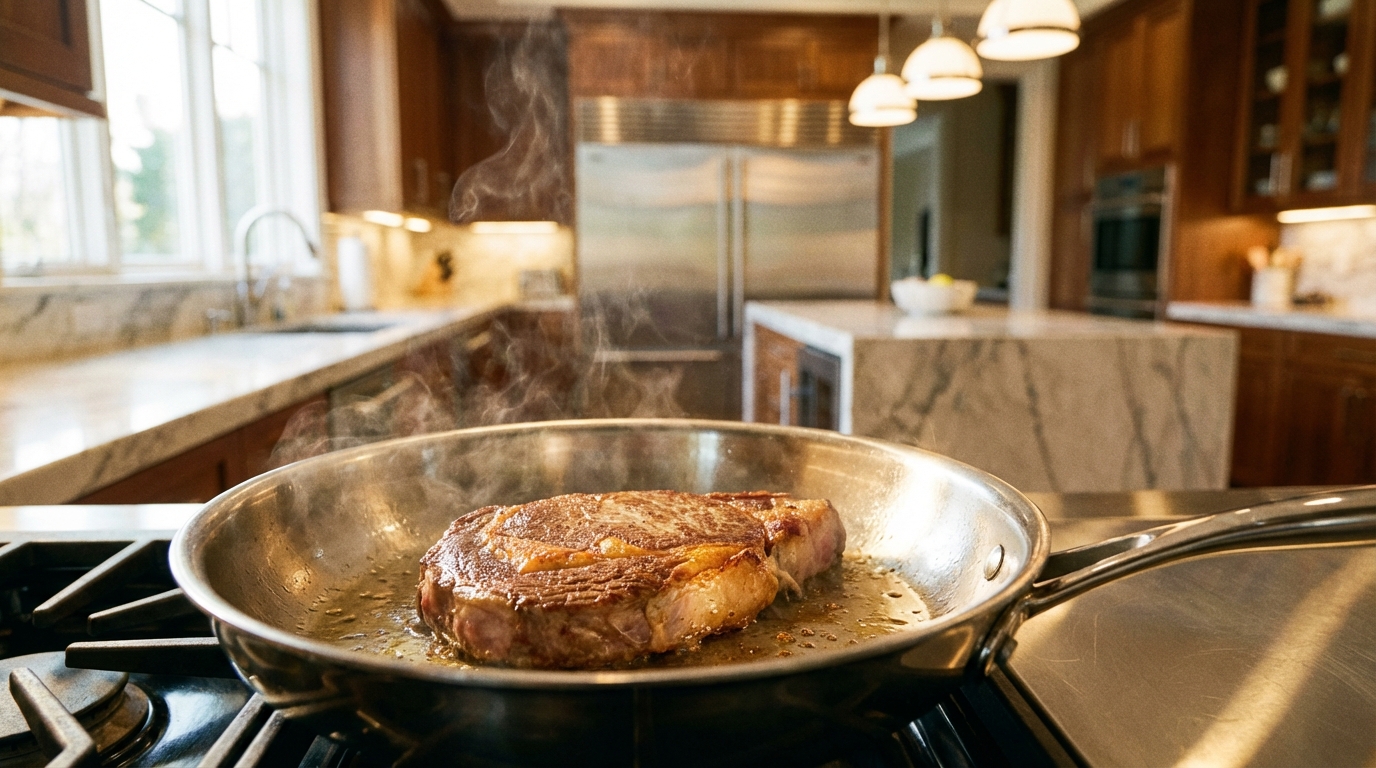
Let your steak sit until it's no longer ice-cold, heat the empty stainless pan until a shimmering 1-2 tsp of avocado oil quietly dances across its surface, then lay the meat down and don't budge it--Maillard's golden crust forms as the oil and escaping steam team up to outsmart sticking without a single forever-chemical.
The Maillard Reaction on PFAS-Free Surfaces
The Maillard reaction--that magical transformation creating golden-brown crusts and complex flavors--happens when proteins and sugars meet heat around 285 degreesF, no matter what pan you use [6]. But here's the thing about stainless steel: its surface naturally wants to bond with your food [7]. Proteins especially love to stick because they form strong connections with the metal atoms in your pan [7]. Look closely (really closely) and you'll see that even "smooth" stainless steel has tiny peaks and valleys where food can get trapped [7].
Unlike non-stick coatings that create a barrier between food and metal, getting great browning on stainless steel means working with these natural properties, not against them. Here's how it works: when you heat oil in stainless steel to the right temperature, it gets thinner and flows into those microscopic valleys, creating a temporary coating that prevents food from bonding directly with the metal [7]. No fluoropolymers needed--just physics. That satisfying sizzle you hear?
That's moisture escaping from your food, creating a steam cushion between the food and pan that helps prevent sticking while still allowing the heat transfer you need for perfect browning [7]. Done right, you'll get the same incredible Maillard flavors as any PTFE-coated pan, minus the forever chemicals [8].
Proven Techniques for Consistent Searing and Browning
Getting that perfect sear starts before you even turn on the heat. First, let your food come to room temperature--give cold proteins like steak about 15 minutes on the counter to prevent uneven cooking and sticking [9]. Next comes the most important step: preheating. Heat your pan thoroughly. Now add just 1-2 teaspoons of high smoke-point oil--avocado (520 degreesF) or refined canola (400 degreesF) work great [11]. The oil should shimmer like water but never smoke. If it's smoking, your pan's too hot--let it cool a bit [11]. When placing food in the pan, lay it away from you to avoid splatter [11].
Here's where patience pays off: don't move that food! Your proteins need time to form a proper crust before they'll release naturally [9]. Listen to your pan--a steady, gentle sizzle means you've nailed the temperature. Silence? Too cool. Violent spattering? Too hot [11].Ready to flip? Give your food a gentle nudge with a spatula--if it moves easily, the crust has formed and it's time [9].
Pro tip for steaks: many chefs flip every 30-60 seconds for more even cooking and better crust development [11]. Want restaurant-quality results? Try butter basting in the final minutes for extra flavor and perfect doneness. Don't forget to sear the edges of thick cuts for a complete crust [11]. For cuts thicker than 1.5 inches, finish in a 400 degreesF oven after searing both sides--this prevents burning while the center comes to temperature [11]. Master these techniques and your stainless steel becomes as non-stick as you need it to be, creating incredible browning without any chemical coatings [10].
Maintaining Performance and Extending Lifespan
Hand-wash your stainless steel pan with mild soap, skip the dishwasher and harsh chemicals, and you'll turn a $100-150 purchase into decades of peak performance while ditching the wasteful $200-400 cycle of replacing worn-out nonstick every few years.
Daily Care Practices to Keep the Pan Non‑Stick
Keeping your stainless steel performing like new doesn't require special products or complicated routines. Start with hand washing--skip the dishwasher since its high heat and harsh detergents can damage your pan's cooking surface over time [12]. Let your pan cool down a bit first to avoid warping, then wash with warm water, mild dish soap, and a soft sponge [12]. Got stuck-on food? No problem.
A quick soak or a simple paste of baking soda and water works better than harsh cleaners ever could. Dry your cookware right away to prevent water spots that can affect how your food cooks next time [12]. For storage, hanging works great, or use pan protectors between stacked pieces to prevent scratches. While stainless steel can handle metal utensils, silicone or wooden tools help maintain that smooth cooking surface longer [12]. As covered in our searing techniques, proper preheating remains crucial for maintenance too--it prevents food from sticking in the first place [12].
For tougher cleaning jobs, white vinegar mixed with water tackles discoloration naturally [13]. Just remember: no bleach, ammonia, or chlorine cleaners. These chemicals can damage your pan and potentially end up in your food [13].
Long‑Term Cost Savings Compared to Disposable Alternatives
Let's talk real numbers. A typical nonstick pan costs $30-40 and needs replacing every 2-3 years when the coating wears out. Do the math over 20 years, and you're looking at $200-400 spent on replacements. Compare that to a quality stainless steel pan that costs $100-150 upfront but lasts decades with basic care [16]. The savings go beyond your wallet.
Every scratched nonstick pan that hits the trash adds to landfill waste--and those pans must be tossed once they show any damage, according to Consumer Reports [15]. Stainless steel breaks this wasteful cycle completely. Smart shoppers don't need to overhaul their entire kitchen at once. Start with the pan you reach for most often--maybe that everyday skillet or your go-to saucepan [14]. This approach spreads out the cost while immediately cutting your exposure to chemical coatings where it matters most.
The best part? You already know the maintenance tricks from daily use. Boiling water loosens stubborn bits, baking soda tackles tough spots, and proper preheating prevents sticking in the first place [14]. No special cleaners needed, no replacement schedules to track--just reliable performance year after year.


Selecting Affordable, High‑Quality PFAS-Free Cookware
Build a PFAS-free kitchen on a budget by starting with one multi-layer 18/10 stainless skillet that sears on the stove, finishes in a 600 degreesF oven, and pours drip-free on any cooktop.
Essential Features for Everyday Use
When you're shopping for PFAS-free stainless steel cookware, construction quality makes all the difference in daily cooking. Multi-layered designs with an aluminum core between stainless steel layers deliver even heat without hot spots--and stay light enough to handle easily [17]. Look for food-grade 18/10 steel (that's 18% chromium, 10% nickel) for the best corrosion resistance and long-term durability [19].Temperature versatility is key for everyday cooking. Quality stainless steel handles at least 600 degreesF, letting you move seamlessly from stovetop searing to oven finishing [17]. Unlike traditional non-stick surfaces that release harmful compounds at high heat, stainless steel maintains its safety and performance [19].
When you're searing steaks or finishing a frittata in the oven, this heat tolerance isn't just nice to have--it's essential.Smart design details make cooking easier. Helper handles on larger pans give you better control with heavy dishes, while well-designed main handles stay cooler during cooking [17]. A wide, flat cooking surface lets you brown food in a single layer for better caramelization [19]. And those curved rims? They're perfect for drip-free pouring--no more sauce trails on your countertop [19].Another plus: stainless steel works on every cooktop--induction, gas, electric, you name it [17].
Worried about food sticking? As we covered in the browning techniques section, the right approach creates a natural non-stick effect without any chemical coatings [18]. Your cooking experience improves dramatically when using quality cookware that delivers consistent results meal after meal.
Building a Complete Kitchen Set on a Budget
Building your PFAS-free kitchen doesn't mean emptying your bank account. Start with the pieces you'll use every day instead of buying a complete set right away. This spreads out the cost and gets those chemical-laden pans out of your daily rotation faster. Here's what to prioritize: a quality 10-12 inch skillet (stainless steel or ceramic-coated), a 3-quart saucepan, and a 6-quart Dutch oven. These three handle 90% of what you'll cook.
Enameled cast iron Dutch ovens offer exceptional value--you'll find options under $100 that perform like pricier European brands [21]. For those who want some nonstick functionality, ceramic-coated sets provide chemical-free convenience at reasonable prices [20]. Don't overlook carbon steel either. It develops natural non-stick properties over time without any coatings, and costs less than many stainless options. Round out your collection with quality basics: half sheet pans for roasting, good tongs, and wooden utensils that protect your cookware surfaces [21].
Cooking for just yourself or a partner? Look for smaller-sized pieces that match your needs without the full-sized price tags. When comparing cookware sets, check what's actually included--some mid-range options throw in storage solutions and accessories that would cost extra elsewhere [19]. As we discussed in the cost savings section, investing in quality pieces that last decades beats replacing cheap cookware every few years.
- PFAS chemicals persist for years and are linked to cancer, thyroid disease, and developmental harm.
- Stainless steel is inherently PFAS-free because manufacturing heat destroys organic chemicals.
- Preheat stainless until oil shimmers; food releases naturally once a crust forms.
- Hand-wash, dry immediately, and avoid bleach to keep stainless steel performing for decades.
- Quality stainless with 18/10 steel and aluminum core heats evenly and tolerates 600 degreesF.
- Start with a 10-12-inch skillet, 3-qt saucepan, and 6-qt Dutch oven to replace coated pans.
- https://www.consumerreports.org/toxic-chemicals-substances/you-cant-always-trust-claims-on-non-toxic-cookware-a4849321487/
- https://imcteddy.com/blog-post/does-stainless-steel-contain-pfas/
- https://www.sfenvironment.org/should-i-be-concerned-about-using-non-stick-cookware
- https://www.consumernotice.org/environmental/water-contamination/pfas/cookware/
- https://www.northcarolinahealthnews.org/2025/10/27/unc-study-food-processing-cookware-packaging-to-pfas-exposure/
- https://www.purecook.com/can-stainless-steel-cookware-be-non-stick/
- https://www.scienceofcooking.com/why_food_sticks.htm
- https://cen.acs.org/environment/persistent-pollutants/does-nonstick-cookware-work-should/103/web/2025/04
- https://millionmarker.com/blogs/blog/why-food-sticks-to-stainless-steel
- https://cooksofcrocushill.com/blog/guide-to-pfas-free-cookware/
- https://www.dioro.com/blogs/news/cooking-steak-in-stainless-steel-pan?srsltid=AfmBOoofUlj7Tv7n-cc7CJpcOLxT1Ef8PD9MN1RDZfsJ0D0XDI5lW9-O
- https://www.everythingkitchens.com/blog/pfas-free-cooking-guide--how-to-cook-non-stick-with-stainless-steel-cast-iron-and-ceramic-nonstick-cookware.html?srsltid=AfmBOor5ZvJyGIc9lAPFREsFObthLwUMpehBauhjEjnwFsuH1va71M55
- https://cookinglife.eu/pages/how-to/pannen-zonder-teflon-en-pfas
- https://www.consumerreports.org/home-garden/opt-for-safer-kitchenware-a2506781798/
- https://www.consumerreports.org/home-garden/cookware/best-frying-pans-if-you-want-to-avoid-pfas-chemicals-a1006253549/
- https://www.zendaguide.com/post/best-non-toxic-cookware
- https://www.amazon.com/GreenPan-Stainless-Non-Toxic-PFAS-Free-Measurement/dp/B0DKWHYH2R
- https://www.bonappetit.com/story/the-best-nontoxic-cookware-tested-by-our-experts?srsltid=AfmBOoosF6OfTHm0u4X81tXOltxfAZyqGQG0SkErHBHZhMlt571Wrl9r
- https://www.organicauthority.com/organic-food-recipes/non-toxic-cookware-brands-to-keep-chemicals-out-of-your-food
- https://www.foodandwine.com/lifestyle/kitchen/best-non-toxic-cookware
- https://www.seriouseats.com/new-year-non-toxic-kitchen-favorites-2025-11871157