

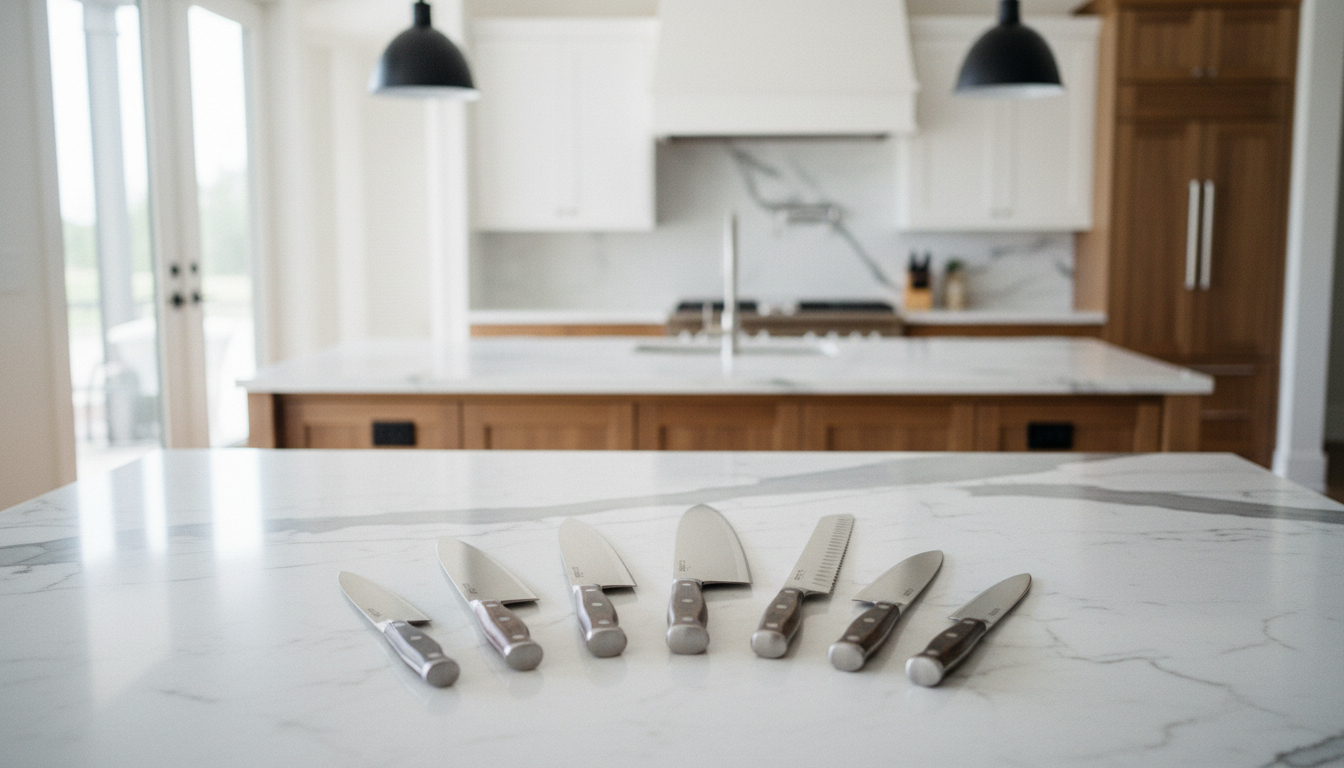
This comprehensive guide demystifies kitchen knives by showing you how to match the right blade to your cooking style, budget and skill level--whether you're a once-a-week cook who needs three affordable workhorses or a daily enthusiast ready to invest in premium steel. You'll learn why an 8-inch chef's, a paring and a serrated bread knife handle 90% of tasks, when Japanese or Western profiles, weights and angles make sense, and how to test balance, handle ergonomics and steel hardness so the knife feels like an extension of your hand. The article walks through specialty blades--boning, fillet, Santoku, Nakiri, cleaver, cheese and tomato knives--explaining exactly which frustrations each solves, then lays out simple care rules (hand-wash, magnetic storage, regular honing, end-grain boards, scheduled sharpening) that keep even mid-priced knives razor-sharp for decades. By focusing on construction quality over brand hype and letting your actual cooking habits drive each purchase, you'll build a compact, high-performing collection that turns prep from a chore into a pleasure while keeping you safer and your food tasting better.
The World of Kitchen Knives: An Introduction
A sharp, well-balanced knife--matched to your cooking style--transforms kitchen prep from a struggle into an effortless, safer ritual where the blade almost guides itself through every cut.
The Impact of Quality Knives on Cooking Success
You know that moment when you're struggling to cut through a tomato and end up squishing it instead? That's when the difference between a quality knife and a mediocre one becomes crystal clear. A sharp, well-balanced knife doesn't just make cooking easier--it completely changes how you experience your time in the kitchen [1]. Here's something that might surprise you: sharp knives are actually safer than dull ones. When your knife glides through ingredients with minimal pressure, you maintain better control.
No more dangerous sawing motions or unexpected slips [2]. This becomes even more important when you're prepping for a dinner party or tackling tougher vegetables. The blade material makes a real difference in how your knife performs day after day. Professional kitchens rely on high-carbon steel because it stays sharp longer and delivers consistent results [1]. While we'll dive deeper into materials later in this guide, knowing the basics helps you understand why some knives feel effortless while others fight you at every cut.
But a great knife isn't just about the blade. When the weight distribution is right, the knife feels like it belongs in your hand--almost like it's guiding itself through the cut [1]. Whether you're mincing garlic or breaking down a chicken, this balance makes everything feel more natural and less like work. With proper care and regular sharpening, a quality knife becomes your most trusted kitchen companion for years to come [1][2].
Understanding Knife Importance in Different Cooking Styles
Your cooking style plays a huge role in determining which knives will serve you best. Love preparing sushi or delicate vegetable dishes? Japanese-style knives with their thinner, lighter blades make those precise cuts feel effortless [5]. More of a hearty stew and roast person?
Western-style knives with their curved blades and extra heft work perfectly for that rocking motion when you're chopping onions or herbs [5]. The techniques you use most often should guide your choices. If you're into French cooking and need to master cuts like julienne, brunoise, or chiffonade, you'll want knives that give you that precision control [5]. These aren't just fancy names--uniform cuts actually help your food cook more evenly and taste better [4].
Different cuisines have developed their own knife preferences over centuries. Chinese cooking makes the cleaver a multitasking hero, while Mediterranean cooking often calls for specialized tools [5]. As we explore different knife types throughout this guide, you'll discover which designs match your go-to recipes and techniques.
How This Guide Will Help You Make Informed Choices
We're here to help you build a knife collection that actually makes sense for your kitchen--no marketing fluff, just practical advice. Instead of getting caught up in how sharp a knife is out of the box (spoiler: most are pretty sharp when new), we'll focus on what really matters: how it feels in your hand, how well it's built, and whether it'll still perform great months from now [6].
You'll discover those not-so-obvious details that make all the difference--like how the curve of a blade affects your cutting style, or why handle shape matters more than you might think [7]. We'll break down which knives you actually need versus the ones that just take up drawer space.
Throughout this guide, we'll match specific knives to real cooking tasks, so you're investing in tools that earn their keep. You'll also learn simple maintenance tricks to keep your knives performing like new--including when it makes sense to use a

Understanding Kitchen Knife Fundamentals
Mastering knife anatomy--from the piercing point through the balance-defining tang to the grip-enhancing handle--lets you pick the perfect blade and cut with precision, safety, and confidence.
Anatomy of a Kitchen Knife (blade, Tang, Handle)
Understanding knife anatomy helps you select the right tool and improves your cutting technique. The blade consists of several functional areas: the point where edge and spine meet (used for piercing); the tip for detailed cutting; the edge running from point to heel; and the spine providing stability [10]. The heel--opposite the point--offers leverage for tough cuts, while the central portion handles most cutting tasks [9]. The tang extends the blade metal into the handle, directly affecting balance and durability. Full tangs run the entire handle length, visible between handle scales and secured with rivets, providing maximum strength and balance [8]. Half tangs extend only midway, compromising durability but reducing weight and cost.
Japanese knives often feature hidden tangs completely enclosed within the handle, creating a lighter feel [8]. Some modern designs eliminate the tang entirely with hollow handles welded directly to the blade [8]. The bolster--where blade meets handle--significantly impacts knife performance. Full bolsters extend down to form finger guards but complicate sharpening the heel area [8]. Half-bolsters provide protection while allowing complete blade access during sharpening [8]. Many premium knives now forgo bolsters completely, especially those with exotic wood handles that naturally provide weight and balance [8].
Handle materials balance comfort, durability and maintenance needs. Natural woods offer traditional beauty but require occasional food-safe oil treatment to prevent cracking [8]. Synthetic options include resin-stabilized woods, pakkawood (resin-impregnated hardwood laminates), and technical materials like micarta (compressed fabric layers with resin) and G-10 (fiberglass laminate)--each offering different balances of grip, durability and weight [8]. The handle should allow versatile grip positions rather than forcing a single hand position [8].
Knife Materials Explained (stainless Steel, Carbon Steel, Damascus)
Knife Materials Explained (Stainless Steel, Carbon Steel, Damascus)
The steel used in a kitchen knife fundamentally shapes its performance, maintenance requirements, and longevity. Understanding these materials helps you select knives that match your cooking style and care preferences rather than being swayed by marketing claims. Stainless steel contains at least 11% chromium and up to 1.2% carbon, creating resistance to corrosion without sacrificing cutting ability [11]. This balance makes stainless knives practical for busy kitchens where meticulous maintenance isn't always possible. Popular variants include German X50CrMoV15 (used in many Western knives) with excellent corrosion resistance and good edge retention, and Japanese VG10 with higher carbon content (1%) for superior hardness and sharpness [11].
Despite the name, stainless steel can still develop rust if subjected to prolonged moisture or acidic foods--just much more slowly than carbon alternatives [11]. Carbon steel contains minimal alloying elements beyond iron and carbon (0.05-2.1%), allowing for exceptional hardness and sharpness [11]. Traditional Japanese knives often feature high-carbon options like Aogami (Blue Paper Steel), which can achieve extraordinary sharpness but require vigilant care to prevent corrosion [11]. The simplicity of carbon steel's composition allows for extremely thin, sharp edges that outperform stainless in pure cutting ability, but demands immediate cleaning and drying after use. In testing with lemon juice exposure, high-carbon 1095 steel showed significant sharpness loss after just 30 minutes, while stainless maintained performance [12].
Damascus steel represents a manufacturing process rather than a specific material composition [11]. Created by forge-welding alternating layers of high and low carbon steels, then etching the blade to reveal the contrasting layers, Damascus creates distinctive wavy patterns [11]. While historically prized for combining the hardness of high-carbon steel with the flexibility of lower-carbon variants, modern Damascus often serves aesthetic purposes more than functional ones. The performance of Damascus depends entirely on the specific steels used in its construction and the skill of its maker [11].
Western vs. Japanese Knife Design Traditions
Western and Japanese knife traditions stem from distinct cultural and culinary needs. German knife-making, centered in Solingen's "City of Blades," dates back to the Middle Ages and has defined what we now recognize as Western knife design [15]. Japanese knife-making evolved from sword-crafting traditions during the Muromachi Period (1336-1573), with significant changes during the Meiji Era (1868-1912) when Japan opened to Western trade and beef consumption became common [13][15]. The blade profiles reveal fundamentally different cutting philosophies. Western chef's knives feature a pronounced curved edge or "belly" ideal for the rocking motion in European cutting techniques [13][15]. This design allows the tip to remain on the cutting board while the knife rocks through ingredients. Japanese Gyuto knives typically have flatter edges with the spine curving downward toward the tip, making them precise for slicing and push-cutting techniques [14][15].
Material composition creates the most significant functional difference between these traditions. Japanese knives feature harder steel (58-65 Rockwell) with higher carbon content, maintaining sharper edges longer [13][14]. This hardness comes with trade-offs--Japanese blades are more brittle and chip-prone if misused. Western knives use softer steel (52-58 Rockwell), offering durability and chip resistance at the cost of more frequent sharpening [13][14]. Japanese knives feature thinner blades with more acute edge angles (typically 7-8 degrees per side) that excel at precision cutting and preserve cellular integrity in foods [14]. Western knives employ wider edge angles (around 10 degrees per side) with thicker blades that better withstand lateral pressure and heavy-duty tasks [14]. This reflects cultural approaches to cutting--Japanese design emphasizes technique requiring minimal force, while German knives leverage weight to help power through ingredients [14].
Physical construction affects balance and handling. German knives traditionally feature full bolsters and full-tang construction, creating a handle-heavy balance [15]. Japanese knives typically lack bolsters, with either partial or stick tangs creating a more blade-forward balance that facilitates precise tip work [15]. These design differences extend to maintenance--Japanese knives demand more meticulous care, requiring whetstones for sharpening rather than honing rods that work well for Western knives [13][15]. If you're looking to keep your knives performing at their best, professional knife sharpening can restore that factory-sharp edge regardless of your knife's origin. Today, many manufacturers create hybrid designs that blend elements from both traditions, offering cooks the benefits of each approach [13][15].
Forged vs. Stamped Blade Construction
The manufacturing process fundamentally shapes a knife's performance and durability. Forged knives start as a single bar of steel heated to 1,800-2,100 degreesF, then hammered into shape either by skilled craftsmen or precision machinery [16][17]. This intensive process creates a denser blade structure with aligned grain patterns, enhancing strength and edge retention [17]. Forged knives are instantly recognizable by their bolster--the wider section where blade meets handle--which adds weight, improves balance, and prevents your hand from slipping onto the blade [16][18].
They typically feature a full tang (metal extending through the handle), visible as metal rivets or along the handle edge, providing stability and better weight distribution [16]. In contrast, stamped knives are cut from large steel sheets using powerful dies--essentially a mechanical cookie-cutter process [18]. After stamping, these thinner, lighter blades undergo honing and heat treatment to improve durability [17][18]. The simplified manufacturing process makes stamped knives more affordable but creates notable performance trade-offs.
Forged knives hold their edge longer, offer better balance for precision cutting, and significantly outlast their stamped counterparts [17][18]. The weight difference is practical--forged knives leverage their heft for challenging cuts while stamped blades offer maneuverability for repetitive tasks [18]. While quality variations exist in both categories, with high-end stamped knives sometimes outperforming cheap forged options, the construction method creates inherent differences in performance ceiling and longevity [16].
Essential Types of Kitchen Knives Every Cook Needs
A perfectly balanced 8-inch chef's knife and a sharp paring knife--chosen by feel, not price--will handle nearly every kitchen task from butchering squash to hulling strawberries if you wash, dry, and store them properly.
Chef's Knife: The Versatile Kitchen Workhorse
Your chef's knife handles about 90% of kitchen cutting tasks, making it the most important tool in your collection. With its versatile 7-10 inch blade, you'll use it for everything from breaking down butternut squash to mincing garlic and portioning chicken breasts [19]. As covered in the knife fundamentals section, Western and Japanese styles offer different advantages--but what matters most is finding one that feels right in your hand [19]. Here's how to choose: Hold the knife and make some cutting motions.
Does the weight feel balanced? Can you grip it comfortably for several minutes? An 8-inch blade works for most home cooks, though smaller hands often prefer 7-inch versions [19]. Don't get caught up in prestige brands--a well-maintained, comfortable knife will outperform an expensive one that sits unused because it feels awkward [19].
Proper care keeps your investment sharp for decades. Always hand-wash and dry immediately after use, then store it properly on a
Paring Knife: Precision Work for Detailed Tasks
Think of your paring knife as precision scissors for the kitchen. Its compact 3-4 inch blade gives you the control needed for detailed work that would feel clumsy with a larger knife [20]. You'll reach for it constantly--peeling apples, deveining shrimp, hulling strawberries, or creating decorative garnishes [20]. The key difference from other knives?
You'll often use it in your hand rather than on a cutting board. When peeling, you'll cut toward your thumb (carefully!) for maximum control--the only time this technique is recommended [20]. The sharp tip handles surgical tasks like removing pepper seeds or scoring pastry dough with precision you can't achieve with larger blades [20]. Know its limits though.
When you hit resistance with harder vegetables like carrots or winter squash, switch to your chef's knife. Forcing a paring knife through tough ingredients risks both the blade and your fingers [20]. Keep it sharp and clean, and this small but mighty tool will handle countless detail tasks that make the difference between good cooking and great presentation [20].
Bread Knife: Serrated Edge for Clean Slicing
A quality bread knife does more than slice your morning toast. Those distinctive serrated teeth work like tiny saws, gripping and cutting through crusty sourdough without crushing the airy interior--something a straight blade simply can't manage [21]. The gentle sawing motion lets the teeth do the work, so you're not mashing down on that perfect baguette you just brought home [21]. Size matters here. For artisanal loaves and large boules, you'll want an 8-10 inch blade.
Working with dinner rolls or smaller breads? A 6-8 inch knife offers better control and maneuverability [22]. Here's what many cooks don't realize: your bread knife is secretly a tomato knife, cake knife, and delicate-food specialist. Those serrations grip tomato skin without squishing the flesh, slice cleanly through layer cakes, and even handle sushi rolls without tearing the nori [21]. Pro tip: Start with light scoring motions to establish your cut line, then saw gently through--and angle the blade slightly for more uniform slices [23].
The trade-off? Serrated edges need professional sharpening when they eventually dull, as standard sharpening tools won't work on those teeth [23]. But with proper care, a good bread knife stays sharp for years, making it an essential tool that earns its counter space [23].
Utility Knife: The Perfect In-Between Blade
The utility knife is your kitchen's multitasker--not too big, not too small, but just right for those in-between jobs. At 4.5-5 inches, it bridges the gap when your chef's knife feels unwieldy and your paring knife lacks reach [24]. Many pros call it the "sandwich knife" because it's perfect for slicing tomatoes, cutting cheese, and prepping all those medium-sized ingredients that make up your lunch [24]. This knife shines when you need precision without sacrificing power.
Trimming chicken breasts? Slicing bell peppers? Sectioning citrus? Your utility knife handles them all with the control you can't get from larger blades [26].
It's particularly valuable in small kitchens or for cooks building their first collection--one versatile tool instead of multiple specialized knives [25]. Choose one that feels balanced in your hand, with a comfortable grip that won't slip during detailed work. While available in both straight and serrated versions, a straight edge offers more versatility for most cooking tasks [26]. Professional chefs consistently rank the utility knife among their top three essentials, right alongside the chef's knife and paring knife--and once you start using one, you'll understand why [25].
Specialized Types of Kitchen Knives for Specific Cooking Tasks
Master your prep by matching the blade to the task: wield a rigid boning knife to zip meat from bone, a flexible fillet knife to trace fish skeletons without waste, a Santoku for compact all-purpose chopping, and a straight-edged Nakiri to slice vegetables cleanly without crushing a leaf.
Meat Preparation Knives (boning, Fillet, Butcher)
Working with meat calls for knives designed to handle specific challenges. Boning knives bring rigid, razor-sharp blades that make quick work of separating meat from bones, removing skin, and trimming away fat. Their stiff construction gives you the control to navigate around complex bone structures with confidence.
These knives are so sharp that professionals often wear protective gloves--even the tip alone can slice through tissue effortlessly [27]. Filleting knives look similar but work differently. Their thinner, more flexible blades bend to follow the natural contours of bones and skin, letting you cleanly separate meat with minimal waste.
This flexibility shines when working with fish or tender cuts, where precision matters most. The narrow profile keeps you in control for delicate work, making these knives your go-to for preparing fish fillets and softer proteins [27]. While many cooks use these terms interchangeably, knowing the difference helps you choose the right tool for the job--rigid for bones, flexible for fillets.
Vegetable-Focused Blades (santoku, Nakiri, Usuba)
Japanese vegetable knives bring specialized design to plant-based prep work, each offering unique advantages. The Santoku ("three virtues") handles vegetables, meat, and fish with equal skill. Its shorter, wider blade and flatter edge work best with simple up-and-down chopping rather than the rocking motion of Western knives [28][29]. After gaining popularity in Japanese homes following World War II, the Santoku's compact 165-180mm blade has become a favorite for cooks with limited counter space who still need versatility [29]. The Nakiri takes vegetable prep to the next level with its distinctive rectangular blade and perfectly straight edge [28].
This double-beveled design slices cleanly through produce without crushing or tearing--even delicate greens stay intact [29]. Since the straight blade makes full contact with your cutting board, you'll get uniform cuts every time, whether you're dicing onions or creating perfect julienne strips [28][29]. For those seeking professional-level precision, the Usuba represents the pinnacle of vegetable knife craftsmanship [28]. Its single-beveled edge demands skill but rewards you with incredible control--professional chefs use it for katsuramuki, a technique that creates paper-thin vegetable sheets by rotary peeling [29]. You'll find regional variations too: the Osaka-style Kamagata with its curved tip and the Tokyo-style Kanto with its square edge [29].
The bottom line? Choose based on your skill level and needs. The Santoku works beautifully for everyday cooking, the Nakiri elevates your vegetable game while staying user-friendly, and the Usuba offers unmatched precision for those ready to master advanced techniques [29].
Cleavers and Heavy-Duty Cutting Tools
Cleavers might look intimidating, but they're incredibly versatile tools that go beyond the butcher block stereotype. Not all cleavers are built for bone-crushing--different styles tackle different kitchen challenges. Traditional meat cleavers pack serious weight (typically 14-16 ounces) into thick blades designed for breaking down chickens, splitting lobster shells, or portioning ribs [30]. The sweet spot for weight?
Heavy enough to work efficiently but not so heavy (over 1.5 pounds) that your arm tires during use [30]. Chinese cleavers tell a different story. Despite their similar rectangular shape, these thinner-bladed workhorses excel at vegetable prep, slicing boneless meats, and using their flat sides to crush garlic or ginger [31]. Japanese variations include traditional Chinese-style cleavers made with Japanese steel techniques, plus the nakiri--a smaller rectangular blade that brings precision to vegetable cutting [31].
Design details matter more than you might think. Slightly curved blades give you better leverage for cutting through bones and allow rocking motions when mincing meat, while straight edges require more direct up-and-down chopping [30]. Your choice of steel affects both performance and maintenance--stainless steel resists corrosion and holds an edge well, while
Specialty Knives for Specific Ingredients (cheese, Tomato, Salmon)
Specialty knives for specific ingredients (cheese, tomato, salmon)
Some ingredients practically demand their own specialized knives--and for good reason. Take cheese knives with their clever perforated blades. Those holes aren't just for show; they prevent cheese from sticking as you slice through everything from rock-hard aged cheddar to creamy brie [33]. The rounded tips pull double duty as spreaders for soft cheeses, while Granton edges (those dimples along the blade) create air pockets that break the vacuum seal between knife and cheese [33]. Tomatoes pose their own challenge--that frustrating combination of tough skin and delicate flesh.
Serrated utility knives handle this beautifully, even if they're not specifically labeled as "tomato knives." Their teeth grip the slippery skin without crushing what's underneath [33]. The compact 4-5 inch blade gives you better control than a longer bread knife when working with round, rolling produce. Speaking of bread knives, they work on tomatoes for the same reason--those serrations slice instead of squish [34]. When it comes to fish, especially salmon, you'll want the right tool for clean, professional results. Fillet knives bring long (5-9 inch), narrow blades with enough flex to follow the natural curves of the fish [35].
This flexibility lets you separate flesh from bones and skin with minimal waste. The curved tip glides along backbones, while the thin profile slices cleanly without tearing delicate fish meat [35]. Japanese deba knives take a different approach--their thicker spines and solid construction power through fish bones when needed, yet still deliver the precision required for careful filleting [34]. For salmon specifically, look for a fillet knife flexible enough to remove skin in one smooth motion but rigid enough to maintain control throughout the cut [33].
Selecting the Right Knife for Your Cooking Style
Let your most frequent cooking tasks--not ads--dictate which knife deserves your money, then grip-test handles until the blade feels like a natural extension of your hand.
Matching Knife Types to Your Most Common Cooking Tasks
The right knife dramatically improves cooking efficiency, and your regular cooking activities should guide your choices rather than marketing claims. Think about what you actually cook most often--that's your starting point for smart knife selection. As we explored in the knife fundamentals section, your cutting technique matters too--if you prefer the rocking motion, Western-style blades work best, while straight up-and-down chopping suits Japanese profiles.
Match your knife to both what you cut and how you cut it. Before investing in specialized knives (covered in detail in Section 4), identify which tasks you perform most frequently and where your current tools create frustration. If you're constantly struggling to slice tomatoes cleanly, that serrated knife becomes essential.
Finding it hard to break down whole chickens? A boning knife moves up your priority list. These pain points reveal exactly where targeted upgrades will make the biggest difference in your cooking [3].
Ergonomics and Hand Fit: Finding Your Perfect Grip
Finding a knife that fits your hand properly transforms cooking from a chore to a pleasure. Handle ergonomics--the science of designing tools to match human anatomy--significantly impacts comfort, control, and safety [37]. Contrary to the one-size-fits-all approach of many manufacturers, handle diameter directly affects grip strength. As handle diameter increases, grip strength improves up to approximately 1.5 inches before declining when fingers can no longer wrap around effectively [39]. Test this yourself: a handle that's too thin creates pressure points, while one that's too thick prevents proper finger wrap.
Handle shape matters as much as size. Traditional Western-style handles feature subtle contours that follow hand anatomy, while Japanese D-shaped handles provide a snug fit specifically for right-handed users [38]. Octagonal handles, common in Japanese knives, offer versatility for both right and left-handed users while providing stable control [38]. The cross-section of most quality knife handles is oval rather than perfectly round, allowing for edge orientation without looking [39]. Your preferred grip style should guide handle selection.
The pinch grip--holding the knife by pinching the blade between thumb and index finger while wrapping remaining fingers around the handle--provides superior control but requires a handle that accommodates this position [38]. The traditional handle grip, with all fingers wrapped around the handle, works better with handles featuring finger grooves or textured surfaces [38]. When testing knives, pay attention to pressure points, particularly where the handle meets your palm's hollow center and the prominence at the base of your thumb [39]. A well-designed handle accommodates these anatomical features rather than fighting against them.
Weight and Balance Considerations
A knife's weight distribution significantly impacts performance and comfort during extended use. The balance axis--where the knife remains horizontal when placed on an edge--reveals how weight is distributed between blade and handle [40]. In a properly balanced knife, this axis sits close to your grip's pivot point (typically at the blade-handle junction in a pinch grip), minimizing the torque your hand must counteract during cutting [40].
Measurements demonstrate this effect: a knife with its balance axis just 1.67 cm from the pivot point feels significantly lighter than one with a 3.66 cm distance, despite nearly identical overall weights [40]. This explains why some knives cause hand fatigue faster than others--blade-heavy designs concentrate stress on specific hand areas, particularly near the pinky finger when using traditional octagonal handles with a loose pinch grip [40]. When testing knives, place each on your finger near the blade-handle junction to find its balance point; knives that tip heavily toward the blade will require more counterforce during use [40].
Balance preferences remain personal--some cooks prefer blade-heavy knives that help power through dense ingredients, while others value neutral balance for precision work and less fatigue during repetitive tasks. There's no universally "correct" balance, just what feels right in your hand [40].
Building a Practical Kitchen Knife Collection Over Time
Building a knife collection strategically yields better results than buying pre-assembled sets that often include redundant blades you'll never touch. Start with that versatile chef's knife--your kitchen workhorse--and really get to know what it can and can't do before expanding [41]. Here's the practical approach: Cook with your chef's knife for a few weeks and pay attention to the moments of frustration. Struggling with bread? Add a serrated knife. Finding detailed work awkward?
Time for a paring knife. Let your actual cooking experience guide each purchase rather than what looks impressive in the knife block [41]. As your skills develop, add specialty knives based on real needs, not marketing promises. Set a realistic budget to avoid transforming from cook to collector--remember, you're building tools for cooking, not trophies for display [41]. Your collection should reflect your cooking style naturally. Prepare mostly vegetables?
That Nakiri might become your new favorite. Love breaking down whole chickens? A quality boning knife pays for itself quickly [42]. Quality beats quantity every time. Three well-made knives that you maintain properly will serve you better than a drawer full of mediocre options.


Caring for Your Kitchen Knife Investment
Hand-washing, immediate drying, and spine-first magnetic storage are the non-negotiable habits that keep your knives razor-sharp, rust-free, and kitchen-safe for years.
Proper Cleaning and Storage Techniques
Let's keep your knives performing like new with proper cleaning habits. The golden rule? Hand-wash your knives right after use with warm water and mild soap [43][44]. This simple step prevents food residue from hardening on the blade, which can dull the edge and cause corrosion--especially when acidic ingredients like tomatoes or citrus are involved. Even stainless steel knives need this care, as they're rust-resistant, not rust-proof [45]. Here's what to avoid: the dishwasher.
We know it's tempting, but those harsh detergents, high heat, and jostling with other utensils will damage your knife's edge and loosen the handle [43][45]. Instead, take 30 seconds to wash by hand, then dry immediately with a clean towel. This prevents water spots and keeps rust at bay [43][44]. Smart storage keeps your knives sharp and your fingers safe. While knife blocks are popular, they have a hidden downside--those narrow slots can trap moisture and bacteria, plus sliding blades in edge-first dulls them faster [43]. Consider magnetic strips or magnetic blocks instead.
They keep your knives visible, well-ventilated, and protect the edges since you place knives spine-first [43][45]. If drawer storage works better for your kitchen, invest in a dedicated knife organizer or individual blade guards. This prevents your carefully maintained edges from banging against other utensils [44]. Whatever you do, avoid tossing unprotected knives in drawers--it's dangerous for your hands and devastating for your blades [43]. And never leave knives in the sink where they can hide under sudsy water or get damaged by other dishes [44]. Remember, consistency matters more than the method--pick a storage solution and stick with it [45].
Sharpening Methods and Maintenance Schedule
Keeping your knives sharp isn't just about better cuts--it's about safer, more enjoyable cooking. How often should you sharpen? It depends on how much you cook. If you're preparing meals a few times a week, twice-yearly sharpening works well.
Cooking most nights? Aim for every three months [46]. Professional kitchens sharpen every other month, while high-volume operations like butcher shops need monthly maintenance [46]. Here's an easy way to remember: schedule sharpening with your spring and fall deep cleans.
Even with normal use, knife edges gradually wear down from cutting board contact and acidic foods [46]. The payoff for maintaining sharp knives goes beyond efficiency--you'll use less force when cutting, which means better control and fewer accidents [46]. Plus, there's real satisfaction in gliding through ingredients rather than wrestling with them. Whether you sharpen at home or use a professional sharpening service, establishing a regular schedule based on your cooking frequency prevents the frustration of dull knives and helps your investment last longer [46].
Cutting Surface Selection to Protect Your Blades
Your cutting board is your knife's best friend--or worst enemy. The surface you choose directly affects how long your blades stay sharp. End-grain wood boards are the gold standard for knife care. Picture it this way: when you cut on end-grain, your blade slides between the wood fibers instead of cutting across them, which preserves the edge and lets the board "heal" itself [47]. Among hardwoods, maple stands out as the knife-friendly champion.
It's durable yet gentle, containing less silica than harder woods like acacia or teak that can quickly dull your blades [47]. Testing proves this difference--quality maple boards keep knives sharper significantly longer than other materials [48]. What about plastic? While convenient for raw meat prep, plastic boards create more friction and wear down edges faster than wood. Even knife-friendly plastic options still can't match wood's gentleness on blades [48].
If you're choosing wood, end-grain beats edge-grain every time--those vertical fibers are much kinder to your knife edge than horizontal ones [49]. For practical kitchen management, use end-grain wood for your daily vegetable prep and precision work, saving plastic boards for raw proteins where easy sanitization matters more [47]. Skip bamboo cutting boards despite their eco-appeal--their high silica content dulls knives quickly, making them better for serving than cutting [49]. While the right board extends time between sharpenings, remember that regular maintenance is still essential [48].
Extending Knife Lifespan: Habits to Adopt and Avoid
Want your knives to last for years? It's all about building the right habits. As mentioned earlier, skip the dishwasher--that combination of heat, harsh detergents, and banging around spells disaster for both blades and handles [50]. Your cutting surface matters too. Hard surfaces like glass, ceramic, marble, or stone are knife killers that quickly chip and dull edges.
Stick with wood or plastic boards that have some give [51]. When it's time to clear your board, flip your knife and use the spine to scrape--using the sharp edge for this task is like using scissors to open paint cans [50]. Here's something many cooks don't realize: acidic ingredients like citrus, tomatoes, and pickles gradually eat away at your blade's edge. Give your knife a quick rinse between cutting these foods and other ingredients [51]. And please, use the right tool for the job.
Your chef's knife isn't a can opener, ice pick, or frozen food saw--misuse leads to chips and bent tips [50]. Between sharpenings, regular honing keeps your edge aligned. A honing rod doesn't sharpen; it straightens the microscopic teeth on your blade's edge, maintaining cutting performance [51]. You'll know it's time for actual sharpening when vegetables start crushing instead of slicing cleanly, meat tears rather than cuts smoothly, or when honing stops helping [50]. Building these habits takes minimal effort but pays huge dividends in knife performance and longevity.
Navigating the Kitchen Knife Market
Test a knife's worth before you buy--check high-carbon stainless steel, 56-62 HRC hardness, full-tang forged build, comfy handle, paper-slicing edge, 15-20 degrees sharpening angle, neutral balance, and budget $30-300 for a chef's blade that will work for you daily.
Quality Indicators to Look For When Buying Knives
Knowing what to look for in a quality knife helps you make smart purchasing decisions. Start with the blade material--high-carbon stainless steel gives you the best of both worlds: excellent sharpness and rust resistance [52]. Look for knives with a hardness rating (HRC) between 56-62, which tells you how well the blade will hold its edge over time [53]. Remember, higher HRC means better edge retention, not necessarily sharper out of the box [52]. Construction method makes a real difference in how a knife performs.
As we covered earlier in the forged vs. stamped section, forged knives offer superior balance and durability [52][53]. You'll want to check that the tang extends through the handle--look for visible rivets or metal along the handle edge [52]. Don't overlook handle comfort. Rather than choosing based on looks alone, hold the knife in different grip positions to ensure it feels right in your hand [52]. A well-designed handle keeps your wrist aligned naturally and distributes weight evenly [52].
Want to test sharpness right away? Try the paper test--a quality knife should glide through paper without tearing [53]. Also consider the sharpening angle based on your needs: Asian knives (around 15 degrees per side) deliver incredible precision but need more frequent maintenance, while Western knives (about 20 degrees per side) prioritize durability [53]. Finally, check the balance as discussed in our weight and balance section--a well-balanced knife won't tip heavily in either direction when rested on your finger near the blade-handle junction [52].
Price Range Expectations for Different Types of Kitchen Knives
Let's talk about what you can expect to pay for different types of kitchen knives--it helps to know where your money goes furthest. Since your chef's knife will be your daily workhorse, it deserves the biggest portion of your budget. Entry-level options from quality manufacturers typically run $30-80, mid-range knives cost $80-150, and premium versions start at $150, with some artisanal pieces exceeding $300 [54]. Bread knives are more budget-friendly--you'll find solid options starting at $25-40, with premium models topping out around $100-120 [54]. Since serrated edges stay sharp longer without maintenance, you don't need to splurge here.
Paring knives range from $10-70, though honestly, a good $20-30 option performs nearly as well as pricier versions [54]. For specialty knives, let your cooking habits guide your spending. Santoku knives run $50-200, with noticeable quality improvements above $80 [55]. Boning, fillet, and carving knives typically cost $40-120 for quality options. Specialized Japanese vegetable knives like Nakiri and Usuba start around $80, with premium versions exceeding $200 [55].
Remember that construction affects price--forged knives with full tangs cost more because they deliver better balance, durability, and edge retention [55]. Starter sets often save you 20-30% compared to buying pieces separately, making them smart entry points for building your collection [55]. Here's the truth: for most home cooks, the jump from a $150 to $300 chef's knife offers minimal improvement. Once you hit that mid-range sweet spot, you're getting diminishing returns on your investment [55].
Trusted Knife Brands and Their Specialties
Understanding Knife Manufacturing Traditions and Quality
The knife industry centers around two main manufacturing traditions that shape quality and performance. German knife-making, based in Solingen (known as the "City of Blades" since medieval times), emphasizes durability and versatility. These manufacturers typically produce knives with full-tang construction, pronounced bolsters for balance, and steel that resists chips and stains through heavy use [56]. Japanese bladesmithing brings centuries of sword-making expertise to kitchen knives.
Manufacturers in regions like Niigata create blades with distinctive features like Damascus patterns (layered steel compositions) and tsuchime hammering that creates dimples to prevent food sticking [56]. These knives often feature harder steel that holds exceptional sharpness but requires more careful maintenance [56]. Some manufacturers blend both traditions, creating knives that balance Japanese precision with Western durability. This hybrid approach produces blades with harder steel than traditional German knives for better edge retention, yet more chip-resistant than ultra-thin Japanese designs [57][58].
Entry-level lines from established manufacturers often use stamped construction to keep prices accessible, while premium lines feature forged blades with specialized treatments like ice-hardening for enhanced durability [58]. Commercial kitchen suppliers focus on creating professional-grade tools that withstand intensive daily use while maintaining performance--proving that quality doesn't always require premium pricing [56][58]. Understanding these manufacturing approaches helps you select knives that match your cooking style and maintenance preferences. German-style knives suit cooks who value durability and low maintenance, Japanese-style knives reward those willing to provide careful upkeep with exceptional cutting performance, and hybrid designs offer a middle ground for home cooks seeking the best of both worlds.
Where to Buy: Specialty Shops vs. Online Retailers
Choosing where to buy your kitchen knives can be just as important as selecting the knives themselves. Specialty knife shops give you something invaluable--the chance to hold and test knives before buying. Don't be shy about asking for a cutting board to try different grips and cutting motions. As one expert notes, "There's no better way to get a feel for a knife's size than actually holding it" [59]. The knowledgeable staff at specialty stores can assess your hand size and cooking style to guide you toward the right blade length and design. They'll demonstrate proper techniques and explain maintenance needs for different blade materials--particularly helpful when deciding between Western and Japanese styles.
Online shopping offers different advantages. You'll find broader selection, easier price comparisons, and detailed specifications alongside real customer reviews. This proves especially valuable for cooks with specific needs--like left-handed users seeking specialized designs or those wanting unusual blade lengths that local shops don't stock. Plus, once you know your preferences, online shopping provides convenient access to exactly what you want. Smart shoppers often combine both approaches. Visit a local shop first to test different knife styles and understand what feels right in your hand.
Then leverage online resources to find specific models or better pricing. Just make sure any retailer--whether physical or online--offers a solid return policy [60]. Remember, quality knives are an investment in your cooking enjoyment. Taking time to find the right purchasing channel ensures you'll end up with knives that feel great to use every day. And once you've built your collection, professional knife maintenance services can help keep your investment in top condition.


Conclusion: Equipping Your Kitchen with the Right Blades
Summary of Essential Kitchen Knife Types and Their Applications
You've learned about many knife types throughout this guide, but here's what really matters: a few well-chosen knives handle nearly all your kitchen tasks. Your chef's knife (8-10 inches) tackles most jobs--chopping, slicing, dicing, and julienning. Whether you prefer Western styles with curved blades for rocking motions or Japanese varieties with straighter edges for precision cuts, this versatile tool adapts to your technique [3]. Your paring knife (around 3.5 inches) becomes indispensable for detail work. Unlike larger knives, you'll use it in-hand for peeling, coring, and creating garnishes--tasks where precision matters more than power [61].
A serrated bread knife rounds out the essentials, slicing through crusty loaves without crushing and handling tomatoes or other delicate foods with tough exteriors [61]. Beyond these three core knives, your cooking style determines what else you need. Regular meat preparation? Consider a boning knife. Vegetable-focused cooking?
A Santoku or Nakiri might transform your prep work. The key is matching knives to your actual cooking habits rather than collecting tools that gather dust. Remember, the right knife for each task means less effort, better control, and safer cooking--you're working with the tool, not against it [3].
Personalized Recommendations Based on Cooking Frequency and Style
For occasional cooks who prepare simple meals 1-3 times weekly, start with a reliable chef's knife that balances affordability with performance. Look for features like a non-slip ergonomic handle that maintains grip even when wet--safety matters most when you're still building confidence [62]. Add an inexpensive paring knife and serrated bread knife to complete your basic set. These three knives handle most kitchen tasks without overwhelming you with choices or breaking your budget. Home cooking enthusiasts who prepare meals 4-6 times weekly benefit from investing in higher-quality versions of essential knives. Look for chef's knives with full tang construction for stability and control, or consider lightweight options with exceptional sharpness that maintain their edge longer [62]. Add a quality utility knife for versatile prep work and consider a Santoku if vegetables dominate your cooking. This combination addresses most recipe requirements while reducing hand fatigue during longer preparation sessions. Regular maintenance--including professional sharpening every few months--keeps these workhorses performing at their best.
Serious home chefs who cook daily should build a comprehensive collection based on their specific cooking preferences. For Western cooking traditions featuring rocking cutting motions, choose chef's knives with excellent balance and durable construction [62]. Those focusing on Asian cuisines might prefer knives with harder steel cores and flatter profiles ideal for precision slicing and push-cutting techniques [62]. Match your primary knife to your dominant cooking style, then add specialized tools that address your regular tasks--boning knives for frequent protein preparation, Nakiri knives for vegetable-focused cooking, or fillet knives for seafood enthusiasts. Professional cooks or culinary enthusiasts might consider custom knives that offer personalized features tailored to specific needs. While representing a significant investment, custom knives provide exceptional performance with blade geometry and materials selected for your exact requirements [63]. The craftsmanship in custom knives transforms them from tools to precision instruments that enhance cooking technique with personalized balance and edge profiles [63]. However, high-quality commercial options with professional-grade performance remain accessible at various price points--focus on construction quality, steel composition, and ergonomics rather than brand prestige [62]. Budget-conscious cooks should prioritize quality versions of essential knives rather than accumulating numerous mediocre options.
Well-made commercial knives provide reliable performance without custom pricing, making them accessible for any skill level [63]. Remember that proper maintenance dramatically extends knife longevity--regular sharpening based on your cooking frequency and appropriate storage on magnetic strips or in blocks protects your investment. A well-maintained mid-range knife often outperforms a neglected premium blade [62]. Your dietary preferences should guide knife selection for maximum efficiency. Plant-based cooks find Japanese-style Nakiri knives transform vegetable prep with their straight blades creating clean, precise cuts. If you regularly prepare meat, a quality boning knife alongside your chef's knife saves time and improves results. Bakers benefit from longer serrated knives that handle artisanal loaves without crushing. When upgrading, start with your most-used tool--typically your chef's knife--and choose blade profiles that match your technique: curved edges for rocking motions or flatter profiles for push-cutting. Let your cooking habits, not marketing claims, drive your choices.
Taking Action: Next Steps for Upgrading Your Knife Collection
Ready to upgrade your knives? Start by honestly assessing your current tools. Before buying anything new, sharpen what you have--you might discover some blades just need proper maintenance to perform well again [64]. There's no "perfect" knife collection because every cook has different needs [64]. When shopping, always test knives in person if possible. How does the handle feel?
Is the weight comfortable for extended use? Can you maintain control with your natural grip? Start with quality basics while learning your preferences--save specialty or custom knives for when you understand exactly what you need [64]. Focus your budget wisely: three excellent knives outperform ten mediocre ones [64]. For most home cooks, an 8-9" chef's knife handles the majority of tasks. Add a paring knife and bread knife to cover nearly everything else [64].
Only add specialized tools when you regularly perform tasks that would benefit--buying a fillet knife when you rarely cook fish just clutters your kitchen [64]. Consider maintenance before purchasing. Some high-performance steels demand careful handling and immediate cleaning, while others forgive a bit more neglect. Match your knife care routine to your lifestyle [64]. Let your collection grow naturally with your skills and cooking habits. Each addition should solve a real problem in your kitchen, not fulfill an imaginary need [64].
- Sharp knives are safer than dull ones because they require less pressure and offer better control.
- A quality chef's knife handles 90% of kitchen tasks--start here before buying anything else.
- Japanese knives use harder steel for sharper edges but chip easily; Western knives are tougher but dull faster.
- Forged knives with full tangs last longer and balance better than cheaper stamped blades.
- Hand-wash and dry knives immediately; dishwashers ruin edges and loosen handles.
- Match knife profile to cutting style: curved blades for rocking, flat blades for push-cutting.
- Build your collection gradually--three well-chosen knives outperform ten mediocre ones.
- https://www.dalstrong.co.uk/blogs/chef-blog/professional-chef-knives-exploring-quality-and-performance
- https://www.chuboknives.com/blogs/news/the-importance-of-using-a-sharp-knife-in-the-kitchen
- https://www.escoffier.edu/blog/culinary-arts/different-knives-and-the-best-uses-for-each/
- https://www.webstaurantstore.com/article/796/types-of-knife-cuts.html?srsltid=AfmBOopvwTTj5I4g45o4selUXBkoBDDEwPJcujRFQ-YD47c7DFJUGm3u
- https://www.chuboknives.com/blogs/news/essential-culinary-cutting-terms-a-guide
- https://www.consumerreports.org/home-garden/kitchen-knives/buying-guide/
- https://www.choice.com.au/home-and-living/kitchen/utensils/buying-guides/kitchen-knives
- https://elementknife.com/pages/kitchen-knife-anatomy?srsltid=AfmBOopdAw5JcrcRg6B7_gb9yRNFKCAg_S2TQHXfbHo1tcXCOTwQqOdx
- https://knifeaid.com/blogs/knife-mastery/anatomy-of-a-knife?srsltid=AfmBOopukiznbajVXtgIn80pTel5nRJIjmzi-bZ3pSabS_dpGncTaUsP
- https://www.sharpeningsupplies.com/blogs/articles/identify-the-parts-of-your-knife?srsltid=AfmBOopYojZdUnBMF5jWDudbr41x1Nt5p8drVTpD458yIGsGWj8Gc1Fv
- https://www.knivesandtools.com/en/ct/steel-types-for-kitchen-knives.htm
- https://knifesteelnerds.com/2021/10/19/knife-steels-rated-by-a-metallurgist-toughness-edge-retention-and-corrosion-resistance/
- https://www.seriouseats.com/western-versus-japanese-style-chefs-knives-6751328
- https://oishya.com/journal/whats-difference-german-japanese-knives/
- https://cutleryandmore.com/blogs/knives/german-vs-japanese-chefs-knives?srsltid=AfmBOoqEcJ8bMwlFkOii0inoexu3n2FSM8X0TkyEPaFQ8KbYj2ZGM6-3
- https://www.thespruceeats.com/what-is-a-forged-knife-what-is-a-stamped-knife-908924
- https://oishya.com/journal/forged-vs-stamped-knives-whats-the-difference/
- https://theforgedblade.com/blogs/articles/stamped-vs-forged-knife?srsltid=AfmBOorIOt3Cb37zeLwfCknypwuQ_RMpkc7AOh-_VbwWn3CEZqh9R1A6
- https://www.chuboknives.com/blogs/news/what-is-a-chef-knife
- https://www.escoffier.edu/blog/recipes/paring-knife-101/
- https://sharpedgeshop.com/blogs/knife-types/the-essential-uses-of-a-serrated-knife-a-complete-guide?srsltid=AfmBOoo7_2585NCBFGfY3zAMhqMoQs7fuiG7i60bI1Rm0EKepcfp0mY5
- https://www.qspknife.com/blogs/news/serrated-straightedge-bread-knife-comparison?srsltid=AfmBOoo4_yhJzk-SezywXVp_kxPk3RDmvHxpCBCYszHWCeUiL7QPHA82
- https://en.tyrolitlife.com/guide/knife-guide/bread-knife-all-information/
- https://kamikoto.com/blogs/fundamentals/understanding-kitchen-knives-types?srsltid=AfmBOoq_yEB3aSjw0eUBwzoJxFSUinYyZW1wZuL2Qt3yYc5nzJlcW84u
- https://www.t-fal.com/blog/post/which-kitchen-knife-to-use?srsltid=AfmBOope8DGMzLwoBeRmHRMu1ZRa2BHATzlcnHJuF3ZwVXrTW1D4CB4A
- https://shun.kaiusa.com/blade-shapes?srsltid=AfmBOoq8IGj_T4HbLa6as6uQ5BfXvo9C_6dOUkaLCqjmHAuzI2PcfXGM
- https://www.knivesandtools.com/en/ct/boning-knife-vs-filleting-knife.htm
- https://nakano-knives.com/blogs/blog-posts-1/different-types-of-japanese-kitchen-knives
- https://www.chuboknives.com/blogs/news/japanese-knife-types-and-how-to-use-them
- https://www.seriouseats.com/how-to-choose-buy-care-for-a-meat-cleaver
- https://www.chuboknives.com/blogs/news/what-is-a-cleaver
- https://louismartincustomknives.com/cleaver-knife-types-complete-guide/
- https://cutco.com/learn/types-of-knives
- https://www.seriouseats.com/the-best-essential-knives
- https://www.tigerchef.com/complete-guide-to-kitchen-knives.html?srsltid=AfmBOoqkm_TpOurg3xT6mg9TeoWVKGxuZ1uQdtl4xmOd3MNHcPdVY6d7
- https://www.opinel-usa.com/blogs/news/how-to-choose-the-right-knife-for-every-kitchen-task
- https://linoroso.com/blogs/articles/mastering-comfort-and-control-a-guide-to-ergonomic-kitchen-knife-handles?srsltid=AfmBOorp32c2AkQvnj9pMDtN1Yyv_88qHW8y3sd3GeXvMNbADLrY5gb3
- https://www.insight-kitchenknife.com/how-do-different-knife-handles-affect-grip-and-comfort.html
- https://blademag.com/knifemaking/knife-handle-ergonomics-101-getting-a-grip-on-the-basics
- https://knivesandstones.us/blogs/news/ergonomics-and-knife-balance
- https://www.koiknives.com/blogs/japanese-knives/guide-to-building-your-kitchen-knife-collection?srsltid=AfmBOopEg_t3MDWbbkmMX7--wiPXDsU8gN2tM_o7C4dShbT6dnb2--6Q
- https://www.insight-kitchenknife.com/how-to-build-the-ultimate-kitchen-knife-collection.html
- https://www.esquire.com/food-drink/a69441581/how-to-care-for-kitchen-knives/
- https://nakano-knives.com/blogs/blog-posts-1/how-to-clean-and-store-your-kitchen-knives
- https://misen.com/pages/knives-care?srsltid=AfmBOopaOkvJFvl4Jl_bbayvbzpa7aR2iXHB-I1skW00oSo5RyqtsuVn
- https://seriouslyfastsharpening.com/how-often-sharpen-knives
- https://www.seriouseats.com/best-cutting-boards-7496186
- https://www.nytimes.com/wirecutter/reviews/best-cutting-board/
- https://www.bcknife.com/blogs/news/the-science-of-cutting-boards-wood-vs-plastic-vs-b/
- https://www.nellacut.com/7-tips-for-increasing-the-longevity-of-your-kitchen-knives/
- https://www.nytimes.com/wirecutter/guides/how-to-care-for-kitchen-knives/
- https://kitchenpluse.com/knife-materials-and-construction/
- https://forged.nl/en/knowledge-base/How-to-recognize-a-good-quality-knife-5-characteristics-of-a-top-knife-for-the-demanding-chef/
- https://prudentreviews.com/types-of-kitchen-knives/
- https://brownskitchen.com/blogs/ask-the-experts/how-to-choose-the-perfect-kitchen-knife-for-your-cooking-style?srsltid=AfmBOoosnzlY-Uu8qXgbU6kL6PLv4fVrIbTRXfLuK0s2PN7rpd-iLgyJ
- https://www.tastingtable.com/1807419/ultimate-guide-choosing-chef-knife/
- https://www.chefscomplements.co.nz/general/knives/the-best-knife-guide/?srsltid=AfmBOooQROhPN3bkud4ux-y0ByoScQkqvkKwkOXd05rZwSdtXalGIJYY
- https://www.williams-sonoma.com/pages/tips-and-ideas/types-of-kitchen-knives/
- https://www.insight-kitchenknife.com/what-kitchen-knives-do-chefs-recommend.html
- https://apacheknifeworks.com/custom-knives/custom-vs-commercial-chef-knives-which-one-cuts-it-in-the-kitchen/
- https://www.quora.com/How-do-I-build-the-ultimate-kitchen-knife-collection
- Summary
- The World of Kitchen Knives: An Introduction
- Understanding Kitchen Knife Fundamentals
- Essential Types of Kitchen Knives Every Cook Needs
- Specialized Types of Kitchen Knives for Specific Cooking Tasks
- Selecting the Right Knife for Your Cooking Style
- Caring for Your Kitchen Knife Investment
- Navigating the Kitchen Knife Market
- Conclusion: Equipping Your Kitchen with the Right Blades
- Key Takeaways
- References