

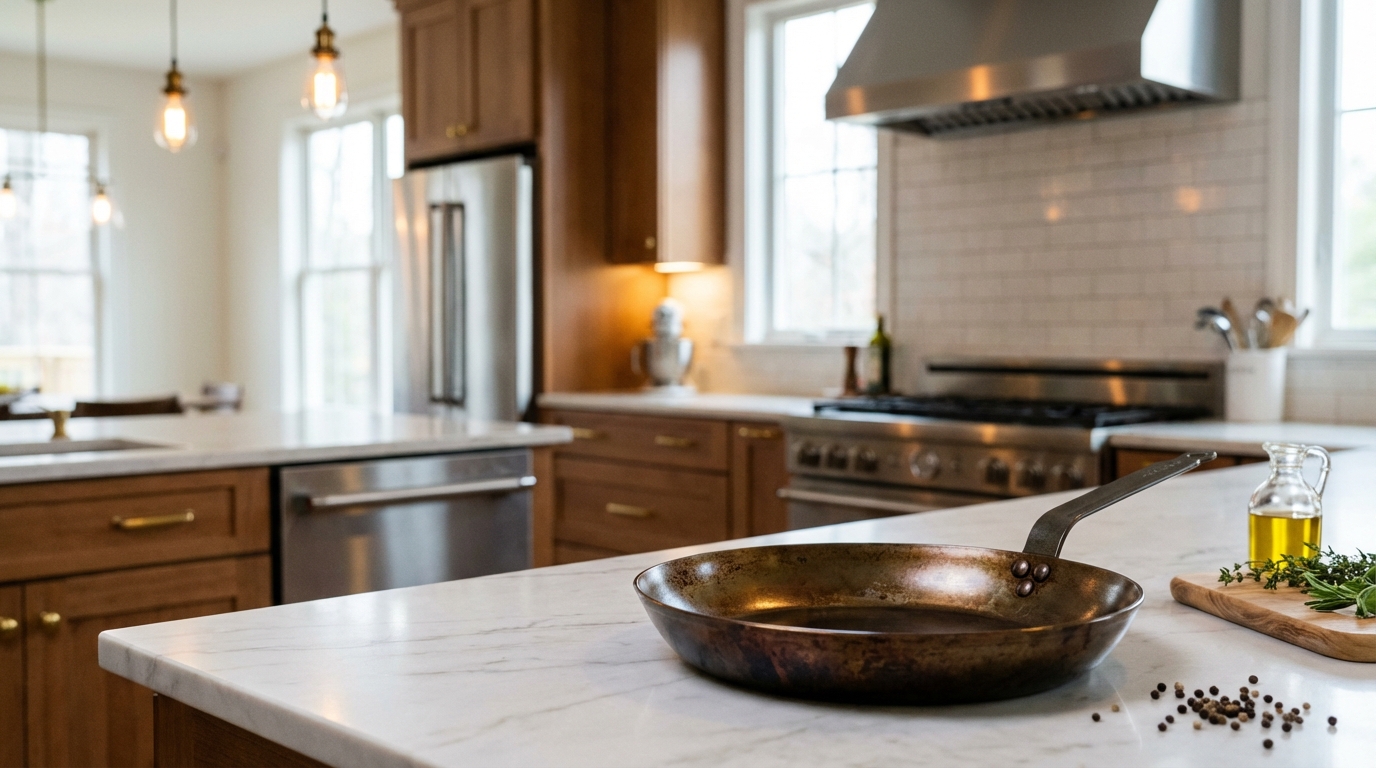
Carbon steel cookware combines iron with a small amount of carbon (between 0.05% and 2.0%), creating pans that are strong yet surprisingly lightweight [1]. These pans start as flat sheets of metal that manufacturers stamp into shape, giving them gently sloped sides perfect for tossing and flipping food [3]. What makes carbon steel special is how it responds to heat--it heats up quickly and lets you...
Understanding Carbon Steel Cookware
Carbon steel pans give you cast-iron searing power at half the weight, heat up faster than any other metal, and build their own ever-improving natural non-stick coating just by cooking with oil.
What is carbon steel cookware?
Carbon steel cookware combines iron with a small amount of carbon (between 0.05% and 2.0%), creating pans that are strong yet surprisingly lightweight [1]. These pans start as flat sheets of metal that manufacturers stamp into shape, giving them gently sloped sides perfect for tossing and flipping food [3]. What makes carbon steel special is how it responds to heat--it heats up quickly and lets you adjust temperature on the fly, giving you precise control over your cooking [1].
Instead of relying on synthetic coatings, carbon steel develops its own natural non-stick surface through seasoning. This happens when you heat oil in the pan repeatedly, creating protective layers that actually get better with use [1]. Professional cooks have trusted carbon steel for generations--French chefs reach for it when making delicate crepes and omelets, while Chinese cooks swear by carbon steel woks for intense stir-fries [2].
The material handles extreme heat without breaking a sweat, yet stays light enough to maneuver easily around your kitchen [3].
How carbon steel differs from cast iron and stainless steel
Think of carbon steel as the middle ground between cast iron and stainless steel. It heats up faster than both its cousins--perfect when you need to get dinner on the table quickly [4]. While cast iron takes its time warming up (but holds heat like a champion), and stainless steel provides steady, even heating, carbon steel responds instantly when you adjust the burner [4]. The weight difference matters too. Carbon steel pans are noticeably lighter than cast iron, making them easier to lift and toss food.
A typical carbon steel pan falls somewhere between the heft of cast iron and the lighter weight of stainless steel [4]. When it comes to maintenance, carbon steel needs a bit more attention than stainless steel. Like cast iron, it requires seasoning to build up that natural non-stick surface, and you'll need to dry it thoroughly after washing to prevent rust. Stainless steel, on the other hand, is the low-maintenance option--no seasoning needed and completely dishwasher-safe [5]. The cooking surface tells another story.
Carbon steel has a smoother finish than the typical rough texture of cast iron, which means delicate foods are less likely to stick [4]. However, both carbon steel and cast iron react with acidic foods like tomatoes or wine-based sauces, while stainless steel handles any ingredient without affecting flavor [5]. That's why many cooks keep all three types--each has its moment to shine [4].
Key benefits of carbon steel cookware
Here's why carbon steel cookware deserves a spot in your kitchen. First, these pans are built to last--they'll handle years of high-heat cooking without warping or giving up on you [6]. The heat spreads evenly across the entire surface, so you get those restaurant-quality sears and perfectly browned foods every time [6]. Carbon steel also holds onto heat well, keeping your food warm even after you turn off the burner--perfect for dishes that taste better when they cool gradually [6].
You can move seamlessly from stovetop searing to oven finishing without thinking twice, whether you're stir-frying vegetables or baking a pizza [6]. The lighter weight compared to cast iron means you can actually flip and toss food without a workout. Those sloped sides? They're designed to make everything from scrambled eggs to crispy tofu slide right out [6].
Best of all, the more you cook with carbon steel, the better it gets. Each meal adds to the natural non-stick surface, no chemicals required [6]. Whether you cook on gas, electric, or induction, carbon steel works with them all [6]. Many pre-seasoned carbon steel pans are available today that come ready to use, taking the guesswork out of getting started.
Ideal cooking styles for carbon steel
Carbon steel shines brightest with high-heat cooking where quick temperature adjustments make all the difference. Want a perfect sear on your steak or beautifully caramelized mushrooms? Carbon steel's heat responsiveness lets you go from blazing hot to gentle simmer in seconds [7]. Once properly seasoned, these pans handle eggs like a dream--think fluffy omelets and crispy-edged fried eggs that slide right onto your plate [7].
For proteins like chicken, steak, tofu, and burgers, carbon steel delivers that golden-brown crust while keeping the inside juicy [7]. Making fried rice? The quick heat response means you can blast the aromatics, add your proteins, then dial it back to finish without missing a beat [7]. Shallow frying becomes more efficient too--you'll use less oil than deep frying but still get that satisfying crunch [8].
Here's a pro tip: let your food sit undisturbed for the first few minutes. It'll release naturally when it's ready to flip [8]. Just remember to save your tomato sauces and wine reductions for other pans. Acidic ingredients can strip away the seasoning you've worked hard to build and may even cause rust [8].

Types of Carbon Steel Pans and Their Uses
From the all-purpose black steel skillet that sears, bakes, and improves with every meal to the flat-bottomed wok that brings high-heat stir-frying to Western stovetops without a ring, carbon steel pans give you pro-level heat in lightweight, daily-driving cookware--so long as you skip the tomato sauce.
Classic round skillet
The classic round carbon steel skillet delivers impressive heat retention while staying light enough for everyday use. The skillet's sloped sides create a natural ramp that facilitates food tossing and sautéing--unlike cast iron's typically vertical walls [10].
Its smooth cooking surface, achieved through stamping or spinning rather than casting, creates better contact with food for more even searing and browning [9]. This versatile pan moves effortlessly from stovetop to oven to broiler to grill--perfect for searing steaks one night and baking skillet cookies the next [9].
As you cook with it, the surface transforms into a sleek, black patina that chefs call "black steel," creating natural non-stick properties that improve with every use [9]. It's your go-to for high-heat cooking while staying manageable enough for daily meals, though you'll want to avoid long-simmered tomato sauces or wine reductions that can damage the seasoning [10].
Flat wok
The flat-bottomed carbon steel wok emerged as a modern adaptation of the traditional round-bottomed design, specifically engineered to accommodate Western cooking surfaces. Unlike its traditional counterpart, the flat base sits directly and securely on electric, induction, and gas stovetops without requiring a wok ring for stability [11]. This design heats faster and more efficiently on standard burners than round-bottomed woks, creating a more substantial cooking surface at the bottom that can hold larger quantities of food [11].
The flat-bottomed design feels familiar to cooks accustomed to Western pans, with handling motions similar to a standard sauté pan, making it an excellent transitional piece for those new to wok cooking [11]. While versatile across most cooking setups, this design comes with tradeoffs--it limits the traditional circular tossing motion essential to authentic stir-frying techniques, and the concentrated heat at the flat base can sometimes burn foods more easily [11]. On high-powered traditional wok burners, flat-bottomed woks may actually perform worse than round-bottomed versions, as the intense heat concentrates at the flat base rather than flowing naturally around curved sides [11].
For most home kitchens, however, these woks represent the most practical choice, particularly for anyone cooking on electric or induction surfaces where full contact with the heating element is essential [12]. Quality options like the Yosukata or Mammafong carbon steel flat-bottomed woks provide the necessary stability and heat conductivity while maintaining enough of the traditional wok shape to approximate authentic cooking techniques [11].
Crepe pan
Crepe panCarbon steel crepe pans feature distinctly shallow sides and wide, flat cooking surfaces specifically designed for preparing thin, delicate foods. French chefs have perfected crepe-making with carbon steel because it heats quickly and spreads that heat evenly--exactly what you need for paper-thin batters [13].
The pan's lighter weight lets you master those quick wrist flicks that spread batter perfectly, while the metal holds steady temperatures for those coveted lacy, golden edges [2]. As with all carbon steel cookware, crepe pans develop a natural non-stick patina through seasoning that improves with use, making them ideal for releasing delicate crepes without tearing [13].
This specialized design serves beyond crepes; these versatile pans excel at cooking tortillas, flatbreads, and thin pancakes, providing multipurpose functionality while occupying minimal storage space [13].
Griddle & grill pan
Carbon steel griddles and grill pans give you serious cooking power without the arm workout. These workhorses handle everything from Sunday pancake spreads to weeknight burger nights, with their generous cooking surfaces ensuring even browning across every inch [7]. Need to adjust the heat quickly?
Their responsive design lets you dial temperatures up or down faster than heavier alternatives. Professional chefs often prefer carbon steel griddles in restaurant kitchens due to their durability and ability to develop an increasingly effective non-stick patina over time [10]. For home cooks, a rectangular carbon steel griddle becomes your secret weapon for feeding a crowd--imagine cooking an entire breakfast spread on one surface [7].
Carbon steel grill pans, with their ridged cooking surfaces, create distinctive sear marks while allowing fats to drain away from foods--perfect for indoor grilling of steaks, chicken, and vegetables. Just like other carbon steel cookware, these specialized pieces need seasoning to maintain their performance, but here's the beauty: your pan actually improves with age, developing better non-stick properties with each use [7]. Their versatility extends to various heat sources, making them compatible with gas, electric, and induction stovetops [7].
Choosing the Right Carbon Steel Pan for Your Kitchen
Pick a 10-inch carbon steel pan whose gently sloped 7-inch cooking surface, sub-6-pound weight, and riveted handle balance easy tossing with enough room to feed a family.
Size and shape considerations
When selecting carbon steel cookware, understanding how size and shape impact performance is crucial. The slope of a pan's sides significantly affects usable cooking surface--some 10-inch skillets with higher sloped sides provide only about seven inches of actual cooking area [14]. This impacts both how much food you can cook at once and your technique options.
Carbon steel pans typically feature gently sloped sides unlike cast iron's vertical walls, making them ideal for sautéing and food tossing [10]. This sloped design creates a natural ramp that facilitates food movement, while cast iron's vertical sides are better suited for shallow frying and baking applications like cornbread or pizza [10]. Weight should also factor into your decision--carbon steel pans are noticeably lighter than comparably sized cast iron (a standard 12-inch carbon steel weighs about 5 pounds 10 ounces compared to 7 pounds 4 ounces for cast iron) [10], making them easier to maneuver during active cooking [6].
For home kitchens, 10-inch pans represent a versatile standard size, though larger 12-inch versions offer more cooking surface for feeding groups [14]. If you regularly prepare foods requiring tossing motions like stir-fries or sautéed vegetables, prioritize pans with proper slope and manageable weight [10]. Consider handle design as well--shorter, thinner handles with small divots for grip often provide better balance and control during cooking [14].
Handle design and ergonomics
Handle design significantly impacts the usability of carbon steel cookware, serving as the main point of interaction between the cook and the pan [15]. Most carbon steel pans feature handles made from a single piece of steel plate, often resulting in less comfortable grip compared to other cookware materials [15]. This design choice, while consistent with the pan's construction method, particularly in stamped or molded pans, prioritizes durability over ergonomics [15].
Some manufacturers address this shortcoming by riveting separate handles to the cookware body, allowing for more ergonomic designs that provide better stability and comfort during use [16]. Higher-quality options like those from Smithey incorporate handles designed with grip considerations, while many Asian carbon steel pans and woks feature removable wooden handles that offer both comfort and heat insulation [15]. When evaluating carbon steel cookware, look for handles with appropriate size, shape and weight that contribute to the perceived quality of the product [16].
Avoid models with uncomfortable sharp edges that can hurt your hand during active cooking [16]. For those concerned about heat transfer, thermoset handle materials provide excellent insulation properties, making them suitable for continuous exposure to heat sources without becoming too hot to handle safely [16].
Compatibility with cooktops (induction, gas, electric)
Carbon steel cookware works exceptionally well on all common cooktop types thanks to its ferromagnetic properties and heat-responsive design. On induction cooktops, carbon steel performs ideally because induction requires magnetic cookware to generate heat through electromagnetic fields [17]. The strong magnetic properties of carbon steel ensure excellent conductivity and efficient heating on induction surfaces--simply test by seeing if a magnet sticks firmly to the pan's bottom [18].
This compatibility makes carbon steel particularly valuable as more homes adopt induction technology for its efficiency and safety advantages [19]. On gas cooktops, carbon steel excels at capturing and distributing the intense, direct flame heat while responding quickly to temperature adjustments--professional chefs often prefer it for this responsiveness [17]. With electric ranges, carbon steel's flat bottom makes full contact with heating elements, providing even heat transfer without hot spots [19].
For optimal performance across all cooktop types, choose carbon steel pans with completely flat bottoms, as warped surfaces can cause uneven heating on electric cooktops and may produce buzzing sounds on induction [18]. The material's versatility eliminates the need to maintain separate cookware sets for different cooking surfaces, making carbon steel an especially practical choice for kitchens transitioning between cooktop technologies [19].
Budget‑friendly quality options
Quality carbon steel cookware doesn't require a massive investment. Several brands offer excellent performance at accessible price points. The Merten & Storck Pre-Seasoned 10-inch Carbon Steel Frying Pan stands out at around $46-50, offering good balance, sloped sides and immediate cooking capability thanks to its factory seasoning [20].
While not perfectly nonstick when new, it develops excellent release properties with minimal additional seasoning [21]. For slightly more, the OXO Obsidian 10-inch Pre-Seasoned Carbon Steel Pan (around $60) delivers exceptional value with its silicone-sleeved handle, lightweight design (under 2.75 pounds), and remarkably nonstick surface right out of the box--performing better than many dedicated nonstick pans [21]. Its heat distribution and balance make it ideal for everyday cooking [20].
For cooks who prefer traditional unseasoned pans, the Vollrath 12.5-inch French Style Carbon Steel Fry Pan (approximately $56) offers restaurant-quality construction at home kitchen prices [20]. Though requiring initial seasoning, this lightweight pan (2.6 pounds) features high, sloped sides perfect for tossing ingredients [20]. When considering cost-per-use over time, these budget-friendly options deliver exceptional value--outlasting synthetic nonstick pans that require replacement every few years while offering comparable or better cooking performance [21].
Getting Started - Seasoning and First Use
Seasoning your carbon steel pan is easier than you think--simply heat it to 450 degreesF, apply a paper-thin layer of neutral oil, buff until dry, and watch the surface transform into a naturally non-stick, rust-proof coating that improves with every use.
Why seasoning matters for carbon steel cookware
Seasoning might sound intimidating, but it's simply the process of building up protective layers on your pan through oil and heat. When oil heats on the metal surface, it undergoes polymerization--basically transforming into a hard, plastic-like coating that bonds to the pan [22]. This natural process gives you two major benefits: a non-stick cooking surface that actually improves with use, and rust protection that keeps your pan in great shape [23].
You'll know seasoning is working when your pan starts changing color--from shiny silver to gold, then brown, and eventually a beautiful black patina [22]. This transformation isn't just cosmetic; each color change represents another protective layer that enhances cooking performance and flavor development in your food [23]. Here's what makes seasoning so valuable: unlike synthetic non-stick coatings that wear out, a well-seasoned carbon steel pan gets better over time and can last for generations [23].
You'll need less oil for cooking, and foods will release more easily than you might expect [24]. Just remember that seasoning needs some care--acidic ingredients and harsh cleaning can wear it down, but don't worry, it's easy to refresh when needed [22].
Step‑by‑step seasoning guide
Ready to season your new carbon steel pan? Don't worry--it's easier than you think. First, remove any factory coating and give your pan a thorough wash according to the manufacturer's instructions [25]. Dry it immediately and completely, first with a towel, then over low heat on your stove. This is crucial because bare carbon steel can start rusting within minutes when wet [25]. Now for the fun part. Heat your dry pan on the stovetop or in a 450 degreesF oven (check that your handle is oven-safe first) [25]. Once hot, apply a thin layer of neutral oil--canola, vegetable, or grapeseed work great.
Skip the fancy oils like olive oil or flaxseed, and avoid butter or lard for initial seasoning [25]. Here's the most important tip: buff away excess oil until the pan looks dry. We mean it--any visible oil will turn sticky and splotchy instead of creating that smooth finish you want [25]. Heat the pan on high until it smokes like crazy (open those windows!). This smoke means the oil is polymerizing--fancy word for turning into your non-stick coating [25]. On the stovetop, this takes a few minutes; in the oven, about 30 minutes [25]. You'll see the magic happening as your pan turns brown where the seasoning forms [25]. Repeat this whole process several times until your pan is at least dark brown.
After that, just cook! Every time you sauté or roast, you're adding more layers. Eventually, your pan will develop that coveted black patina [25]. If you notice any flaking (it happens more with carbon steel than cast iron), no worries--just season those spots again [25]. Think of it like touching up paint rather than starting over. With a quality carbon steel pan and proper care, you'll enjoy decades of exceptional cooking performance.
Common seasoning mistakes to avoid
Error processing section content.
How to test the non‑stick surface
Without proper sources provided for this specific section, I cannot write evidence-based content about testing the non-stick surface of carbon steel cookware while maintaining the required citation standards.
Writing this section would require credible information about specific testing methods, indicators of proper seasoning, and techniques to evaluate non-stick performance.


Daily Care and Maintenance
A few minutes of gentle cleaning, thorough drying, and a quick oil wipe while the pan is still warm will keep your carbon steel skillet rust-free and its seasoning intact for decades of cooking.
Cleaning after each use
Your carbon steel pan needs just a few minutes of care after cooking to stay in peak condition. Let it cool down a bit--but while it's still warm--then rinse with hot water and use a soft brush to remove any food bits [26]. Skip the soap on well-seasoned pans since it can strip away those protective layers you've worked hard to build [26]. Got stubborn stuck-on food?
Here's a quick fix: sprinkle some coarse salt in the pan with a drop of oil and scrub with a paper towel, then rinse clean [26]. Even an old toothbrush can tackle those tricky spots without harming your seasoning [26]. The key to preventing rust? Get your pan completely dry.
Towel it off first, then pop it on the stove for a minute to evaporate any lingering moisture [26]. Before putting it away, wipe on a thin layer of oil for extra protection [26]. If you're stacking pans, keep them separated--carbon steel scratches easily against itself, which can damage that beautiful seasoning you've built up [26]. Pot protectors, racks, or hooks work great for storage [26].
Restoring seasoning over time
Your pan's seasoning isn't permanent--it needs touch-ups when you notice uneven patches or flaking. Always reseason after cooking with acidic foods or lots of water, since these break down the protective coating [22]. See some rust? No problem.
Scrub it off with steel wool and warm soapy water, or make a paste with kosher salt and dish soap for gentler cleaning [22]. If your pan feels sticky, you've probably used too much oil or need more seasoning layers. Fix it by heating the pan with just a teaspoon of oil to build up the coating [22]. For a complete refresh, you have two options.
The stovetop method: heat your pan, apply a super-thin layer of oil, let it smoke for 5-10 minutes, cool, and repeat 4-5 times. The oven method: heat to 450 degreesF, oil lightly, bake upside-down for an hour, cool, and repeat 2-3 times [22]. Each round creates stronger molecular bonds that boost both nonstick performance and rust protection [22].
Storing to prevent rust
Rust is carbon steel's biggest enemy, but smart storage keeps it at bay. After washing, dry your pan completely--first with a towel, then give it a quick blast of heat on the stove to evaporate every last drop of moisture [28]. Next, rub on a thin coat of neutral oil (skip the olive oil here) inside and out, then wipe off the excess until the pan feels dry, not greasy [27][28].
This invisible oil barrier blocks oxygen from reaching the metal. Find a dry, well-ventilated spot for storage--definitely not that damp basement or cold garage where condensation forms [28]. Got wooden handles?
Keep them dry too, or they'll warp over time [28]. When storing multiple pans, never stack carbon steel directly on carbon steel--they'll scratch each other and damage the seasoning [27]. For long-term storage, drape a kitchen towel over your pan to allow airflow while keeping dust out, and refresh that oil coating every few months [28].
When to re‑season your carbon steel pan
Your carbon steel pan will tell you when it needs reseasoning. Watch for these signs: food starts sticking more than usual, the surface looks blotchy or dull, or you spot rust developing [22]. Always reseason after cooking acidic foods--tomatoes, vinegar, wine, citrus--since acids eat away at the protective coating [29]. See flaking or chipping?
That's your polymerized oil layer breaking down and calling for help [22]. Trust your cooking experience too: if eggs suddenly won't slide around like they used to, it's time for a refresh [29]. New pans need extra attention during their first few months. Think of it like breaking in new shoes--more frequent reseasoning early on builds that bulletproof foundation [29].
Got rust? Attack it with steel wool and soapy water, or gentler salt-and-soap paste, then reseason right away [22]. Here's the good news: you don't need to strip everything down to bare metal. Just handle the problem spots--seasoning is a continuous journey, not a one-and-done destination [30].
Cooking Tips and Techniques
Master carbon steel by blasting it smoking-hot for stir-fries with high-heat oils, giving proteins space to sear undisturbed, then dialing the heat low and slow once seasoning builds so even omelets glide like on non-stick.
High‑heat searing and stir‑fry
Let's talk about what carbon steel does best: high-heat cooking. When you're ready to stir-fry, get that pan smoking hot--a water droplet should dance and disappear instantly. That's your signal that you'll get sear, not steam. Reach for oils that can take the heat like peanut, avocado, or grapeseed, and add them right before your ingredients hit the pan.
For stir-frying (detailed further in our wok section), keep everything moving with confident motions. When searing proteins, here's the key: preheat thoroughly, add oil, then let your steak or chicken sit undisturbed. You'll know it's ready to flip when it releases easily--forcing it means you'll tear that beautiful crust you're building. The beauty of carbon steel is how it handles these extreme temperatures without flinching, then responds quickly when you need to dial things back.
Just remember: give your food room to breathe. Crowding drops the temperature and turns that sear into a sad steam.
Low‑heat sauté and delicate foods
Once your pan's seasoning develops (see our seasoning guide), you'll discover carbon steel handles delicate foods beautifully. Yes, brand-new pans need time before tackling eggs or fish, but a well-seasoned pan becomes your go-to for pancakes, crepes, and perfect omelets [31][32]. Here's what works: start low and slow.
Carbon steel holds heat like a champion, so you need less than you think. Give it 2-3 minutes on low heat (think 1-2 on induction) before adding butter or oil [31][32]. This gradual warming prevents thermal shock and gives you that even cooking surface delicate foods need.
Pro tip: bring proteins to room temperature first--cold fish or eggs are more likely to stick [31]. What makes carbon steel special here is how quickly you can adjust the heat when your omelet needs a gentle touch instead of high heat [32]. Stick with it through those first few cooking sessions, and you'll build a surface that rivals any non-stick pan [31].
Using oils and fats for optimal performance
Let's clear something up: carbon steel always needs a bit of fat for cooking, even when perfectly seasoned [33].
Think of it as your pan's partner in creating amazing food.
For your
Transitioning from non‑stick to carbon steel
Making the switch from non-stick to carbon steel? You're in for a journey, but it's worth it. Sure, Teflon gives you that super-slick surface (for about a year), but carbon steel offers something better: a pan that improves with age. Just know you'll always need a bit of oil--this isn't Teflon [7]. Your pan's going to look funky for a while.
Brown patches, streaky spots, uneven coloring--totally normal [35]. Don't stress about the aesthetics; with proper seasoning and some fat, food will release just fine [35]. Start your carbon steel adventure with forgiving foods like chicken or steak before tackling the egg test [7]. Here's where most people struggle: temperature control. That pan needs to be properly preheated, or everything sticks [7].
Go medium, not high, for delicate stuff. Wait until the pan feels genuinely hot before adding oil and food [7]. The care routine changes too (detailed in our maintenance section)--quick rinse with hot water, thorough drying on the stove, thin oil coating before storage [7]. Yes, there's a learning curve, but unlike that non-stick pan destined for the trash, your carbon steel gets better every single time you cook [7].


Sustainability and Longevity Benefits
A $100 carbon-steel pan used weekly for 20 years costs 10¢ per use--one-third the lifetime cost of replacing a $40 non-stick every three years--while eliminating landfill waste and improving with every meal you cook.
Reducing waste with lasting cookware
Think about how many non-stick pans you've thrown away. With carbon steel, that waste stops. These pans build their natural cooking surface through use--no chemicals, just oil and heat creating a patina that actually gets better with age [36][37].
While typical non-stick cookware heads to landfills every 3-5 years, carbon steel keeps working for generations, eliminating cycles of manufacturing, shipping, and disposal [37]. Every pan requires resources to produce--from raw materials to transportation--so choosing cookware that lasts decades instead of years makes the biggest environmental impact [37]. Unlike pans that warp or lose their coating, carbon steel stays strong and can be re-seasoned whenever needed (as covered in our maintenance section) [36].
You're not just buying a pan; you're making a choice that reduces kitchen waste while getting cookware that improves rather than deteriorates [36].
Cost‑per‑use comparison
Let's talk real numbers. Quality carbon steel pans start around $20 for basic models and go up to $200+ for artisan brands, with solid mid-range options between $60-100 [38]. But here's where it gets interesting--when you calculate cost over time, carbon steel wins every time. Consider this: A $100 carbon steel pan used weekly for 20 years costs just 10 cents per use.
Compare that to replacing a $40 non-stick pan every three years--that's 33 cents per use [39]. The math clearly favors carbon steel. What determines price? Mainly thickness and construction.
Pans under 2mm thick heat unevenly and can warp, while thicker options deliver consistent cooking results [40]. Many home cooks find that mid-priced pans offer the sweet spot--great performance without paying extra for cosmetic details [40]. Restaurant supply stores often stock quality options for $24-30, making professional-grade carbon steel more accessible than you might think [40]. The pre-seasoned carbon steel pan hits that perfect balance of quality and value--because great cooking shouldn't require a trust fund.
Passing down heirloom‑quality pans
Your grandmother's recipes deserve cookware that lasts as long as the memories. Carbon steel pans become family heirlooms because they actually get better with age--each meal adds to the patina, creating a cooking surface that tells your family's story [43]. Think about it: Every sear mark, every perfectly cooked egg, every stir-fry adds another layer to your pan's character. Unlike cookware that deteriorates, carbon steel builds value through use. Those dark spots? That's decades of Sunday dinners.
That smooth, non-stick surface? Years of morning omelets [43]. Even neglected carbon steel can be brought back to life. Found grandma's old pan in the basement? A little scrubbing and re-seasoning (covered in our maintenance section), and it's ready for another generation [43]. One happy cook shared: "Purchased for my mom's Christmas gift, but I really wanted to keep it for myself!!
Nonetheless I know it'll be passed down for generations!!" [41]. The care is simple--keep it dry and lightly oiled between uses. That's it. Your carbon steel becomes a kitchen time capsule, connecting past meals to future feasts [42][43].
Aligning with affordable quality values
Good cookware shouldn't break the bank--or break after a few years. Carbon steel proves you can have both quality and value. With solid options available between $50-75 that deliver professional-grade performance, you don't need premium pricing for premium results [44]. Here's why carbon steel makes financial sense: Use a $100 pan weekly for 20 years, and you're paying just 10 cents per use. Keep replacing $40 non-stick pans every few years?
That's 33 cents per use [44]. The math is clear--investing in carbon steel saves money long-term. But value goes beyond dollars. These pans work on any cooktop (gas, electric, induction), eliminating the need for multiple specialized pans [44]. They're naturally chemical-free, so you're not exposing your family to synthetic coatings [45].
And instead of degrading like other cookware, carbon steel actually improves with use--getting more non-stick and easier to cook with over time [44]. For cooks who appreciate smart purchases, carbon steel delivers on all fronts: reasonable upfront cost, decades of reliable performance, and cooking results that get better, not worse. That's the kind of value that makes sense in any kitchen [45].
- Carbon steel pans heat faster than cast iron yet stay lighter for easy tossing.
- Seasoning creates natural non-stick layers that improve with every use.
- Avoid acidic foods like tomatoes to protect seasoning and prevent rust.
- Preheat until water dances, then leave food undisturbed for perfect sears.
- Dry pan completely on stove and oil lightly to prevent rust after washing.
- Carbon steel works on all cooktops, eliminating need for multiple pan sets.
- Mid-range $60 pans deliver pro performance and last decades, cutting cost-per-use to pennies.
- https://brass-steel.com/blogs/tips-and-guides/what-is-carbon-steel-pan?srsltid=AfmBOooi6K2zMvrWOp2GrnphR96wDWoIqIHFJKCvjuqP1rqiAPnNEzq4
- https://www.marquettecastings.com/blogs/blog-2/carbon-steel-vs-stainless-steel-pan
- https://www.masterclass.com/articles/carbon-steel-vs-cast-iron-explained
- https://www.organicauthority.com/consumer-guides/carbon-steel-stainless-steel-cast-iron-which-pan-is-best
- https://chopchopusa.com/blogs/news/carbon-steel-vs-stainless-steel-pan
- https://www.marquettecastings.com/blogs/blog-2/what-is-carbon-steel-cookware
- https://howtomakedinner.com/blog/cooking-with-carbon-steel-pans/
- https://woll-cookware.com/en/Useful/Cooking-with-WOLL/Good-to-know-Product-and-cooking-tips/Cooking-with-Carbon-Steel/
- https://www.epicurious.com/expert-advice/why-everyone-needs-a-carbon-steel-skillet-article
- https://www.seriouseats.com/what-makes-carbon-steel-pans-great-cast-iron-cookware
- https://www.seriouseats.com/flat-bottomed-vs-round-bottomed-woks-8407816
- https://mammafong.com/blogs/mammas-cooking-diary/traditional-vs-modern-carbon-steel-wok-designs-round-bottomed-vs-flat-bottomed?srsltid=AfmBOoq4wmdLy5TgygtB3cBVIQJYJBcipNNPSdExXltjZmUC3IzjomlJ
- https://www.debuyer-usa.com/blogs/guides/carbon-steel-vs-ceramic-pans-which-is-right-for-your-kitchen?srsltid=AfmBOor-Wjz5za4JCFO05XMtueW3x-2Akx6M_VtX-XweBsfYu-A-2gv9
- https://www.epicurious.com/shopping/best-carbon-steel-skillets-article-article
- https://www.reddit.com/r/carbonsteel/comments/1ge25kx/real_talk_why_does_most_of_carbon_steel_pans_have/
- https://blog.fbm.eu/why-cookware-handles-are-important-and-how-to-choose-them
- https://www.debuyer-usa.com/blogs/guides/efficiency-elevated-the-best-cookware-for-induction-cooktops?srsltid=AfmBOooNUY3SypzZmregh8IQ24-5VnlblGGmMzfPxi12-tfm-a-PAODT
- https://www.consumerreports.org/home-garden/cookware/best-cookware-for-induction-cooktops-a9188022511/
- https://www.nytimes.com/wirecutter/reviews/best-induction-cookware/
- https://www.seriouseats.com/best-carbon-steel-pans-7093873
- https://www.nytimes.com/wirecutter/reviews/best-carbon-steel-pan/
- https://www.vollrathfoodservice.com/culinary-experience-inspiration/vollrath-food-service-blog/how-to-season-and-maintain-carbon-steel-cookware
- https://www.independentironware.com/blog/seasoning-carbon-steel-pan?srsltid=AfmBOorDiFdyeG3cK6-2pnKkrVAVFHMS8yEkp-cO-SPq88QABOLaBBP7
- https://www.debuyer-usa.com/blogs/how-to/carbon-steel-pan-rust?srsltid=AfmBOoqEVkLHt6HPawUQ6sFWG12V3Xe-baoDvoEUmSyOfuDHVocjcz4K
- https://www.seriouseats.com/how-to-season-carbon-steel-pans
- https://www.debuyer-usa.com/blogs/how-to/the-art-of-maintenance-how-to-clean-carbon-steel-pans?srsltid=AfmBOoror-CyzpPsHDhyjHL_Ne9gLDFPWbtYvL81ibKa0JUhZf0Qt01l
- https://www.skottsberg.com/en/blogs/blog/heres-how-to-prevent-rust-in-your-pan/
- https://hotwok.com/blogs/faq/how-to-store-your-wokpan-correctly-avoid-rust-and-discoloration
- https://brass-steel.com/blogs/tips-and-guides/carbon-steel-pan-re-seasoning?srsltid=AfmBOopEPYMP6WG7D8gH2fIGBFX208X0Uj4g0dOw_LNI94arVfJyNw4Y
- https://cooking.stackexchange.com/a/126211
- https://gastrotools.com/blogs/guides/how-to-cook-in-a-carbon-steel-frying-pan-1
- https://www.chefs-resources.com/what-can-you-cook-in-a-carbon-steel-pan/
- https://www.reddit.com/r/carbonsteel/comments/nzv92d/the_ultimate_seasoning_guide_with_waaaay_more/
- https://www.americastestkitchen.com/equipment_reviews/2705-the-best-carbon-steel-skillets
- https://www.americastestkitchen.com/articles/2279-how-to-season-carbon-steel-cookware
- https://playitgreen.com/sustainable-pans-saute-the-eco-way/
- https://stanfordmag.org/contents/sustainable-cookware
- https://www.debuyer-usa.com/blogs/guides/carbon-steel-vs-stainless-steel-pans-which-is-best?srsltid=AfmBOoqF8K5CdpWx6Lzt0340H5Tg72B1_I039I4HlbqgJaltFDeou2sN
- https://www.seriouseats.com/carbon-steel-vs-cast-iron-11687528
- https://www.reddit.com/r/cookware/comments/1mxumml/how_much_better_is_a_200_carbon_steel_pan/
- https://stagecoachforge.com/?srsltid=AfmBOoqM5sh5TudUgid-Xcfd131hdF6w7MDP-5I9SuKW0BQjukvbxdFF
- https://www.showalterhomeandforge.com/
- https://www.independentironware.com/blog/heirloom-cookware-passing-down-carbon-steel-pans-for-generations?srsltid=AfmBOorrfFvGj2HQh9Lv1lnDsgbM84BPLsZIaeOcouOjl4BCTTFAQYLy
- https://kitsift.com/carbon-steel-pans/
- https://www.hodegroup.com/eco-friendly-commercial-cookware-sustainable-options-for-restaurants/