

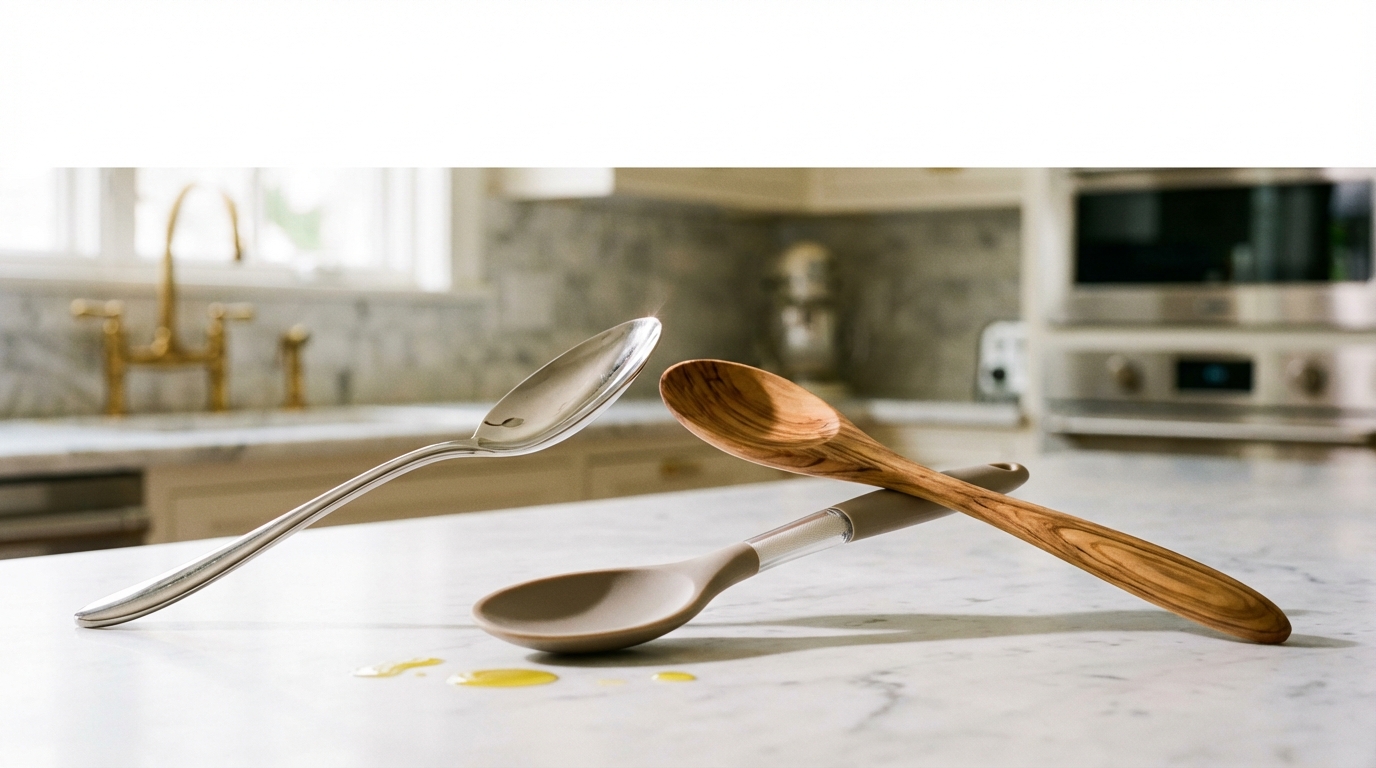
Master the chef spoon to transform your cooking through constant tasting and real-time adjustments. Discover how to choose the right spoon material for different dishes, use proper grip techniques for accurate flavor assessment, and balance sweet, salty, sour, bitter, and umami to create restaurant-quality meals that stimulate all taste receptors.
Chef Spoon Fundamentals for Flavor Balance
Master the chef spoon--your most essential kitchen tool for tasting, saucing, and balancing flavors by choosing the right material and grip to protect delicate tastes and maximize every drop of flavor.
Understanding the role of a chef spoon
Your chef spoon isn't just another utensil--it's your most essential cooking tool. Unlike regular spoons, these specialized tools handle multiple kitchen tasks: tasting for seasoning, applying sauces precisely, and controlling ingredients with confidence [1]. In professional kitchens, they're called "Cuillère à goûter" (tasting spoons), and every cook keeps their own set handy for food safety [1].
The famous Gray Kunz spoon, created in the early 1990s, shows why design matters. Its 2.5 tablespoon capacity and pointed tip make it perfect for flipping, stirring, tasting, making quenelles, and precise saucing [2]. Your choice of material directly impacts performance: wooden spoons stay cool and won't react with acidic foods; silicone protects non-stick surfaces at high heat; stainless steel handles heavy-duty mixing [3].
Specialty designs expand your options--channel spoons with cooling channels, tong spoons for precision grabbing, and fork spoons for versatile tasks [1].
Choosing the right material for flavor control
The material of your chef spoon directly affects how your food tastes. Wood stays neutral with acidic ingredients like tomatoes or citrus, preventing unwanted flavor changes [4]. It also maintains consistent temperatures since it doesn't conduct heat, protecting delicate flavors [5].
When you're deglazing, wooden edges gently scrape up the flavorful fond without scratching, incorporating those concentrated flavors back into your sauce [4]. Stainless steel spoons deliver durability but can conduct heat and react with highly acidic foods, potentially altering flavors. Silicone matches wood's flavor neutrality and handles high-acid foods without chemical reactions [4].
Its flexibility helps you scrape every bit of sauce from the pan, maximizing flavor transfer to the plate. For our
Grip and angle for accurate tasting
How you hold your chef spoon makes all the difference for accurate tasting and safety. Start with your thumb on the natural grip indent of a quality spoon, letting your fingers spread naturally across the handle for stability [6]. A well-balanced spoon feels weightless, preventing fatigue during multiple tastings.
Master the two-spoon method that professional chefs use: dip your cooking spoon into the dish, then hold it above your personal tasting spoon without letting them touch [7]. Step back from the pot before transferring--this prevents contamination [8]. Your angle matters: too steep and you'll spill; too shallow makes transfer awkward.
Hold the receiving spoon at about 45 degrees to catch the sample cleanly. This technique keeps food safe while letting you taste as many times as needed without burning through clean spoons [8]. Keep your wrist relaxed and adjust your grip to match what you're tasting--firm for thick sauces, lighter for broths and delicate liquids.
Chef spoon balancing flavors: why it matters
Great dishes depend on balanced flavors, and your chef spoon is the key tool for achieving this. Use it to monitor and adjust the five essential tastes--sweet, salty, sour, bitter, and umami--throughout cooking [10]. Without regular tasting, even perfectly executed dishes can taste flat or unbalanced [9].
Each sample tells you what's needed: maybe acid to brighten, salt to enhance, or umami for depth [10]. The chef spoon's precise design enables controlled, consistent sampling so you can catch subtle flavor shifts that irregular tasting would miss [9]. This matters because flavor involves more than taste--it combines aroma and texture for the complete experience [11].
When you use your chef spoon properly, you evaluate both individual flavors and how they work together, ensuring nothing overpowers the dish [10]. This systematic approach separates home cooking from professional results--while casual cooks might taste occasionally, pros sample constantly throughout cooking, making small adjustments to achieve perfect balance [9].

Stirring and Mixing Techniques
Master your chef spoon like a heat conductor: figure-eight risottos, lazy-circle sauces, and push veggies to pan edges so everything browns evenly and finishes at the same moment.
Even heat distribution through proper stirring
Here's where your chef spoon becomes a heat management tool. When you stir properly, you're doing more than just moving food around--you're creating flow patterns that eliminate hot spots and ensure everything cooks evenly [12]. This controlled movement directly affects the Maillard reaction (that delicious browning process), making sure every ingredient gets its fair share of heat exposure [12]. Your stirring technique affects more than just temperature distribution.
Quick, deliberate stirring speeds up sauce reductions by increasing surface evaporation, while slow, gentle movements protect delicate proteins from breaking apart [12]. The spoon itself matters too--its bowl shape moves food efficiently, while materials like wood or silicone stay temperature-neutral, so they won't steal heat from your dish [12]. Try these specific patterns: For risotto and other thick mixtures, use a figure-eight motion that reaches into the pan's edges where food loves to stick. For sauces, stick with smooth circular motions that blend without whipping in unwanted air bubbles [12].
Here's a pro tip for one-pan meals: use your spoon to create temperature zones. Push quicker-cooking vegetables to the cooler edges while keeping heartier ingredients in the center's direct heat [13]. This simple technique solves the eternal problem of some ingredients finishing before others [13].
Controlled motion for delicate sauces
Delicate sauces require specific motion control that directly impacts their final texture and flavor clarity. For reduction sauces, use a gentle circular motion that creates small, lazy bubbles without reaching a full boil--vigorous agitation clouds sauces and risks scorching [14]. The chef spoon's bowl shape allows efficient movement while maintaining controlled contact with the pan bottom to prevent scorching.
Hold the spoon at a slight angle and maintain consistent, deliberate movements that vary by sauce thickness: a slower figure-eight pattern works best for velvety reductions, while a gentler sweeping motion suits lighter emulsions [15]. For timing, thick tomato-based sauces require more frequent attention (every 2-3 minutes) while lighter wine reductions need just occasional stirring to maintain even evaporation [15]. This controlled approach allows you to judge a sauce's progress through visual cues--watch for the sauce to coat the back of your spoon in a smooth layer that leaves a clean trail when you drag your finger through it (the "nappe" test) [14].
The spoon's rounded edge provides perfect scraping control for deglazing, letting you incorporate flavorful fond without breaking the sauce's emulsion. Throughout the process, maintain a relaxed wrist and consistent stirring speed to avoid introducing unwanted air that would create foam rather than silky smoothness [14].
Using the spoon to incorporate seasonings
Your chef spoon is the key to getting seasonings just right. Keep dedicated tasting spoons nearby--it's what the pros do [16]. When adding seasonings, hold your spoon at a consistent height to sprinkle evenly across the entire dish.
No one wants to bite into a salt bomb because all the seasoning landed in one spot. After stirring in your spices, taste using proper technique (detailed in our "Tasting and Adjusting Seasonings" section) to check your work [8]. The right stirring pattern matters too--use circular motions for liquids and gentle folding for thicker mixtures to distribute seasonings evenly.
This attention to detail transforms good cooking into great cooking. By tasting and adjusting throughout the process, you'll develop the intuition to know exactly what your dish needs.
Avoiding over‑mixing to preserve texture
Here's a truth every cook needs to hear: more mixing isn't better mixing. Each stir breaks down food structure, and once you've crossed that line, there's no going back [17]. For batters (think pancakes or muffins), stop the moment dry ingredients disappear. Those lumps?
They're your friends--they'll create tender, fluffy results. With ground meat, use gentle folding motions instead of aggressive stirring. You want distinct texture, not meat paste. Learn to recognize when you're done: cake batter should form ribbons when you lift the spoon, sauces should coat the spoon's back smoothly.
Each ingredient has its limits--overwork dough and you'll develop tough gluten strands; overmix hollandaise and watch it break before your eyes. For vegetables, think "toss" not "stir." This preserves their structure and prevents that mushy texture nobody wants [17]. Your chef spoon is a precision instrument--use it with intention, not force.
Tasting and Adjusting Seasonings
Master the two-spoon tasting rhythm--dip, step away, transfer without touching--to catch every flavor gap in real time and turn good dishes into perfectly balanced ones.
Taste‑as‑you‑go workflow
Professional cooking relies on systematic tasting throughout preparation--not just at the end. Set up your workflow by keeping a container of clean spoons at your station and a separate container for used ones [1]. The two-spoon method forms the core of efficient tasting: use one spoon to extract food from the pot, deliberately step away from the cooking area, transfer the sample to your dedicated tasting spoon without letting the utensils touch, then taste and evaluate [8].
This technique maintains food safety while allowing unlimited taste tests without needing dozens of clean spoons [8]. For high-volume cooking, some chefs keep sanitizer or hot running water nearby to maintain clean utensils, while others use disposable tasting spoons to minimize contamination risk [7]. Implement strategic tasting points in your cooking process--after adding each new ingredient, when adjusting heat, and before final seasoning.
This continuous feedback loop creates the foundation for balanced flavors that distinguish professional cooking from casual home preparation.
Identifying flavor gaps with a chef spoon
Identifying flavor gaps requires systematic tasting throughout the cooking process rather than just at the end. Professional chefs use chef spoons as precision instruments to detect missing or imbalanced elements in dishes by taking small, deliberate samples [18]. When searching for flavor gaps, use the proper technique: take a small portion that includes all layers of the dish on your chef spoon, step away from the cooking area, then transfer to your tasting spoon without the utensils touching [19].
This method allows you to detect subtle flavor imbalances while maintaining food safety. Evaluate each sample methodically--first notice overall balance, then mentally isolate each flavor component (sweet, salty, sour, bitter, umami) to identify which might be lacking [18]. The chef spoon's design allows you to test for specific gaps: use the bowl's depth to hold enough liquid to fully coat your palate, while the pointed tip helps target specific areas in layered dishes [19].
For proper assessment, neutralize your palate between tastings with water, bread, or mild crackers to prevent flavor fatigue that can mask subtle imbalances [18]. Document your findings systematically--many professional kitchens maintain digital flavor profiles that track adjustments and create a consistent language for describing gaps in flavor development [18]. This iterative approach transforms good cooking into exceptional cooking, as each tasting with your chef spoon provides actionable data about what the dish needs next--perhaps acidity to brighten, salt to enhance, or umami to add depth [18].
Balancing sweet, salty, sour, bitter, umami
Balancing sweet, salty, sour, bitter, umamiMastering flavor balance requires understanding both the science and art of how the five basic tastes interact. Each taste plays a specific role: salt amplifies existing flavors rather than just making food salty; sweetness rounds out harsh elements; acidity adds brightness and cuts through richness; bitterness provides depth; and umami delivers savory satisfaction [10]. When using your chef spoon for systematic tasting, evaluate each flavor component separately--this sequential assessment reveals which elements need adjustment [20].
The spoon's design allows for precise sampling: use the bowl's depth to hold enough liquid to fully coat your palate while testing, and maintain proper temperature for accurate flavor perception. For technical corrections, follow these principles: counteract excessive saltiness with a touch of acid or sweetness; balance overwhelming acidity with small amounts of sweetness or fat; tame bitterness with salt or sweet elements; enhance flat dishes with umami-rich ingredients like miso or soy sauce [21]. Professional chefs develop this balancing skill through constant practice--tasting frequently throughout cooking rather than just at the end, which allows for incremental adjustments before flavors become too concentrated to fix [20].
Remember that brands and ingredients vary in intensity, making recipes only starting points; your chef spoon becomes the crucial instrument for making final adjustments based on actual taste rather than prescribed measurements [20].
Quick fixes using a spoonful of sugar, acid, or fat
Experienced chefs rely on three primary elements for quick flavor fixes when dishes taste imbalanced. When a meal tastes flat despite adequate salt, a splash of acid often provides the solution - a squeeze of lemon, dash of vinegar, or even pickle brine wakes up flavors and brightens the entire dish [22]. For overly spicy or bitter preparations, a small amount of sweetness counters harsh notes without making food overtly sweet - try a teaspoon of maple syrup or honey to round out flavor edges [23].
When dishes lack depth or mouth-filling qualities, incorporating fat creates richness and enhances flavor delivery - a drizzle of olive oil, pat of butter, or splash of coconut milk coats the palate and integrates disparate flavor components [21]. The chef spoon becomes the perfect tool for these micro-adjustments, allowing precise additions that transform dishes without overwhelming them. For best results, add these elements incrementally - start with half a teaspoon, stir thoroughly, taste with your chef spoon, then decide if more is needed [21].
These quick fixes work because they directly address fundamental taste imbalances rather than simply adding more of existing ingredients, making them invaluable techniques for salvaging dishes that aren't quite meeting their potential.
Ergonomic Use and Strain Reduction
Master four grip switches--pinch, claw, shovel, and traditional--while keeping your wrist neutral and sliding back on Misen's perfectly balanced spoon to turn marathon cooking sessions into effortless, strain-free artistry.
Hand positioning for comfort
Finding the right grip makes all the difference during long cooking sessions. As we covered in the fundamentals section, proper thumb placement on the grip indent is essential--but let's explore how to adapt your grip for different tasks. The traditional grip works well for general stirring, but you'll want to switch things up to prevent fatigue [24].
Try the pinch grip for delicate work like drizzling sauce or creating garnishes--just hold the handle between your thumb and index fingertip for better control [24]. When you're mixing thick doughs or heavy ingredients, the claw grip gives you more leverage by using your thumb, index, and middle fingers while curling the others inward [24]. For repetitive scooping tasks, the shovel grip spreads the work across your whole palm, reducing strain [24].
Here's the key: keep your wrist neutral and aligned with your forearm, not bent at awkward angles [26]. When working over high heat, slide your grip further back on the handle for safety. You'll find that switching between these grips throughout your cooking session keeps any single muscle group from overworking--think of it as giving different parts of your hand mini-breaks while you cook.
Weight distribution of Misen chef spoons
Misen chef spoons are designed with balance in mind--and you'll feel the difference the moment you pick one up. The balance point sits right where the handle meets the bowl, creating a natural pivot that takes the strain off your wrist [27]. It's like the spoon becomes an extension of your hand, moving effortlessly whether you're tasting, saucing, or plating. The construction combines durability with thoughtful weight distribution.
The silicone versions feature a nylon core that provides just enough heft to feel substantial without being heavy [28]. This balance really shines during those long cooking sessions--you know, when you're making Sunday sauce or prepping for a dinner party. The spoon stays comfortable in your hand hour after hour, letting you focus on perfecting your dish rather than fighting hand cramps. What makes this design particularly helpful is how it handles precision work.
Whether you're forming quenelles or drizzling a delicate sauce, the balanced weight gives you steady control without the wobble you get from lighter utensils. The ergonomic handle naturally settles into your palm, making extended use feel effortless [28].
Tips to reduce wrist fatigue
Let's talk about keeping your hands happy during those marathon cooking sessions. Start with your grip--rest your thumb on that natural indent in the handle and let your fingers spread comfortably for support [29]. The most important tip? Keep your wrist neutral and aligned with your forearm.
Think of drawing a straight line from elbow to spoon--no awkward bending [30]. The weight of your spoon matters more than you might think. A well-balanced spoon with a stainless steel core (around 2-3 ounces) prevents that annoying wobble that makes your hand work overtime to compensate [29]. When you're stirring something thick like risotto or polenta, use your whole arm--shoulder and elbow included--rather than just cranking away with your wrist [30].
Build in mini-breaks throughout your cooking: - Roll your wrists in gentle circles between tasks - Stretch your forearms after intense stirring - Switch between different cooking activities every few minutes - Alternate between stirring and folding motions to use different muscles [30] For those who cook frequently or in larger batches, look for spoons with slightly wider handles that distribute pressure more evenly across your palm [31]. These small adjustments add up to make a big difference in how you feel at the end of a cooking session.
Maintaining consistent technique over long sessions
Cooking for hours requires smart strategies to maintain your technique without wearing yourself out. Professional chefs know the secret: vary your grip throughout the session. Start with the traditional grip, then switch to the pinch grip for detail work as your hands get tired--rotating grips every 15-20 minutes keeps different muscle groups fresh [32].
Your spoon's construction plays a huge role in maintaining stamina. Silicone handles with stainless steel cores (weighing around 2-3 ounces) provide the sweet spot of weight distribution that prevents your wrist from overcompensating [33]. This balanced feel lets you work longer without the strain that comes from constantly adjusting for a wobbly utensil.
Here's how to pace yourself during extended cooking: - Take 30-second wrist rolls when switching between tasks - Use the figure-8 stirring pattern--it's efficient even when you're tired - Engage your whole arm for heavy stirring, not just your wrist - Watch for warning signs like inconsistent stirring or changing your grip frequently [32][33] The figure-8 technique deserves special mention--professional kitchens swear by it because it maintains consistent results whether you're 10 minutes or 3 hours into service [33]. By moving in this pattern, you're naturally alternating muscle groups and maintaining even coverage of your pot or pan. Remember, good technique isn't about powering through--it's about working smarter so you can cook longer without sacrificing quality or comfort.


Maintenance and Longevity
Hand-wash stainless steel spoons with hot soapy water, skip the dishwasher, and give them a 30-second olive-oil buff between tasks to keep a restaurant-grade shine and add years to their life.
Cleaning methods for stainless steel and silicone spoons
Keeping your chef spoons clean extends their life and maintains food safety. For stainless steel spoons, skip the dishwasher--hand washing with hot, soapy water preserves their finish and edge [34]. Stubborn residue? Make a paste of baking soda and water, let it sit for a few minutes, then scrub gently with a sponge [34].
Never use steel wool, which leaves permanent scratches. Silicone spoons need different care. That slightly greasy feeling after washing? It's normal--some chefs say it helps maintain the non-stick surface [35].
For everyday cleaning, hot soapy water works fine, though most quality silicone spoons handle the dishwasher well [36]. To tackle stubborn grease or stains, try this kitchen hack: mix baking soda with lemon juice into a paste, spread it on problem areas, wait 10 minutes, then scrub clean [36]. For lingering odors, a 30-minute soak in hydrogen peroxide does the trick [36]. Just avoid bleach or harsh cleaners--they break down silicone and can make it unsafe for food [36].
Polishing to retain shine
Want your stainless steel spoons to keep that professional shine? A little maintenance goes a long way. Start with a good wash in warm, soapy water, getting into all the curves where food likes to hide [37]. For everyday polishing, here's a simple trick: put a few drops of olive oil on a soft cloth and buff your spoons in circular motions.
You'll see that restaurant-quality shine come right back [38]. Need deeper cleaning? Mix baking soda with water to make a paste, or try soaking in equal parts vinegar and water for 15-20 minutes--both cut through oxidation naturally [39]. After either treatment, give them a good buff with a microfiber cloth [39].
Pro tip from restaurant kitchens: take 30 seconds to buff your spoons between tasks. This quick habit prevents tarnish from ever building up [39]. And remember--no steel wool or harsh cleaners. They'll leave permanent scratches [37].
Extending lifespan to avoid landfill waste
Investing in quality chef spoons isn't just about better cooking--it's about tools that last. When you choose well-made stainless steel or silicone utensils, you're getting years of reliable performance instead of constantly replacing cheap alternatives [40].
Quality construction means these spoons handle daily use, high heat, and repeated washing without breaking down. Think about it: a single set of durable


Putting It All Together: Chef Spoon Techniques for Everyday Cooking
Keep a jar of tasting spoons beside your stove and taste constantly--then master the quenelle--because these two habits alone will build the flavor intuition and steady-hand finesse that elevate everyday cooking into memorable meals.
Key takeaways for balanced flavor
Building flavor intuition starts with one simple habit: taste constantly. Keep a jar of tasting spoons right next to your stove--they're your visual reminder to sample throughout cooking, not just at the end [41]. This practice transforms good cooking into great cooking, developing your palate the same way musicians train their ears [41]. As covered in the Fundamentals section, you'll evaluate those five essential flavors with each taste.
But here's how to put that knowledge into action: when your perfectly salted dish still tastes flat, add a squeeze of lemon. When bitterness dominates, counter with a touch of honey. When richness is missing, swirl in butter or olive oil [42]. These aren't just fixes--they're the moves that separate everyday cooking from memorable meals.
Remember the two-spoon method from earlier sections for safe, unlimited tasting. Having quality chef spoons makes this process seamless--their balanced weight and comfortable grip encourage frequent sampling, which is exactly what builds your flavor intuition [41].
Next steps for daily practice
Ready to level up your skills? Start with the quenelle--that elegant oval shape you see in fine dining. Dating back to 1824 Lyon, it's more achievable than you think [43]. Begin with ice cream between -10 degreesC and -12 degreesC (that's just below your freezer's standard temp).
This gives you the perfect consistency for learning [43]. Work fast, touch the ice cream minimally, and for firmer textures, dip your spoon in hot water first [44]. Here's your practice plan: drag one curved spoon against another to create smooth, symmetrical ovals. Start with ice cream, then graduate to mousses, purées, even mashed potatoes [44].
Snap a photo each day--you'll see your progress in the increasingly perfect shapes. Why bother? This single technique builds three essential skills: temperature awareness, steady hands, and fluid motion. Master these, and every dish you make improves [44].
Why quality tools matter for lasting joy
Here's what nobody tells you about quality tools: they change how you feel about cooking. A well-crafted spoon isn't just functional--it's your daily reminder that cooking is worth doing well [45]. Professional chefs get this. Their tasting spoons aren't accessories; they're extensions of their craft [46].
When you hold a properly balanced spoon, you're not just stirring or tasting--you're connecting with the creative process that makes cooking fulfilling [45]. Think about it: the right sauce spoon transforms precise saucing from a chore into something satisfying. Its weight, balance, and comfort let you focus on the food, not the tool [47]. This matters because cooking isn't just about feeding people--it's about finding those "small wonders" in everyday tasks [45].
Quality tools create a positive feedback loop. They make you want to cook more carefully, taste more frequently, present more beautifully. As one chef-turned-artisan discovered, "what sustains in the long-term is art"--and the right tools help you find that art in your everyday cooking [45].
- Taste dishes at every cooking stage rather than waiting until the end to catch seasoning imbalances when they're still easy to fix.
- Choose wooden spoons for acidic ingredients like tomatoes or vinegar since they won't introduce metallic tastes that distort your seasoning judgments.
- Use stainless steel spoons for high-heat applications where you need to scrape fond from pan bottoms without charring the utensil.
- Hold the spoon with your middle finger supporting the handle and thumb and index finger on top for wrist-controlled tasting movements.
- Taste from the broad side of the spoon rather than the tip to evaluate whether salt and seasonings are evenly distributed.
- Stir continuously rather than occasionally to cook food twice as fast while achieving uniform browning and preventing hot spots.
- Move food through both the high-heat sear zone at the wok bottom and the steam zone on the sides for optimal cooking.
- https://clubandresortchef.com/what-is-a-tasting-spoon/
- https://www.epicurious.com/expert-advice/the-5-kitchen-spoons-you-absolutely-need-article
- https://www.souschef.co.uk/blogs/the-bureau-of-taste/what-is-a-kitchen-spoon-used-for
- https://www.anzhucraft.com/wood-vs-silicone-utensils/
- https://nomliving.com/blogs/thingswedo/why-are-wooden-spoons-and-utensils-better-to-cook-with-a-brief-explanation
- https://toolsfortasting.com/specialty-spoons-for-chefs-and-tasters-buying-guide/
- https://www.reddit.com/r/Chefit/comments/1im1fg/tasting_spoon_questionvery_basic_probably_a/
- https://creators.yahoo.com/lifestyle/story/chefs-use-a-two-spoon-method-when-tasting-a-dish-they-are-preparing-it-couldnt-be-more-simple-134251367.html
- https://www.yahoo.com/lifestyle/importance-humble-tasting-spoon-professional-034555501.html
- https://www.culinaryartsswitzerland.com/en/news/balancing-five-flavors-how-achieve-culinary-harmony/
- https://www.escoffier.edu/blog/culinary-arts/how-culinary-students-explore-flavor-profiles/
- https://palmnakiplates.com/blogs/news/the-art-of-stirring-techniques-every-home-cook-should-know?srsltid=AfmBOoomhK17ycqoD9DwDAtW2Tf83sDut0u9PdgeLLlTljEMalxAyODm
- https://www.culinaryartsswitzerland.com/en/news/cooking-techniques/
- https://www.chefapprovedtools.com/blog/reducing-sauces-restaurant-technique
- https://vault.nimc.gov.ng/blog/stirring-occasionally-master-the-culinary-technique-1767646918
- https://www.reddit.com/r/Cooking/comments/1lvdoh6/cooking_techniques_to_make_you_feel_like_an/
- https://www.munchery.com/blog/the-12-techniques-to-master-as-a-home-chef/
- https://www.eatmemagazine.com/why-tasting-during-preparation-is-the-chef-s-golden-rule/
- https://cafemeetingplace.com/fifty-minute-classroom/item/2552-taste-like-a-chef
- https://www.cordonbleu.edu/news/how-to-balance-the-five-flavours/en
- https://chefsamanthageorge.com/how-to-balance-the-five-flavors-in-cooking-my-secrets-to-flavorful-family-dinners/
- https://communitynaturalfoods.com/blog/5-simple-ways-to-build-flavour-in-healthy-cooking/
- https://thespicegirlkitchen.com/salt-fat-acid-heat/
- https://www.chefio.co/blogs/blog/elevate-cooking-perfect-spoon-grip-guide-mastering-handling?srsltid=AfmBOooEnyVQf7XHNo8muxe44v0Ax_6ozD8z7ygBmKTOPeWM1TVQWIni
- https://www.dioro.com/blogs/news/basting-spoons?srsltid=AfmBOooKnTTeShdATEHxR78H9qN636oc01K3O2qr03_hQhjIE_CrQtPl
- https://mdtherapeutics.com/blogs/news-1/chef-ergonomics?srsltid=AfmBOoqHG5XSmfSyl8zOXEqmHJqK9O8G7VW9uLm16VOq0Q3g5dLRgpq0
- https://shop.app/products/7790047363153/serrated-chef-spoon
- https://www.amazon.com/Misen-Silicone-Slotted-Spoon-Resistant/dp/B09S4L44VX
- https://www.dioro.com/blogs/news/solid-spoon-for-stirring-and-mixing?srsltid=AfmBOop8tzOjX2k-CBNG1av3Ts4-vCuJAKYdMT_MJ6SExd1AzYTS7qQR
- https://mdtherapeutics.com/blogs/news-1/chef-ergonomics?srsltid=AfmBOoqs0pnif8ZClRys9i5NvgpLyGkJvMFLueg92wPz-uX42iQ7azDS
- https://professional-secrets.myshopify.com/products/chefs-cooking-spoon?srsltid=AfmBOooq7yR6RtX0xJlsM3-W0fPVZLc24nwe1STY54kTXR6YAYObwMi0
- https://www.dioro.com/blogs/news/mixing-spoon?srsltid=AfmBOoqiYD0f_KAGk9WQNGeG98nuA10iZ-AHSiR6uPMvYHKRoEIgKLWG
- https://www.dioro.com/blogs/news/solid-spoon-for-stirring-and-mixing?srsltid=AfmBOoqw5upvpKBqFAUEScYVJV52N_A_wPr-GczKjEOe0Uth3RdBjy04
- https://www.escoffieronline.com/proper-ways-to-clean-your-kitchen-utensils/
- https://cooking.stackexchange.com/questions/1100/how-to-take-care-of-silicone-cookware
- https://www.dioro.com/blogs/news/silicone-spoon?srsltid=AfmBOoqcJ64WavAQqcbLVKZZd5HWdmae84AgCvtXTL4uqm3Vdd-ogWAM
- https://www.silversuperstore.com/blog/the-ultimate-guide-to-stainless-flatware-care.asp?srsltid=AfmBOorU68hntn9-kJfGScaco2OsT_uXjrK3Ys-FV7dcUjSuBEXfsLYu
- https://www.alain-saint-joanis.com/en/service-and-housekeeping-how-can-you-keep-your-cutlery-shiny-and-strong/
- https://www.ks-housewares.com/blog/how-do-i-polish-my-stainless-steel-spoon-set-to-make-it-shine-844115.html
- https://www.abrinternationaljournal.org/articles/edible-cutlery-an-emerging-sustainable-approach-towards-a-healthy-future-102958.html
- https://bittmanproject.com/to-get-intimate-with-your-food-you-gotta-taste-it/
- https://tbthealth.substack.com/p/four-scientific-principles-that-make?utm_source=%2Fbrowse%2Ffood&utm_medium=reader2
- https://www.cucina.li/en/tutorial-how-to-make-the-perfect-quenelle/?srsltid=AfmBOoptPyEbOBa6ghucerTTM_Bq61Sl3AYHCQmhlVy6zYCS7tijP67w
- https://nordic-chefs.com/how-to-make-a-quenelle/?srsltid=AfmBOorDPVlZXLWg9iohmFaz4Tv0GKc-333CrNU-3PKRmjFP2wuw5TvX
- https://lookashley.com/blog/self-care-reminders-from-chef-spoon
- https://www.thedailymeal.com/1505003/importance-tasting-spoons-kitchen/
- https://www.seriouseats.com/sauce-spoon-review-7500742