

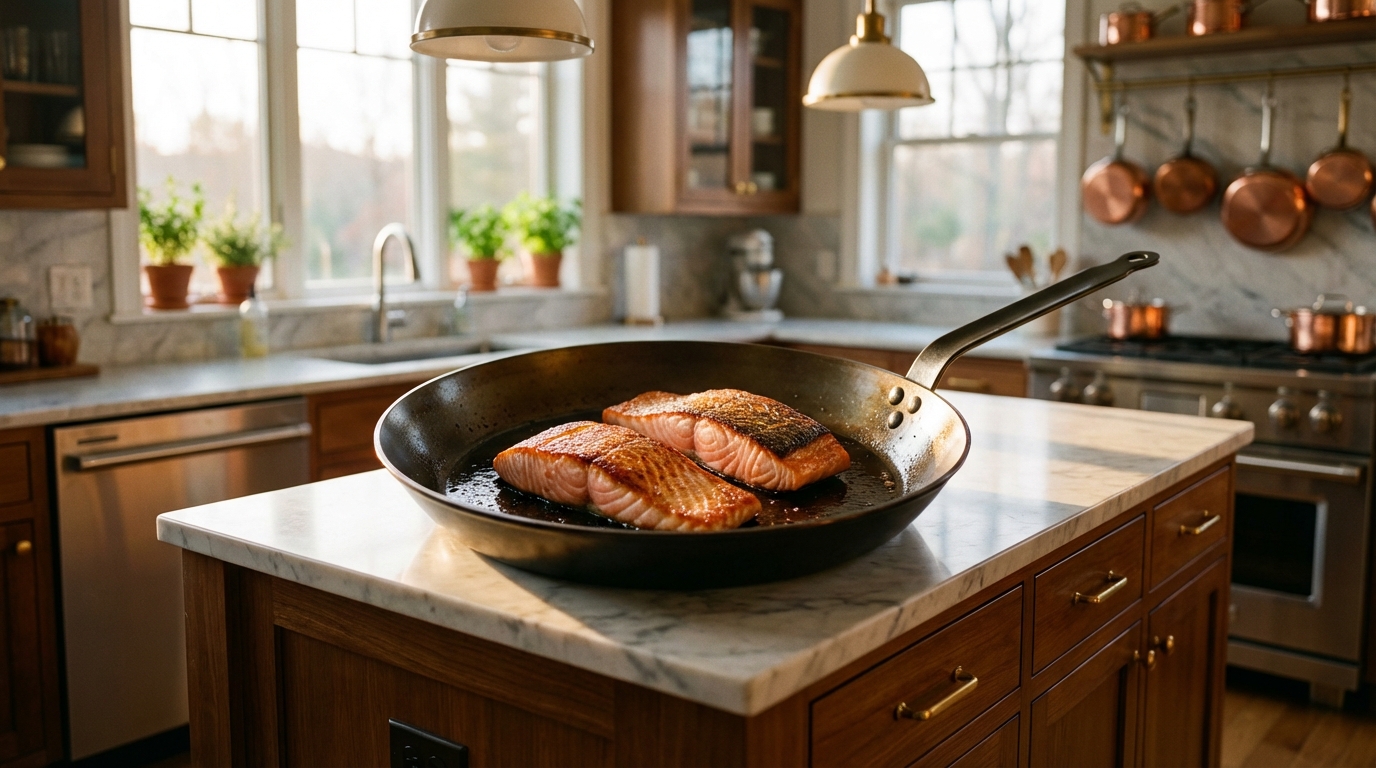
Carbon steel pans let you achieve glassy-crisp salmon skin without the PFAS "forever chemicals" that flake off non-stick coatings and linger in your body and the planet for decades, and this article shows exactly how to do it. Readers learn the science behind PFAS risks, why "PFOA-free" labels can still mislead, and how a simple room-temperature "cold-start" method--placing the fish in an unheated, lightly oiled pan and ramping the heat slowly--prevents curling, splatter, and tearing while the naturally polymerized seasoning does the non-stick work. Step-by-step visuals teach the glide test for perfect pan readiness, the 90 % skin-side rule for even cooking, and a 15-second flesh-side finish for medium-rare results that work for salmon, grouper, or mahi-mahi. Beyond health, the piece breaks down the economics: a $70 carbon steel pan that lasts decades costs as little as $3.50 a year versus $15 every year replacing degraded non-stick, while also slashing landfill waste and toxic manufacturing runoff as states move to outlaw PFAS cookware. By mastering easy seasoning and low-soap cleaning habits, home cooks gain a lifetime of restaurant-quality sears, safer meals, and a lighter environmental footprint--no specialty chemicals required.
Why Carbon Steel Beats Nonstick for PFAS-Free Fish
Ditch the PFAS-laden nonstick and master the cold-start carbon-steel method to get flawlessly crispy, chemical-free fish skin every time.
Understanding PFAS risks in cookware
You've probably heard about PFAS--those "forever chemicals" in nonstick cookware that create the slippery surfaces we love but come with serious downsides [1][3]. They earn that nickname because they persist in your body and the environment for years, accumulating over time [2][3]. The health risks aren't theoretical either. Studies link PFAS exposure to liver damage, decreased immunity in children, increased cancer risk, and fertility issues [1][2].
Here's what's particularly concerning: even pans labeled "PFOA-free" can be misleading. Testing found PFOA and other PFAS chemicals in PTFE-coated pans despite these claims [1]. Your exposure happens multiple ways--overheated pans release toxic fumes, scratched coatings can flake into food, and PFAS pollute the environment during manufacturing and disposal [1]. While the FDA says authorized PFAS in cookware aren't known safety concerns [3], remember that cooking is just one exposure source alongside food packaging, drinking water, and household products [2][3].
The good news? States are taking action. Minnesota, Connecticut, Maine and California are banning cookware with intentionally added PFAS between 2025 and 2030 [2].
How carbon steel delivers crisp skin without chemicals
Carbon steel achieves its non-stick magic through seasoning--a natural polymerization process that creates a slick surface without any chemicals. This makes it perfect for getting that crispy fish skin you're after. What really sets carbon steel apart is how it enables the "cold-start" technique.
Instead of the traditional method that causes splattering and fish curling, you start with your salmon in a room-temperature pan [4]. As pan and fish heat together, you avoid the temperature shock that makes fish buckle and skin tear. The gradual heating also means less oil splatter since moisture evaporates slowly rather than all at once [4].
We'll walk you through the exact timing in the next section, but this method delivers that glassy, crispy skin every time. Sure, you can get crispy skin with stainless steel, but you'll need more oil and perfect timing to prevent sticking [5]. With a well-seasoned
Preparing the Perfect PFAS-Free Salmon: Step-by-Step
Dry your salmon like you mean it, wait for the oil to dance across your carbon steel, then slide the fillet in--if it glides like a skater, you've nailed the temperature for shatter-crisp skin without a single PFAS in sight.
The carbon steel PFAS-free fish test: what to look for
Getting ready to cook fish in carbon steel? Here's a simple test that tells you when your pan is perfectly heated without needing those chemical coatings. Start by adding enough oil to coat the bottom of your pan. You'll know it's ready when the oil shimmers and starts to move freely--almost like it's dancing across the surface [5]. Want to be absolutely sure?
Try the glide test: gently drag the edge of your fish fillet across the pan without letting go. If your pan's ready, the fish will glide smoothly "like a skater on ice" [5]. Still sticking? Give it another minute and test again. This works beautifully with carbon steel because you're checking both temperature and seasoning at once.
Here's a tip: watch the oil, not the clock. The oil's behavior tells you everything you need to know about readiness. Once you add your fish skin-side down, press gently for about 10 seconds to ensure full contact and prevent curling, then reduce to medium-low [5]. You'll see the skin develop that gorgeous, even golden color without any puckering--that's your carbon steel distributing heat perfectly.
Seasoning, temperature, and technique for flawless skin
Ready to achieve restaurant-quality crispy skin? Let's walk through what really makes the difference. First things first--grab those paper towels and dry your fish thoroughly. Every bit of moisture you remove now means crispier skin later [6]. Season generously with salt and pepper, ideally 45 minutes ahead (but right before cooking works too if you're pressed for time) [6]. Now, here's where carbon steel really shines. You've got two great methods to choose from: Traditional approach: Heat oil in your carbon steel pan until it shimmers, then reduce to medium-low before adding fish [6].
This gives you that satisfying sizzle right from the start. Cold-start method (as we introduced earlier): Place salmon skin-side down in a room-temperature oiled pan, then crank the heat to high [4]. This gradual warming prevents the dreaded buckle and keeps oil splatter to a minimum--your stovetop will thank you [4]. Whichever method you choose, remember to press gently on the fish for about 10 seconds after it hits the pan. This ensures every bit of skin makes contact for even crisping [6]. Timing varies by method: Cold-start needs 2 minutes on high, then 6-8 minutes on low until you see the flesh turning opaque [4]. Traditional method takes about 5-7 minutes total to reach that perfect 120 degreesF (49 degreesC) for medium-rare [6]. Here's the key--let the fish cook 90% through on the skin side before even thinking about flipping [6].
When the skin releases easily with a gentle nudge, you're ready. Still sticking? Give it another minute [6]. Once flipped, just kiss the flesh side with heat for 15 seconds and you're done [6]. Best part? This technique works beautifully with mahi-mahi, grouper, and other firm fish too [4].
Maintaining Your Carbon Steel Pan for Longevity
Keep your carbon-steel pan alive for decades by skipping the soak, giving it a quick soap-and-sponge wash, drying it immediately, and sealing it with a whisper-thin oil layer.
Cleaning without harsh chemicals
Cleaning your carbon steel pan is refreshingly simple--no harsh chemicals needed, which means no hidden PFAS exposure from specialty cleansers. Here's the reassuring truth: modern dishwashing liquid won't harm your seasoning like the lye-based soaps of decades past. A small amount with a gentle sponge works perfectly for everyday cleaning. Just remember the golden rule: dry thoroughly and apply a thin oil layer to prevent rust [7].
For stuck-on food, here's a chef's trick--pour water into your still-warm pan and let it loosen things up before scraping with your spatula [7]. Got stubborn bits? A chainmail scrubber becomes your best friend, effectively cleaning without damaging that precious seasoning you've built [7]. The salt method works wonders too--gently heat your pan with oil and coarse salt, then scrub away [7].
One word of caution: avoid extended soaking, which can weaken the bond between seasoning and pan [7]. And yes, eggs can be tricky on carbon steel--but with proper seasoning and adequate fat, you'll master them in no time [7].
Seasoning and storage tips to keep performance
Think of seasoning your
Saving Money and the Planet with Durable Cookware
Switching from throwaway nonstick pans to a single carbon-steel skillet slashes your annual cookware cost to $3.50, keeps up to ten PFAS-laden pans out of landfills each decade, and delivers better kitchen performance for life.
Cost comparison: long-term value vs disposable pans
When comparing cookware costs, looking beyond the price tag reveals the true value. Quality carbon steel pans typically cost $40-100+, while nonstick options range from $20-50 [9][10]. But here's what really matters: your actual cost per year of use. Let's break down the math. A nonstick pan lasts 1-3 years before the coating degrades [9][11].
That $30 "bargain" pan replaced every two years costs $15 annually. Meanwhile, a well-maintained carbon steel pan can serve you for decades with simple care [10][11]. That same $70 investment spread over 20 years? Just $3.50 per year. The savings multiply when you consider most kitchens need multiple pan sizes.
Three nonstick pans replaced every few years quickly becomes an expensive cycle [9]. Plus, you're left with two poor choices: keep buying replacements or continue cooking on potentially harmful degraded surfaces [9]. Yes, carbon steel requires learning proper seasoning and care techniques. But mastering these simple skills rewards you with exceptional high-heat performance and lifetime savings [10][11]. For everything except the most delicate egg dishes, carbon steel delivers better results at a fraction of the long-term cost.
Environmental impact of PFAS-free, reusable cookware
Your cookware choices impact far more than your kitchen. As discussed in the first section, PFAS chemicals persist in the environment for centuries, contaminating water and ecosystems [1][2]. But there's a simple solution: choosing durable, uncoated cookware. The environmental math is straightforward. Each nonstick pan you buy becomes landfill waste within 1-3 years [12].
Over a decade, that's 3-10 pans per household contributing to PFAS pollution during manufacturing and disposal [2]. In contrast, one carbon steel pan can serve multiple generations and be recycled at end-of-life [12]. States are taking notice. Minnesota leads the charge, banning PFAS-containing cookware sales in 2025, with Connecticut, Maine, Vermont, and Rhode Island following by 2028 [2]. California joins them in 2030 [2].
These bans recognize what smart cooks already know--we need cookware that performs without poisoning our planet. While ceramic coatings offer PFAS-free nonstick surfaces, uncoated options like carbon steel provide the ultimate environmental benefit. They require fewer toxic manufacturing inputs, last exponentially longer, and can be fully recycled [12]. Every carbon steel pan you choose over disposable nonstick is a vote for cleaner water, healthier ecosystems, and a more sustainable kitchen.
- PFAS in nonstick pans persist for years and are linked to liver damage, cancer, and fertility issues
- Carbon steel achieves nonstick performance through natural seasoning without any PFAS chemicals
- Cold-start method in carbon steel prevents fish curling and reduces oil splatter for crispy skin
- A $70 carbon steel pan costs $3.50/year over decades vs $15/year replacing nonstick every 2 years
- States including Minnesota, California will ban PFAS cookware between 2025-2030
- Carbon steel pans last decades and are recyclable, while nonstick pans become landfill waste in 1-3 years
- https://www.consumerreports.org/toxic-chemicals-substances/you-cant-always-trust-claims-on-non-toxic-cookware-a4849321487/
- https://www.nbcnews.com/select/shopping/best-nonstick-cookware-alternatives-rcna233182
- https://www.americastestkitchen.com/articles/7586-are-nonstick-pans-skillets-safe-toxic
- https://www.thechoppingblock.com/blog/utilizing-carbon-steel-for-crispy-skinned-fish
- https://lifehacker.com/get-crispy-fish-skin-every-time-without-resorting-to-g-1850300533
- https://www.seriouseats.com/crispy-pan-seared-salmon-fillets-recipe
- https://www.reddit.com/r/Cooking/comments/linxqp/carbon_steel_frying_pans_how_the_do_i_clean_these/
- https://www.seriouseats.com/how-to-season-carbon-steel-pans
- https://www.seriouseats.com/why-cheap-nonstick-skillets-are-best
- https://www.nytimes.com/wirecutter/reviews/best-carbon-steel-pan/
- https://gastrotools.com/blogs/guides/carbon-steel-vs-non-stick-pans-8-differences
- https://cen.acs.org/environment/persistent-pollutants/does-nonstick-cookware-work-should/103/web/2025/04