

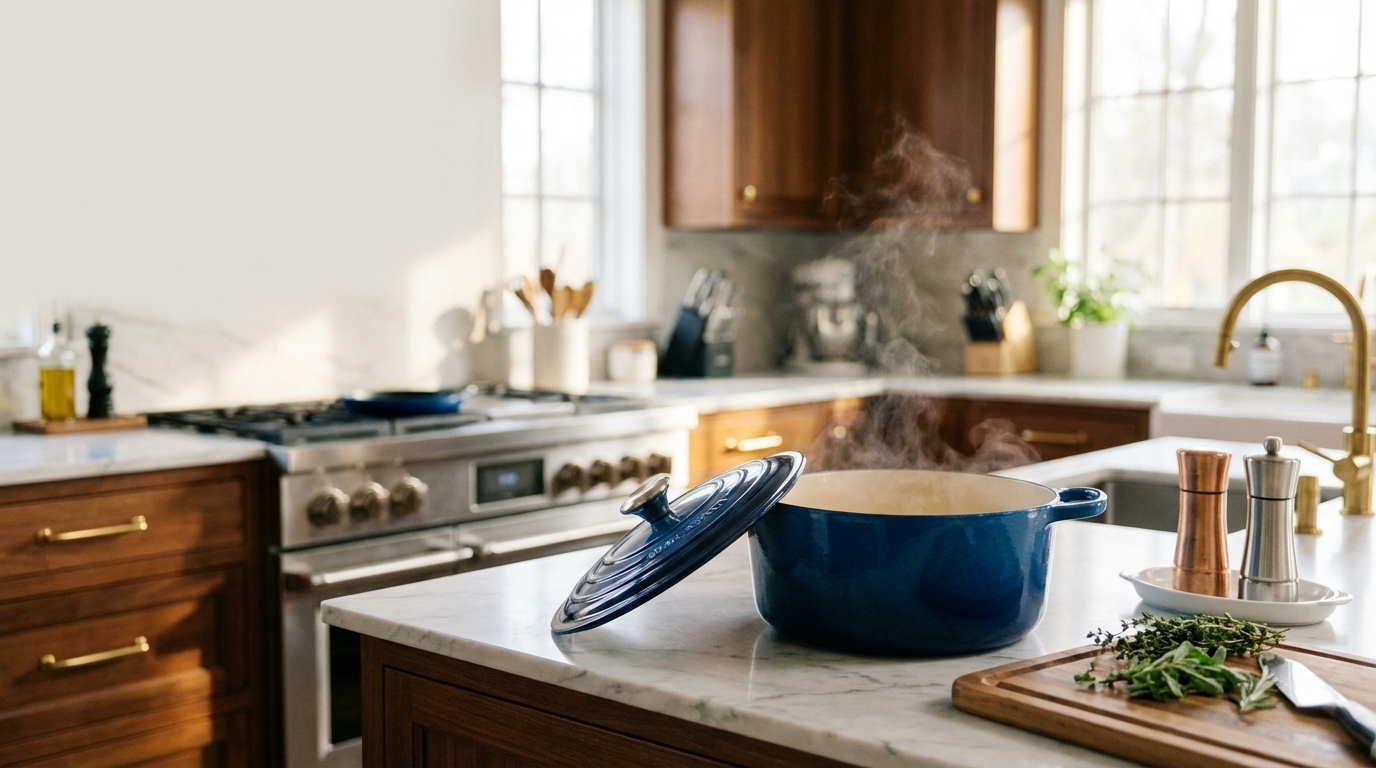
This 2025 guide empowers home cooks to choose a Dutch oven that transforms everyday meals by demystifying the trade-offs between traditional cast iron, enameled cast iron, and lightweight ceramic options, then matching size, shape, and performance features to real cooking habits--whether you're searing steaks, baking crusty bread, or slow-braising short ribs--while proving that a $65-$100 pot with proper heat retention, induction-ready construction, and metal knob can deliver decades of restaurant-quality results if you protect the enamel with gentle utensils, gradual cooling, and moisture-free storage.
How to Identify the Best Dutch Oven for Everyday Cooking
Pick a 5-7-quart enameled Dutch oven that's third-party verified as lead- and PFAS-free so you get cast-iron heat retention, zero seasoning chores, and one pot that effortlessly moves from searing steaks to simmering tomato sauce.
Material matters: cast iron, enameled, and sustainable options
Your Dutch oven's material determines how it performs, how long it lasts, and how much care it needs. Traditional cast iron delivers exceptional heat retention and can last for generations, though it requires regular seasoning to maintain its natural non-stick surface [2]. While acidic foods like tomato sauces can strip seasoning from bare cast iron, properly maintained pieces develop their own character and cooking personality over time [2]. Enameled cast iron gives you the best of both worlds - cast iron's superior heat retention with a protective glass-based coating that eliminates seasoning requirements [1].
This coating lets you simmer tomato sauces and braise with wine without worrying about reactivity, plus cleanup becomes much simpler [3]. Quality matters here - well-made enamel resists chipping and staining for years, while cheaper versions may show wear quickly [3]. When evaluating enamel quality, look for third-party testing confirming the absence of lead, cadmium, and PFAS (per- and polyfluoroalkyl substances) [1]. The Alva Nori Dutch oven uses recycled cast iron with non-toxic enamel, demonstrating sustainability improvements in this traditionally resource-intensive product category [2].
Alternative materials like ceramic-coated aluminum offer lighter weight options that work differently than traditional cast iron, performing best at lower temperatures [3]. While these materials don't retain heat quite as well, they're perfect if you need something easier to lift or if you're constantly moving your Dutch oven from stovetop to oven [3]. Finding the right balance between performance and practicality makes all the difference in your everyday cooking.
Size and shape: picking the right capacity for your meals
Choosing the right Dutch oven size makes everyday cooking more enjoyable and efficient. A 5-7 quart Dutch oven hits the sweet spot for most home cooks - it's roomy enough for family dinners yet still manageable when full [4]. This size provides adequate surface area for browning meat and high walls to prevent spillage, making it ideal for everything from stews to bread baking [4]. For solo cooks or couples, a 3-4 quart Dutch oven provides just enough space without excess, though sizing up gives you more cooking flexibility [5]. Larger households or those who love hosting should consider 8-10 quart models - they're perfect for batch cooking and feeding crowds, just remember they need more storage space and arm strength [4].
The shape of your Dutch oven matters just as much as its size. Round Dutch ovens work beautifully with standard burners, distributing heat evenly for soups, stews, and that crusty artisan bread you've been wanting to perfect [6]. Oval Dutch ovens trade some heating efficiency on round burners for extra length - perfect when you're roasting a whole chicken or fitting in that holiday roast [4]. The extra space prevents crowding and helps larger cuts cook more evenly [6]. Don't overlook depth when choosing your Dutch oven.
Standard deep models excel at soups, stocks, and anything with lots of liquid, while shallow versions (braisers) shine when you want moisture to stay close to your food during braising [4]. That wider surface area in braisers also means better browning and more even searing before you add your braising liquid [5]. For detailed care instructions on maintaining any Dutch oven style, see our care guide in the maintenance section below.
Key Performance Features of the Best Dutch Oven
Premium Dutch ovens like Le Creuset use thick cast iron and tight-fitting lids to deliver 500 degreesF-plus heat with zero hot spots, locking in moisture for perfectly crusted meats and caramelized vegetables that budget models simply can't match.
Heat distribution, retention, and stovetop/oven compatibility
Heat distribution directly determines how evenly your food cooks in a Dutch oven. Cast iron provides superior heat retention, holding cooking temperatures longer after removing from heat, while its thickness eliminates hot spots that cause uneven browning [3]. Premium Dutch ovens like Le Creuset deliver consistently even heating, producing well-crusted meat and uniformly caramelized vegetables without cold spots [7]. In contrast, budget models often develop temperature inconsistencies, particularly noticeable when searing meat.
The shape of your Dutch oven affects heating patterns - rounded bases heat more evenly on standard burners, while oval shapes may create cooler areas when used on round stovetops [3]. Wall thickness matters too - thinner walls heat faster but retain less heat, while thicker walls maintain temperature consistency during long braises. Most quality Dutch ovens can handle oven temperatures up to 500 degreesF, but maximum tolerance varies significantly between brands - some enameled cast iron models withstand 580 degreesF while others with phenolic knobs have lower heat limits [3]. For those exploring durable options, consider this temperature range carefully, as it matters particularly for bread baking, which requires sustained high heat.
The lid design significantly impacts moisture retention during cooking. Well-designed models feature tight-fitting lids that create a vapor seal, with some exceptionally heavy lids preventing even rapidly boiling water from sputtering out [7]. Many Dutch ovens incorporate moisture-recirculation dimples on the underside of the lid, designed to collect and redistribute condensation back onto the food for self-basting, though testing shows minimal difference in actual cooking results [7]. Material composition determines stovetop compatibility - all cast iron works on any cooking surface including induction, while ceramic options cannot be used with induction cooktops [3].
Lid seal, handle ergonomics
A Dutch oven's lid seal directly affects flavor development in your food. The best lids rest securely on the pot while allowing some steam to escape, which creates more concentrated, flavorful braises [8]. In testing, Dutch ovens that allowed moderate evaporation (around 16% liquid loss) produced richer stews than those with extremely tight seals (6% loss) [8]. Many manufacturers incorporate self-basting designs with moisture-recirculation dimples on the lid's underside that collect condensation and redistribute it over the food [2]. These raised bumps create a natural basting cycle that keeps ingredients moist during long cooking sessions [2].
Handle design significantly impacts usability, especially since Dutch ovens are heavy even before adding food. Wide, looped handles provide secure grip points when wearing oven mitts or using towels [8]. Look for generous handles that allow comfortable gripping even with protection - the roomiest handles tested make a real difference in daily use [8]. Avoid models with thin, spindly handles that become difficult to grasp safely when the pot is hot and full [8].
As mentioned in the materials section, quality manufacturers now offer non-toxic enamel coatings free of PFAS, lead, and cadmium [2]. When evaluating enamel quality, seek third-party testing confirming the absence of harmful substances [2]. Some brands remain less transparent about heavy metals in their finishes, making independent verification crucial before purchase [2].
Balancing Cost and Value When Buying the Best Dutch Oven
Spending $350 on a Dutch oven that lasts 25 years costs $14 annually--$3 less per year than repeatedly buying an $80 pot every five years--while premium enamel survives drop tests that shatter budget coatings and carries a lifetime warranty the company actually honors.
Cost‑per‑use analysis: why quality saves money over time
Let's talk real value when investing in a Dutch oven. Premium options actually save you money over time - here's why. A well-made Dutch oven lasting 25+ years (and many go even longer) costs significantly less per year than replacing cheaper models every 5 years [9]. When you break down the math, that $350+ premium pot costs under $15 annually, while an $80 budget model replaced every 5 years runs nearly $17 per year - making quality 14% less expensive over time [10].
Durability testing reveals dramatic differences between price points. Premium Dutch ovens withstand lid-dropping tests without damage, while budget options lose chunks of enamel that compromise both safety and performance [11]. Quality enamel resists chipping, staining and wear through daily use, with handles, lids and heating properties staying consistent for decades [9]. Warranty policies tell another important story.
Premium manufacturers typically honor their lifetime guarantees straightforwardly, while budget brands often use fine-print exceptions to deny claims [9]. Consider the environmental impact too - one quality Dutch oven prevents the waste of replacing multiple inferior pots over your cooking lifetime [10]. When evaluating options across different brands, remember that durability is the true measure of value.
Affordable durability: getting a lasting Dutch oven without breaking the bank
You don't need to spend a fortune to get a Dutch oven that performs well in your kitchen. Budget-friendly options between $40-100 can deliver solid cooking performance with features that matter most - like comfortable handles and even heating [8]. When shopping for affordable Dutch ovens, prioritize these practical features: generous handles that accommodate oven mitts, thick cast iron for heat retention, and a warranty that the company actually honors [8][12].
Many budget models now offer lifetime warranties, though durability testing shows most will experience some enamel chipping over time [13]. Here's how to maximize your budget Dutch oven's lifespan: - Always hand-wash instead of using the dishwasher - harsh detergents gradually erode enamel [12] - Let your pot cool before washing to avoid thermal shock [8] - Heat gradually on the stovetop rather than cranking up the heat - Use wooden or silicone utensils to protect the enamel surface [12] While budget Dutch ovens may not last multiple generations, proper care can extend their useful life significantly. With mindful use, an affordable Dutch oven provides excellent value for everyday cooking - from braising meats to baking bread [13].
The key is understanding what features matter most for your cooking style and maintaining your cookware properly.


Caring for Your Best Dutch Oven to Extend Its Life
Treat your Dutch oven like delicate glass--no cold-water shocks, no metal utensils, no empty preheating, just gentle hand-washing, occasional oil massages, and low-to-medium heat--to turn a $150 pot into a lifelong heirloom.
Seasoning, cleaning, and safe use tips for daily cooking
Proper Dutch oven handling directly affects longevity and cooking performance. Here's the key to Dutch oven longevity: treat it gently. Never shock hot cast iron with cold water--that sudden temperature change can crack or warp your pot [16]. For enameled Dutch ovens, skip preheating empty. Always add oil, water, or food first to distribute heat evenly and protect the enamel [14]. Good news for your energy bill: medium heat works perfectly for most tasks since these heavy pots hold temperature so well [15]. Grab wooden, silicone, or nylon utensils to keep the cooking surface pristine--metal tools can scratch or chip the enamel [15]. Let's bust a myth: mild dish soap won't ruin your cast iron Dutch oven's seasoning [16].
Clean it while warm (not hot) with a soft sponge, dry completely, then apply a thin coating of neutral oil to maintain that protective layer [16]. Got stubborn bits? Try this trick: sprinkle kosher salt with a few water drops while the pot's warm, then gently scrub [16]. Or simply boil 1-2 cups of water to loosen residue before scraping with a wooden spatula [16]. Enameled Dutch ovens play by different rules--no seasoning needed except on exposed cast iron rims [15]. Always hand wash after cooling, even if the label says dishwasher-safe. Those harsh detergents gradually wear down enamel over time [15]. Notice some staining inside?
That's normal and won't affect your cooking [14]. For cleanup, make a gentle baking soda paste to lift discoloration without scratching [16]. If you spot rust on exposed edges, clean with dish soap, dry well, and rub cooking oil on the rim for protection [14]. Want to refresh your cast iron's seasoning? Here's the simple process: coat the entire surface with neutral oil, wipe until it looks almost dry, then bake upside down at 450-500 degreesF for one hour [16]. Let it cool completely in the oven--this builds up the protective layer that creates your natural non-stick surface [16]. Think of it as giving your Dutch oven a spa treatment that pays you back with better cooking performance.
Storage, maintenance, and simple repairs to avoid landfill waste
Smart storage keeps your Dutch oven performing like new. Choose a dry spot to prevent rust, and cushion with towels when stacking cookware to protect the enamel [17]. For cast iron models, a light oil coating on exposed metal creates moisture protection [17]. Consider padded dividers or fabric covers for extra protection--your Dutch oven deserves a comfortable home between cooking sessions. Check your Dutch oven regularly to catch small problems early. Small enamel chips?
Food-safe cookware epoxy stops them from spreading [18]. Rust on exposed edges needs quick attention--scrub gently with dish soap, dry completely, and seal with cooking oil [17]. These five-minute fixes can add years to your pot's life. When your Dutch oven finally retires, you've got sustainable options. Working pots deserve new homes--donate to thrift stores, shelters, or community kitchens [18]. Beyond repair?
Metal recycling facilities accept cast iron after you remove non-recyclable parts like plastic knobs [18]. Some manufacturers run take-back programs for responsible recycling [18]. Get creative before tossing--old Dutch ovens make charming planters, bird baths, or garden art [18]. Every pot kept from landfills matters, since cast iron takes centuries to decompose [18]. Your well-loved Dutch oven can continue serving, just in a different way.
- Enameled cast iron resists acidic foods and needs no seasoning, unlike raw cast iron.
- 5-7 qt Dutch ovens suit most families; go 3-4.5 qt for 1-2 people or 7+ qt for batches.
- Round ovens heat evenly on standard burners; oval can overhang and create hot spots.
- Quality ovens boil water in ~12 min vs 25+ for lesser models and hold heat far better.
- Budget $65-$100 enameled models can last decades if handled with wood/silicone tools.
- Dry thoroughly before storage and use towel separators to prevent enamel chips.
- Choose light interiors to monitor browning; dark interiors hide stains over time.
- https://www.zendaguide.com/post/best-dutch-ovens-2025
- https://www.leafscore.com/eco-friendly-kitchen-products/cookware/the-best-pfas-free-dutch-ovens/
- https://www.everydayhealth.com/wellness/best-dutch-ovens/
- https://www.foodandwine.com/cooking-techniques/dutch-oven-sizes
- https://www.marquettecastings.com/blogs/blog-2/what-size-dutch-oven-should-i-buy
- https://www.insiderskitchen.com/what-size-dutch-oven-do-i-need-the-ultimate-guide/
- https://www.epicurious.com/expert-advice/best-dutch-oven-enameled-cast-iron-casserole-pot-article
- https://www.nytimes.com/wirecutter/reviews/best-dutch-oven/
- https://www.seriouseats.com/cheap-versus-expensive-dutch-ovens-6827315
- https://www.5circles.com/dutch-ovens-paying-a-lot-more-means-better-value/
- https://www.techgearlab.com/topics/kitchen/best-dutch-oven
- https://www.bonappetit.com/story/best-dutch-ovens?srsltid=AfmBOooQdBSaxzAV7VvqXW4GDppEedBpnKu6SfBab2ftCjXyLkWGl7LC
- https://www.seriouseats.com/best-cast-iron-dutch-ovens-equipment-review
- https://www.lodgecastiron.com/pages/cleaning-care-enameled-cast-iron?srsltid=AfmBOoqsG6peEJMbkxrT10yjlpbrqwn-9iARXj4tkCL8S7bgsbnTnOIL
- https://www.meganfranceslloyd.com/how-to-care-for-clean-and-season-your-enameled-cast-iron
- https://www.nytimes.com/wirecutter/guides/how-to-clean-cast-iron-skillet/
- https://www.chefsdeal.com/blog/sustainable-kitchen-partners-and-practices?srsltid=AfmBOopYa4YoVb3csOGnwzTA6XH4a4jQTPMlQBdQEX8zHs78T8JdajNp
- https://harlesdenskiphire.org.uk/blog/sustainable-disposal-methods-for-pots-and-pans