

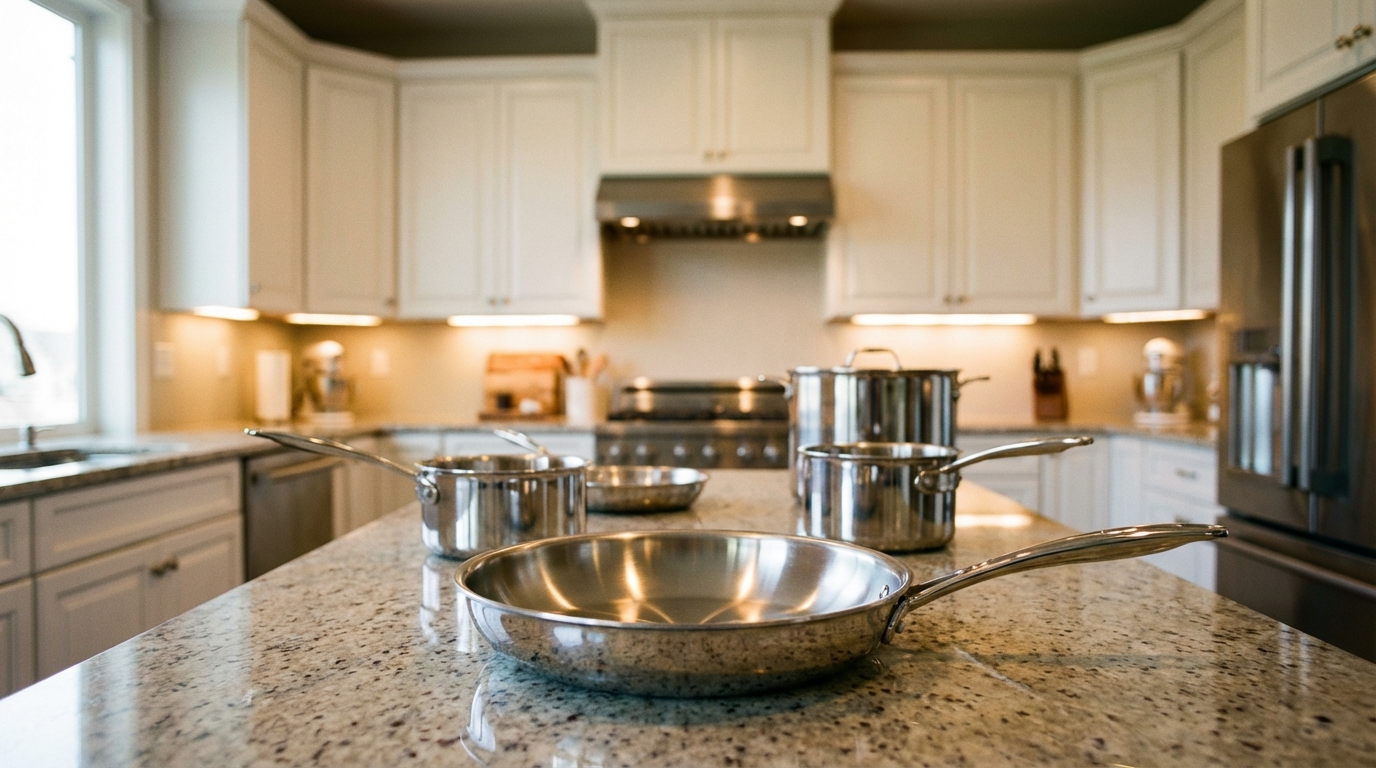
This ultimate guide equips home cooks to choose and master stainless steel pans by decoding steel grades (18/10 offers the best balance of shine, stain resistance, and value), explaining how tri-ply or five-ply aluminum/copper cores eliminate hot spots and deliver professional-level heat control, and detailing which pan shapes--skillets, sauté pans, saucepans--suit every cooking task. Readers learn to spot durability cues like fully-clad construction and sealed rims, pick budget, mid-range, or premium pieces that last decades, and confidently perform the water-drop test, preheat and oil correctly, avoid common mistakes, and clean with simple deglazing or Bar Keepers Friend to keep pans pristine. With these insights you'll sear, sauté, and simmer on any cooktop (including induction), move from stovetop to 500 degreesF oven, and turn out restaurant-quality crusts and sauces while investing once in cookware that can outlive non-stick by 10-30 years.
Understanding Stainless Steel Construction
Those 18/10 numbers on your pan reveal its 18% chromium rust shield and 10% nickel armor, giving you professional-grade cookware that stays mirror-bright through countless dishwasher cycles and tomato sauces.
The Science of Stainless Steel Quality (18/10, 304, 316)
Here's what those numbers on stainless steel really mean--and why they matter for your cooking. Chromium is the secret ingredient that gives stainless steel its rust-fighting superpowers, creating an invisible protective layer that actually repairs itself when scratched [1]. The numbers you see (like 18/10) tell you exactly what's in your cookware--the first number is chromium percentage, and the second is nickel [3]. You'll find 304 stainless steel (also called 18/8) in most quality cookware.
With 18% chromium and 8% nickel, it handles everyday cooking beautifully and resists corrosion from acidic foods like tomatoes and wine [2]. It's the workhorse of kitchen materials--reliable, affordable, and perfect for daily use [2]. Step up to 18/10 stainless steel, and you get that extra 2% nickel that makes a real difference. Your pans stay shinier longer, resist staining better, and handle repeated dishwasher cycles like a champ [1].
That higher nickel content creates a brighter, more polished finish that professional chefs love--and is widely used in premium stainless steel cookware for superior durability [1]. At the top tier, 316 stainless steel adds molybdenum to the mix--think of it as stainless steel with armor plating [1]. While you'll rarely need this level of protection in home kitchens, it's essential for marine environments or industrial use where extreme corrosion resistance matters [2]. For most home cooks, 18/10 provides the perfect balance of performance and value [1].
Multi-Clad Construction: Tri-ply vs. 5-ply
Think of multi-clad cookware like a metal sandwich--each layer brings something special to your cooking experience [4]. Tri-ply construction keeps things simple with an aluminum filling between two slices of stainless steel [5]. This smart design spreads heat evenly across your pan while keeping weight manageable and prices reasonable [5].
The aluminum core does the heavy lifting for heat distribution, though you might notice occasional hot spots if the construction isn't quite perfect [5]. Want even better performance? Five-ply construction takes things up a notch with a more sophisticated recipe--two layers of pure aluminum plus an aluminum alloy center, all wrapped in stainless steel [4].
These extra layers work together like a team, delivering more even heating, better heat retention, and quicker response when you adjust the temperature [5]. Yes, five-ply pans cost more and feel heavier in your hand, but they're built to last longer and resist warping better than their tri-ply cousins [5]. The difference isn't just marketing--those extra layers genuinely improve how your pan performs, especially for techniques like searing or making delicate sauces [4].
Core Materials and Their Impact on Heat Conductivity
Let's talk about what makes heat move through your pan--because stainless steel on its own is actually terrible at conducting heat (only about 16 W/m*K for the curious) [7]. That's why quality pans hide aluminum (237 W/m*K) or copper (401 W/m*K) cores inside--these metals move heat around 15 to 25 times better [7]. It's like the difference between walking and driving when you need to get somewhere fast. Your choice of core material shapes your entire cooking experience. Copper cores give you Formula One-level control--perfect for finicky hollandaise or delicate reductions where every degree counts [7]. Aluminum cores deliver excellent everyday performance without the premium price tag, handling everything from morning eggs to evening stir-fries with ease [7]. But here's the catch: core thickness needs to be just right.
Too thin? Hello, hot spots and burnt pancakes. Too thick? Your pan becomes sluggish when you need quick temperature changes [6]. Watch what happens when heat hits different pans. Cheap, thin pans create a bullseye effect--scorching hot directly over the burner while the edges stay cool [6]. Well-designed multi-clad pans spread heat sideways first, then up to your food, creating that even golden-brown crust we all love [7].
Testing proves it: quality multi-clad construction delivers 50% better heat distribution than basic stainless steel [7]. Here's where it gets interesting--different cooking tasks need different core thicknesses. Your trusty skillet needs a thicker core to hold heat for that perfect steak sear, even when you add cold ingredients [6]. But your saucepan? It needs a thinner, more responsive core so you can quickly dial back the heat before your béchamel breaks [6]. Smart cookware makers adjust core thickness based on what each pan needs to do best.
How Construction Affects Your Cooking Experience
Here's where all this technical stuff becomes real in your kitchen. Quality multi-clad construction means heat travels sideways through your pan before moving up to your food--no more shuffling ingredients around to avoid burnt spots [8]. The magic happens in how different core thicknesses serve different purposes: that thick-bottomed skillet holds heat like a champ for restaurant-quality sears, while your saucepan's thinner core lets you quickly adjust from rolling boil to gentle simmer [8].
Five-ply construction brings everything together beautifully. Those alternating layers of stainless steel and aluminum work in harmony--aluminum moves the heat around efficiently without adding much weight, while stainless steel gives you a tough, non-reactive surface that won't react with your grandmother's tomato sauce [9]. Here's a pro tip: because heat spreads so evenly in quality multi-clad pans, you can actually cook most dishes on medium heat instead of cranking it to high [9].
Watch how professional chefs match their pans to their techniques--they'll grab a heavy-duty pan for searing steaks but reach for something more responsive when making delicate pan sauces. Understanding your cookware's construction helps you make these same smart choices at home.

Essential Features to Look for in Stainless Steel Pans
Choose a tri-ply stainless pan with an aluminum or copper core for fast, even heat that ends hot-spot frustration and works on any cooktop.
Heat Distribution and Retention Properties
As we explored in the construction sections above, the science behind heat distribution determines how well your pan performs. Since stainless steel alone doesn't conduct heat efficiently, quality pans rely on their aluminum or copper cores to spread heat evenly across the cooking surface [10]. This design prevents those frustrating hot spots that burn your food in one area while leaving it undercooked in another. Here's what really matters when evaluating heat distribution: how quickly and evenly the pan heats up, and how well it holds that heat. When you're searing a steak, you want a pan that maintains its temperature even when you add cold meat.
But when you're making a delicate sauce, you need something that responds quickly when you turn down the heat [10]. That's why many professional chefs keep both thicker and thinner pans in their arsenal. The number of layers also makes a real difference in your cooking experience. Tri-ply construction gives you solid performance without breaking the bank--it's that sweet spot of good heat distribution and manageable weight [11]. Five-ply pans take it up a notch with extra layers that create more even heating, though they'll be heavier and pricier [11].
The payoff? You can cook most dishes on medium heat instead of cranking it up to high, which means better control and less risk of burning [10]. Think about your cooking style when choosing: if you love getting that perfect sear on proteins or do a lot of high-heat cooking, investing in thicker, multi-ply construction will serve you well [12].
Ergonomics: Handles, Weight, and Balance
Error processing section content.
Versatility Across Cooking Methods and Heat Sources
One of the best things about quality stainless steel pans? They work on virtually any cooktop--gas, electric, or induction [13]. This flexibility really shines if you move homes or upgrade your kitchen. With induction cooktops becoming more popular, it's worth noting that multi-clad pans perform especially well here. The magnetic stainless steel exterior heats up from the induction field, while the aluminum core spreads that heat evenly across the pan [15].
Without that conductive core, induction can create intense hot spots in a small area--but quality clad construction eliminates this problem [15]. Temperature versatility is another major advantage. Quality stainless steel pans can handle serious heat--some withstand temperatures up to 800 degreesF in the oven or under the broiler [14]. The Misen stainless steel pan safely goes from stovetop to oven up to 500 degreesF, making it perfect for recipes that start with a sear and finish with a roast. This heat tolerance means you can brown chicken thighs on the stovetop, then slide the whole pan into the oven--no extra dishes needed [14].
This temperature range opens up so many cooking techniques. You can gently simmer a delicate beurre blanc, crank up the heat for a restaurant-quality steak sear, or anything in between. That's the real beauty of stainless steel--it adapts to whatever you're cooking [14].
Durability Factors That Determine Longevity
When you invest in quality stainless steel, you're looking at cookware that can last anywhere from 10 to 30 years--sometimes even longer [16]. But not all pans age equally. Here's what separates the workhorses from the ones that'll disappoint you after a few years. The steel grade matters more than you might think. Higher nickel content, like you'll find in 18/10 stainless steel, creates better resistance to corrosion and everyday wear [16][18].
Thickness is another telltale sign of longevity--those heavier pans that feel substantial in your hand will resist warping far better than lightweight options [16][18]. Construction quality shows up in the details. Fully-clad pans, where the aluminum or copper core extends throughout the entire pan, hold up better than disc-bottom designs where layers can eventually separate [16]. Check the rim too--sealed edges prevent water from sneaking between layers and causing rust [16]. And those handles?
Securely riveted or welded attachments will stay tight even after thousands of trips from stovetop to sink [18]. Even the best pans eventually tell you when it's time to retire them. Watch for these warning signs: warping that makes the pan rock on your cooktop, handles that wiggle no matter how much you tighten them, deep scratches that food sticks to, rust spots, or visible separation between metal layers [16][17]. Here's the real kicker: with basic care--using the right utensils, avoiding extreme temperature shocks, and storing them properly--quality stainless steel outlasts non-stick pans by years, even decades. While you might replace non-stick every 2-3 years, a good stainless steel pan becomes a kitchen companion you can pass down to your kids [16][17].
Different Types of Stainless Steel Pans
Grab a 12-inch stainless skillet for daily searing and sauce-making magic, then add a straight-sided sauté pan when you need splash-free braising and 30% more surface area.
Skillets and Frying Pans: The Kitchen Workhorses
Skillets and frying pans are the same thing--the terms are completely interchangeable, though you'll sometimes hear "skillet" used more often for cast iron versions [19][20]. These workhorses feature flat bottoms with sloped sides that make flipping and stirring easy [19]. The shallow depth and flared edges serve real purposes: they give you better spatula access and create more surface area for moisture to escape, which is exactly what you need for proper browning [19][20]. What makes stainless steel skillets special?
They handle everything. You can sear a steak, then deglaze with wine for a pan sauce without worrying about damaging any coating [21]. Those browned bits (called fond) that stick to the bottom? That's flavor gold waiting to be turned into sauce [20].
While they take a bit more technique than non-stick pans, the payoff is huge--you get better browning, more versatility, and a pan that lasts decades. For size, go with a 12-inch skillet as your main pan. It's large enough to cook dinner for four without crowding, but still manageable for everyday tasks [19]. If you're building your collection piece by piece, a quality stainless steel skillet should be one of your first purchases--it's the pan you'll reach for most often.
Sauté Pans: When Deep Sides Matter
Sauté pans have straight, vertical sides that give you about 30% more cooking surface than a skillet of the same diameter [22]. Those high walls aren't just for show--they contain liquids without splashing and give you room to toss ingredients without losing them over the edge [24]. Think of a sauté pan as the best of both worlds: it sears like a skillet but holds liquid like a saucepan [24].
The straight sides make it perfect for recipes that start with browning and end with braising, or when you're making pan sauces that require vigorous whisking [22]. Most come with lids, turning them into mini ovens for dishes that need covered cooking [22]. Yes, they're heavier than skillets--that extra metal provides better heat retention but means you'll want a helper handle for safe pouring [24].
The payoff? You can brown chicken thighs, add liquid for braising, and finish the whole dish in one pan. For home cooks who love one-pan meals, a good sauté pan quickly becomes indispensable.
Saucepans and Specialty Cookware
Saucepans are built for liquids--making soups, cooking grains, reducing sauces. Their tall sides and included lids create the perfect environment for simmering and steaming [25]. The key is finding the right balance of responsiveness (for delicate sauces) and heat retention (for steady simmering). When shopping for saucepans, pay attention to rim construction.
Sealed rims protect the inner layers from moisture damage, especially if you use the dishwasher [26]. Handle attachment matters too--welded handles create a smooth interior that's easier to clean, while riveted handles offer tried-and-true durability [26]. Specialty pieces like roasting pans round out your stainless steel collection. Look for practical details: Does the lid fit well?
Is the handle comfortable when the pan is full? These small differences matter more than minor variations in steel grade, since most quality cookware uses similar materials [25][26].
Individual Pieces vs. Complete Sets: What to Consider
Should you buy a complete set or build your collection piece by piece? There's no universal answer, but here's what to consider. Sets offer better value per piece but demand a bigger upfront investment. Individual pieces let you spread the cost over time--typically $100-$200 per quality pan [27][28]. More importantly, buying individually means you only get what you'll actually use. Many sets include redundant pieces (do you really need three different saucepan sizes?) that eat up valuable storage space [27][29].
The smart approach? Start with the essentials. Cooking experts recommend these five pieces for most home cooks: a 3-4 quart saucepan, nonstick frying pan, cast iron skillet, Dutch oven, and sheet pan [29]. Build from there based on what you actually cook. Love stir-fries? Add a wok.
Make lots of stocks? Get a stockpot. Whether you choose sets or individual pieces, the quality markers stay the same: look for thick, even bottoms and solid construction. The beauty of buying individually is you can invest in higher quality where it matters most--splurge on that skillet you'll use daily, save on the stockpot you'll use monthly [27].


Top Stainless Steel Pan Recommendations for 2025
Premium 2025 stainless-steel pans justify their cost with tri-ply aluminum cores, 600 degreesF-safe alloys, and sealed, flush-rivet designs that out-sear, out-last, and clean up easier than mid-range $80-150 alternatives.
Premium Options: All-Clad, Hestan, and Other Luxury Brands
When you're investing in premium stainless steel cookware, you'll find several standout features that justify the higher price point. Premium pans often feature advanced bonding techniques and construction methods that have been refined over decades [30]. The best premium options showcase tri-ply construction with aluminum cores that distribute heat remarkably evenly, making them reliable choices for both home cooks and professionals [30]. You'll notice these pans offer generous cooking surfaces, thoughtfully designed flared edges that prevent spills, and impressive temperature tolerance--often safe up to 600 degreesF or higher [31].
What sets premium cookware apart is the attention to detail and innovative materials. Some high-end options incorporate revolutionary construction techniques, like molecular-bonded surfaces that resist scratching and maintain their finish through years of use [31]. Look for features like sealed rims that protect internal layers and flush rivets that create smoother cooking surfaces [30]. These design choices make cleaning easier and extend the pan's lifespan significantly [31].
The most advanced premium collections push boundaries even further, using multi-layer construction that can reach up to seven different metal alloys [31]. These heavy-duty pieces excel at heat retention--essential for achieving restaurant-quality sears [30]. Special surface treatments on premium pans can create naturally non-stick properties while maintaining the durability stainless steel is known for [30]. For induction cooking, premium bases often perform significantly more efficiently than standard designs, making them worth considering if that's your primary cooking method [31].
Mid-Range Value: Made In, Misen, and Similar Options
Finding the right balance between quality and price is key when shopping for stainless steel cookware. Mid-range options typically run between $80-150 per pan and often deliver impressive performance that rivals much pricier alternatives [33].
You'll find that many mid-range pans feature the same tri-ply construction we discussed earlier, providing even heat distribution with minimal hot spots [34]. At this price point,
Budget-Friendly Pans That Don't Compromise Quality
You don't need to spend a fortune to get quality stainless steel cookware. Budget-friendly options under $80 can deliver surprisingly good performance for everyday cooking [33]. The key is knowing what features matter most and what you can compromise on without sacrificing cooking results. Look for pans that heat quickly and evenly--the best budget options can reach cooking temperature in about a minute with minimal temperature variation between the center and edges [33].
Weight is another consideration; while some budget pans are heavier (around 3.5 pounds), ergonomic handles and good balance can make them manageable [33]. Others prioritize lightweight construction (just over 2 pounds), making them perfect if you prefer easy maneuvering during active cooking [37]. What you'll find with budget stainless steel is that it often performs just as well as pricier options for basic tasks like browning chicken or crisping salmon skin [37]. The main differences show up in details--budget pans might develop a patina over time, require slightly more careful temperature management, or have less usable cooking surface due to steeper sides [36][37].
Some feature aluminum-core bases rather than fully-clad construction, but this doesn't necessarily mean poor performance [33]. The secret to success with budget cookware? Focus on the essentials: even heating and comfortable handling. You can skip premium features like sealed rims or five-ply construction--these are nice to have but not necessary for creating delicious meals [33].
Best Overall Stainless Steel Pan for Most Home Cooks
So what's the best stainless steel pan for most home cooks? After considering all the factors we've discussed--from construction methods to heat distribution--a quality 12-inch skillet with tri-ply construction hits the sweet spot for versatility and performance [38][39]. The ideal pan delivers even heating with no hot spots, creating those perfect sears on proteins and vegetables that make your cooking shine [38][39]. As we covered in the construction section, fully clad tri-ply design provides that crucial balance of heat distribution, retention, and responsiveness without making the pan too heavy to handle comfortably [39].
Look for a pan with a generous cooking surface (around 9.5 inches for a 12-inch pan) and gently sloped sides that make it easy to flip food and allow moisture to evaporate properly [39]. Durability is where quality stainless steel really proves its worth. Many home cooks report using their favorite pans daily for 5-10 years without any warping or damage [38][40]. That's the kind of longevity that makes the investment worthwhile.
If you're looking for value, there are excellent options that perform nearly identically in blind tests to the most expensive brands, producing evenly golden chicken and perfectly seared fish [38]. For most kitchens, a 12-inch pan provides the versatility to handle everything from weeknight dinners to weekend entertaining. If you frequently cook for just two people or have limited storage, a 10-inch version might be more practical [39]. Whatever size you choose, remember that a quality


Mastering Cooking Techniques with Stainless Steel
Master the water-drop "dance" at 370-450 degreesF and your stainless-steel pan will naturally release food every time.
The Perfect Preheat: Testing When Your Pan is Ready
Getting your stainless steel pan to the perfect temperature is easier than you might think--and it's the key to cooking without sticking. The water drop test (sometimes called the mercury-ball or Leidenfrost test) is a simple, reliable way to know when your pan is ready, typically between 370 degreesF and 450 degreesF [41]. Here's how to do it: start by heating your pan over low heat for a few minutes, then bump it up to medium. Drop a small amount of water onto the surface and watch what happens. If the water vanishes instantly, your pan needs more time.
If it splatters into tiny droplets, it's too hot--let it cool slightly. But when that water forms a perfect little ball that glides across the surface like it's dancing? That's your sweet spot [42]. This happens because the water creates a protective steam layer between itself and the pan--a phenomenon called the Leidenfrost effect [42]. At this ideal temperature, two important things happen: the metal expands just enough to smooth out tiny surface imperfections, and your food can form its own protective vapor layer to prevent sticking [42].
Once you nail the water test, dial the heat back to medium-low or medium before adding oil and food--stainless steel holds heat really well, so this prevents burning [43]. Don't worry if this seems technical at first. After a few tries, you'll know exactly when your pan is ready just by feel [41].
Preventing Food from Sticking (Without Non-Stick Coating)
Here's the secret to cooking without sticking: understanding how stainless steel works. The surface has tiny, microscopic pores that expand and contract with temperature changes [44]. When you get the temperature just right, these pores behave perfectly to release your food naturally. Start by taking proteins out of the fridge 15 minutes early--room temperature food is far less likely to stick [45]. Heat your pan over medium or medium-low heat for 1-2 minutes, then do the water droplet test we just covered [45].
When water beads up and dances across the surface, you've created that magical vapor barrier [46]. Now add your oil or butter and let it heat until it shimmers--this is crucial timing [45]. Here's where patience pays off: when you add food to the pan, don't touch it! The temperature drops slightly when food hits the surface, causing those tiny pores to temporarily grab onto your food [44]. But as the pan returns to temperature, the food will release on its own--if your spatula meets resistance, give it another minute [45].
Keep your pan from getting crowded too. Too much food drops the temperature and creates steam instead of that beautiful sear you're after [46]. Master this technique with a quality
Common Mistakes Beginners Make and How to Avoid Them
Let's talk about the mistakes we all make when starting with stainless steel--and how to avoid them. The biggest one? Moving food too early. Your chicken or steak needs time to develop that golden crust before it'll release naturally. Fight the urge to peek or flip--patience really is a virtue here [47].
Another common error is cranking up the heat too high. Stainless steel is incredibly efficient at holding heat, so moderate temperatures work best for most cooking. Too much heat just leads to smoke, discoloration, and even warping [47]. Temperature shock is another pan killer--never take cold ingredients straight from the fridge to a hot pan. Give proteins 10-15 minutes to come to room temperature first.
They'll cook more evenly and stick far less [47]. When it comes to cleaning, avoid these pitfalls: frequent dishwasher use will dull your pan's shine; adding salt to cold water can cause pitting; and running cold water over a hot pan can warp it permanently [47]. Finally, don't skip the preheating step! Use that water droplet test--when water forms dancing beads instead of sizzling away or exploding, you're ready to cook [47].
Care, Cleaning, and Maintenance for Lifelong Performance
Taking care of your stainless steel pan is surprisingly simple when you know these tricks. First rule: let your pan cool down completely before cleaning--shocking hot metal with cold water causes permanent warping [48]. For everyday cleaning, scrape out excess oil with a spatula, then deglaze with hot water while the pan's still warm. A long-handled dish brush works wonders for loosening food bits without scratching [49]. Got stubborn, burnt-on food? Fill the pan with water and a squirt of dish soap, then let it simmer for 10-15 minutes.
This gentle approach saves your arms and your pan [48]. Notice some rainbow discoloration from high heat? That's normal! White vinegar removes it easily, though dish soap won't touch it [48]. For serious stains, Bar Keepers Friend is your best friend--it outperforms baking soda and requires way less elbow grease [49]. Really tough spots?
Make a baking soda paste, let it sit, then scrub gently with a non-abrasive pad. Or try boiling a baking soda solution right in the pan [49]. Prevention beats cleaning every time: use enough oil when cooking, preheat for 2-3 minutes before adding oil, and keep food moving to prevent sticking [48]. Stick with wooden or silicone utensils to keep your cooking surface pristine [48]. When storing, slip pan protectors between stacked pans--this simple habit adds years to their life [48]. While stainless steel can handle occasional overnight soaking, regular harsh chemical baths or constant dishwasher runs will shorten its lifespan [48].
- 18/10 stainless steel balances shine, stain resistance and dishwasher durability for home kitchens
- Tri-ply (stainless-aluminum-stainless) evens heat, keeps weight down and cost reasonable
- Fully clad pans last decades; disc-bottom ones can delaminate and warp
- 12-inch tri-ply skillet is the most versatile first piece--size suits 90% of daily tasks
- Water-bead test (Leidenfrost) signals 370-450 degreesF sweet spot to prevent sticking
- Let proteins rest 15 min out of fridge; cold food on hot steel guarantees sticking
- Cool pan completely before washing; thermal shock warps stainless permanently
- https://www.machining-custom.com/blog/1810-vs-316-vs-304-stainless-steel.html
- https://www.metaltek.com/blog/304-vs-316-stainless-steel-which-one-is-better/
- https://www.xometry.com/resources/materials/18-8-vs-18-10-vs-18-0-stainless-steel/
- https://gastrotools.com/blogs/guides/what-is-the-difference-between-3-ply-and-5-ply
- https://www.debuyer-usa.com/blogs/guides/comparing-3-ply-vs-5-ply-cookware?srsltid=AfmBOopvpQfM0eGFt7oYcEg12_BSNZzuVHwAKbBUbhxm3XX0GBxUQZ1x
- https://www.heritagesteel.us/blogs/cookware-knowledge/the-5-rules-of-good-cookware?srsltid=AfmBOoqqUlM47-_8kjw-TWyYL03pFZAiCADk4ccbjQ_hn5-hHsfzwZvI
- https://www.hg-cooker.com/analysis-of-the-thermal-conductivity-principle-and-advantages-of-three-layer-stainless-steel-cookware/
- https://www.atcooker.com/stainless-steel-thickness-cooking-durability/
- https://www.madeincookware.co.uk/blogs/news/the-10-most-frequently-asked-questions-about-stainless-clad-cookware-answered
- https://www.heritagesteel.us/blogs/cookware-knowledge/the-5-rules-of-good-cookware?srsltid=AfmBOopFWyanz7aPNdJcgPYeY0NEdSP2zZXgQ-TQkH8q2qwmoUHrf5kf
- https://algaecookingclub.com/zine/best-stainless-steel-pans?srsltid=AfmBOooRAseBK-Ot4Ojyuua01KYBXGTbFCA4J2ep12If6WlFK2DF_JR3
- https://madeincookware.ca/blogs/news/understanding-the-pros-and-cons-of-stainless-steel-cookware
- https://www.amazon.com/All-Clad-Dishwasher-Stainless-Cookware-Silver/dp/B00FUF5OIS
- https://algaecookingclub.com/zine/best-stainless-steel-pans?srsltid=AfmBOoqhmifY4_GUW0CRpZgJsLEXqUORD45DKd_wwrHfuFc7gKLwSDyk
- https://www.reddit.com/r/AskCulinary/comments/t2w7yj/do_3ply_pans_improve_performance_on_induction/
- https://chopchopusa.com/blogs/news/how-long-do-stainless-steel-pans-last
- https://www.chefs-resources.com/stainless-steel-cookware-pros-and-cons/
- https://www.zhenneng.com/a-news-cracking-the-code-key-indicators-of-a-high-quality-stainless-steel-pot
- https://stahlkitchens.com/blogs/news/skillet-vs-frypan?srsltid=AfmBOoqSRQiWO7HsPkt-XVot1HFdmtKJeBU_x5atiDfpuizdftrjC-Sv
- https://www.debuyer-usa.com/blogs/guides/skillet-vs-pan?srsltid=AfmBOorc-CeVVPU6fSM-4NUIBsBXvgKzUD1ZTimwuP6N-UGJ5SL9Ku7o
- https://www.bauteam.com/the-5-remarkable-health-benefits-of-cooking-with-stainless-steel/
- https://www.debuyer-usa.com/blogs/news/saute-pan-vs-frying-pan-detailed-guide?srsltid=AfmBOortyK2pXss9ADndQMCyUdI3-IOrs0qQPV7SsuiuVBIvDog2CzXm
- https://www.360cookware.com/blogs/360-cookware-blog/advantages-of-cooking-with-stainless-steel?srsltid=AfmBOopG7xO6xzeQjtOLtwr6WOPlzaYGfTmQKE01Ij7Sw-l3Hk14G7w5
- https://www.dalstrong.co.uk/blogs/chef-blog/what-is-a-saute-pan
- https://www.boroughkitchen.com/blogs/news/a-guide-to-stainless-steel-pots-pans
- https://www.reddit.com/r/cookware/comments/1cvvvte/what_differentiates_stainless_steel_pans/
- https://www.zhenneng.com/a-news-stainless-steel-cookware-sets-vs-individual-pots-and-pans-how-to-choose.html
- https://www.reddit.com/r/cookware/comments/1bh8ajf/individual_pots_and_pans_vs_whole_set/
- https://www.consumerreports.org/home-garden/cookware/skip-the-cookware-set-here-are-the-5-pieces-you-really-need-a3107165716/
- https://www.epicurious.com/expert-advice/the-best-frying-pans-stainless-steel-article
- https://www.bonappetit.com/story/best-stainless-steel-pan-skillet?srsltid=AfmBOoreGhaqCPJE5h5qqJuYv6Axk-i8KXe_gEMTY7I5O4iRrMM1B9t5
- https://www.nytimes.com/wirecutter/reviews/the-best-skillet/
- https://www.bonappetit.com/story/best-stainless-steel-pan-skillet?srsltid=AfmBOoovBP8w_sY-sV6mf_FVAit2-JXtAwteypT2i_SFpLbxQ3ArIgdD
- https://www.foodandwine.com/best-stainless-steel-skillets-6753861
- https://www.seriouseats.com/best-stainless-steel-skillets
- https://www.americastestkitchen.com/equipment_reviews/1944-12-inch-stainless-steel-skillets
- https://www.bonappetit.com/story/best-stainless-steel-pan-skillet?srsltid=AfmBOooLRwyvw_Ii02_XEi8UrPolB-rTNIIjOdIQ8JpH4zGjQBL6CuYc
- https://gastrotools.com/blogs/guides/heres-how-easy-it-is-to-cook-in-a-stainless-steel-pan
- https://www.forksoverknives.com/how-tos/make-stainless-steel-pans-nonstick-with-mercury-ball-water-drop-test/
- https://www.t-fal.com/blog/post/stainless-steel-cookware-beginner-guide?srsltid=AfmBOoqYb-6bAyJ9BzVljt7dIyuD_2tAZxkVEkH7Bn_MBopuFQfr5w2q
- https://www.heritagesteel.us/pages/cooking-techniques?srsltid=AfmBOopqhaocmTsvRnO5JO6Mu4OyHRlFPlBgsifz_49cE1VOqfchffuT
- https://www.foodnetwork.com/fn-dish/recipes/how-to-make-stainless-steel-nonstick
- https://algaecookingclub.com/zine/how-to-prevent-food-from-sticking-to-your-stainless-steel-pan?srsltid=AfmBOop7EFp5cjVwSt3ZpuJsvMB49bIwTaJypQraxFAS8vxBeiLf7oe5
- https://chopchopusa.com/blogs/news/how-to-cook-with-stainless-steel-pans
- https://www.marthastewart.com/7617742/how-care-stainless-steel-pan-prevent-burning-warping
- https://www.nytimes.com/wirecutter/guides/how-to-clean-stainless-steel-pans/