

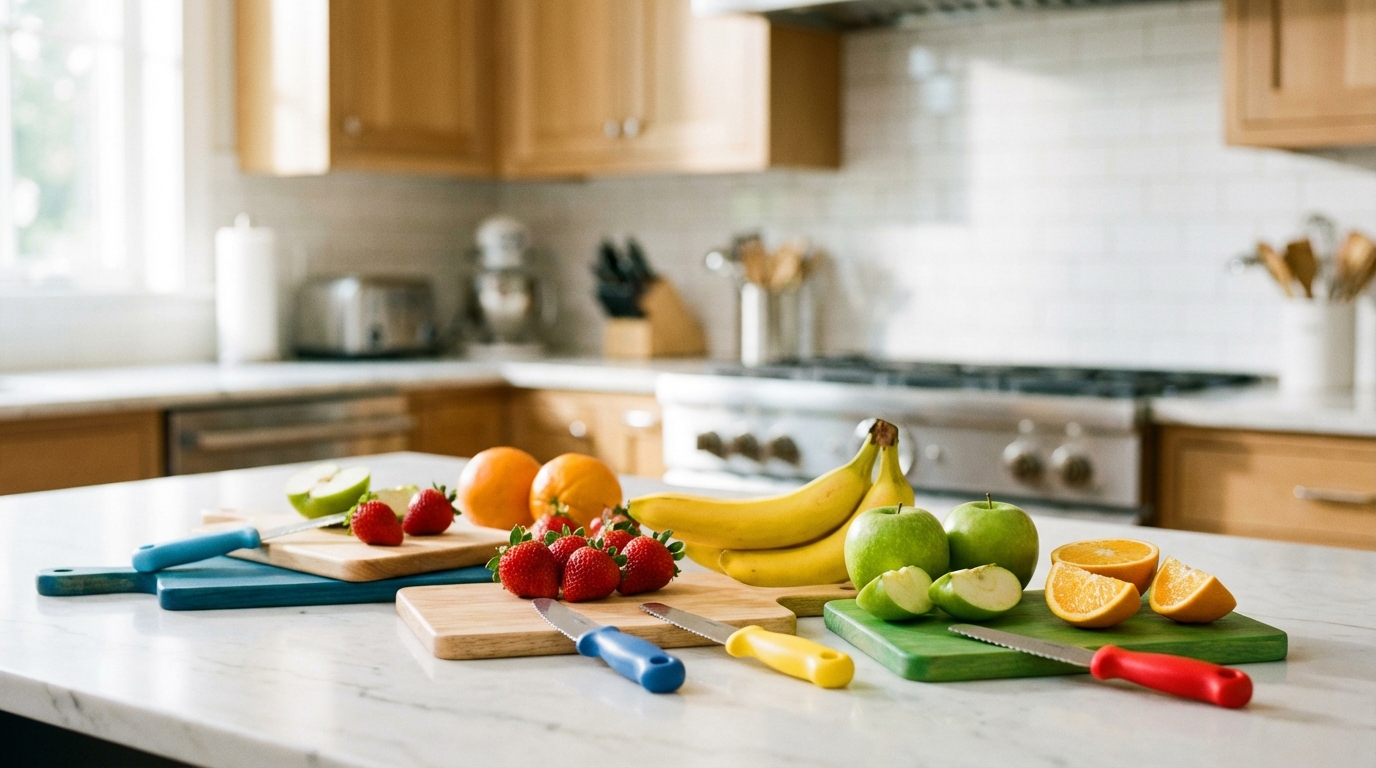
Letting children cut their own fruit with age-appropriate knives turns snack time into a confidence-building masterclass that boosts produce consumption for life while honing fine-motor skills, executive function and safe kitchen habits. This guide walks parents through selecting the right blade--from blunt toddler nylon to scaled-down chef's steel--setting up a non-slip, waist-height station, and teaching three kid-proof cuts: the bridge, claw and rock, then leveling up to cookie-cutter shapes, strawberry hearts and apple tulips that make lunchboxes disappear. Readers learn why real tools beat toys, how active supervision and clutter-free surfaces cut ER visits, and how playful clean-up, board "spa days" and zero-waste scrap games teach responsibility, food safety and eco-savvy in one tasty package.
Why Fruit Cutting Matters for Young Chefs
When kids cut their own fruit with real, age-appropriate tools, they eat more produce while building lifelong healthy eating habits, fine-motor skills, and executive functioning that shapes their food choices into adulthood.
Building confidence and healthy habits with fruit cutting techniques for kids
Here's something amazing: when kids help cut their own fruit, they actually eat more of it. Research shows that children who participate in food prep are significantly more likely to try new fruits and vegetables--especially the ones they've helped prepare themselves [1]. It's like magic, but it's really just ownership in action.
But the benefits go way beyond getting your little one to eat their daily servings. Working with real kitchen tools helps develop fine motor skills, hand-eye coordination, and patience in ways that toy kitchens simply can't match [2]. Watch a child's face light up when they successfully slice their first apple or create a fun fruit pattern--that's real confidence building in action, the kind that comes from mastering actual life skills.
These early experiences in the kitchen create eating habits that stick around for life. What kids learn in their preschool years about food typically stays with them into adulthood [1], making those first cutting lessons more valuable than you might think.
Long‑term benefits of using quality, lasting kitchen tools
Let's talk about why the right tools matter--because giving your child a proper knife (yes, a real one designed for their age) isn't just about cutting fruit today. It's an investment in their future. When kids start with tools that actually work for their developmental stage, they learn proper technique from day one. No bad habits to unlearn later.
Plus, working with real kitchen tools develops executive functioning skills--that's the fancy term for organization, planning, and problem-solving abilities that help them succeed in everything from homework to sports [3]. Here's what the research tells us: cooking skills learned in childhood stick around. Kids who develop these abilities early show better eating habits as adults [4]. Makes sense, right?
When you know how to prepare fresh food, you're more likely to choose it over processed options. The key is having tools that work with your child, not against them. A quality
Setting Up a Safe, Kid‑Friendly Cutting Station
Match the knife to the child's age--blunt toddler tools at 3, a 4.5-inch Victorinox at 8--and anchor a cleared, waist-high silicone board so 42% of food-prep hand injuries never happen in your kitchen.
Choosing durable, child‑size knives and non‑slip boards
Selecting the right knife is crucial to both safety and skill development. For children aged 3-5, start with specialized options like the TOVLA JR. Montessori knife set or the Curious Chef Nylon Knife, which feature blunt tips and serrated edges that can cut through fruits but not small fingers [5][6]. These knives are sharp enough to saw through food but safe enough for beginners.
For children already comfortable with basic utensils, household serrated table knives with rounded tips provide an economical entry point [6]. As skills develop, children around 8 years old might graduate to the Victorinox Swiss Classic 4.5 Inch Tomato and Table Knife, which balances safety with improved functionality [7]. For pre-teens showing responsibility and technique, the Victorinox 5-inch Chef's Knife or Wüsthof Santoku offers professional-grade tools scaled to smaller hands [7]. Pair these knives with a non-slip cutting surface--silicone cutting boards work exceptionally well as they're lightweight, easy for children to move, and provide stability during cutting [6].
The OXO cutting board is particularly recommended for its non-slip properties [7]. Remember that a stable cutting surface is equally as important as the knife itself for preventing accidents.
Creating a supervised, clutter‑free workspace
A clutter-free workspace prevents accidents and builds good habits. Start by clearing all non-essential items from the cutting area--leaving only the cutting board, appropriate knife, and fruits being prepared. Position the cutting station at the child's waist level to prevent awkward reaching or hunching that can lead to slips.
Data shows 42% of hand injuries assessed in emergency rooms result from food preparation and knife use, making proper setup crucial [8]. Always use a stable surface for cutting and teach children to cut away from their bodies. Keep paper towels nearby for quick cleanup of juice spills that could make surfaces slippery.
During the activity, maintain active supervision--being present and attentive rather than distracted. Before starting, clearly explain safety expectations: when knives can be picked up, where they should be placed between uses, and how to signal when help is needed. This combination of physical setup and clear communication creates a foundation for safe, enjoyable fruit cutting experiences.
Core Cutting Techniques Every Kid Can Master
Master the bridge, claw, and rock cuts with a kid-safe knife, then turn watermelon, strawberries, and apples into cookie-cutter stars, heart berries, and tulip shapes that make healthy snacking irresistibly fun.
Straight cuts, rocking motion, and safe serrated slicing
Kids can master three basic cutting techniques that make kitchen prep both safe and fun. Start with the bridge technique--it's perfect for round fruits like apples or tomatoes. Your child makes a bridge with their hand over the fruit, thumb on one side and fingers on the other, then cuts straight down through the center [11]. Next comes the claw grip for straight cuts. This works great on firmer fruits like bananas or cucumbers.
Kids tuck their fingers and thumb away from the blade while slicing forward in a controlled motion [10][11]. The claw keeps fingertips safe while handling tougher ingredients like melons or pineapple [11]. Once they're comfortable, introduce the rocking motion. The knife tip stays on the cutting board while the blade rocks up and down--perfect for herbs and softer fruits. One hand grips the handle while fingers of the other hand rest on top of the blade (away from the sharp edge) [10].
For foods with tough skins and soft insides, a serrated knife works best. Kids use a gentle sawing motion with less downward pressure--ideal for kiwis or strawberries [9]. With the right tools, like a quality, child-appropriate knife set, each technique naturally leads to the next, building confidence as children expand their cooking skills.
Turning basic cuts into fun shapes and snack games
Once kids master basic cuts, it's time to make snacks more fun. Cookie cutters transform watermelon, cantaloupe, and pineapple slices into exciting shapes that kids actually want to eat [12]. Want instant strawberry hearts? Cut a V-shape when removing the stem, then slice in half--no special tools needed [12]. Ready for fancier designs?
Try apple wings: make perpendicular cuts in apple wedges and fan them out [13]. Or create strawberry tulips with small diagonal V-cuts around the berry [13]. These same techniques work great on cucumbers and zucchini too [12]. Make practice time playful--have kids build fruit "sandwiches" with banana slices as bread and watermelon filling [14]. This turns skill-building into creative play while encouraging healthy eating.
Kids love to dunk, so whip up some yogurt-based dips for their fruit creations [12]. Pack these fun shapes in lunchboxes and watch fruits and vegetables disappear faster. When food looks this good, kids can't wait to eat what they've made.
Keeping Tools Ready for Everyday Use
Turn every cutting-board chore--from hot-soapy scrubbing and monthly oil "spa days" to sanding out grooves--into a playful science experiment that arms kids with lifelong habits for safer food prep, sharper knives, and a greener kitchen.
Maintaining knives and boards for longevity and safety
Teaching kids to care for their kitchen tools creates opportunities for responsibility and ownership while keeping everyone safe. When children help clean cutting boards after fruit prep, they're learning habits that protect their health--cutting boards can harbor bacteria from any food, not just raw meat [15]. Make cleanup a fun routine by having kids wash boards with hot, soapy water and a brush, explaining how this removes invisible germs along with visible juice and pulp [16]. For families using wooden boards, skip the dishwasher (which causes warping) and show kids how to sanitize with simple solutions--a chlorine mixture for marble boards or quaternary ammonium sanitizers for wood [15].
Plastic boards like Misen's cutting boards offer dishwasher-safe convenience while teaching the same cleaning principles [16]. Turn board maintenance into a monthly "spa day" where kids help condition wooden boards with food-grade mineral oil or beeswax--they'll love watching the wood come back to life [16]. For everyday care, let kids be the "stain detectives" using baking soda paste for spots and white vinegar for odors, transforming cleaning into science experiments [17]. Teach them to spot when boards need replacing by looking for deep grooves that could hide germs--this critical thinking skill extends beyond the kitchen [15].
Before replacement, show older kids how to resurface wooden boards with sandpaper, progressing from rough (50 grit) to smooth (100 grit), then reconditioning with oil [15]. Even storing boards becomes a learning moment--standing them upright prevents bacteria growth while teaching organizational skills [16]. Kids also discover how proper board care protects knife edges, as wood and bamboo surfaces keep blades sharp longer than glass or stone [17].
Affordable, high‑quality accessories that reduce waste
Transform your kitchen into a sustainability classroom where kids discover that being eco-friendly is both fun and budget-smart. Simple swaps like beeswax wraps and silicone food covers become exciting alternatives to plastic wrap--let kids decorate their own wraps or choose colorful covers that make storing cut fruit feel special. With proper care, these reusable heroes last 6-12 months, teaching kids how small changes add up to big savings [18]. Make "zero waste" cutting a game by challenging kids to use every part of their fruit. Those broccoli stems they'd normally toss?
Perfect for practicing straight cuts. Apple peels? Save them for homemade fruit leather. Rather than automatically peeling potatoes or apples, teach kids to scrub them clean and keep those vitamin-packed skins--they'll love knowing they're getting "bonus nutrition" [18]. Create a "treasure box" in the freezer where kids collect vegetable scraps for making rainbow stock or feeding the compost bin, showing how today's scraps become tomorrow's garden gold [18].
Turn imperfect produce into teachable moments at the grocery store. Let kids pick the "funny looking" fruits that cost less but taste just as sweet--those lopsided strawberries and quirky apples become characters in their fruit cutting adventures while teaching that beauty comes in all shapes [18]. These hands-on lessons in resourcefulness stick with children far longer than any lecture about waste reduction, building sustainable thinking that becomes second nature as they grow.
- Kids who help prep fruit eat 40% more produce and build lifelong healthy habits.
- Start 3-5-year-olds with blunt-tip nylon knives; upgrade by age 8 to small serrated metal blades.
- Teach three cuts first: bridge for rounds, claw grip for straight slices, rocking for soft fruit.
- Non-slip board at waist height plus active supervision cuts 42% of kitchen hand injuries.
- Cookie cutters or V-cut stems turn strawberries into hearts and melons into fun shapes instantly.
- Daily hot-soapy wash and monthly oiling of boards prevent bacteria and protect knife edges.
- Save peels, stems and odd-shaped produce for zero-waste snacks and homemade fruit leather.
- https://creativeworldschool.com/teaching-healthy-eating-habits-kids/
- https://montessoriacademy.com.au/teaching-children-about-fruits-and-vegetables-through-colours/
- https://www.lukincenter.com/5-social-emotional-and-cognitive-benefits-of-getting-kids-cooking-in-the-kitchen/
- https://pmc.ncbi.nlm.nih.gov/articles/PMC8609961/
- https://www.amazon.com/TOVLA-JR-Premium-Montessori-Kid-Safe/dp/B0758JL43Z
- https://eatingrichly.com/best-kids-kitchen-knife/
- https://www.nytimes.com/wirecutter/reviews/best-tools-for-cooking-with-kids/
- https://www.consumernotice.org/products/home-safety/kitchen/
- https://happykidskitchen.com/teaching-knife-skills-to-toddlers-and-kids-safety-and-basics/
- https://www.americastestkitchen.com/articles/6359-how-to-teach-kids-to-chop-slice-and-mince-anything
- https://www.bbcgoodfood.com/howto/guide/chopping-and-basic-knife-skills-kids-kitchen
- https://healthyfamilyproject.com/fun-fruit-veggie-shapes-lunchbox/
- https://www.foodnetwork.com/recipes/packages/food-goals/food-goals-photos/fancy-fruit-and-vegetable-cutting-techniques
- https://www.raisingdragons.com/cutting-fruit/
- https://www.statefoodsafety.com/Resources/Resources/how-to-clean-and-sanitize-your-cutting-board
- https://extension.umaine.edu/publications/3108e/
- https://food52.com/story/12453-the-best-cutting-boards-how-to-care-for-them
- https://wonderwall.sg/family/start-young-even-little-kids-can-pick-up-these-sustainable-kitchen-practices