

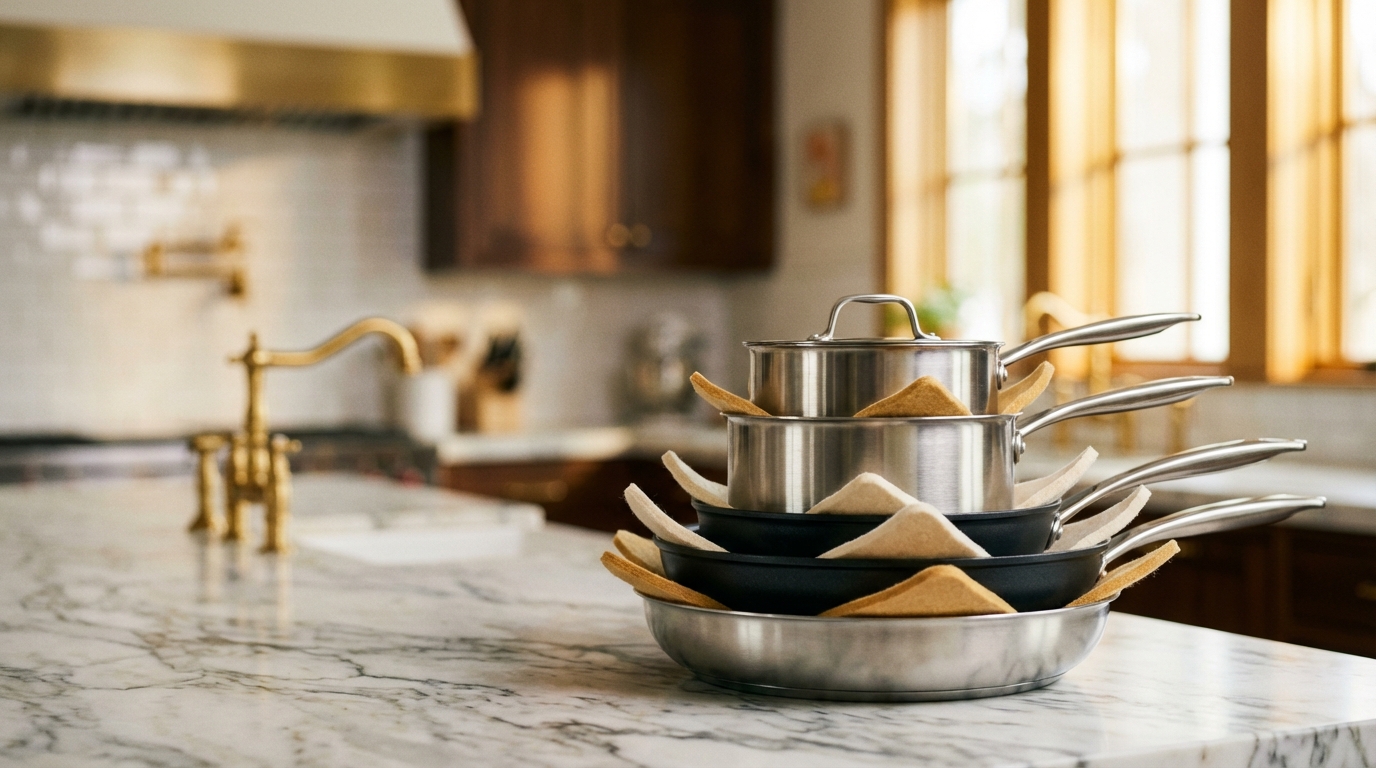
Pan protectors are the unsung heroes of a sustainable, money-saving kitchen, shielding stacked cookware from the barely visible scratches that snowball into ruined non-stick coatings, warped stainless, and premature landfill fodder; by slipping a breathable felt, silicone, or DIY fabric barrier between each pot and pan, you can double or triple the life of your investment, eliminating the costly two-year replacement cycle most cooks accept as inevitable. The article walks you through choosing the right material and size--thicker felt for weighty cast iron, quick-dry silicone for humid climates, star-shaped patterns you can trim to fit everything from skillets to oval bakers--then shows the two-second stacking trick that keeps handles and rims dent-free, plus a simple wash-and-air-dry routine that keeps protectors fluffy and effective for years. Beyond storage, it links protection to everyday cooking habits: moderate heat, no empty-pan preheating, and wood or silicone utensils, creating a full-circle care system that preserves performance and seasoning while slashing both household costs and the 95% extra energy drain of producing new aluminum pans. With ready-made sets starting at just a few dollars--or free repurposed towels and coffee filters in a pinch--readers learn how this micro-upgrade delivers macro returns, turning any kitchen into a calmer, greener, better-cooking space.
Why Pan Protectors Matter for Everyday Cooking
A one-time purchase of soft pan protectors can triple the life of your cookware, saving you money and keeping aluminum-heavy pans out of landfills by stopping the hidden scratches that ruin non-stick coatings and heat distribution.
Preventing Scratches and Extending Pan Lifespan
Here's what happens every time you stack unprotected cookware: metal grinds against metal, creating tiny scratches you might not even notice at first. But those scratches add up fast--especially on non-stick pans, where even minor damage means eggs start sticking and heat stops spreading evenly [1]. Pan protectors solve this problem with a simple cushioning layer between your stacked pots and pans.
These soft barriers absorb the impact and friction that would otherwise chip, dent, and scratch your cookware [2]. It's not just about keeping things looking nice (though that matters too). Protected cookware actually works better and lasts longer--whether you're preserving a non-stick coating, maintaining the mirror finish on stainless steel, or protecting seasoned cast iron [3].
With proper protection, your pans can last two to three times longer, which means real savings over time [1].
Saving Money and Reducing Waste
Let's talk about the real cost of unprotected cookware. Many home cooks get stuck replacing their non-stick pans every couple of years when food starts sticking and burning [6]. That gets expensive fast, especially when you're buying quality pieces.
But there's an environmental cost too--all those discarded pans pile up in landfills, and producing new ones takes serious resources. Aluminum cookware alone requires 95% more energy to make from scratch than from recycled materials [4]. Pan protectors break this cycle by preventing the damage that forces early replacement. A small investment in protection pays off big, extending your cookware's life by years while keeping perfectly good pans out of the trash.
This matters even more with quality cookware that's built to last decades, not just a few seasons [5].

Choosing the Right Pan Protectors for Your Cookware
Match your pan protector's material to your kitchen's moisture level--breathable felt or cloth for damp spaces, silicone or rubber for dry ones--and size it 2-3 inches larger than your cookware's diameter for stack-proof, scratch-free storage.
Material Types and Their Benefits
Pan protectors come in several materials, each with unique advantages for different cookware types. Felt protectors offer versatility and effective protection in various thicknesses--thicker versions provide superior cushioning for heavy cookware while thinner options work better with lightweight pans [7]. Felt breathes naturally, preventing moisture buildup that could damage pans, and can be trimmed to custom-fit specific cookware shapes [8].
Fabric options like cloth potholders and kitchen towels provide similar breathability benefits while repurposing items you likely already own, eliminating the need for additional kitchen products [9]. For those concerned about moisture, silicone and rubber protectors deliver exceptional durability and easy cleaning, though they may trap moisture against pans in certain environments [9]. Foam dish drying mats offer an affordable alternative that combines cushioning with breathability, particularly useful for irregularly shaped cookware [9].
When selecting materials, prioritize breathability for environments where moisture could be an issue, and consider thickness based on your cookware weight--heavier pots benefit from thicker protection to prevent damage during stacking [8].
Sizing and Fit Tips for Different Pan Shapes
Proper sizing is essential for effective pan protection. Measure your cookware's diameter before selecting or making protectors. Standard pan protectors typically come in three sizes--small (8-10"), medium (10-12"), and large (12-14")--but you can adapt patterns to fit unusual shapes [12]. For round frying pans, measure the widest point across the cooking surface.
Large protectors with a 13" diameter work well for 10" frying pans, while smaller protectors better suit mixing bowls [11]. When making custom protectors, adjust the pattern by changing the length of the "legs" to accommodate your specific cookware dimensions [10]. The star or asterisk shape works for most round cookware, but irregularly shaped items like oval baking dishes may require modified patterns with elongated sides [11]. For cookware with handles, position protectors so the "legs" extend beyond the handle junction to provide complete base coverage [10].
If stacking multiple pieces, create a set of graduated sizes that nest together efficiently, allowing ¼-½ inch of clearance between each piece [12]. Consider thickness as well--heavier cast iron requires sturdier protection than lightweight aluminum pans [11].
How to Use and Care for Your Pan Protectors
Protect every pan in seconds--slip a dry protector between each piece, stack heavy-to-light, and you'll never see another scratch.
Installation Steps for Immediate Protection
You'll have your cookware protected in seconds. Simply place a protector on the cooking surface before stacking the next pan on top [12]. For round pans, center the star-shaped design with its "legs" extending outward--this creates the cushioning barrier that keeps your surfaces pristine [14]. Stack smart: place your heaviest cookware at the bottom, working up to lighter pieces, with a protector between each layer [13]. When protecting pans with handles, position the protector so its extended sections reach beyond where the handle joins the pan [14].
This ensures complete coverage where scratches typically occur. If cabinet space is tight, try vertical storage. Stand pans on their sides with protectors between each piece--you'll prevent metal-on-metal contact while maximizing space [13]. Using homemade or fabric protectors? Make sure they're completely dry first, as trapped moisture can damage your cookware [12].
Need immediate protection? Kitchen towels, paper towels, or even coffee filters work as temporary solutions until you get dedicated protectors like Misen's Pan Protector [13]. The key is consistency--make returning protectors between pans as automatic as putting cookware away [13].
Cleaning, Maintenance, and Longevity
Your protectors need simple care to keep working effectively. For fabric and felt versions, hand wash with mild soap when they look dirty, then let them air dry completely [15]. As discussed in Material Types, trapped moisture can damage your cookware, so thorough drying is essential. Silicone and rubber protectors are even easier--wash with warm, soapy water or toss them in the dishwasher [16]. Just make sure they're bone dry before using again. Check your protectors regularly for wear.
Look for fraying edges, thinning spots, or areas that stay compressed. When they lose their cushioning power, it's time for new ones--effective protection depends on maintaining that buffer between your pans [17]. Storage matters too. Keep unused protectors flat or loosely rolled, never folded. Creases reduce their protective ability. Got flattened felt protectors?
Try a quick steam treatment to restore their loft. Living somewhere humid? Skip silicone protectors on cast iron or carbon steel--they can trap moisture and encourage rust [16]. Keep all protectors away from heat sources and stovetop splatter to maximize their lifespan [17]. With this simple care routine, your protectors will safeguard your cookware for years.


Integrating Pan Protectors into a Sustainable Kitchen Routine
Pairing $5-$16 pan protectors with low-heat cooking, wooden utensils, and post-cooldown cleaning can stretch your non-stick, stainless, or cast-iron cookware from a couple of years to decades while slashing replacement costs.
Combining Pan Protectors with Proper Cooking Techniques
You'll get the most from pan protectors by pairing them with smart cooking habits. Keep non-stick pans on medium heat or lower--high temperatures damage coatings in ways that even the best protectors can't fix [17]. Never heat an empty non-stick pan. Instead, add a bit of oil first, then warm it up.
Stick to wooden, silicone, or nylon utensils to avoid scratches [17]. For stainless steel and cast iron cookware, proper seasoning works hand-in-hand with physical protection. A well-seasoned surface naturally resists damage during cooking and storage [19]. After cooking, let pans cool down naturally before cleaning or stacking.
Quick temperature changes can warp cookware and compromise its structure [17]. When you combine pan protectors with these cooking techniques, you're creating a complete care system. As we discussed in the earlier sections about cookware lifespan, this approach can extend your pans' life from a few years to potentially decades [19]. It's not just about preventing scratches--it's about maintaining performance [18].
Affordable Quality: Making Pan Protectors a Kitchen Staple
Making pan protectors part of your kitchen routine doesn't have to break the bank. Quality protectors typically cost between $5-$16 for a set of three, with silicone options at the higher end due to their durability and non-slip properties [20]. That's a small price to pay for protecting your cookware investment--especially when you consider the replacement costs we covered earlier. If you're watching your budget, DIY options work just as well.
You can make your own with basic materials like felt or fabric, customizing them to fit your specific pans [12]. No-sew versions using just felt are particularly quick and affordable [12]. For those who prefer ready-made options, Misen's pan protectors offer durable protection designed to fit standard cookware sizes. The smart approach?
Invest in quality protectors for your most-used pans and make DIY versions for occasional-use cookware. This strategy gives you complete protection without overspending. In shared kitchens or rental properties, pan protectors become especially valuable--they're your insurance against damage that could cost you a security deposit [12].
- Pan protectors double or triple cookware lifespan by blocking scratch damage.
- Unprotected non-stick pans lose coating fast, causing food to stick and heat unevenly.
- Felt breathes to stop moisture; silicone traps it--match material to your climate.
- Measure pan diameter and pick star-shaped protectors 2-3 in larger for full coverage.
- Stack heavy pots on bottom with a dry protector between every layer.
- Wash felt by hand, silicone in dishwasher, and always dry thoroughly before reuse.
- $5-$16 protector sets save the cost of replacing pans every few years and cut landfill waste.
- https://www.hongyinonwovens.com/blog/the-benefits-of-using-cooking-pot-protectors-protect-your-investment0
- http://oreateai.com/blog/the-essential-guide-to-pot-and-pan-protectors-keeping-your-cookware-safe/2705719cf24dd0700a089d8ac5288c1e
- https://www.oreateai.com/blog/understanding-pan-protectors-the-unsung-heroes-of-your-cookware/c77744e624f5b30595e6ffb9b365bbd2
- https://kingstonuponthamesskiphire.co.uk/blog/recycling-pots-and-pans-to-help-reduce-kitchen-waste
- https://www.cuminco.com/blogs/our-blog/sustainability-in-your-kitchen-why-durable-cookware-is-the-future?srsltid=AfmBOor9y9qNidMnJADJVlOYHurj0LDRolmoxdF1S2RjDFoLTWzRME45
- https://www.reddit.com/r/Cooking/comments/1ljcnuf/sick_of_replacing_nonstick_pans_every_two_years/
- https://www.amazon.com/Savina-Pot-Pan-Protectors-8pcs/dp/B088H5KRSV
- https://www.hongyinonwovens.com/blog/how-to-choose-the-right-felt-pot-protectors-for-your-cookware1
- https://www.reddit.com/r/cookware/comments/15fppso/storing_pans_nesting_them_products/
- https://madamsew.com/blogs/sewing-blog/sew-a-pan-protector?srsltid=AfmBOoqSDLn4pPMmfxeReK9TZLrHyM0TzpnLShva0_LZiA3UquJGV-K-
- https://sewnbytanya.com/blog/diy-pot-protectors-tutorial/
- https://hellosewing.com/diy-pot-pan-protectors/
- https://kitchenbap.com/how-to-use-cookware-protectors/
- https://madamsew.com/blogs/sewing-blog/sew-a-pan-protector?srsltid=AfmBOoqU9U5TFHGcTZNi2kDMMG_FmYQGQ-hsAHBrC0NZZviK0J4Fsh7K
- https://food52.com/story/25458-how-to-care-for-nonstick-pans
- https://www.cupindy.com/blogs/info/clean-nonstick-pans-guide?srsltid=AfmBOooCN_PuyhaxhJxgejyggMrNKXPZdEjXdxrqSgTed8S6Ga4LzXIl
- https://gourmetkitchenworks.com/blogs/recipes/essential-guide-proper-use-and-storage-of-non-stick-pans-for-longevity
- http://oreateai.com/blog/the-ultimate-guide-to-choosing-the-best-pan-protectors/c49964ee1dae4f546baab2ec4ce56329
- https://berghoffworldwide.com/en/blog/extend-the-lifecycle-of-your-cookware
- https://www.amazon.com/Protectors-Separators-Protector-Anti-Slip-Scratching/dp/B0BHW1KNPB
- https://www.etsy.com/market/pan_protectors_set?ref=rlte_stm_6