

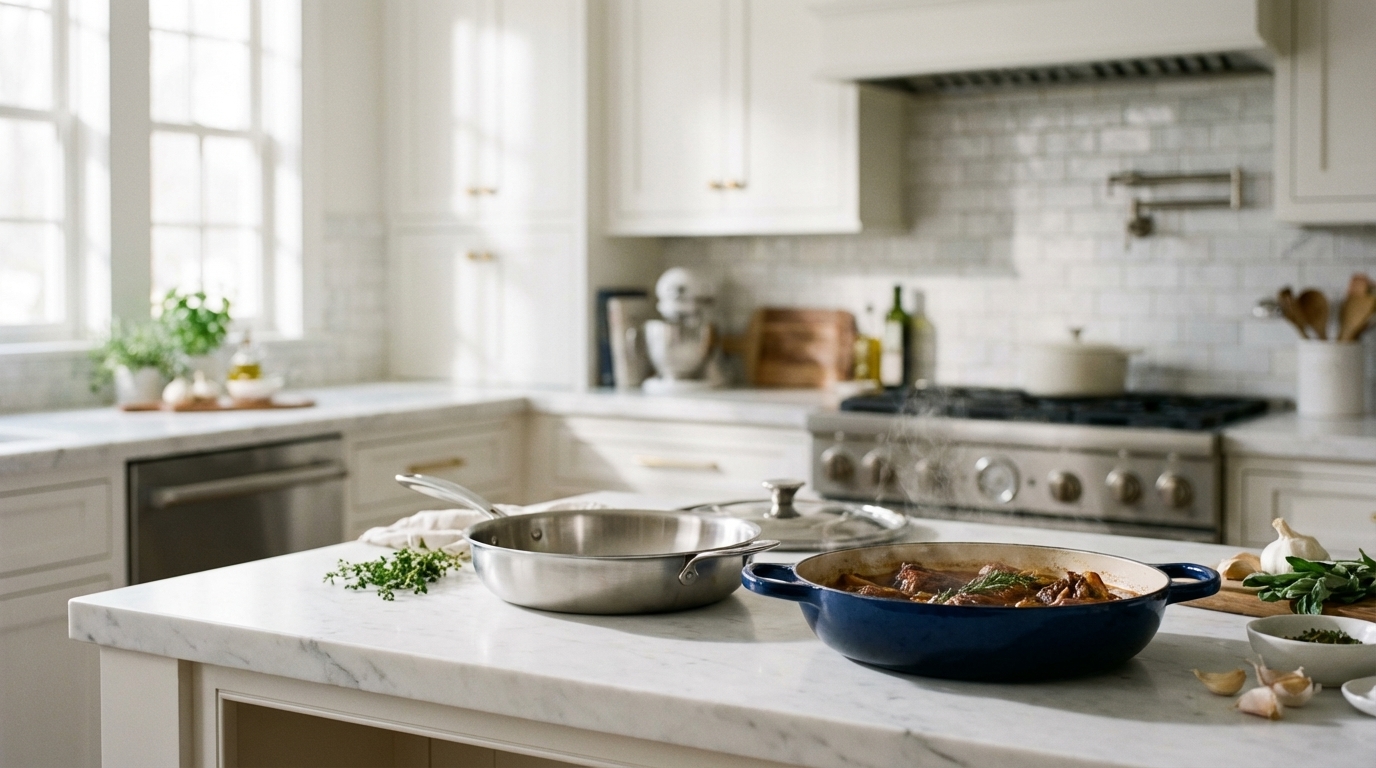
This ultimate buyer's guide shows you how to pick a braiser pan that turns weeknight dinners and slow-weekend braises into foolproof successes by zeroing-in on the sweet spot between enameled cast-iron's heat-holding heft and lighter aluminum or stainless options, then matching size (2 qt for singles, 3.5 qt for most families, 5 qt for crowds) and cooktop compatibility--induction included--to your real-world menus. You'll learn why premium enamel resists chips, why straight sides speed evaporation while curved ones keep dishes moist, and how roomy handles and oven-safe lids let you slide from stovetop sear to low-oven finish without juggling pans. The article demystifies materials: cast iron for steady, acidic-friendly braises; stainless for rapid fond-building; anodized aluminum for responsive, lightweight sautéing; and multi-ply hybrids that deliver pro durability with even heat. It also arms you with care know-how--cool-before-washing, baking-soda simmer for stubborn bits, oil-rim rust protection, and smart storage--to keep your investment performing for decades. By the last sentence you'll know exactly what to buy, how to use it for everything from no-knead bread to weeknight chicken thighs, and how to maintain it so every meal emerges tender, flavorful, and ready to reduce into a glossy sauce right in the same wide, shallow pan.
How to Choose the Best Braiser Pan for Your Kitchen
Choose a braiser pan by balancing enameled cast-iron's heat retention and chip-resistant durability with the right cooking surface--straighter sides for more sear space or sloped sides to keep moisture in--and oversized handles that let you safely move a hot, heavy pan from stove to oven.
Key Features to Look For
When selecting a braiser pan, material quality should top your considerations. Enameled cast iron offers superior heat retention and durability, with premium options featuring more chip-resistant enamel that withstands repeated metal utensil use [1]. The cooking surface area significantly impacts performance--straighter sides provide more cooking area but evaporate liquid faster, while more sloped sides preserve moisture but offer less searing space [1].
Comfortable, well-designed handles make all the difference when transferring a hot, heavy pan. Look for side handles at least four inches long and two inches wide, and lid knobs at least two inches in diameter for easy gripping with oven mitts [1]. Size selection and stovetop compatibility deserve careful consideration--we cover household sizing in detail in the "Size, Shape, and Compatibility" section below.
Alternative materials each bring unique benefits, which we explore thoroughly in "Material Matters" [2][3]. A tight-fitting lid is essential for proper moisture retention during long braises [3].
Matching the Pan to Your Cooking Style
Your cooking style and favorite recipes should guide your braiser selection. Cast iron braisers excel at low-and-slow cooking methods like stews, jambalayas, and bread baking due to their superior heat retention [4]. Each material excels at different cooking methods--enameled cast iron transforms tough cuts into tender meals through consistent heat, while stainless steel delivers superior high-temperature searing [6].
For delicate foods or recipes prone to sticking, nonstick surfaces prevent frustration while still allowing proper browning [6]. Consider investing in a quality For detailed size recommendations based on your household needs, see our comprehensive guide in the "Ideal Capacity for Different Households" section [5]. The braiser's wide, shallow base makes it particularly suited to recipes requiring liquid reduction and sauce development, unlike Dutch ovens which excel at soups and stews [6].
If your cooking regularly involves shallow-frying, roasting smaller cuts of meat, or dishes with minimal liquid, a braiser's lower walls provide better access for flipping foods and faster sauce reduction than taller vessels [5].

Material Matters: Comparing Popular Braiser Materials
Enameled cast-iron braisers deliver the unbeatable combo of cast-iron heat retention and even cooking with a rust-proof, acid-safe, increasingly nonstick enamel that lets you braise tomatoes in wine all afternoon and still pop the pot in the sink for a soak.
Enameled Cast Iron Benefits
Let's talk about why enameled cast iron has become the gold standard for braisers. The exceptional heat retention means your braiser maintains consistent temperature throughout those long, slow cooking sessions that transform tough cuts into melt-in-your-mouth meals [7]. Here's what makes enameled cast iron special: you get all the heat retention benefits of traditional cast iron without the hassle of seasoning. The enamel coating provides a smooth cooking surface that actually develops a natural patina over time, becoming more nonstick with use [8].
For braising enthusiasts, the non-reactive enamel surface is a game-changer. You can simmer acidic ingredients like tomatoes, wine, and citrus without worrying about metallic flavors or damage to your cookware [7]. Cleanup becomes refreshingly simple too--unlike bare cast iron, you can soak your enameled braiser and scrub away without fear of rust [8]. Quality matters with enameled cast iron.
Premium versions feature chip-resistant enamel that stands up to regular use and even metal utensils [7]. While these braisers excel at their namesake technique, they're surprisingly versatile--think of them as your go-to for searing, sautéing, baking bread, and slow-cooking soups [8]. Yes, they're heavier than other options, but that weight translates to durability. A well-made
Stainless Steel vs. Aluminum Options
Now let's explore your other material options, each with distinct advantages for different cooking styles and budgets. Stainless steel braisers bring professional-grade durability to your kitchen. These workhorses resist scratches, dents, and warping through years of heavy use [10]. Like enameled cast iron, stainless steel won't react with acidic braising liquids, preserving the pure flavors of your wine reductions and tomato-based sauces [9]. The weight provides welcome stability during those long braising sessions, and once heated, stainless steel maintains temperature beautifully [10]. Where stainless really shines? Developing fond--those caramelized bits that become the foundation of rich sauces.
The surface releases these flavor bombs easily when deglazing [10]. Aluminum offers a completely different experience. Thanks to thermal conductivity that outperforms stainless steel by several times, aluminum braisers heat lightning-fast and respond immediately to temperature adjustments [9]. This responsiveness makes them ideal when you need precise heat control [10]. The lightweight construction is a blessing when maneuvering a full braiser from stovetop to oven--your wrists will thank you [10]. Budget-conscious cooks appreciate aluminum's accessible price point [9]. Just remember: bare aluminum reacts with acidic ingredients, so opt for anodized aluminum that solves this issue while boosting durability [9][10].
The latest innovation? Hybrid construction that gives you the best of both worlds. These multi-ply braisers sandwich aluminum or copper cores between stainless steel layers, delivering superior heat distribution with professional durability [10]. If you cook on induction, double-check that any aluminum braiser includes a magnetic stainless base [10]. While stainless steel costs more upfront, its decades-long lifespan often makes it the smarter investment [10].
Size, Shape, and Compatibility: Getting the Right Fit
Pick a 3.5-quart braiser--big enough for tomorrow's pasta yet small enough that you can lift it off the induction hob without scratching glass or your back.
Ideal Capacity for Different Households
Finding the right braiser size makes all the difference in your cooking experience. If you're cooking for one, a 2 to 2.5-quart braiser gives you plenty of room without the extra weight. Don't let the compact size fool you--a 2-quart capacity matches a medium saucepan and can easily feed up to 4 people when you're entertaining [11]. For couples and small families, you'll want something between 2.5 and 3.5 quarts. This size offers enough capacity without getting too heavy when it's full of delicious food [11].
The 3.5-quart size hits the sweet spot for most home cooks--it's roomy enough for family dinners yet still easy to handle. You can fit five chicken breasts or make enough pasta for tomorrow's lunch, just like you would in a large saucepan [11]. Cooking for 5-6 people? Look at a 4-quart braiser. Feeding 6-8?
You'll need a 5-quart model [12]. Here's something to keep in mind: cast iron gets heavy fast, even before you add food and liquid. A smaller braiser is easier to move around, clean up, and tuck away in your cabinet [11]. You'll also use less liquid in your recipes with a smaller pan, which means your ingredients go further [11]. Many professional chefs suggest starting with a 3.5-quart braiser if you're buying just one--it's the perfect balance of versatility and manageability [12].
Stovetop and Oven Compatibility, Including Induction
Good news: most quality braisers work perfectly on any cooktop you have. But if you're cooking on induction, there are a few things to know. Enameled cast iron braisers from reputable manufacturers typically work great with induction cooking [1]. You might notice your induction cooktop manual warns against cast iron or enameled cookware because of potential glass damage, but countless home cooks use these pans daily without any problems [14].
Those warnings are mostly there to protect the manufacturer, not because damage is likely [14]. Want to keep your induction cooktop pristine? Always lift your braiser instead of sliding it across the surface. You can also use silicone mats made specifically for induction cooktops [14].
These clever mats protect against scratches while still letting the heat flow through perfectly [14]. When it comes to oven use, most enameled cast iron braisers can handle temperatures up to 500 degreesF, though this varies depending on the specific model and whether the lid knob can take the heat [13]. This stovetop-to-oven versatility is what makes braisers such workhorses--you can sear on the stove and finish in the oven without switching pans [1]. Before you buy, double-check that both the pan and lid can handle the temperatures you need for all your cooking adventures [1].


Maintenance and Longevity: Caring for Your Braiser
Treat your braiser like the heirloom it can become--cool it before washing, hand-wash with mild soap, boil away stubborn bits with baking soda, shield the rim with a quick oil wipe, and stack it with soft towels between each piece so it stays flawless for decades.
Cleaning Tips to Preserve Enamel
Taking care of your braiser doesn't have to be complicated--think of it like caring for any kitchen investment you want to last. Start by letting your braiser cool completely before cleaning, as sudden temperature changes can damage the enamel [15]. Even if the label says dishwasher-safe, hand washing protects your braiser better and prevents rust from forming on any exposed edges [16]. For everyday cleaning, warm water, mild dish soap, and a soft sponge do the trick perfectly [16].
Got stubborn, stuck-on food? Here's a simple solution: fill your braiser with water, bring it to a boil, and add two tablespoons of baking soda per quart of water [17]. After a few minutes of simmering, use a wooden spoon to gently nudge off those burnt bits--metal utensils can scratch the enamel, so stick with wood or silicone [17]. For those really persistent stains, make a paste with baking soda and water, let it sit on the stained areas, then wash as usual [15].
Notice rust around the rim? That usually happens when braisers aren't dried thoroughly. Simply clean with a nylon sponge and rub a thin layer of cooking oil around the rim to seal and protect it [15]. One more tip: always add oil to your braiser before heating--preheating an empty enameled braiser can damage the coating [15].
Storage and Care Practices for Durability
Smart storage keeps your braiser performing like new for years. The golden rule? Never let cookware surfaces touch directly. Use soft towels or felt protectors between stacked items--this simple step prevents scratches and chips that can ruin your braiser's cooking surface [18]. When stacking is necessary (and let's face it, most of us don't have unlimited cabinet space), place your heaviest pieces on the bottom and work up to the smallest.
This prevents wobbling and uneven pressure that can damage your cookware [18]. If you're tight on space, vertical storage using pan organizers or drawer dividers works great--your braiser stays protected and you can actually see what you have [18]. Wall-mounted racks offer another smart solution, keeping your braiser accessible while freeing up valuable cabinet real estate [18]. Just make sure to store lids separately in a lid organizer to avoid metal-on-metal contact [18]. And here's what not to do: never nest other cookware inside your braiser, as this almost guarantees scratches [19].
Keep your braiser away from damp areas like under the sink--moisture can cause rust on any exposed edges. If your braiser gets stuck in storage, resist the urge to yank it out by the handle. Take a moment to rearrange things properly rather than risk weakening the handle attachment [18]. A little care in storage goes a long way toward preserving your investment.


Putting It All Together: Pick a High‑Quality, Affordable Braiser Pan
Choose a cast-iron, enamel-coated 3-5 qt braiser with a tight lid, oven-safe to 500 degreesF, from a value brand like Lodge or Crock-Pot, and you'll sear, simmer, and serve--without blowing the budget.
- Choose enameled cast iron for best heat retention and chip-resistant durability.
- Pick 3.5-quart size for most households; 2-quart for singles, 5-quart for 6-8 people.
- Ensure handles are ≥4 in long and lid knobs ≥2 in for safe oven-mitt gripping.
- Hand-wash and dry rims to prevent rust; never preheat an empty braiser.
- Use baking-soda simmer or paste to remove stubborn food without scratching enamel.
- Protect cooktop by lifting cast iron; silicone mats prevent scratches on induction.
- Store with towels between surfaces and avoid nesting to prevent chips and rust.
- https://www.seriouseats.com/best-braisers-6753394
- https://www.lecreuset.ca/en_CA/blog/8-questions-to-ask-yourself-before-buying-a-braiser.html?srsltid=AfmBOortc08w9U7SY6CqqN3zmLF3QfQyUxFqsYTnaeVuMiAIikEwcjge
- https://medium.com/@latashadar79/best-braiser-pans-22e848116ecf
- https://www.thespruceeats.com/best-braising-pans-5080036
- https://www.americastestkitchen.com/equipment_reviews/2136-braisers
- https://www.lecreuset.ca/en_CA/blog/6-braiser-features-and-5-braiser-recipes.html?srsltid=AfmBOopQMuPyn3RmGnaFpZsyjyRb76Xa5S_eL3Nmxd2D2CmEdJTMRgF5
- https://www.seriouseats.com/cast-iron-vs-enameled-cast-iron-skillets-7496188
- https://www.lecreuset.ca/en_CA/blog/why-use-enamelled-cast-iron-cookware.html?srsltid=AfmBOooPh4FXbl41Lx-bIBDt52ewypOGnxyFSQRK7q7XfH4NbF7wkBcY
- https://www.purecook.com/aluminum-vs-stainless-steel-cookware/
- https://chopchopusa.com/blogs/news/aluminum-vs-stainless-steel-cookware
- https://www.booniehicks.com/best-size-braiser/
- https://www.winimoranville.com/recipes-stories-reviews-and-more/2021/3/17/what-size-of-braiser-should-i-buy
- https://www.amazon.com/Caraway-Enameled-Cast-Iron-Braiser/dp/B0DJRXSBNQ
- https://www.reddit.com/r/Cooking/comments/118wi4a/lecreuset_and_cast_iron_pans_on_induction_cooktop/
- https://www.lodgecastiron.com/pages/cleaning-care-enameled-cast-iron?srsltid=AfmBOoqoERaF677zCjKNZ5XzRPTtrJMTzkwmFlOcH7yW50FoxHOcNq00
- https://www.marthastewart.com/8376500/how-to-clean-enameled-cast-iron-cookware
- https://www.thekitchn.com/how-to-clean-burnt-stains-off-enameled-cookware-cleaning-lessons-from-the-kitchn-217457
- https://www.debuyer-usa.com/blogs/how-to/how-to-organize-pots-and-pans-expert-tips-for-longevity-and-easy-access?srsltid=AfmBOorO9A8-cbFepwG8q9glkw7y12HHiCI85YD01VM52SQN_m2i_Cew
- http://fesmag.com/products/guide/tabletop-and-smallwares/cookware/18790-braising-pan-cleaning-and-maintenance
- https://www.closetandstorageconcepts.com/norwalk-connecticut/2023/04/25/how-to-store-and-protect-your-pots-and-pans/
- Summary
- How to Choose the Best Braiser Pan for Your Kitchen
- Material Matters: Comparing Popular Braiser Materials
- Size, Shape, and Compatibility: Getting the Right Fit
- Maintenance and Longevity: Caring for Your Braiser
- Putting It All Together: Pick a High‑Quality, Affordable Braiser Pan
- Key Takeaways
- References