

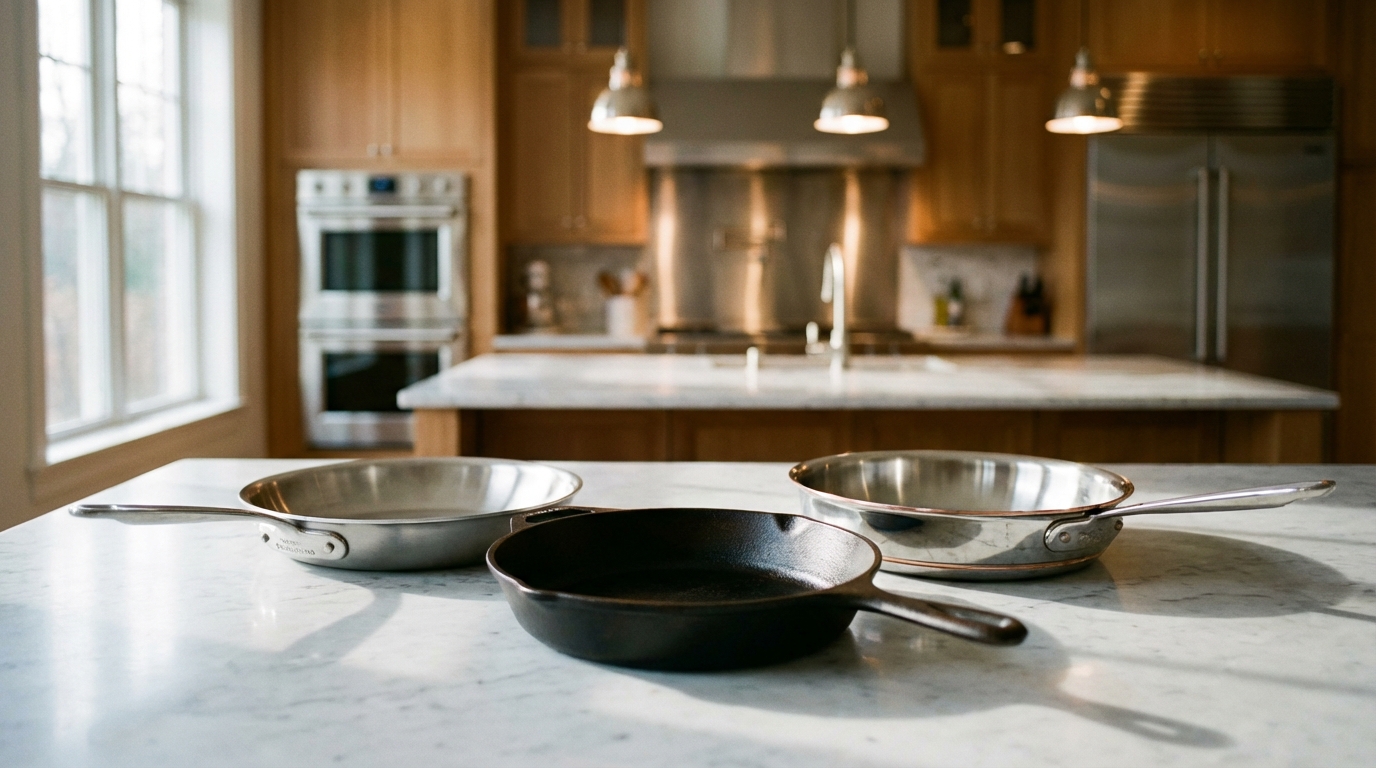
A truly great skillet balances three critical factors--material, design, and surface care--each of which directly determines how evenly it heats, how comfortably it handles, and how long it will last in your kitchen. By understanding the personality of each metal--copper and aluminum for speed, cast iron for heat retention, and multi-ply stainless for the best of both--you can match the pan to your cooking style and never fight hot spots or wimpy sears again. Smart shape choices (sloped sides for quick sautés and straight sides for braises) plus stay-cool, securely attached handles turn a simple pan into an extension of your hand, while deciding between low-maintenance non-stick and forever-seasoned cast iron or carbon steel lets you trade a few minutes of upkeep for generations of performance. Professionals judge any skillet by three quick checks--uniform heating, a 4-4.5-pound balanced weight, and a flawlessly flat, fully clad surface--so you can confidently invest once and cook better every single day.
Material Matters: Choosing the Right Metal for Your Skillet Pan
Pick the skillet metal that matches your cooking rhythm--copper or aluminum for lightning-fast responsiveness, multi-ply stainless for low-maintenance durability, or cast iron for unrivaled heat retention that perfects your sear and lasts generations.
Heat Conductivity and Even Cooking
Understanding how different metals conduct heat helps you choose the right skillet for your cooking style. Think of it this way: copper heats up and cools down like a sports car - fast and responsive, giving you precise control when you're making delicate sauces or need to quickly adjust temperatures [1]. Aluminum responds almost as quickly while staying lightweight and budget-friendly, which explains why it's such a popular choice [1].
Stainless steel on its own doesn't conduct heat well, but here's where smart engineering comes in - quality stainless pans sandwich aluminum or copper cores between steel layers, giving you the best of both worlds [1]. The stainless steel pan uses this multi-ply construction for even heating without hot spots. Cast iron takes its time warming up but holds onto heat like nothing else, making it unbeatable for getting that perfect sear on steaks [1].
The bottom line? Quick-heating pans give you control but need quality construction to avoid hot spots, while slower-heating options reward patience with incredibly consistent cooking temperatures.
Durability for Daily Use
When you're investing in a skillet, you want something that'll stick around as long as your favorite recipes. Cast iron takes the crown for durability - these pans are practically indestructible and actually get better with age, which explains why so many are passed down through families [4]. The trade-off? They need regular care to prevent rust (we'll cover maintenance techniques in the Finishes and Care section). Stainless steel strikes a nice balance between toughness and convenience.
These pans resist corrosion, won't warp under high heat, and need minimal babying [4]. When you see multi-ply construction (3- to 5-ply), that means layers of different metals working together - not just for better heat distribution but also added strength [4]. If you love cast iron's durability but find it too heavy, carbon steel might be your answer. The carbon steel pan offers similar longevity at about 30% less weight, making it easier to maneuver while still building that coveted natural non-stick surface over time [4]. Here's what to check when evaluating durability: Feel the weight - it should be substantial but manageable.
Check that the base is thick and even. As discussed in the Design Details section, handle attachment matters too. Remember, a well-made skillet is an investment that pays dividends every time you cook [4].

Design Details That Influence Performance
Choose sloped sides for lightning-fast sears and effortless flips, straight sides for moisture-locking braises, and a cool-touch, double-riveted handle for safe, strain-free cooking every time.
Surface Shape and Edge for Versatile Cooking
The shape of your skillet's sides makes a bigger difference than you might think. Sloped sides let heat escape quickly, which is exactly what you want when sautéing vegetables or searing proteins [5]. They also make it easier to flip ingredients and slide that perfect omelet onto your plate. These pans shine when you're making pan sauces--the angled walls help you deglaze effectively and capture all those delicious caramelized bits [5].
Straight-sided pans with higher walls work differently. They're great at keeping liquids contained (less splatter on your stovetop!) and holding in moisture for longer cooking times [6]. The trade-off? Those higher sides trap steam, which can prevent the browning you want for certain dishes [6].
They do make butter basting easier though, and you can fit more ingredients when making one-pot meals [6]. Most professional kitchens keep both styles on hand because each design changes how heat moves through the pan and how moisture behaves during cooking [6]. Think about what you cook most often--quick stir-fries and sautés favor sloped sides, while braises and pan-roasting work beautifully in straight-sided skillets.
Handle Construction and Safety Features
A skillet's handle determines comfort, control, and safety during cooking. Well-designed handles distribute weight evenly across your grip, reducing strain when you're cooking for longer periods or managing a full pan [8]. How the handle attaches matters too--double reinforced screws create a much more stable connection than spot-welded handles that can wiggle loose after months of use [7]. Safety should be your top priority when evaluating handles.
Materials like Bakelite and special nickel-based alloys stay cool to the touch even when your cooking temperature hits 392 degreesF (200 degreesC) [8]. These materials won't release harmful chemicals when heated, and they'll save you from painful burns [8]. Look for handles with non-slip features--they make a real difference when your hands are wet or you've got oil splatter to deal with [8]. The angle and length of the handle affect how the pan feels in your hand.
Longer handles give you better leverage for flipping and tossing, but they can be awkward in tight spaces [9]. Stay away from bare metal handles unless they have heat-resistant coatings--they'll get dangerously hot during cooking [8]. For the most cooking flexibility, choose handles that can go in the oven at the same temperatures as the pan itself. This lets you start a dish on the stovetop and finish it in the oven without switching pans [9]--perfect for everything from frittatas to roasted chicken.
Finishes and Care: Coatings, Seasoning, and Maintenance
Choose non-stick for effortless eggs today, or seasoned cast-iron/carbon steel for steaks and a pan your grandkids will fight over.
Non‑Stick vs. Natural Seasoned Surfaces
When choosing between non-stick and naturally seasoned surfaces, you're really choosing between convenience and longevity. Non-stick pans come ready to use with synthetic coatings--usually PTFE (that's Teflon) or ceramic--that let you cook with minimal oil from day one [10]. Cast iron and carbon steel, on the other hand, build their non-stick properties through seasoning, where oils bond to the metal creating a natural coating that gets better with every meal [11]. Here's how they stack up in your kitchen: Non-stick shines with delicate foods like eggs, fish, and crepes, but keep the heat at medium or below (around 300-400 degreesF) to protect the coating [11]. Seasoned surfaces? They love high heat and excel at searing steaks, baking cornbread with those crispy edges, and moving seamlessly from stovetop to oven [10].
For versatility, many cooks are turning to carbon steel pans which offer cast iron's heat tolerance in a lighter package. The real difference shows up over time. Non-stick pans typically need replacing every 2-5 years as their coatings wear down, no matter how careful you are [11]. Well-maintained cast iron or carbon steel? These workhorses last generations, actually improving their cooking performance as the seasoning builds [10]. Of course, this durability requires some attention.
Non-stick pans need gentle handling--soft utensils only, hand washing with mild soap. Cast iron and carbon steel need immediate drying after washing and occasional re-seasoning to maintain their protective layer [11]. Think of it as a small investment of time for a lifetime of great cooking. There's even a health angle to consider: cast iron naturally adds small amounts of dietary iron to your food (helpful if you're iron deficient), while modern non-stick coatings are safe at proper temperatures but shouldn't be overheated [11].
Practical Cleaning and Longevity Tips
Taking care of your skillet isn't complicated--just a few simple habits will keep it performing beautifully for years. Let's start with cast iron, which has more myths around it than any other cookware. First, forget what you've heard: mild dish soap is perfectly fine for seasoned pans [13]. What will damage them? Soaking overnight or running them through the dishwasher--both invite rust [12]. Daily Cast Iron Care: After cooking, rinse with hot water and scrub gently with a non-abrasive sponge. Dry completely--either towel dry or pop it on the stovetop for a minute [13]. Got stuck-on food? Here's a chef's trick: sprinkle kosher salt in the warm pan with a few drops of water and scrub gently.
The salt works as a natural abrasive without damaging your seasoning [13]. For really stubborn bits, boil a cup or two of water in the pan to loosen everything up, then scrape with a wooden spoon [13]. The finishing touch: rub a tiny amount of neutral oil (canola or sunflower work great) over all surfaces, including the handle. We're talking drops, not tablespoons--just enough to maintain that protective layer [13]. See some rust spots? Don't panic. Scrub them off with a dry sponge or rust eraser, then re-season right away [13]. Enameled Skillet Care: These beauties need gentler treatment. Always let them cool before washing to prevent thermal shock that can crack the enamel.
Skip the steel wool--it'll scratch the surface. Instead, use soft sponges and non-abrasive cleaners [13]. For stubborn stains, make a paste with Bar Keepers Friend or baking soda and water. Really tough discoloration? Mix one part bleach to three parts water and let it soak for a few hours, then wash thoroughly [13]. With these simple steps, your skillets will serve you well for decades.


Professional Checklist: The 3 Details Pros Inspect in a Skillet Pan
Pros judge a skillet by three non-negotiables: dead-even heat that erases hot spots, a 4-4.5 lb heft that balances heat retention with wrist-friendly control, and a handle angle that keeps the pan level from stove to plate.
Heat Distribution and Retention
When professionals evaluate skillets, they start by checking heat performance - both how evenly the pan distributes heat and how well it holds temperature. As covered in our material section above, different metals behave differently, and pros know exactly what to look for [1]. They test for hot spots by heating an empty pan and watching for temperature variations across the surface. Quality pans heat evenly without those frustrating hot areas that burn food in one spot while leaving it undercooked in another [14].
Cast iron gets praise for holding heat, but professionals know it can develop uneven hot spots if not properly preheated [14]. That's why many pro kitchens stock multi-ply stainless steel with aluminum or copper cores - you get stainless steel's durability plus better heat distribution [14]. The real test comes when adding cold ingredients. Pros watch how quickly a pan recovers its cooking temperature after food hits the surface.
Cast iron's density creates a heat buffer that maintains searing temperatures even when you add room-temperature proteins [15]. For home cooks seeking that professional performance, a quality stainless steel pan with proper core construction delivers both responsive temperature control and reliable heat retention [14].
Weight, Balance, and Surface Integrity
Professional chefs know that weight and balance make or break a skillet's performance. The sweet spot? A 10-inch pan weighing 4-4.5 pounds - heavy enough for proper heat retention but light enough to handle comfortably [17]. Go lighter and you risk warping and poor heat retention. Go heavier and cooking becomes a workout [17].
Balance matters just as much as weight. Pros test how a pan feels in hand, checking whether the weight distributes evenly between the cooking surface and handle [16]. Well-designed handles sit at just the right angle to maintain balance when lifted, preventing wrist strain during those long cooking sessions [16]. This simple balance check tells you whether you'll enjoy using the pan or struggle with it every time you need to toss ingredients or transfer from stovetop to oven [18]. Surface integrity is the third thing professionals examine closely.
They check the base for perfect flatness - any warping means uneven contact with your burner and inconsistent cooking [18]. They look for manufacturing defects like pitting, cracks, or rough spots that could affect performance [17]. With stainless steel, pros want fully-clad construction (metal layers bonded all the way up the sides) rather than disc-bottoms that only have layered metal on the base [16]. For cast iron, they assess surface smoothness, which comes from quality casting and careful finishing [17]. These three elements - weight, balance, and surface quality - work together to determine whether a skillet will perform reliably day after day.
- Copper/aluminum heat fast for control; cast iron heats slow but holds heat for perfect sears.
- Multi-ply stainless layers aluminum or copper cores for even heating without hot spots.
- Sloped sides suit quick sautés; straight sides trap moisture for braises and reduce splatter.
- Non-stick lasts 2-5 yrs; cast iron/carbon steel improve with age and can last generations.
- 10-inch skillet sweet spot: 4-4.5 lb for heat retention without wrist strain.
- Check for fully-clad construction up the sides, flat base, and smooth surface for pro-level performance.
- Cast iron care: mild soap OK, avoid soaking, dry thoroughly, light oil rub to maintain seasoning.
- https://thermtest.com/the-impacts-of-thermal-conductivity-on-cooking-technique
- https://www.debuyer-usa.com/blogs/guides/choosing-your-champion-cast-iron-vs-stainless-steel?srsltid=AfmBOoonrngvo0E7USDG-2nefXFO4An3VkXH78Ps_LYZ9DSPCsIZiXh4
- https://www.vikingculinaryproducts.com/blogs/articles/the-most-durable-cookware-materials-ranked?srsltid=AfmBOorcerU35XBdRApcNS9TYcTVrD7NP_JvQ3-AlpYzTMPc6Az-TzuT
- https://www.cupindy.com/blogs/info/cooking-pans-materials-guide?srsltid=AfmBOorLaZp4TGNUy1P-kTynkYYxVJiOw5vr5zbq-4CIBs4j2eQvHhhV
- https://www.ice.edu/blog/sloped-vs-straight-sided-pans
- https://www.reddit.com/r/Cooking/comments/6omn4v/any_reason_not_to_buy_a_pan_with_high_sides/
- https://www.amazon.com/Vegoran-Triply-Professional-Stainless-Skillet/dp/B0CGZKQZ97
- https://www.xianghai.com/news/heat-resistant-cookware-handles-stay-cool-safe-with-iso-certified-ergonomic-design/
- https://www.cnn.com/cnn-underscored/reviews/best-nonstick-pan
- https://fitmencook.com/blog/cast-iron-vs-nonstick-cookware/
- https://shop.ttkprestige.com/blog/post/buying-guides/cast-iron-vs-nonstick-cookware?srsltid=AfmBOors8qlznevylobFFH0bay6wxXZiCB5dWq-iJlQdHwheeOkmbet-
- https://extension.umaine.edu/food-health/2024/03/28/cast-iron/
- https://www.nytimes.com/wirecutter/guides/how-to-clean-cast-iron-skillet/
- https://www.debuyer-usa.com/blogs/guides/choosing-your-champion-cast-iron-vs-stainless-steel?srsltid=AfmBOooNUQb44n5lE8oQ-pfnVuH0M4PqFCqExHnZIx11ZNGn42TN47j_
- https://khymos.org/2007/03/01/staying-warm-cast-iron-vs-stainless-steel/
- https://www.epicurious.com/expert-advice/the-best-frying-pans-stainless-steel-article
- https://fieldcompany.com/pages/field-vs-lodge?srsltid=AfmBOorvadxHs1pFMlOAjie0NhoF-X9livaG4t1OTFdFxC-ApT_MwkDv
- https://therestaurantwarehouse.com/blogs/restaurant-equipment/restaurant-quality-pans-guide?srsltid=AfmBOor2icmmnQdaG39F4a2rxZu5mSjDTs9T7W-y6rxJ3t8Ll-cGJ8vJ