

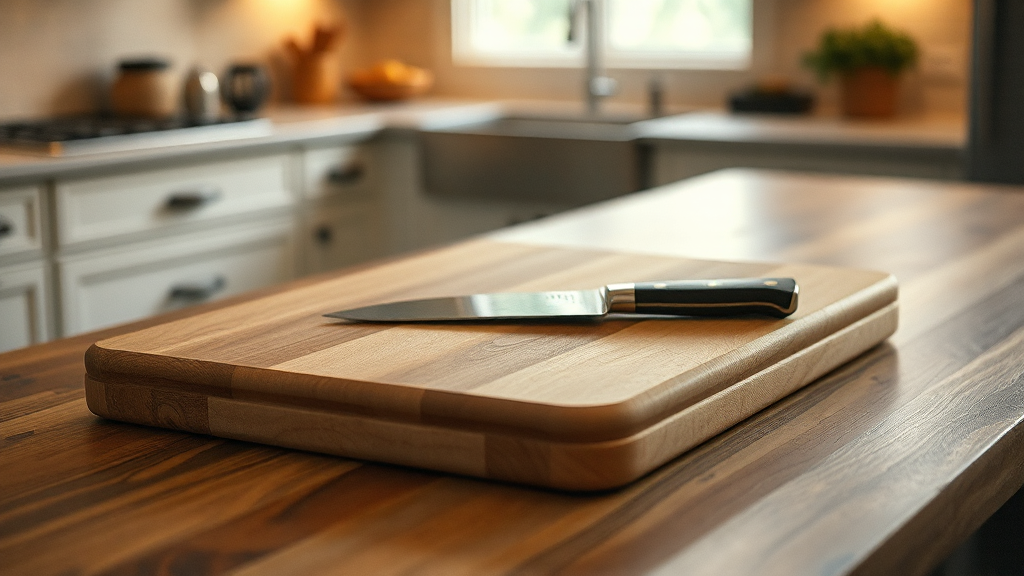
To protect your knife edges, choose a hardwood with a Janka hardness between 900 and 1,500 lbf, such as maple, walnut, or cherry. These closed-grain woods are hard enough to resist deep grooves but gentle enough to avoid accelerating blade dulling. While end grain boards are often considered superior, controlled testing shows negligible wear differences compared to edge grain, making both safe choices for home kitchens.
Why Wood Choice Affects Your Knife's Edge
How Wood Hardness Interacts with Blade Steel
A cutting board's impact on your knife edge depends heavily on the Janka hardness rating of the wood. This scale measures the force in pounds-force (lbf) required to embed a steel ball halfway into a wood sample.
For cutting boards, the ideal range sits between 900 and 1,500 lbf, a sweet spot that is hard enough to resist damage but gentle enough not to dull your knives [1]. When a board falls below 900 lbf, the surface is too soft, and knife scars accumulate quickly, creating deep grooves that trap bacteria.
Conversely, when a board exceeds 1,500 lbf, the surface is too hard, and your knife edges suffer with every stroke [1]. Selecting a wood within this middle range ensures the board absorbs the impact of your blade without wearing down the steel.
The Role of Grain Density in Preventing Dulling
Grain density determines how a board interacts with moisture and food particles, which indirectly affects blade longevity by influencing how you clean and maintain the surface. Closed-grain woods, such as maple, walnut, and cherry, have tight, microscopic pores that do not easily absorb moisture or trap food particles [1].
This tight structure is critical for hygiene because it prevents the board from becoming a reservoir for bacteria. Open-grain woods, like red oak or ash, have visible pores that act as bacterial reservoirs, which is problematic for food prep [1].
A dense, closed-grain surface allows for a cleaner cutting experience, reducing the need for aggressive scrubbing that can accelerate board wear and potentially affect the stability of the surface under your blade.
Top Wood Options for Preserving Blade Sharpness
Maple: The Standard for Knife Protection
Maple is widely considered the superior material for most kitchens because it combines durability with a gentle surface for steel edges. It is tough and resilient enough to continue serving for years of regular chopping, slicing, and dicing [2].
The neutral color and tight grain pattern of maple make it a classic choice that fits almost any kitchen aesthetic, and its closed-grain structure makes it easier to keep clean [2]. Because maple falls within the ideal Janka hardness range, it resists the deep grooves that trap bacteria while remaining soft enough to protect your knife edges from excessive wear.
If you are looking for a high-quality cutting board that balances performance and value, a product made from maple is a standout option.
Walnut and Cherry: Softer Alternatives for Gentle Cuts
Walnut and cherry are excellent alternatives for those who prefer a slightly softer cutting surface. Both are closed-grain woods with tight, microscopic pores, making them hygienic and resistant to moisture absorption [1].
These woods fall within the 900–1,500 lbf ideal range, meaning they are hard enough to resist damage but gentle enough not to dull your knives [1]. Walnut and cherry also pass the food safety rule of thumb used by professional woodworkers: they come from trees that produce edible fruit, nuts, or syrup.
This makes them safe for food prep and a reliable choice for anyone who wants a beautiful, durable board that is kind to their steel.
Wood Types to Avoid for Knife Longevity
Why Softwoods Like Pine Damage Edges
Softwoods such as pine are generally unsuitable for cutting boards because they fall below the 900 lbf Janka hardness threshold. When a board is too soft, knife scars accumulate quickly, creating deep grooves that trap bacteria and compromise the board's structural integrity [1].
While a soft surface might seem gentle on a blade, the rapid accumulation of cuts leads to a uneven surface that can affect your cutting precision. Furthermore, the deep grooves in softwoods make it difficult to clean the board thoroughly, posing a food safety risk.
For these reasons, pine and similar softwoods are best avoided if you want to maintain both the sharpness of your knives and the hygiene of your kitchen.
Hardwoods That Are Too Abrasive for Blades
Hardwoods that exceed 1,500 lbf on the Janka scale are too hard for regular cutting board use. When a board is too hard, your knife edges suffer with every stroke, leading to accelerated dulling .
While these woods may be durable and resistant to dents, the trade-off is significant wear on your steel. Woods like bamboo, which is technically a grass but often grouped with hardwoods in cutting board contexts, can also be abrasive depending on the density and construction.
To protect your investment in high-quality knives, stick to the 900–1,500 lbf range and avoid any board that feels like it is grinding against your blade rather than sliding under it.
Practical Selection Criteria for Your Kitchen
End Grain vs. Edge Grain: Impact on Blade Life
The orientation of the wood grain significantly affects how a board interacts with your knife. End grain construction, where the cross-section of fibers faces up, is often called the professional gold standard because the knife fibers part rather than sever, creating a self-healing surface that is gentler on blades and lasts longer [1].
Edge grain construction, where the narrow edge faces up, is more durable and serves as the workhouse of most home kitchens [1]. However, controlled robotic testing has shown that knife wear differences between edge grain and end grain are negligible, with some tests even showing edge grain performing slightly better [3].
In practical kitchen use, both are knife-safe when made from quality hardwood like walnut or maple. The dramatic advantage often attributed to end grain simply doesn’t show up under measurable testing conditions, so you should choose based on your budget and aesthetic preference rather than assuming one will significantly extend your blade's life.
Maintenance Routines That Protect Both Wood and Steel
Regular maintenance is essential to keep your board in top condition and ensure it continues to protect your knives. It is recommended to oil your wood grain cutting board at least once a month, or whenever it starts to look dry, using food-grade mineral oil for best results [4].
You can also use cooking oils like olive, rapeseed, or grape seed; apply the oil with a dry cloth and rub it well in the direction of the wood grain so that it soaks in properly and nourishes the wood [5]. To prevent warping, avoid prolonged exposure to water and dry the board promptly after washing [4].
If you use a wooden board for raw meat, clean it thoroughly after use to prevent bacterial growth, as end grain boards are particularly good for meat preparation because they are less likely to develop deep grooves [4].
Conclusion
Choosing the Right Board for Your Cooking Style
The best cutting board is the one that fits your counter, your cooking habits, and the ingredients you prep most often [6]. If you mostly slice fruit, make sandwiches, and chop a few vegetables at a time, a smaller board may be all you need.
For family dinners, meal prep, or carving roasts, a larger board gives you room to work without pushing ingredients onto the counter [6]. Many home cooks are happiest with two boards: a substantial wood board for everyday produce, bread, and serving, plus a separate dishwasher-safe board reserved for raw meat [6].
When selecting your wood, maple is a reliable standard for knife protection, while walnut and cherry offer softer alternatives that are still gentle on steel. By choosing a board within the 900–1,500 lbf Janka range and maintaining it with regular oiling, you can ensure that your knife edges stay sharp and your board remains a safe, stable surface for years to come.
Frequently Asked Questions
-
Is end grain construction actually better for knives than edge grain?
While end grain is often called the professional gold standard because fibers part rather than sever, controlled robotic testing shows that knife wear differences are negligible. You can choose either based on budget and preference, as both are knife-safe when made from quality hardwoods like maple or walnut.
-
Why should I avoid softwoods like pine for cutting boards?
Pine and similar softwoods fall below the 900 lbf Janka hardness threshold. This makes them too soft, causing knife scars to accumulate quickly and create deep grooves that trap bacteria, which compromises both hygiene and cutting precision.
-
How often should I oil my wooden cutting board?
It is recommended to oil your wood grain cutting board at least once a month, or whenever it starts to look dry. Using food-grade mineral oil helps nourish the wood and maintain its protective surface.
-
Are walnut and cherry safe for food preparation?
Yes, both walnut and cherry are closed-grain woods with tight pores that resist moisture absorption. They also come from trees that produce edible fruit, nuts, or syrup, making them a safe and hygienic choice for food prep.
- Maple is the standard for knife protection, offering a durable, closed-grain surface that resists bacteria and gentle on steel edges.
- Woods below 900 lbf (like pine) are too soft, leading to deep grooves that trap bacteria, while woods above 1,500 lbf are too hard and dull blades quickly.
- Maintenance involves oiling the board monthly with food-grade mineral oil and drying it promptly to prevent warping and preserve the wood's protective properties.
- https://www.kimecopak.ca/blogs/news/best-woods-for-cutting-boards
- https://wholesalecuttingboards.ca/wooden/maple-or-walnut-for-cutting-boards/
- https://bonobuilt.com/blogs/blog/edge-grain-vs-end-grain-cutting-boards
- https://www.thebambooguy.com/blogs/kitchen-knives/the-science-behind-wood-grain-cutting-boards-which-type-is-best-for-your-kitchen
- https://www.opinel-usa.com/blogs/news/how-to-maintain-your-cutting-board
- https://www.tooillcabinets.com/uncategorized/guide-to-choosing-cutting-boards/