

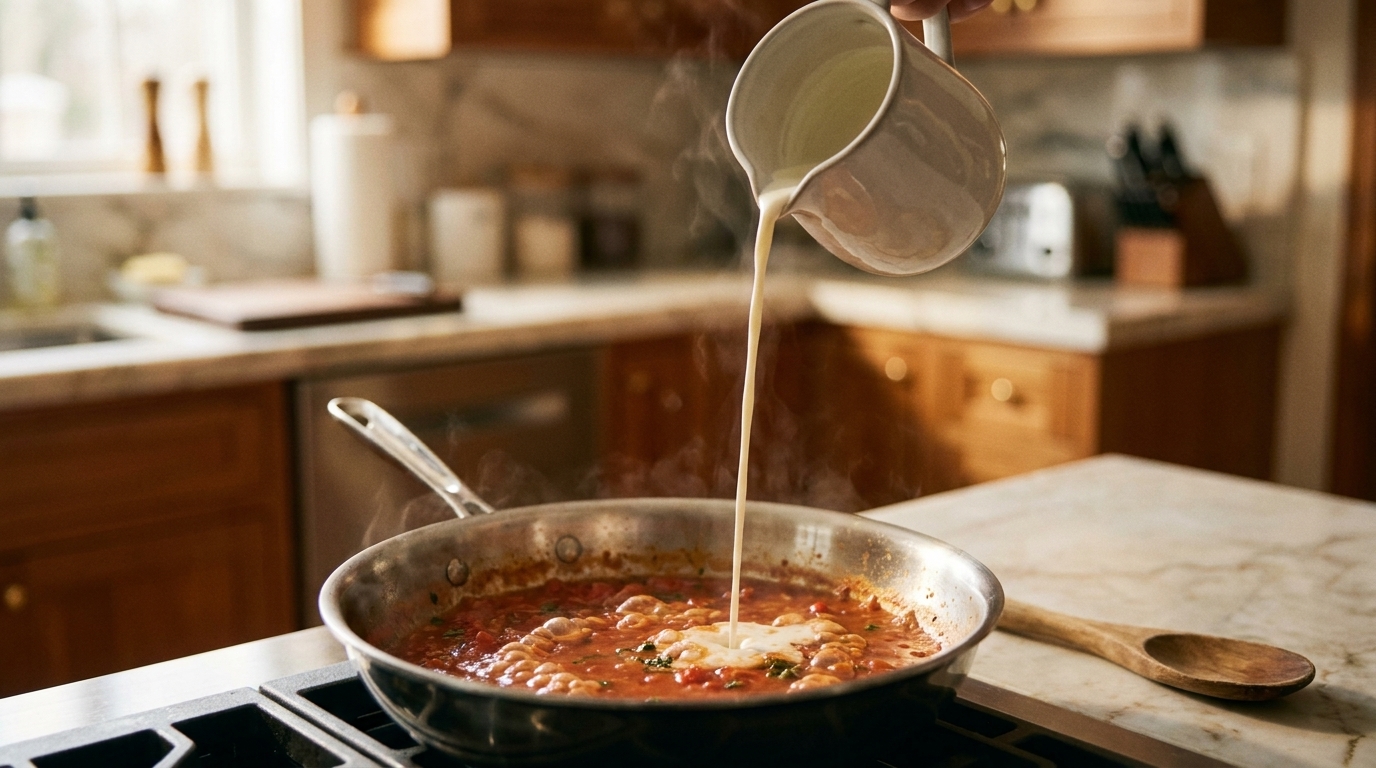
Half-and-half can work in steam sauces, but its lower fat content (10-18%) makes it prone to curdling compared to heavy cream's stable 36-40% fat. Success requires careful temperature control, tempering, starch stabilizers, or adding butter to raise the fat content and keep your sauce silky.
The Direct Answer: Half-and-Half Works in Steam Sauces With One Critical Caveat
Half-and-half works in steam sauces if you add it after the pan drops to a simmer and temper it first with hot liquid.
Why fat content matters: 10-15% vs. 30-40% and what it means for your sauceThe fat percentage gap between half-and-half (10-18%) and heavy cream (36-40%) directly controls how a steam sauce behaves under heat.
Fat globules act as physical barriers that surround denatured casein proteins -- at 36-40% concentration, there are enough globules to absorb those proteins before they clump and break the sauce. [2] Half-and-half's lower fat leaves more casein exposed, so heat triggers visible separation faster.
Food writer Harold McGee identifies the fat stability threshold at around 25%, meaning half-and-half falls well below the cushion needed to keep a sauce smooth under sustained heat. [2] For light, briefly cooked sauces that gap matters less; for anything requiring a long simmer or prolonged steam heat, it's the line between a silky result and a broken one. [1]
The curdling risk--and how to prevent it when temperatures spike
Curdling happens when casein proteins denature under sustained heat or acidity -- and half-and-half faces both risks at once in a steam sauce.
The most practical fix is timing: add half-and-half only after the pan has dropped to a simmer, never while it's still at a full boil. [4] If the sauce is still hot, temper the dairy first by ladling a small amount of the hot liquid into the half-and-half, stirring to equalize temperatures, then combining the warmed mixture back into the pan. [4] Acid ingredients like wine, lemon juice, or tomatoes accelerate protein breakdown, so any sauce with those components needs a starch stabilizer added before the dairy goes in. [4]
Understanding Fat Content: How Half-and-Half and Heavy Cream Behave Differently Under Heat
Heavy cream stays stable above 25% fat because fat coats proteins before they denature, while half-and-half curdles under direct heat due to lower fat concentration.
Composition breakdown: milk solids, water, and fat ratios explained
Both half-and-half and heavy cream are built from the same basic components -- milkfat, water, and milk solids-not-fat (MSNF) -- but in very different ratios. [6] MSNF includes casein and lactalbumin proteins, lactose, and minerals like calcium and phosphorus; fat-soluble vitamins A, D, E, and K travel with the fat portion. [6] Half-and-half is equal parts whole milk and cream, and since whole milk runs roughly 87% water and 13% total solids, that high water content carries directly into the final product. [5][6] That's the key structural difference: if you're swapping half-and-half for heavy cream in any recipe, you're introducing more water and fewer fat globules -- and that shift behaves differently depending on what you're cooking.
Heat stability comparison--why heavy cream stays silky while half-and-half can break
Heavy cream's stability under sustained heat comes down to fat concentration acting as a physical buffer for casein proteins.
At 36-40% fat, there's enough fat to coat casein molecules before they denature and clump -- even direct boiling won't break the emulsion. [1] Half-and-half's lower fat (10.5-18%) leaves those proteins exposed; in a boiling test at 212 degreesF, it separated into floating white clumps and translucent whey within 90 seconds, while heavy cream showed no separation after four full minutes. [1] The stability threshold sits around 25% fat -- above that, the fat phase absorbs denatured proteins before they bond and cause visible curdling, which is why light creams consistently split under direct heat while heavy or double cream holds firm. [7]
Steam Sauce Success: When Half-and-Half Works and When It Fails (Decision Flowchart Included)
Rich reductions, butter emulsions, and high-heat sauces break with half-and-half unless you lower heat, slow addition, and add starch.
Sauce types where half-and-half performs well: light cream sauces, pan sauces, and gentle reductions
High-risk applications: rich reductions, butter-based emulsions, and recipes requiring sustained heat above 180 degreesF Three sauce applications consistently break when you swap in half-and-half: rich reductions, butter-based emulsions like beurre blanc, and any recipe that holds above 180 degreesF for more than a few minutes. Rich reductions concentrate water and protein as liquid evaporates, which raises the ratio of exposed casein and speeds up curdling as the sauce tightens.
Butter-based emulsions depend on fat staying suspended -- lower fat content destabilizes that structure before it sets. For all three, lower-fat dairy needs lower heat, slower addition, and a starch buffer; if those conditions can't be met, a substitute for heavy cream with higher fat content is the more reliable path. [11]
The Workaround Solutions: How to Use Half-and-Half Successfully When You're Out of Heavy Cream
Cornstarch and butter both stabilize half-and-half by preventing protein clumping, so you can make silky sauces even without heavy cream.
The cornstarch stabilization method: ratios and step-by-step application for steam sauces
Cornstarch stabilizes half-and-half in a steam sauce by physically blocking protein aggregation -- starch granules absorb water and expand, preventing casein proteins from bonding into clumps and keeping fat from separating out. [12] To apply this method, whisk the cornstarch into the cold half-and-half before any heat is applied, which distributes the starch evenly and prevents clumping once the mixture hits a hot pan. [12] Add the slurry only after the pan has dropped to a simmer, giving the starch time to hydrate and form its protective network before casein proteins encounter sustained heat. [13] Any sauce that also contains acid -- wine, lemon juice, or tomatoes -- needs this stabilization step before the dairy goes in, since acidity accelerates protein breakdown independently of temperature. [12]
The butter addition technique: restoring fat content and preventing separation in half-and-half substitutions
Adding butter to half-and-half before it enters the pan is the most direct way to close the fat gap between half-and-half's 10.5-18% and the 36-40% range that keeps dairy stable under sustained heat. [14] Butter's concentrated fat raises the effective fat content of the mixture, giving casein proteins enough of a buffer to stay suspended as temperatures climb rather than bonding into visible clumps. [11] For a sauce already showing early signs of separation, whisking in a small amount of softened butter off heat can re-establish the emulsion -- the added fat recoats exposed proteins before they aggregate into solids. [15] Add the butter gradually to give the fat time to incorporate fully rather than pool on the surface. [11]
- Half-and-half (10-18% fat) lacks the fat buffer heavy cream (36-40%) needs to prevent curdling under sustained heat.
- Fat globules protect casein proteins from denaturing; below 25% fat concentration, proteins clump visibly within 90 seconds at boiling temperature.
- Add half-and-half only after heat drops to a simmer, or temper it first by slowly mixing in hot sauce to equalize temperatures.
- Acidic ingredients like wine or lemon juice accelerate protein breakdown, requiring cornstarch stabilization before dairy is added.
- Cornstarch or butter can stabilize half-and-half by blocking protein aggregation or raising effective fat content to safe levels.
- Rich reductions, butter emulsions, and sauces held above 180 degreesF for extended periods consistently fail with half-and-half substitutions.
- https://lifetips.alibaba.com/kitchen-hacks/difference-between-heavy-cream-half-and-half
- https://scifood.blog/2025/05/01/everything-you-ever-wanted-to-know-about-cream-the-food-not-the-band/
- https://www.thespruceeats.com/prevent-milk-from-curdling-when-cooking-996067
- https://www.thetakeout.com/2113680/best-time-add-dairy-soup-avoid-curdling/
- https://www.davidlebovitz.com/what-is-half-and-half/
- https://www.idfa.org/definition
- https://www.sciencedirect.com/topics/agricultural-and-biological-sciences/cream
- https://www.micheldumas.com/en/how-to-make-a-creamy-sauce/
- https://josieandnina.com/butter-cream-sauce/
- https://reluctantgourmet.com/simple-reduction-sauce/
- https://www.allrecipes.com/article/rules-for-heating-dairy-ingredients/
- https://www.seriouseats.com/how-to-use-cornstarch-and-evaporated-milk-to-make-stable-emulsion-cheese-sauce
- https://healthyrecipesblogs.com/broccoli-cheese-sauce/
- https://www.realsimple.com/food-recipes/cooking-tips-techniques/heavy-cream-substitute
- https://www.gobble.com/blog/how-to-fix-broken-sauce/?srsltid=AfmBOoqdzRtmO5Uf3LAlf1R6t-wUJaVoqcUVNP18fON-PVXfg2j4Jf4Z
- Summary
- The Direct Answer: Half-and-Half Works in Steam Sauces With One Critical Caveat
- Understanding Fat Content: How Half-and-Half and Heavy Cream Behave Differently Under Heat
- Steam Sauce Success: When Half-and-Half Works and When It Fails (Decision Flowchart Included)
- The Workaround Solutions: How to Use Half-and-Half Successfully When You're Out of Heavy Cream
- Key Takeaways
- References