

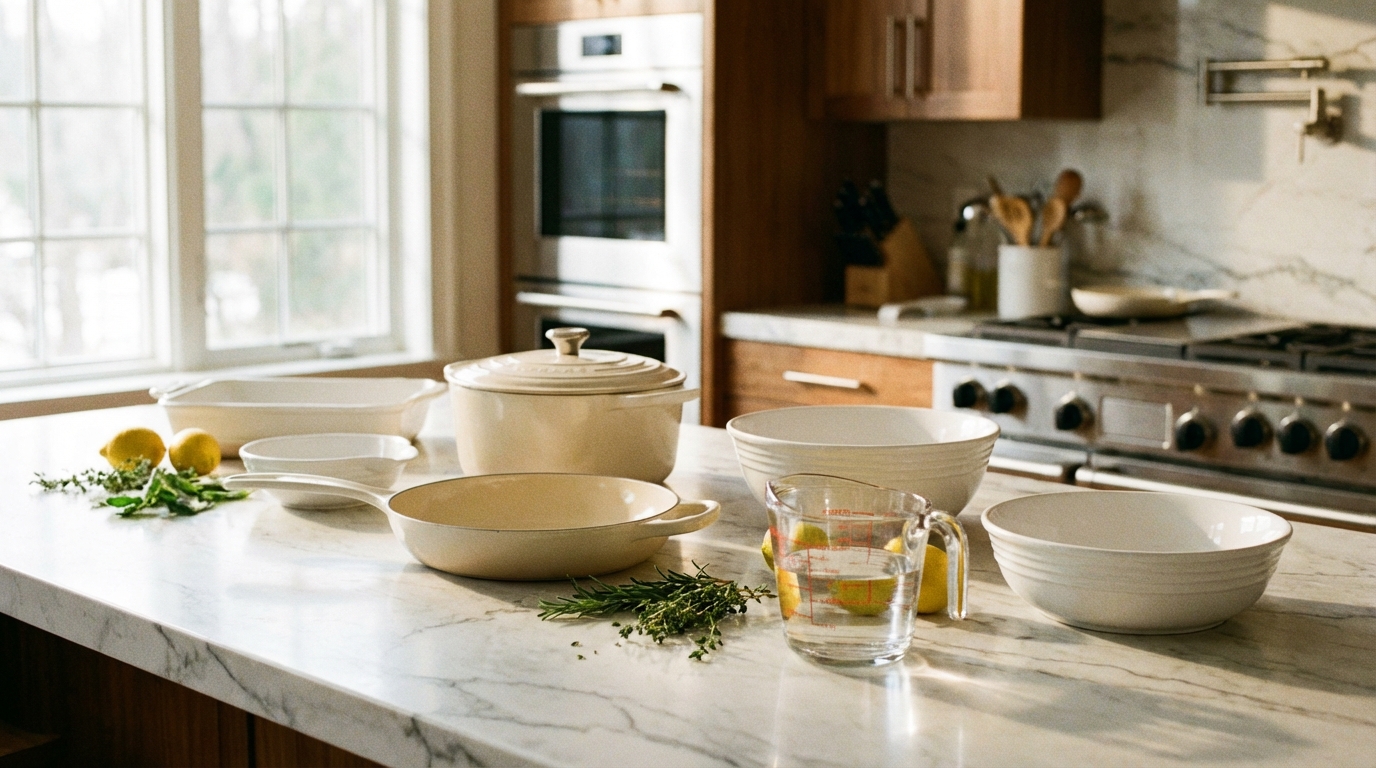
Learn how ceramic-coated pans really perform and how to pick, test and care for ones that stay truly safe. You'll cook with calm confidence knowing your pan is PFAS-free and built to outlast the hype.
Understanding Ceramic Cookware: Materials and Safety
Your "ceramic" pan is just metal sprayed with a proprietary nano-coating--PFAS-free, yes, but the maker won't disclose what else is in it, so "non-toxic" isn't the whole story.
What makes ceramic cookware different?
Here's what most people don't realize: that ceramic pan in your kitchen probably isn't ceramic at all. You're actually cooking on a metal pan--usually aluminum, sometimes cast iron or stainless steel--that's been sprayed with a silica and metal oxide mixture through something called a sol-gel process. The whole thing gets fired at 400 degreesF to 800 degreesF, which sounds hot until you learn that real ceramics need temperatures above 2,000 degreesF.
That's why industry insiders sometimes call these products 'quasi-ceramic.' [1] These pans took off when home cooks started worrying about PTFE (Teflon) and PFOA--and for good reason. These chemicals have been linked to serious health issues and environmental damage. DuPont alone settled more than 3,550 PFOA-related lawsuits. [1] So yes, ceramic-coated pans genuinely avoid those specific chemicals, which is why you see 'non-toxic' on the label.
But here's where it gets complicated: those sol-gel coatings are proprietary blends of silicon- and titanium-based nanoparticles, and manufacturers don't have to tell you exactly what's in them. Without that transparency, it's tough to know if every coating formula is truly harmless. [2] If you're looking for maximum transparency in materials, traditional options like
is ceramic cookware non toxic - the science behind the claim
Let's start with what the science actually shows. The non-toxic label has one rock-solid foundation: these pans really don't contain PFAS. When Consumer Reports tested ceramic-coated pans, screening for 96 different PFAS compounds, they found zero. [4] Makes sense when you look at the chemistry--ceramics are built from silicon dioxide and metal oxides, not PTFE or any PFAS building blocks. There's simply no structural reason these chemicals would show up. [4] But--and this is a big but--the non-toxic label doesn't tell you about everything else in that coating. Independent testing found high titanium levels in several popular ceramic pan brands, suggesting they use titanium dioxide nanoparticles.
Here's why that matters: the EU banned titanium dioxide in food, it's classified as a potential carcinogen, and research links it to intestinal inflammation and neurotoxicity. [5] A 2016 study not only confirmed titanium dioxide in these coatings but showed it can actually migrate into your food while cooking. [5] There's more. Some coatings appear to use siloxanes as nonstick agents--chemicals with their own risk profiles depending on the type. At least one lawsuit claimed a major brand's coating contained silane, aluminum oxide, tetraethoxysilane, and potassium titanate. Some of these compounds are classified as hazardous by regulators. [5] Then there's that aluminum core underneath. Research consistently shows acidic foods accelerate aluminum leaching, and here's the kicker: as the sol-gel coating wears down over time, more of that aluminum substrate gets exposed to your food. [6] We'll dive deeper into how this happens with different foods in the next section.
Bottom line? Ceramic-coated pans aren't categorically dangerous, but calling them "non-toxic" only tells part of the story. They're PFAS-free, yes. Everything else? That's where the proprietary coating formulas and lack of transparency leave us with more questions than answers. [4] [5]
How Leaching Happens: Real Risks and Misconceptions
Your cookware--no matter the type--can quietly leach metals into dinner once it's scratched, overheated, or simply asked to handle acidic foods like tomato sauce.
Common sources of leaching in cookware
Here's what actually happens: every type of cookware can leach under certain conditions--it's not just ceramic-coated pans. Traditional pottery glazes often contain lead that migrates into food when not properly fired, and you'd never taste the difference. [7] With aluminum pans, acidic foods like tomatoes or wine-based sauces speed up metal transfer and can actually pit the surface, which is why you shouldn't store these foods in aluminum. [7] Unlined copper poses similar risks with acidic ingredients--the FDA warns that enough copper leaching can cause nausea, vomiting, and diarrhea. [7] Even stainless steel, which most people consider completely safe, contains chromium and sometimes nickel or molybdenum.
While no health hazards from stainless steel leaching have been confirmed, manufacturers still recommend avoiding prolonged contact with acidic or salty foods. [7] The takeaway? Three factors increase leaching across all cookware: damaged coatings, excessive heat, and acidic ingredients.
For ceramic-coated pans specifically, the risk comes when that sol-gel coating breaks down from overheating. Once compromised, it exposes the aluminum core directly to your food--exactly what the coating was meant to prevent. [1] PTFE pans work the same way: heat them above 570 degreesF and they release various forever chemicals into the air and potentially your food. [1]
Testing methods that reveal potential contaminants
Scientists use two main approaches to detect cookware leaching. First, X-ray fluorescence (XRF) reveals what metals are actually in your pan before you even cook with it.
One study found lead, cadmium, nickel, chromium, and other toxic metals already present in the raw materials of aluminum, steel, and copper cookware. [6] The second method tests what actually transfers to your food. Researchers boil a solution of 4% acetic acid (which mimics acidic foods like tomato sauce) in cookware, then analyze it using specialized equipment to measure exactly which metals leached out and how much. [6][9] This acetic acid test forms the basis of EU and UK safety standards for ceramics.
Studies using this method found cobalt, chromium, cadmium, copper, antimony, and lead migrating from glazed ceramic dishware--and the leaching gets worse with microwaving, dishwashing, or if the surface shows any crazing. [9] What can you do at home? The FDA suggests hardware-store lead test kits for vintage or imported ceramics, though these often can't detect the low levels that California's Prop 65 considers unsafe. [8] The most direct confirmation comes from blood tests--studies have documented elevated aluminum, lead, cadmium, and nickel levels in people who regularly use low-quality aluminum cookware, proving that what happens in lab tests translates to real exposure. [6] For safer cooking,
Practical Tests You Can Do at Home
Run these quick kitchen tests--vinegar soak, lead swab, eye for chips--to catch a failing pan before dinner tastes like metal.
Simple kitchen experiments to check for leachates
The vinegar test checks for acid damage: fill your pan with white vinegar or lemon juice and let it sit for 24 to 48 hours.
Yellow vinegar indicates lead release, while a dulled or discolored surface shows the coating is breaking down and releasing materials. [12] For vintage or questionable cookware, grab a lead test kit from your hardware store--though know that these only detect surface lead and often miss the low levels that California's Prop 65 flags as concerning.
Test two or three times to avoid false readings. [11]
Interpreting results: what's safe for everyday cooking
Here's what these tests won't tell you: how much is actually leaching. You'll know migration is happening if you taste metal or see surface changes, but not whether it's above or below safety thresholds. Only professional lab testing with methods like ICP-MS can measure exact concentrations. [6] If any home test shows problems, stop using that pan for acidic foods immediately--the visible damage proves the coating isn't stable anymore.
Retire any cookware with chips, cracks, or scratches completely, since surface damage speeds up leaching in all materials. With ceramic-coated pans specifically, a damaged coating exposes the aluminum underneath directly to your food. [1] This is why choosing the right construction matters from the start--our stainless steel cookware eliminates the aluminum exposure risk entirely, even as it ages. Think of these home tests as early warning systems: they're quick, cheap ways to spot problems that merit either retiring the pan or investing in professional testing if you need certainty.
For everyday cooking, stick to neutral pH foods with questionable cookware--save the tomato sauce and wine reductions for pans you trust. [6]
None of these home tests produce numbers, which is their core limitation. A metallic taste or surface discoloration tells you migration is occurring--not how much.
That distinction matters because regulatory thresholds for metals like lead, cadmium, and chromium are concentration-based: cookware that visibly fails a vinegar test could still fall below the legal limit, or well above it. Professional leach testing--where a certified lab boils a food simulant like 4% acetic acid in the pan and measures what transfers using atomic absorption spectrophotometry or ICP-MS--is the only method that produces data you can act on. [6] If a home test flags a problem, the practical response is to stop using that pan for acidic foods regardless of whether you pursue lab confirmation, since the visible surface change already proves the coating is unstable.
Damaged, crazed, or scratched coatings should be retired entirely: surface degradation accelerates migration across all cookware materials, and with ceramic-coated pans specifically, a decomposed sol-gel layer exposes the aluminum substrate directly to food. [1] For everyday cooking, neutral foods carry the lowest risk--lab data consistently show minimal leaching under neutral pH conditions--while highly acidic ingredients like tomato sauce represent the highest-risk scenario across aluminum, copper, and ceramic-coated pans alike. [6]
Choosing Durable, Non‑Toxic Ceramic Pans for Daily Use
Pick a ceramic pan whose core stays food-safe even after the coating chips--like Made In's stainless-steel-clad CeramiClad or hard-anodized GreenPan--and back it up with brands that publish third-party lab data proving it.
Features of high‑quality ceramic cookware that stay safe
The single most useful safety indicator in a ceramic-coated pan is what sits directly beneath the coating. Most ceramic-coated pans use an aluminum core, which means a degraded or scratched coating exposes aluminum directly to food--the exact leaching scenario the coating was meant to prevent.
Made In's CeramiClad addresses this by building its ceramic coating over a 5-ply stainless steel body rather than bare aluminum, so even when the nonstick surface wears down, the layer beneath it is food-safe stainless steel rather than a reactive metal. [13] For pans that do use aluminum cores, hard-anodized construction--used by GreenPan's Valencia Pro--creates a pre-treated, scratch-resistant surface that adds a meaningful buffer between the aluminum substrate and the coating above it. [14] Beyond the core, coating thickness and reinforcement predict longevity more reliably than brand claims: diamond-infused ceramic coatings, like GreenPan's Thermolon, resist surface damage significantly better than standard ceramic layers and are rated oven-safe up to 600 degreesF, which itself signals structural integrity under thermal stress. [14]Third-party testing is where safety claims either hold up or fall apart. Brands worth trusting publish actual test results rather than vague PFAS-free labeling.
Alva Cookware, for example, has completed at least 24 separate migration, content, and composition tests confirming compliance with EU food contact standards (EC1935:2004) as well as German, Italian, French, and Dutch food safety regulations--plus specific tests confirming the absence of PFOA and PFOS. [13] Caraway submits its cookware to globally accredited third-party labs including SGS and TÜV, and carries California Prop 65 certification, which screens for more than 800 compounds linked to cancer or reproductive harm. [14] GreenPan holds NSF certification--an independent food safety and toxicity standard--and was the first ceramic nonstick brand to achieve it. [14] Warranty length is a secondary but meaningful signal: Alva offers a 10-year warranty on ceramic nonstick, and Xtrema backs its pure ceramic cookware with a 10-year warranty plus a first free replacement policy, both indicating that the manufacturer expects the material to hold up under real use rather than controlled lab conditions. [15]
Caring for your pans to maintain non‑toxic performance
Your ceramic pan's lifespan depends on three simple rules: moderate heat, gentle cleaning, and smart storage. Heat destroys ceramic coatings faster than anything else. As discussed earlier, the aluminum core and ceramic coating expand at different rates, creating invisible stress fractures that eventually lead to failure. [16] Stick to medium heat for almost everything--you'll get the same results without the damage. Let cold pans warm to room temperature before heating, and never run cold water over a hot pan. Both create thermal shock that weakens the coating bond. [17] Hand wash your ceramic cookware--always. Dishwashers use alkaline detergents and high heat that break down ceramic coatings. [17] For stuck food, soak for 10-15 minutes, then use a soft sponge.
Stubborn spots? Make a paste with baking soda and water. It cleans without scratching. [18] Use silicone or wooden utensils exclusively. One scrape from a metal spatula creates micro-scratches that compound into a rough, food-sticking surface. This isn't a preference--it's essential for coating longevity. [17] Store pans with care. Stacking them directly creates pressure points that damage the coating.
Use pan protectors or hang them separately. [18] Every few months, wipe a thin layer of neutral oil (vegetable or sunflower work well) on the warm pan to fill microscopic surface irregularities and maintain nonstick performance. Avoid cooking sprays--they leave residue that degrades the coating faster than regular oil. [18] Know when to retire your pan. When food starts sticking regularly or you see any flaking or peeling, it's done. Using a degraded ceramic pan defeats the entire purpose--you're now cooking on exposed aluminum, exactly what the coating was supposed to prevent. [16]
- Ceramic pans are metal sprayed with silica, not true ceramic.
- Titanium dioxide nanoparticles can migrate into food.
- Damaged coatings expose aluminum to acidic foods.
- Vinegar test reveals coating breakdown in 24-48 hours.
- Stainless cores eliminate aluminum leaching risk.
- Hand wash only; dishwashers destroy ceramic coatings.
- Retire pan when food sticks or coating flakes.
- https://ceramics.org/ceramic-tech-today/ceramic-coated-cookware-safety/
- https://www.seriouseats.com/nonstick-vs-ceramic-skillets-7110252
- https://www.organicauthority.com/guide/cookware-safety-what-is-leaching
- https://www.consumerreports.org/toxic-chemicals-substances/you-cant-always-trust-claims-on-non-toxic-cookware-a4849321487/
- https://www.theguardian.com/lifeandstyle/2025/jun/09/ceramic-nontoxic-cookware
- https://pmc.ncbi.nlm.nih.gov/articles/PMC10386729/
- https://hgic.clemson.edu/factsheet/cookware-safety/
- https://www.consumerreports.org/lead/why-you-should-test-your-vintage-or-imported-dishes-for-lead-a2722202665/
- https://www.nal.usda.gov/research-tools/food-safety-research-projects/investigation-migration-metals-glazed-ceramic-ware
- https://miriamsearthencookware.com/mec-blog/the-baking-soda-test-a-simple-reliable-method-to-test-cookwares-toxicity-in-your-kitchen/?srsltid=AfmBOory6Rqoy8J5kpH1PCn8PMBTG4_LMYEz1Lejj0mKamTl0Y1JUTx0
- https://www.leafscore.com/eco-friendly-kitchen-products/cookware/test-cookware/
- https://digitalfire.com/test/glle
- https://www.leafscore.com/eco-friendly-kitchen-products/non-toxic-nonstick-pans/
- https://www.organicauthority.com/organic-food-recipes/non-toxic-cookware-brands-to-keep-chemicals-out-of-your-food
- https://alva-cookware.us/blogs/news/best-healthy-ceramic-cookware-sets-2026-889-10?srsltid=AfmBOoqSykoR7ufe796hh4WmkEBYVA0d6t-X8iLx2r3hTSYVEYrC1sX1
- https://xtrema.com/blogs/blog/everything-you-need-to-know-about-ceramic-coated-cookware?srsltid=AfmBOor7XXFo_nAndMuNIjggsoFz6IqLiDnxfEurtbxkoZFNlMt_4sP7
- https://homeec.io/blogs/home-ec-blog/how-to-care-for-ceramic-cookware-so-it-lasts
- https://crumble.co/blogs/articles/how-to-clean-and-maintain-ceramic-cookware?srsltid=AfmBOoo1xZkdA52W1z1Dsi8XPhh3phnGfcz_iADfFXW9PIA40n0R6Sev