

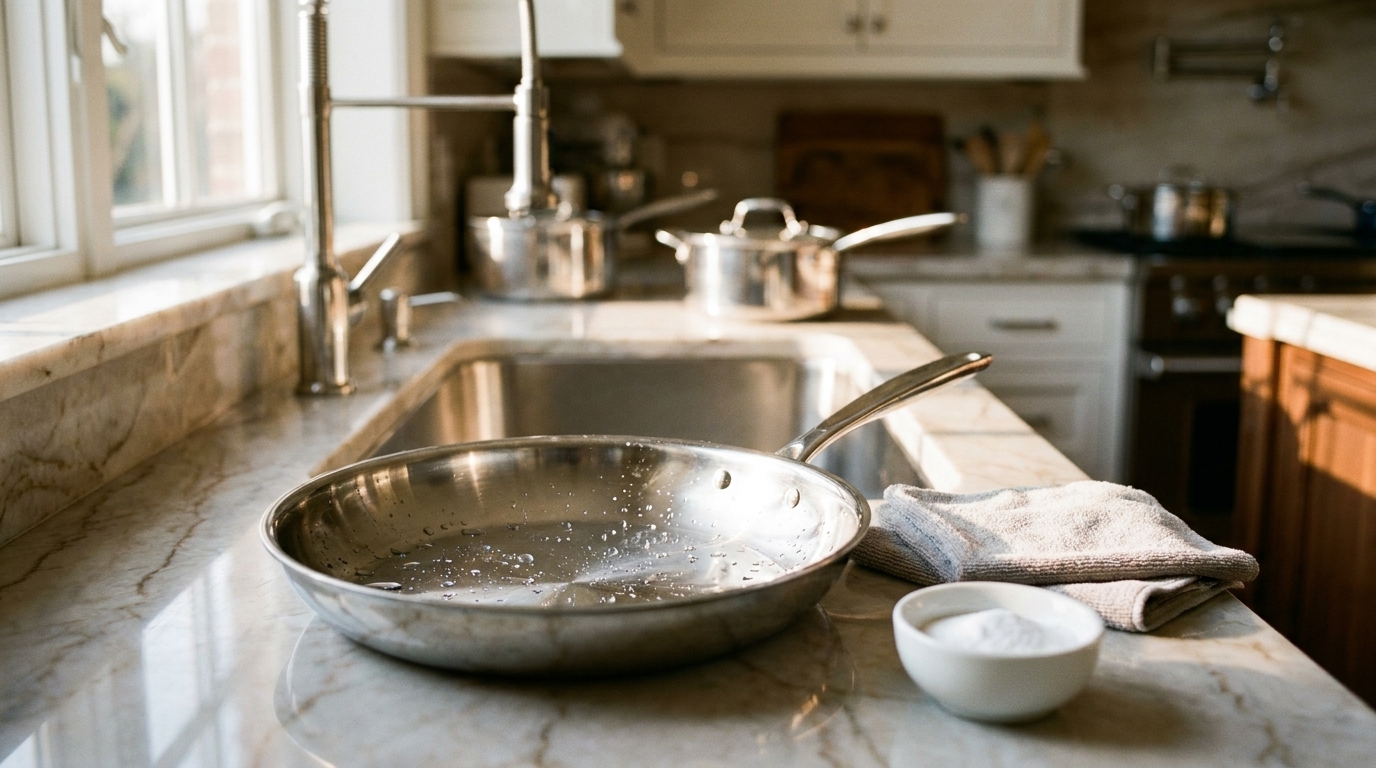
Stainless steel resists rust through a self-healing chromium oxide layer, but salt, acidic foods, standing water, and abrasive cleaning can break it down and cause corrosion. Daily hand-washing, immediate drying, proper storage, and periodic oil treatments prevent rust while simple fixes like baking soda paste restore minor surface damage.
Yes, Stainless Steel Can Rust--Here's Why It Happens
Chlorides, acids, abrasive scrubbing, and contact with dissimilar metals all compromise stainless steel's protective oxide layer, exposing the iron beneath to rust.
The Science: Why 'Stainless' Doesn't Mean 'Rustproof'
The term 'stainless' refers to resistance, not immunity. To qualify as stainless steel, an alloy must contain at least 10.5% chromium, which reacts with oxygen to form a passive chromium oxide layer just one to three nanometers thick on the metal's surface [1].
This invisible film blocks oxygen and moisture from reaching the iron beneath -- and it self-repairs automatically when lightly scratched or damaged [2]. But it has real limits: chloride exposure, acidic conditions, physical abrasion, and heat can all degrade this layer, leaving the iron in the alloy exposed to oxidation and, eventually, rust [1].
Common Triggers That Break Down the Protective Layer
Galvanic corrosion is one trigger that catches many home cooks off guard: when stainless steel stays in prolonged contact with a dissimilar metal -- like cast iron or carbon steel -- in the presence of moisture, an electrochemical reaction accelerates passive film breakdown. [4] Chloride ions from salt and brine are especially destructive because they penetrate microscopic surface flaws and cause pitting, small but deep corrosion spots that spread inward and resist surface-level cleaning. [5] Abrasive scrubbing pads and metal utensils physically remove the passive layer faster than it can regenerate, and strong acids like vinegar or citrus juice can chemically strip it on contact -- particularly during prolonged cooking or soaking. [5]
What Causes Stainless Steel to Rust in Your Kitchen
Salt, acidic foods, and standing water damage stainless steel through repeated exposure, while proper drying and smart storage prevent most kitchen rust.
Salt, Water, and Acidic Foods: The Three Main Culprits
The three most common kitchen culprits -- salt, standing water, and acidic foods -- damage stainless steel through repeated exposure rather than single incidents.
Tomatoes, citrus, and vinegar-based sauces are especially problematic because their acidity persists throughout cooking; one study found that nickel and chromium concentrations in tomato sauce increased up to 26-fold after six hours of simmering in a stainless steel pan, with new cookware leaching the most. [6] Sea salt and high temperatures together accelerate surface discoloration and pitting, particularly when salt is added to a cold, dry pan before any liquid. [7] Standing water is a quieter threat -- moisture left on the surface after washing keeps conditions favorable for oxidation, especially when the passive film already has damage, making thorough drying a core step in cleaning stainless steel pans. [7]
Surface Damage and Metal-to-Metal Contact That Accelerates Corrosion
When cast iron or carbon steel rests against stainless steel in a shared sink or stacked drawer, iron particles transfer to the stainless surface and rust there -- a process called flash rusting that's frequently mistaken for the stainless pan itself corroding. [9] Unlike pitting caused by chlorides, flash rust sits on top of the surface and often lifts off with targeted cleaning, but it signals that your storage habits are creating repeated passive layer disruptions. [8] Abrasive cleaning tools add a second layer of risk by carving micro-abrasions that become hotspots for corrosion before the passive layer can self-repair. [9] Keeping dissimilar metals separated -- and understanding how cast iron and stainless steel interact day-to-day -- stops both problems at the source.
How to Prevent Rust: A Maintenance Checklist for Stainless Steel Cookware
Daily hand-washing, immediate towel-drying, and periodic oil treatments form the foundation of rust prevention for stainless steel cookware.
Daily Cleaning and Drying Habits That Stop Rust Before It Starts
Rust prevention at the daily level comes down to three habits: wash soon after cooking, dry completely, and avoid the dishwasher.
Once the pan has cooled, hand-wash with warm water and a few drops of mild dish soap using a soft sponge -- enough to clear food residue and oil without scratching the passive layer. [11] Air-drying is the main culprit behind water spots and mineral deposits, both of which keep moisture against the metal surface, so towel-dry each pan immediately after rinsing. [10] Avoiding the dishwasher matters too: harsh detergents and high heat can dull the finish and warp the pan over time, even on cookware labeled dishwasher-safe -- and if you want to reduce stuck-on residue that makes post-cook cleanup harder, how you cook matters as much as how you clean. [11]
Long-Term Care: Storage, Seasoning, and Protective Treatments
Beyond daily cleaning, storage habits and periodic oil treatments extend the passive layer's resilience between uses. Store pans in a dry spot -- stacking without protection creates micro-abrasions, so pan protectors or a folded kitchen towel between pieces preserves the surface [13].
Applying a thin coat of high-smoke-point oil, like vegetable or rapeseed oil, after washing creates a light barrier against ambient moisture: heat the pan over medium heat, add the oil, let it smoke briefly, then wipe down to leave only a thin film -- repeating two to three times builds a more durable protective coating [12]. If you're unsure which fats polymerize properly versus going rancid on a hot surface, this breakdown of how butter and oils behave when heating a pan helps you choose the right one for this step.
How to Remove Rust and Restore Stainless Steel Cookware
Most stains on stainless steel are harmless--only deep pitting requires replacement, while surface rust responds well to baking soda or Bar Keepers Friend.
Spotting Early Rust: Discoloration vs. True Corrosion
Not every mark on a stainless steel pan signals corrosion.
Rainbow-colored heat tint -- running from yellow through blue or purple -- forms when high heat thickens the chromium oxide layer and shifts the wavelengths of light it reflects; it's optical, not structural, and leaves cooking performance unaffected. [14] White hazy deposits are calcium carbonate left by tap water minerals, not metal degradation, and dissolve when treated with an acidic solution like diluted white vinegar. [14] Reddish-brown spots are different and worth taking seriously: in early pitting, only small discolorations or shallow depressions appear at the surface, but the damage beneath frequently widens into a trough shape -- meaning the visible mark understates how far corrosion has already progressed into the metal. [15]
DIY Removal Methods and When to Seek Professional Help
Surface rust responds to a baking soda paste -- three parts baking soda to one part water -- applied to the affected area, left 15-20 minutes, then scrubbed with a soft cloth along the grain and rinsed. [16] For stubborn spots, soak in white vinegar for up to an hour, then apply baking soda to neutralize the acid before the final rinse. [16] Bar Keepers Friend cuts through tougher oxidation faster and restores shine more fully than baking soda alone, but rinse it off within a minute to prevent surface discoloration. [17] When pitting is deep or widespread, no household method reverses that structural damage -- replacing the pan with a quality stainless skillet is the practical move. [16]
- Stainless steel resists rust through a chromium oxide layer that self-repairs when lightly damaged, but chlorides, acids, and abrasion can degrade it.
- Salt, standing water, and acidic foods like tomatoes and vinegar are the top kitchen culprits that damage stainless steel through repeated exposure.
- Hand-wash with mild soap and soft sponges, dry immediately with a towel, and avoid the dishwasher to prevent rust and surface damage.
- Store pans separately with protective layers between them, and apply thin coats of high-smoke-point oil periodically to strengthen the passive layer.
- Flash rust from contact with cast iron or carbon steel sits on the surface and lifts off with cleaning, but pitting from chlorides causes deep structural damage.
- Heat tint and mineral deposits are harmless; treat surface rust with baking soda paste, white vinegar soaks, or Bar Keepers Friend for restoration.
- Deep pitting cannot be reversed with household methods and signals that replacement is the practical choice for the cookware.
- https://jhmim.com/can-stainless-steel-really-rust/
- https://m.sakysteel.com/news/stainless-steel-corrosion-resistance-what-you-need-to-know
- https://www.amardeepsteel.com/blog/does-stainless-steel-rust.html
- https://www.delmet.it/en/stainless-steel-and-rust/
- https://www.lianjer.com/what-is-the-enemy-of-stainless-steel/
- https://pmc.ncbi.nlm.nih.gov/articles/PMC4284091/
- https://www.fsrmagazine.com/feature/the-unseen-science-of-your-restaurants-stainless-steel/
- https://www.reliance-foundry.com/blog/how-to-clean-stainless-steel?srsltid=AfmBOoorRK3htc116AIZY8zgim_89SWKI-E3Af2OmuYETNksEY7gcqrr
- https://www.thenafemshow.org/8-ways-to-protect-stainless-steel/
- https://chopchopusa.com/blogs/news/how-to-make-stainless-steel-cookware-last-a-lifetime
- https://williamsfoodequipment.com/blog/does-stainless-steel-rust-a-practical-guide-for-kitchen-equipment/?srsltid=AfmBOoqMw9f386hStU8xIvkzHdbU9LQzniv4SJLcreVilxy-Z7Qj9K6u
- https://www.purecook.com/how-to-condition-stainless-steel-cookware/
- https://www.kitchentoolsadvisor.com/why-cookware-rusts-even-after-drying/
- https://thecookwareadvisor.com/6-stains-on-stainless-steel/
- https://www.behaelter-kg.de/en/insights/Pitting-corrosion-and-rust-on-stainless%20steel-What-are-the-causes-and-solutions.html
- https://williamsfoodequipment.com/blog/cookware-and-utensils-how-to-deal-with-rust-on-different-materials/?srsltid=AfmBOoruckPqc_D_3SDyZiF9wLHGeX6dqY1CeAELSf4tdF4n5PlFZ81j
- https://www.nytimes.com/wirecutter/guides/how-to-clean-stainless-steel-pans/