

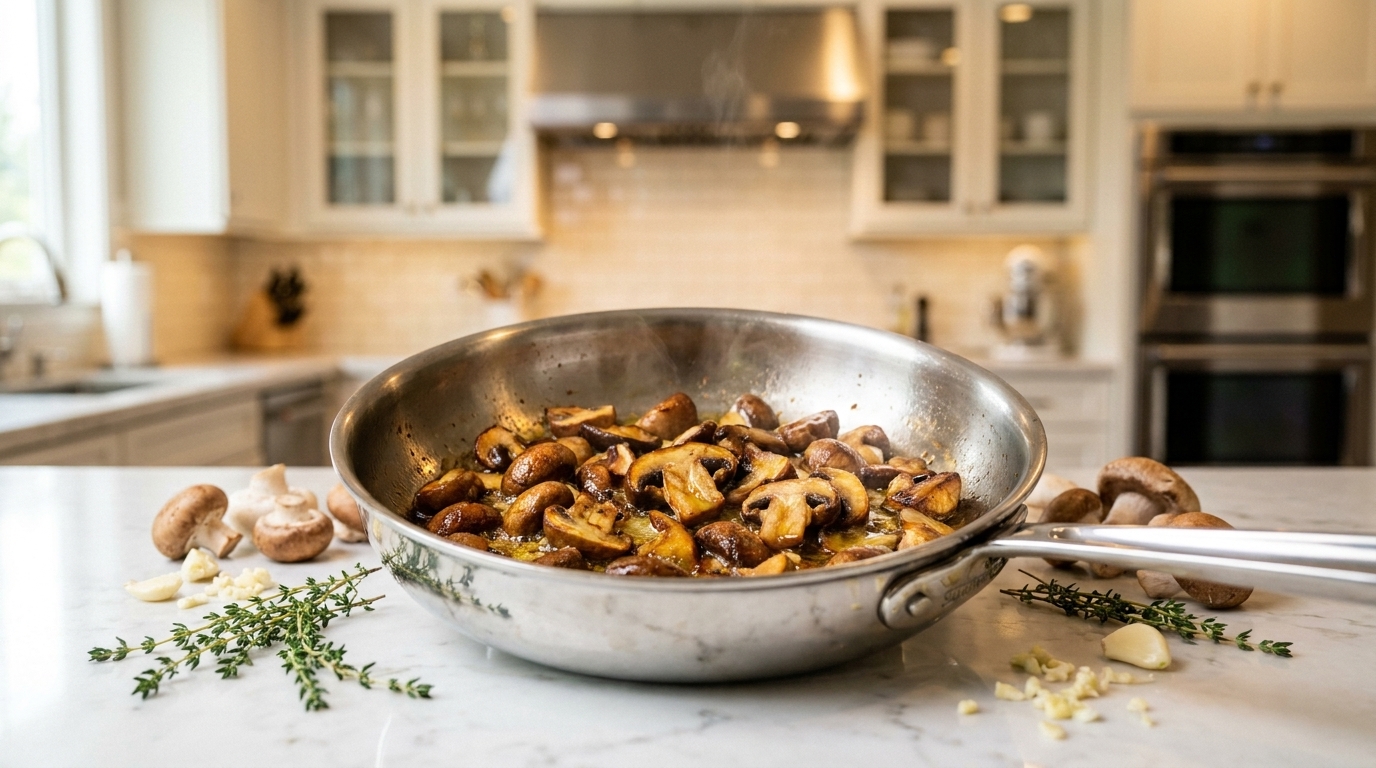
Master sautéing mushrooms by selecting the right varieties, prepping consistently, and using proper heat and pan technique to achieve golden-brown results. The key is resisting the urge to stir or overcrowd, letting mushrooms develop a flavorful crust through sustained contact with a hot surface.
Selecting and Preparing Mushrooms
Mixing two or three mushroom varieties in one pan layers flavors and textures in ways a single type cannot match.
Choosing the right mushroom varieties
Button, cremini, and portobello mushrooms are the easiest to source and sauté reliably, but branching out opens up noticeably better flavor. Shiitake caps deliver a meaty, umami-forward taste that holds up to high heat, while oyster mushrooms bring a clean savory note and maitake a nutty, slightly smoky depth -- all three increasingly available in standard supermarkets [1].
For anyone learning how to sauté mushrooms, mixing two or three varieties in one pan is worth trying -- textures and flavors layer in ways a single type can't match [1]. Whatever you pick, look for firm, dry mushrooms with no soft spots or surface moisture before you start.
Cleaning techniques for different mushroom types
Most cultivated mushrooms need nothing more than a dry paper towel wipe; if they're visibly dirty, a quick rinse under cold water and a spin in a salad spinner works fine. [3] Mushrooms absorb only about 1-2% of their weight when rinsed, which won't affect your sauté as long as you cook them right after. [3] Portobello caps need extra prep: pull out the woody stem and scrape the dark gills with a spoon tip, since the gills turn everything in the pan muddy brown. [3] Shiitake stems are too fibrous to eat and should be pinched off at the base; for oyster mushrooms, just run a knife around the central stem and the caps fall away. [3]
Proper slicing and sizing for even cooking
Consistent sizing matters more than slice thickness -- the goal is for all pieces to release moisture and brown at roughly the same rate.[4] For cremini and white button mushrooms, halve small caps (1 to 1½ inches in diameter) and quarter larger ones; portobello caps should be halved and then cut into ½-inch pieces.[4] Oyster mushrooms tear cleanly into 1-inch pieces by hand, while shiitake caps follow the same halve-or-quarter logic as cremini based on diameter.[4] Cutting any variety too thin risks over-drying before the exterior browns -- the result is leathery texture instead of the meaty bite you're after.[4]
Essential Equipment and Ingredients
A 10- to 12-inch stainless steel or carbon steel pan, high smoke-point oil, and butter give you the foundation for perfectly browned mushrooms with rich, savory flavor.
Selecting the ideal pan for sautéing
For sautéing mushrooms, a 10- to 12-inch stainless steel or carbon steel pan is your best option -- both handle high heat well and brown food effectively without reacting with acidic additions like wine or vinegar. [5] Stainless steel responds quickly to temperature adjustments, which helps you push past the steaming phase the moment mushrooms start releasing moisture. [6] Carbon steel builds a natural seasoning over time and is lighter than cast iron while delivering comparable heat performance for high-heat cooking. [5] Nonstick surfaces aren't suited for this task -- they can't reach the temperatures needed for proper browning, and the coating suffers under sustained high heat. [7]
Choosing the right fats: butter vs. oil
Fat choice is a two-stage decision.
Start with a high smoke point oil -- olive oil, avocado oil, or grapeseed oil all work -- because butter burns before mushrooms have a chance to properly brown at the temperatures this technique requires. [8] Once the mushrooms are golden and most of their moisture has cooked off, reduce the heat and add butter; it melts into a glossy coating and delivers richness that oil alone can't match. [8] Using oil to raise the pan's smoke point and finishing with butter for flavor gives you a properly browned exterior and a savory, silky result without either fat working against you. [9]
Seasoning options to enhance flavor
Mushrooms respond well to three seasoning categories: aromatics, sauces, and dry spices. [12] Garlic is the most reliable starting point -- add minced cloves once the mushrooms have browned and the pan heat has dropped slightly, so they soften without burning. [11] Soy sauce and seasoned rice wine vinegar deliver a savory-sweet depth that works across all common varieties; a pinch of chili flakes alongside them adds a clean back heat. [10] Fresh flat-leaf parsley, thyme, or dill work best as finishing herbs -- added off the heat so their brightness survives. [10] Salt goes in after browning, not before -- early salting draws out moisture and slows the crust you're building. [11]
The Sautéing Process
Preheating your pan and letting mushrooms sit undisturbed allows one side to develop a golden crust before you stir, just like searing meat.
Achieving the perfect heat level
Start with a dry pan brought to just over medium heat before adding any fat -- preheating ensures the fat distributes evenly the moment it hits the surface [13]. Once the oil shimmers or the butter is fully melted and beginning to foam, add the mushrooms [13].
Around the 5-minute mark, mushrooms will release liquid into the pan; the sound shifts from sizzling to bubbling and the pan temperature drops momentarily -- don't drain it [13]. Raise the heat slightly to push through this steaming phase, and browning resumes once the liquid has fully evaporated and the pan is dry again [13].
If you're using stainless steel, learning how to manage heat with stainless steel makes navigating these temperature shifts much easier.
Proper mushroom placement in the pan
Once the pan is hot and the oil is ready, place mushrooms cut side or flat side down to maximize contact with the cooking surface. [14] A single layer is non-negotiable -- visible gaps between pieces let moisture escape as steam rather than pool, which is what allows browning to happen. [15] Resist filling the pan just because there's space; cooking in batches raises browning success measurably compared to crowding everything in at once. [14] If pieces overlap or touch, the trapped moisture drops the pan temperature and shifts the cook from searing to steaming before color has a chance to develop. [14]
Timing and flipping techniques for even browning
Once mushrooms are in the pan and moisture has cooked off, resist the urge to stir -- leaving them undisturbed for 3 to 4 minutes lets one side develop a proper crust before you move them, the same principle behind building a sear on steak. [16] A useful audio cue: when you hear the pan shift from bubbling to a dry squeak, moisture has fully evaporated and browning can begin. [17] From that point, occasional stirring every few minutes is enough to color multiple sides without disrupting each new contact point as it forms. [4] Total browning time after moisture has cooked off runs roughly 15 minutes over medium-high heat -- longer than most people expect, but cutting it short is what produces pale, limp mushrooms instead of deeply colored ones. [4]
Common Mistakes to Avoid
Overcrowding traps steam and prevents browning, while constant stirring breaks the contact needed for a crust--use two pans or work in batches instead.
Overcrowding the pan and its consequences
The core reason overcrowding fails comes down to temperature: the Maillard reaction -- the chemical process responsible for the deep, savory flavor in properly sautéed mushrooms -- only occurs above 280 degreesF, while boiling water maxes out at 212 degreesF, meaning a pan full of pooled moisture is physically incapable of browning food. [18] When mushrooms are packed too closely, released moisture has no escape route, collects at the bottom of the pan, and keeps the cooking environment below the threshold needed for browning to start. [18] Overcrowding also creates uneven results -- mushrooms in direct contact with the pan surface may steam from below while pieces on top barely cook at all. [20] Using two pans simultaneously or working in batches is the straightforward fix; it takes longer, but it's the only way to consistently hit the temperatures browning actually requires. [19]
The pitfalls of frequent stirring
Frequent stirring prevents browning by breaking the contact that makes it possible -- mushrooms brown where their cut surface presses directly against hot metal, and every time you move them, that contact resets.[21] Constant movement also agitates moisture rather than letting it evaporate, keeping the pan temperature lower than browning requires.[21] The instinct to stir is usually strongest right after the mushrooms go in, which is exactly when leaving them alone matters most.[22] Mushrooms that are constantly moved will never develop color -- they need sustained contact with a hot surface to form a crust.[21]
Seasoning errors that affect taste and texture
The taste and texture penalty for early salting is measurable: testing showed mushrooms salted at the start of cooking took longer to finish, reduced less in volume, and turned out noticeably tougher -- especially delicate varieties like maitake -- compared to those seasoned near the end.[23] Less reduction means less concentrated flavor, since the savory depth in sautéed mushrooms comes from moisture evaporating and solids intensifying in the pan.[23] Garlic added too early faces the reverse problem -- rather than turning tender and savory, it scorches at browning temperatures and introduces bitterness that can't be corrected afterward.[24] Both timing errors share the same fix: build the sear first, then add seasoning and aromatics once the pan has come off peak heat.[24]
Advanced Techniques and Variations
Stage your aromatics by cooking shallots first, then adding garlic and herbs near the end to preserve their distinct flavors and prevent scorching.
Incorporating aromatics and herbs
Aromatics work in two stages: shallots go in first, sweated in butter for 1-2 minutes before the mushrooms are added, building a savory base that works into the fat early on. [4] Garlic and woodsy herbs -- thyme and rosemary are the most reliable choices -- come in near the end, once browning is complete and the pan has dropped below peak heat. [4][25] About 30 seconds over moderate heat is enough to soften the raw edge of the garlic and release the oils from the herbs without scorching either. [4] This staging keeps each aromatic in its optimal window rather than cooking everything at the same temperature for the same duration. [4]
Deglazing the pan for extra flavor
Deglazing captures the fond -- the browned bits stuck to the pan bottom after sautéing -- by adding liquid and scraping them up, dissolving concentrated flavor that would otherwise stay behind. [26] A tablespoon of white wine vinegar with a splash of water is enough: add it after browning is complete and aromatics have cooked through, scraping as the liquid sizzles and reduces in about a minute. [4] For a richer result, substitute ¼ cup of dry red or white wine and let it reduce fully, or add ½ cup of chicken broth after deglazing and simmer until halved -- the emulsified liquid coats the mushrooms in a glossy, savory finish. [1] Any mild acid or stock works; match the liquid to the flavor profile of the rest of the dish. [26]
Experimenting with different cooking liquids
Beyond wine and broth, cream and balsamic glaze open up noticeably different flavor directions worth trying.
A splash of heavy cream added after browning -- about 2 to 3 tablespoons per pound of mushrooms -- simmers into a glossy, rich coating that works over pasta, polenta, or toast.
Balsamic glaze stirred in off peak heat reduces in under a minute and delivers a sweet-acidic depth that pairs particularly well with meatier varieties like portobello or shiitake. [27] The principle is consistent across all options: add liquid only after browning is complete, let it reduce fully, and match the liquid to the flavor profile of whatever dish the mushrooms are going into. [27]
- Use a 10-12 inch stainless steel or carbon steel pan--nonstick can't reach browning temperatures.
- Start with high smoke point oil, then add butter after browning for flavor without burning.
- Never overcrowd the pan; cook in batches so mushrooms brown instead of steam.
- Leave mushrooms undisturbed for 3-4 minutes to develop a crust before stirring.
- Salt and garlic go in after browning; early seasoning draws moisture and slows browning.
- Total browning takes roughly 15 minutes over medium-high heat after moisture evaporates.
- Deglaze with wine or broth after browning to capture fond and add glossy finish.
- https://www.americastestkitchen.com/articles/1196-new-school-sauteed-mushrooms
- https://www.epicurious.com/expert-advice/clean-mushrooms-easy-raw-cooked-article
- https://www.seriouseats.com/knife-skills-how-to-clean-shiitake-portobello-oyster-mushrooms
- https://www.seriouseats.com/sauteed-mushrooms-recipe-7972096
- https://firstpagerecipes.com/blog/right-pan-for-the-job
- https://www.marthastewart.com/1541812/how-choose-between-stainless-steel-nonstick-cast-iron-cookware
- https://www.foodandwine.com/best-frying-pans-8384974
- https://www.rachelcooks.com/sauteed-mushrooms-with-garlic-butter/
- https://www.twopurplefigs.com/steakhouse-mushrooms/
- https://weekendatthecottage.com/sauteed-mushroom-recipe/
- https://mayihavethatrecipe.com/sauteed-mushrooms/
- https://www.mushroomcouncil.com/articles/seasonings-sauces-to-take-mushrooms-to-the-next-level/
- https://naturalcomfortkitchen.com/how-to-saute-mushrooms/
- https://lifetips.alibaba.com/kitchen-hacks/how-to-saute-mushrooms
- https://chefscircle.co.uk/the-chefs-circle-academy/knife-skills-cutting-techniques/10-pro-saute-tips-to-nail-high-heat-without-smoky-chaos/
- https://www.bowlofdelicious.com/sauteed-mushrooms/
- https://www.delish.com/food/a62270396/best-way-cook-mushrooms/
- https://www.delish.com/kitchen-tools/kitchen-secrets/a62639977/dont-overcrowd-your-pan/
- https://www.simplycookingrecipes.com/how-to-guides/why-restaurant-mushrooms-taste-better
- https://www.businessinsider.com/mistakes-when-cooking-on-stove-2019-5
- https://www.tastingtable.com/1765201/common-mistakes-cooking-mushrooms/
- https://www.sun-sentinel.com/2017/12/05/how-to-saute-mushrooms-to-crispy-browned-perfection/
- https://www.epicurious.com/ingredients/when-are-you-actually-supposed-to-salt-mushrooms-article
- https://www.thechoppingblock.com/blog/five-steps-to-saut%C3%A9ing-mushrooms
- https://cravingsomethinghealthy.com/sauteed-mushrooms/
- https://www.marthastewart.com/how-to-deglaze-pan-8608238
- https://www.gimmesomeoven.com/white-wine-sauteed-mushrooms/