

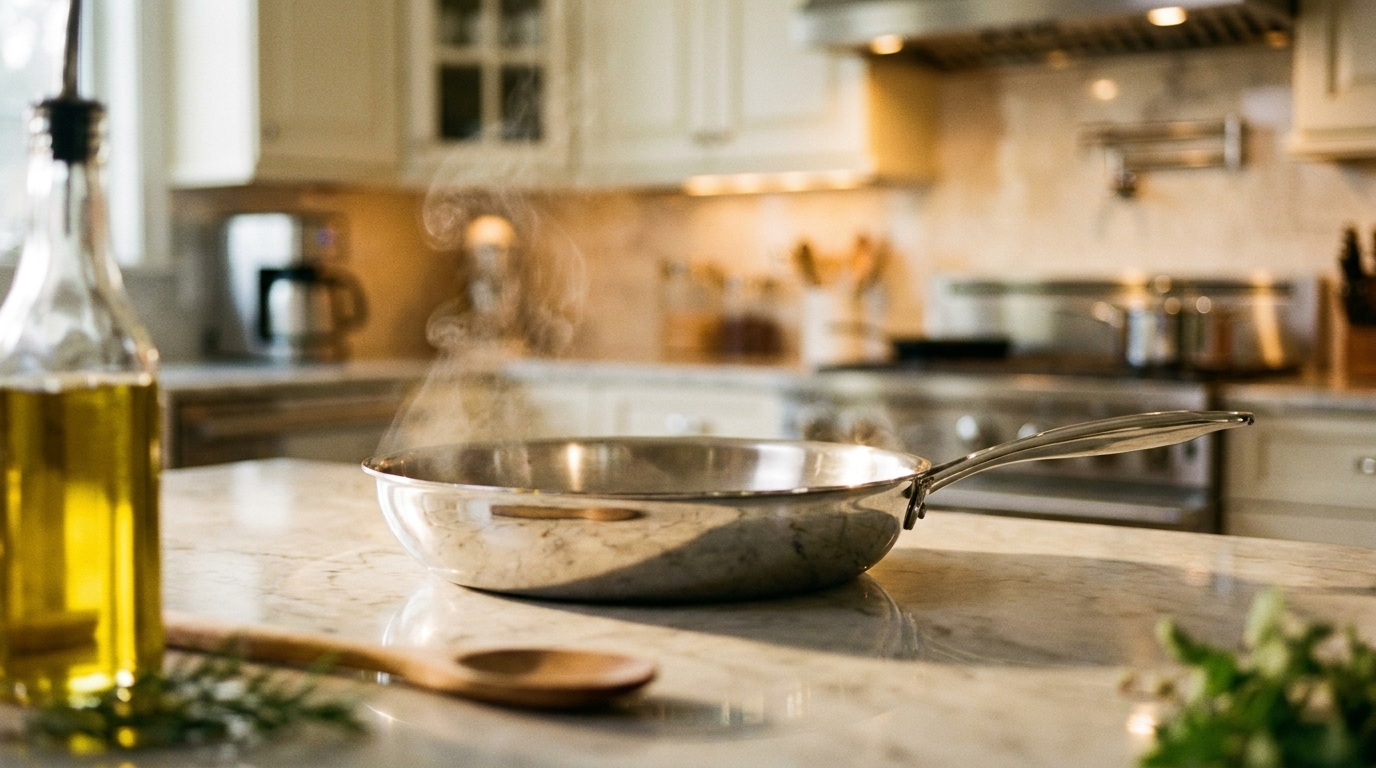
Uncoated stainless steel skillets offer genuine safety because they contain no synthetic coatings that peel, flake, or release chemicals into food--unlike nonstick surfaces where 'PFOA-free' labels don't guarantee the absence of PTFE or other harmful compounds.
Understanding What Makes a Skillet Non-Toxic
Uncoated stainless steel won't peel, flake, or release chemicals at cooking temperatures, while PTFE coatings and PFAS compounds carry real health risks regardless of label claims.
Materials that stay pure: stainless steel vs. coatings
The core difference between a non toxic stainless steel pan and coated cookware comes down to material integrity at high heat.
Stainless steel requires no synthetic coatings -- nothing peels, flakes, or off-gasses into food, which is why it's specified for applications where safety and hygiene are non-negotiable. [1] PTFE-based nonstick surfaces release gases and chemicals at normal cooking temperatures, and a 'PFOA-free' label alone doesn't confirm the pan is free from PTFE or other PFAS compounds. [1] [2] If you're new to uncoated pans, learning how to cook with stainless steel makes the adjustment straightforward.
How "non toxic stainless steel pan" standards are defined
"Non-toxic" has no official regulatory definition in U.S. cookware markets -- the FDA doesn't regulate the term, so any brand can apply it without independent verification. [4] Standards that carry actual weight include NSF certification, EU Regulation EC 1935/2004 (which governs food-contact materials), Germany's stricter LFGB standard, and California's Proposition 65, which sets enforceable limits on heavy metal migration. [3] When shopping for a non toxic stainless steel pan, third-party lab documentation is a more reliable signal than label claims alone -- our breakdown of what PTFE labels actually disclose shows exactly what those terms do and don't guarantee. [4] The EU's move to ban all PFAS in cookware is gradually setting a clearer baseline for what chemical-free construction means in practice. [3]

Key Features to Look for in a Safe Stainless Skillet
Third-party lab testing and migration documentation prove a pan won't leach harmful substances--packaging claims alone aren't enough.
Construction quality: 18/10 stainless, riveted handles, and flat base
18/10 stainless steel contains 18% chromium and 10% nickel -- the nickel content raises corrosion resistance and durability in acidic or salty cooking environments, making it more stable long-term than lower-grade 18/0 steel. [5] Riveted handles create a permanent mechanical bond between the handle and pan body, holding up through repeated heat cycles and heavy use without loosening the way welded or bolted alternatives sometimes do. [5] A flat base matters more than most buyers consider: warping creates uneven heat distribution, hot spots, and poor cooktop contact -- if you cook on a glass or ceramic surface, flat-base construction becomes especially important. [5] Together, alloy grade, handle attachment, and base geometry are the clearest construction signals that a non toxic stainless steel pan will perform consistently and last. [5]
Certification and testing: NSF, PFOA-free, and heavy-metal limits
NSF certification is run by an independent non-profit -- not a government agency -- and confirms through third-party testing that a pan's materials won't leach harmful substances into food under normal cooking conditions. [6] A "PFOA-free" label is narrower than it sounds: it only confirms one specific processing chemical was excluded, not that the pan is free from PTFE or other PFAS compounds. [3] For heavy metal limits, California's Proposition 65 and the EU's EC 1935/2004 regulation set enforceable migration thresholds, with Germany's LFGB standard applying the strictest limits of the three. [3] When comparing non toxic stainless steel pan options, ask for third-party lab documentation showing actual migration test results rather than relying on packaging claims alone -- our guide to pots that pass the nickel test walks through what verified testing actually covers. [3]
Everyday Performance: Cooking Versatility and Flavor
Master searing, sautéing, and deglazing by understanding heat, oil choice, and timing--each technique builds on the last.
One-pan meals made easy: searing, sauteing, and deglazing
A stainless skillet handles searing, sautéing, and deglazing in sequence -- and each technique builds on the last.
For searing, preheat until a water droplet rolls across the surface rather than steaming flat, then add oil and let food sit undisturbed until it releases on its own. [8] Sautéing follows the same logic: moderate heat and a thin layer of fat keep proteins and vegetables moving without sticking -- and stainless stir-fry technique applies the same principle at higher heat. [7] Deglazing ties the process together -- pouring cold stock, wine, or water into a hot pan after searing lifts the browned bits (called fond) from the surface and turns them into a pan sauce without extra cookware. [9]
Maintaining real flavor without leaching: tips for optimal use
Three conditions drive metal migration in stainless: high heat, acidic ingredients, and time -- so simmering tomato sauces or wine reductions at moderate heat, not a hard boil, meaningfully reduces leaching risk. [11] Bringing proteins to room temperature before cooking shortens the time they spend in the pan and helps them release cleanly, preserving fond development without excessive surface contact. [10] Oil selection also matters: olive oil suits medium-heat sautéing, while higher-smoke-point oils like avocado oil handle hard sears better -- cooking above an oil's smoke point stresses both the fat and the pan surface simultaneously. [11] Our guide to cleaning stainless steel pans covers what to do once the cooking is done.


Caring for Your Pan to Extend Its Life
Proper cleaning, storage, and handling keep your stainless steel pan performing well for decades without replacement.
Cleaning practices that keep it non-toxic and scratch-free
The safest cleaning approach for a non toxic stainless steel pan is also the most straightforward: hot soapy water and a soft sponge handle everyday residue without damaging the surface.[13] For stuck or burnt-on food, soak in hot soapy water for 15-30 minutes, then apply a baking soda paste to stubborn marks and scrub with a non-scratch sponge -- steel wool and abrasive scrubbers cause surface scratches that increase metal leaching.[12] Always let the pan cool to room temperature before washing, since adding cold water to a hot surface can warp the base.[12] Dry immediately with a soft towel to prevent water spots, and add salt only after water reaches a boil to avoid irreversible pitting -- pitting cannot be reversed once it forms.[12]
Storage and maintenance tips for a lasting, landfill-friendly skillet
How you store a non toxic stainless steel pan directly affects how long it lasts -- stacking pans without protection causes surface scratches that accelerate metal leaching and dull the finish. [14] Silicone or felt pan protectors between stacked pieces prevent direct metal contact; wall-mounted hooks or hanging racks eliminate the problem entirely for kitchens with the space. [14] Because uncoated stainless has no coating to fail, it doesn't follow the two-to-three year replacement cycle typical of nonstick surfaces -- with consistent care, the same pan can stay in rotation for decades, keeping it out of landfills far longer than coated alternatives. [15] Our stainless skillet is designed with that lifespan in mind, and these care & maintenance tips apply across the full lineup.
- Stainless steel requires no synthetic coatings, so nothing peels or off-gasses into food like PTFE-based nonstick surfaces do.
- 18/10 stainless steel with riveted handles and a flat base delivers consistent performance and durability across decades of use.
- NSF certification and third-party lab testing provide reliable proof of safety--label claims alone don't guarantee what they claim.
- Preheat until water beads roll across the surface, then sear undisturbed until food releases cleanly for proper fond development.
- Simmering acidic sauces at moderate heat instead of hard boil meaningfully reduces metal leaching into food.
- Hot soapy water and a soft sponge handle daily cleaning; baking soda paste removes stuck food without scratching the surface.
- Uncoated stainless lasts 10-30 years with proper care--far longer than nonstick pans that fail in 2-3 years.
- https://nutritionfacts.org/blog/is-stainless-steel-or-cast-iron-cookware-best-is-teflon-safe/
- https://www.cupindy.com/blogs/info/non-toxic-cookware-guide?srsltid=AfmBOorznmzd0PZO0r31INqk4FWrEPXefV_nWXQe0iZQFcXcMv3JlG5S
- https://www.solamexhome.com/the-non-toxic-cookware-reality-check-verify-your-pans-in-4-steps.html
- https://www.everydayhealth.com/diet-nutrition-products/best-non-toxic-cookware/
- https://imarku.net/blogs/news/18-10-stainless-steel-cookware?srsltid=AfmBOoogw52ZMTjUQm3mdgDDg9wZC1psMbLt9L7vXq2oOBY574S-HaJJ
- https://www.cookingforengineers.com/article/84/NSF-Certification
- https://www.heritagesteel.us/pages/cooking-techniques?srsltid=AfmBOoqpdu3AxmDN_r4ahdaYUw_GFPw_sjkVzN-rt6hSUR2A6LJ-oQ5E
- https://www.buymeonce.co.uk/blogs/research/10-delicious-things-to-cook-in-your-stainless-steel-frying-pan?srsltid=AfmBOop5XSsfWRhEwrlsM1V6SPUyOe0n7HS_uiRSiNsF7ydUfum7yGgy
- https://bluejeanchef.com/cooking-school/how-to-deglaze/
- https://www.reviewed.com/cooking/features/how-to-cook-with-stainless-steel-cookware
- https://www.zendaguide.com/post/cookware-leaching-food-chemistry
- https://traditionalcookingschool.com/food-preparation/the-scoop-on-stainless-steel-cookware/
- https://branchbasics.com/blogs/cleaning/how-to-clean-pots-pans-naturally?srsltid=AfmBOorIhYQz94_f31yynn-H240QkdJppqwV0Eqmh21sTiiKMT86W7O8
- https://fissman.ae/blogs/fissman-blog/how-to-care-for-your-cookware-so-it-lasts-longer?srsltid=AfmBOoo40GUscxKoe6mWQsJc06NBCS8n4Yge5JNe0RS1Grjgzj03B21T
- https://berghoffworldwide.com/en/blog/extend-the-lifecycle-of-your-cookware