

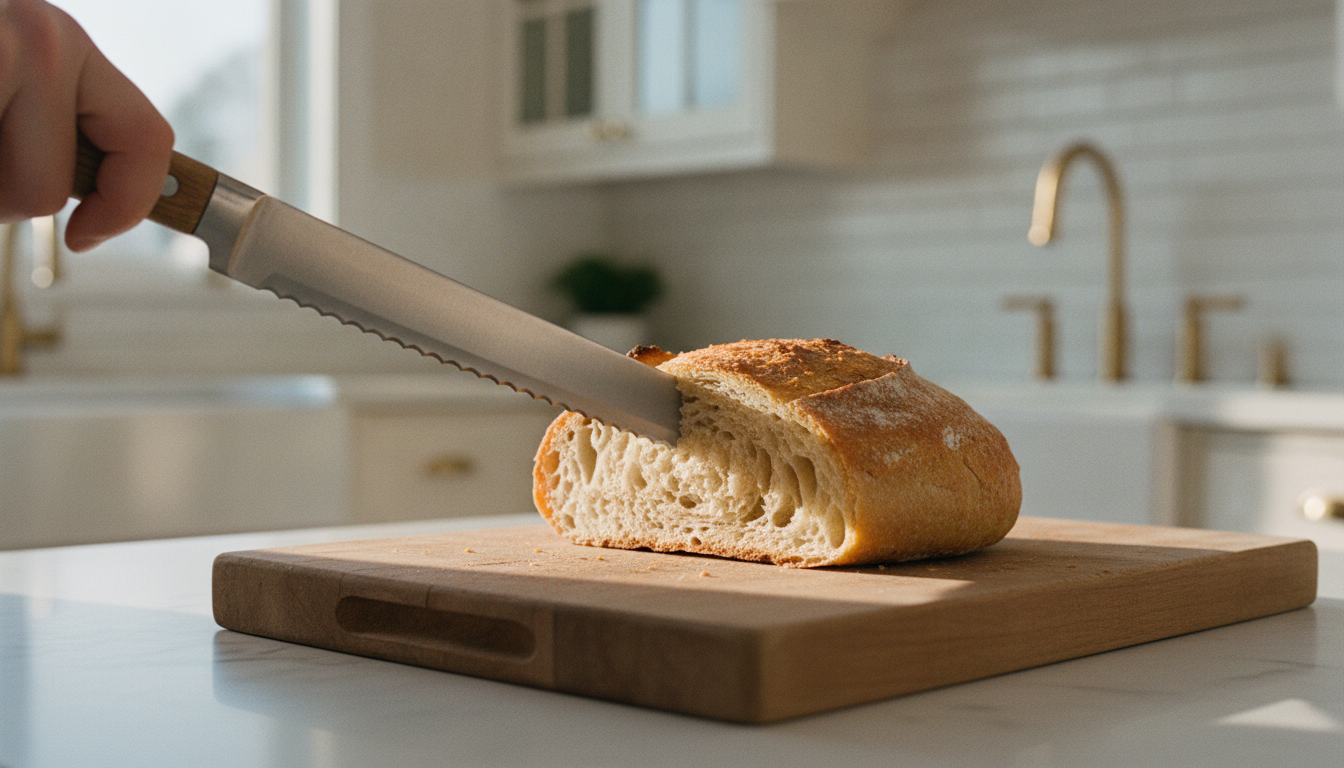
Blade length matters far more than serration style when slicing bread cleanly--a 9 to 10 inch blade spans most loaves in one stroke, while shorter blades force repeated sawing that crushes the crumb. Measure your widest loaf and match it to a blade that clears it in a single pass for clean slices every time.
Why Bread Knife Length Matters More Than Edge Type
A 10-inch blade spans most loaves in a single stroke, letting you slice clean without the crushing pressure that shorter knives require.
How blade length determines clean slicing vs. crushing crumb
Blade length directly affects whether a loaf slices clean or gets mashed down mid-cut. Bread knives with blades on the shorter end, around 8 inches, can't stretch across a large boule in one pass, forcing you to saw back and forth and press down repeatedly--pressure that compresses the crumb before the blade finishes the cut [1].
Longer blades, closer to 10 or 10.6 inches, span most loaves in a single stroke, which means less downward force and a cleaner cross-section [2]. Testing across dozens of models found that blades under 8 inches consistently struggled with wide sourdough boules, while anything approaching 10 inches handled the same loaves with minimal resistance [1].
Length, more than serration style, determines whether your knife slices through crust or crushes it.
Why serrated edges alone won't fix a too-short blade
Serrations grip crust regardless of blade length, but that grip can't compensate for a blade too short to span the loaf [3]. Each tooth creates a small contact point that fractures the crust, while the scalloped valleys behind them give the crumb room to exist without getting compressed [3].
If the blade runs out before the loaf does, you're forced into extra back-and-forth strokes, and those repeated passes reintroduce the same crushing force serrations exist to avoid [3]. The rule holds regardless of tooth pattern: pick a blade longer than your widest loaf, so a single stroke handles the cut instead of leaning on the teeth alone [3].

Matching Knife Length to Common Loaf Shapes: A Quick Reference Guide
Serrated blades grip any loaf shape reliably, and double-serrated designs cut wide boules cleanly even at shorter lengths.
8-inch blades for round boules and artisan loaves
An 8-inch blade suits smaller round boules and standard artisan loaves that stay within its reach, and many bakers who prefer blades in the 7-to-9-inch range find this length works fine for typical bakery loaves [4]. The limitation shows up on wider sourdough boules: 8-inch blades often aren't long enough to cut all the way across a large, bakery-style boule in one stroke [1].
The same issue shows up on plenty of 8-inch knives that handle tomatoes and standard bread well but come up short on bigger sourdough loaves [5]. For smaller loaves, though, an 8-inch blade still offers enough reach, and a pointed tip helps start a clean cut into the crust [4].
10-inch blades for long baguettes and batards
Can you use a serrated knife as a bread knife on any loaf shape? Yes--a serrated blade works on virtually any loaf shape, from tight boules to long baguettes, because the teeth grip crust regardless of how the bread is formed [4].
A straight edge, by contrast, tends to slip on crust and crush the crumb underneath rather than sawing cleanly through it [4]. Double-serrated blades push this further: smaller teeth nested inside the larger scallops create more contact points, so even blades shorter than typical bread-knife length still cut wide boules without snagging [8].
Testing found double-serrated models outperformed standard serrated knives across sourdough, tomatoes, and watermelon, showing edge design can partly offset length limits, though a longer blade still reduces the number of strokes needed [8].
Blade height and dexterity: why longer isn't always easier
A longer blade doesn't always translate to easier handling, since added length often comes with added weight and reduced maneuverability. A 9-inch blade can gain cutting force from extra blade height without adding bulk, while a heavier 10.5" blade may feel unwieldy in hand despite its leverage advantage on crusty loaves [10].
Lighter, shorter blades around 8.6 inches trade some cutting force for a lighter feel and more precise handling on delicate tasks [10]. Blade height matters here too: a taller blade adds heft and downward force for tough crusts, but that same heft can make quick, controlled cuts on smaller items feel clumsy [10].
The right balance depends on whether your kitchen leans toward big sourdough boules or everyday sandwich loaves and pastries [9].


Selecting Your First Bread Knife: Length, Maintenance, and Long-Term Performance
A 9 to 10 inch blade handles most home loaves in a single pass, while an 8 inch works for smaller breads but struggles with large boules.
How to measure and test blade length before committing
Before buying, measure the diameter of your largest typical loaf and compare it directly against the blade length listed on the knife, since the blade should be longer than whatever you're cutting [11]. A 9 to 10 inch blade suits most home bakers, while an 8-inch blade works fine for sandwich loaves and baguettes but falls short on large sourdough boules or round country loaves [11].
If you can test the knife in person, lay it flat across your widest boule to confirm the blade reaches edge to edge without the tip running out mid-loaf [11]. Since most bread knives run 7 to 10 inches, checking this fit before purchase saves you from sawing through crust in multiple strokes [12].
Keeping your bread knife sharp and ready: maintenance tips that extend blade life
Serrated blades hold their edge longer than straight knives since the teeth--not the flat surface--make first contact with food, so most home bakers can go a year or more between sharpenings [13]. Watch for warning signs instead of sharpening on a schedule: excess crumbs, a craggy crust edge, or needing extra force to saw through a loaf all signal it's time [13]. A quick tomato test confirms it--if the skin tears rather than slices clean, the serrations have dulled [13]. When sharpening is needed, use a round ceramic or diamond rod sized to match your serrations, working each scallop individually rather than pulling the blade across in one motion [14]. Skip automatic sharpeners that grind both sides at once, since they can wear down the serrations entirely over time [14]. If you'd rather leave it to a pro, our knife sharpening service brings a dull blade back to a clean edge, and you can always contact us for more care & maintenance tips.
Matching blade length to your most common loaf shape is the simplest way to get clean slices without crushing the crumb. Measure your widest loaf, pick a blade that clears it in one pass, and keep the edge in good shape--that combination handles everything from sandwich bread to wide sourdough. Browse our full collection of knives to find the right fit for your kitchen.
- Blade length matters more than serration style--a 10-inch blade spans most loaves in one stroke, while 8-inch blades force repeated sawing that crushes crumb.
- Match blade length to your widest loaf diameter; the blade should clear it edge-to-edge in a single pass to avoid compression.
- An 8-inch blade works for sandwich loaves and baguettes but falls short on large sourdough boules and round country loaves.
- A 9 to 10-inch blade suits most home bakers; longer blades reduce strokes needed but add weight and can feel unwieldy on smaller items.
- Serrated edges hold their edge longer than straight blades--most home bakers can go a year or more between sharpenings with proper care.
- Watch for warning signs instead of sharpening on schedule: excess crumbs, craggy crust edges, or needing extra force signals it's time to sharpen.
- https://www.seriouseats.com/best-bread-serrated-knives-equipment-review
- https://www.bonappetit.com/story/best-bread-knives?srsltid=AfmBOopWLr3NOqwfU48BnifJwaTEq-GWPxQNI4hBvZFoBqURpUBRuXvT
- https://xinzuo.com.au/blogs/news/bread-knife-guide?srsltid=AfmBOorcCpW2HNZSkv7DMz3Ew8d-LJb5l-qnFBVLVsBhhmHONxas3jHI
- https://www.theperfectloaf.com/the-best-bread-knife-for-sourdough/
- https://www.bonappetit.com/story/best-bread-knives?srsltid=AfmBOor4cyC_k2WhxkUb_j-vSO33BJQAlHE1WZeHJ65TPEOcMEB3Ig3E
- https://pantrymama.com/best-bread-knife-for-sourdough/
- https://www.bonappetit.com/story/best-bread-knives?srsltid=AfmBOoqis7AB4rvc_2R64mZZFHVGNIqeOw2HaeLQCrPtjRwFirwrolAm
- https://www.epicurious.com/shopping/double-serrated-bread-knives-are-the-best-thing-since-sliced-bread
- https://www.victorinox.com/en-US/How-to-Choose-a-Bread-Knife/cms/how-to-choose-a-bread-knife/
- https://www.bonappetit.com/story/best-bread-knives?srsltid=AfmBOorRy1QwCak8GD_MfqWw3nDUGhSGpEFwzKmQAT_u7F_luPe4Q_Fu
- https://xinzuo.com.au/blogs/news/bread-knife-guide?srsltid=AfmBOoolozjsrZvELmykozIVbS0DSnLzdk6Mq4hR5raqFR13G7H2I2_b
- https://www.souschef.co.uk/blogs/the-bureau-of-taste/ultimate-guide-to-bread-knives-which-one-should-i-buy
- https://www.foodandwine.com/how-to-sharpen-a-serrated-knife-7152177
- https://www.knivesandtools.com/en/ct/sharpening-a-bread-knife.htm