

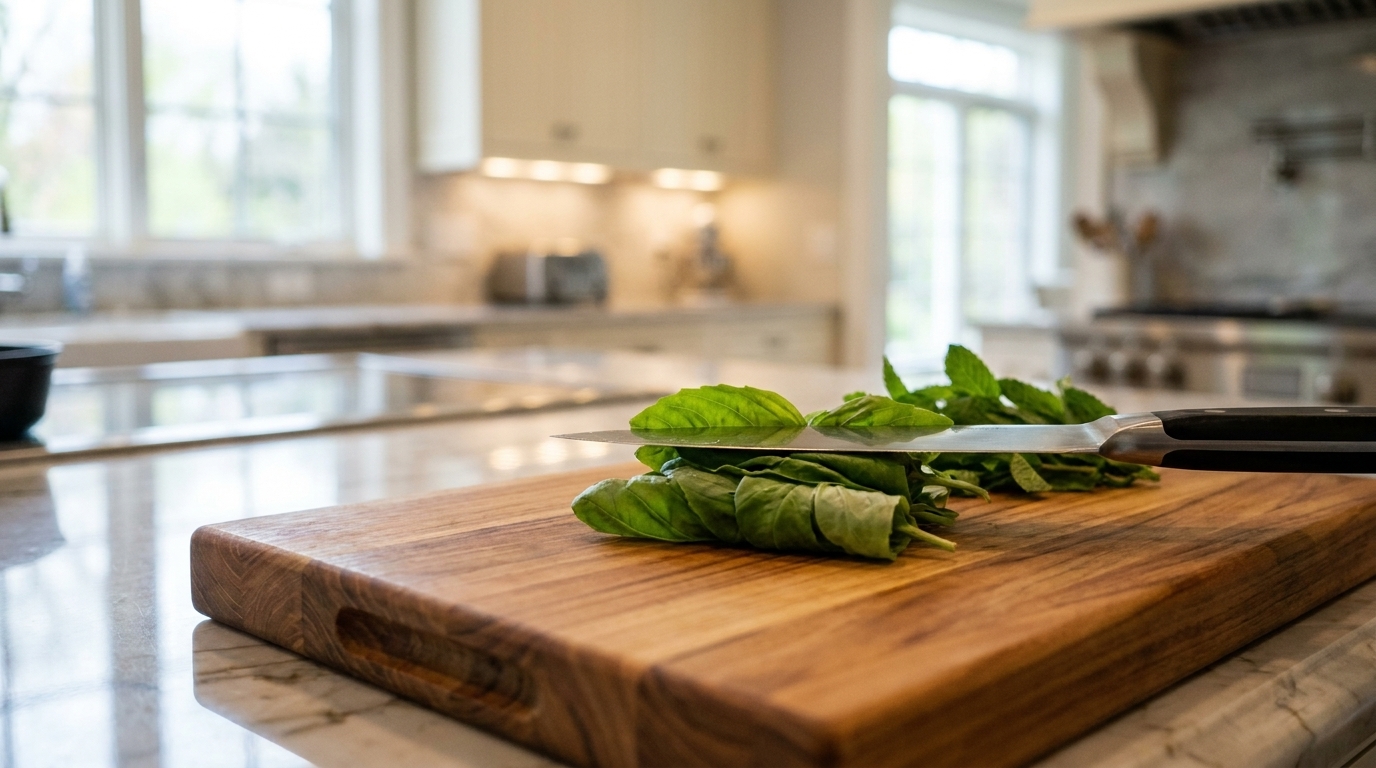
Master chiffonade to slice herbs into delicate ribbons that stay bright and aromatic instead of bruised and bitter. The right knife, cutting board, and technique--rolling leaves tightly and using smooth forward strokes--make the difference between crushed herbs and perfectly sliced garnishes.
What Is Chiffonade and Why It Matters for Delicate Herbs
Clean slicing keeps herbs bright and aromatic by separating leaf cells instead of crushing them, which also releases more flavor compounds than chopping.
The definition: Fine ribbon cuts that preserve herb flavor and appearance
Chiffonade (pronounced shif-uh-nahd) is a French technique for slicing leafy herbs and greens into thin ribbons -- the word itself translates to 'little ribbons' in French. [2] Originally used as garnishes in classic French cuisine, the cut now appears in everything from soups and salads to grain dishes. [1] What makes this chiffonade herbs technique worth learning is the precision: slicing cleanly separates leaf cells rather than crushing them, keeping herbs bright, aromatic, and visually fresh instead of dark and bitter. [3] Finely ribboned basil and mint also release more aromatic compounds than whole or coarsely chopped leaves, so the cut actively improves flavor, not just appearance. [1]
Why bruising happens and how chiffonade prevents it
Bruising in herbs comes from three sources: wet leaves that clump and slide under the blade, over-handling before cutting, and dull knives that use extra downward force to tear rather than slice cleanly. [4] That excess pressure compresses leaves against the board, rupturing more cells and leaving dark, wet-looking surfaces with a harsher flavor. [4] Chiffonade prevents this by rolling thoroughly dried leaves into a tight cylinder before cutting, which stabilizes the stack so the blade passes through with minimal resistance. [4] Smooth forward slicing strokes -- rather than a dragging motion -- complete the job cleanly, limiting the oxidation that turns cut edges brown. [4]
The Right Tools Make Perfect Chiffonade: A Knife and Board Comparison
A 15-degree edge angle and mirror-finished blade reduce bruising by up to 40%, while a stable wooden board with non-slip feet keeps your herbs pristine.
Knife selection: Why blade width and sharpness prevent crushing
Blade geometry has a direct impact on whether herbs cut cleanly or bruise during chiffonade.
A finer edge angle -- around 15 degrees per side on high-carbon stainless -- reduces drag force through herb leaves by 40% compared to a 20 degrees edge, because the narrower contact area limits where plant fluid bridges form across the blade surface. [5] Edge polish matters equally: a mirror-finished edge reduces herb adhesion by up to 55% versus a satin-finished one, limiting the sticking and re-cuts that compound bruising. [5] Wider, heavier blades require more downward force through the rolled stack, compressing leaves and rupturing more cells -- our 3-test sharpness guide confirms in under a minute whether your current knife qualifies. [5]
Cutting board setup: Surface type and stability for clean cuts
Surface material determines how much force your knife needs through each chiffonade stroke -- wood and rubber give slightly under the blade, reducing the downward pressure that bruises herb cells against the board. [6] Bamboo, glass, and hard plastic don't flex, which forces more pressure through the rolled herb cylinder and compounds bruising. [6] Stability matters equally: a board that shifts mid-stroke turns a clean slice into a drag that tears leaf cells instead of separating them. [6] A damp towel underneath or built-in non-slip feet keeps it fixed, and a well-conditioned wooden board stays flatter -- our 5-minute oiling guide covers that in detail. [6]
Step-by-Step Chiffonade Technique: From Leaf to Plate in 5 Moves
Dry leaves thoroughly before stacking and rolling them into a tight cylinder so the blade slices cleanly through all layers at once.
How to prepare and stack leaves without pre-bruising them
Leaf prep starts before the knife touches the board.
Wash leaves under cool water, then dry them thoroughly on a paper towel -- wet leaves slide under the blade, clump together, and bruise instead of slicing cleanly. [8] Stack leaves with the largest at the bottom and smaller ones layered on top, which keeps the cylinder stable and uniform through the entire roll. [8] Basil and mint suit this method best because their broad, flat shape holds the stack together without slipping -- for a similar approach with other leafy greens, the same stacking logic applies to chiffonade spinach. [7] Roll the stacked leaves into a tight cylinder rather than a loose pile so the blade passes through all layers at once with minimal downward pressure and no pre-bruising. [8]
The rolling and slicing motion that creates uniform ribbons
Chiffonade vs. julienne: Size, appearance, and cooking time differences Chiffonade and julienne both produce elongated strips, but their dimensions serve different purposes.
Chiffonade is the thinnest of all cuts -- applied to leafy herbs and greens -- while julienne yields firm rectangular strips about 1/16 inch thick and 1 to 2 inches long, a step narrower than wider cuts like batonnet, and typically used on firm vegetables like carrots or zucchini. [13] That size difference has a direct impact on cooking time: thinner cuts cook and soften faster, so chiffonade ribbons wilt almost instantly in a warm pan while julienne strips hold their structure through a full sauté. [13] Visually, chiffonade drapes loosely as a finishing garnish while julienne reads as a structural ingredient -- and that distinction changes when each cut goes into the dish. [12]
Herbs that shine with chiffonade and common dishes where it matters
Basil and mint suit chiffonade best: their broad, flat leaves stack and roll cleanly, while small herbs like parsley and cilantro are too fine to roll and cut better with a standard chop. [7] Sage works in cooked applications -- thin ribbons stirred into a sauce or stew -- though its intensity makes it impractical as a large-volume garnish. [7] Spinach, chard, sorrel, and arugula follow the same stacking logic, and our chiffonade kale guide shows how the approach extends to heartier greens. [1] Basil ribbons finish pasta, pizza, bruschetta, and caprese; mint works over fruit salads and grain bowls; and thin greens like spinach or chard drop into hot soups at the last minute since they wilt almost instantly. [1]
- Clean slicing separates leaf cells instead of crushing them, keeping herbs bright and aromatic rather than dark and bitter.
- A 15-degree edge angle reduces drag force by 40% compared to 20 degrees, and mirror-finished edges cut herb adhesion by up to 55%.
- Thoroughly dry leaves before cutting--wet herbs clump and slide under the blade, causing bruising instead of clean slices.
- Roll stacked leaves into a tight cylinder before slicing to stabilize the stack and minimize downward pressure that ruptures cells.
- Wooden or rubber cutting boards flex slightly and reduce bruising pressure, while bamboo and glass force more compression through herbs.
- Basil and mint work best for chiffonade due to their broad, flat shape; smaller herbs like parsley cut better with standard chopping.
- Smooth forward slicing strokes limit oxidation that turns cut edges brown, while dragging motions tear leaf cells instead of separating them.
- https://www.forksoverknives.com/how-tos/how-to-chiffonade/
- https://www.bowlofdelicious.com/chiffonade/
- https://cursa.app/en/page/chiffonade-and-herb-handling-clean-cuts-without-bruising
- https://www.jessicagavin.com/how-to-cut-basil/
- https://lifetips.alibaba.com/kitchen-hacks/keep-herbs-from-sticking-to-your-knife-with-cooking-spr
- https://gygi.com/blogs/news/how-choosing-the-right-cutting-boards-prolongs-the-life-of-your-chef-s-knife?srsltid=AfmBOorAz4ZhBfwBGPzCbDLTasQ2YRJoF7-2e28rdY6JCjBcLIIb-CVo
- https://themom100.com/how-to-chiffonade-basil/
- https://www.chowhound.com/1489625/gordon-ramsay-stack-technique-chop-fresh-basil/
- https://chefscircle.co.uk/the-chefs-circle-academy/knife-skills-cutting-techniques/chiffonade-like-a-pro-fast-even-herb-ribbons/
- https://thetinyfairy.com/how-to-cut-chiffonade/
- https://plantin.alibaba.com/plant-wiki/what-is-basil-chiffonade
- https://www.washingtonpost.com/news/voraciously/wp/2018/11/02/how-to-cut-to-the-chase-and-master-the-most-common-knife-skills-vocabulary/
- https://whatagirleats.com/knife-guide/