

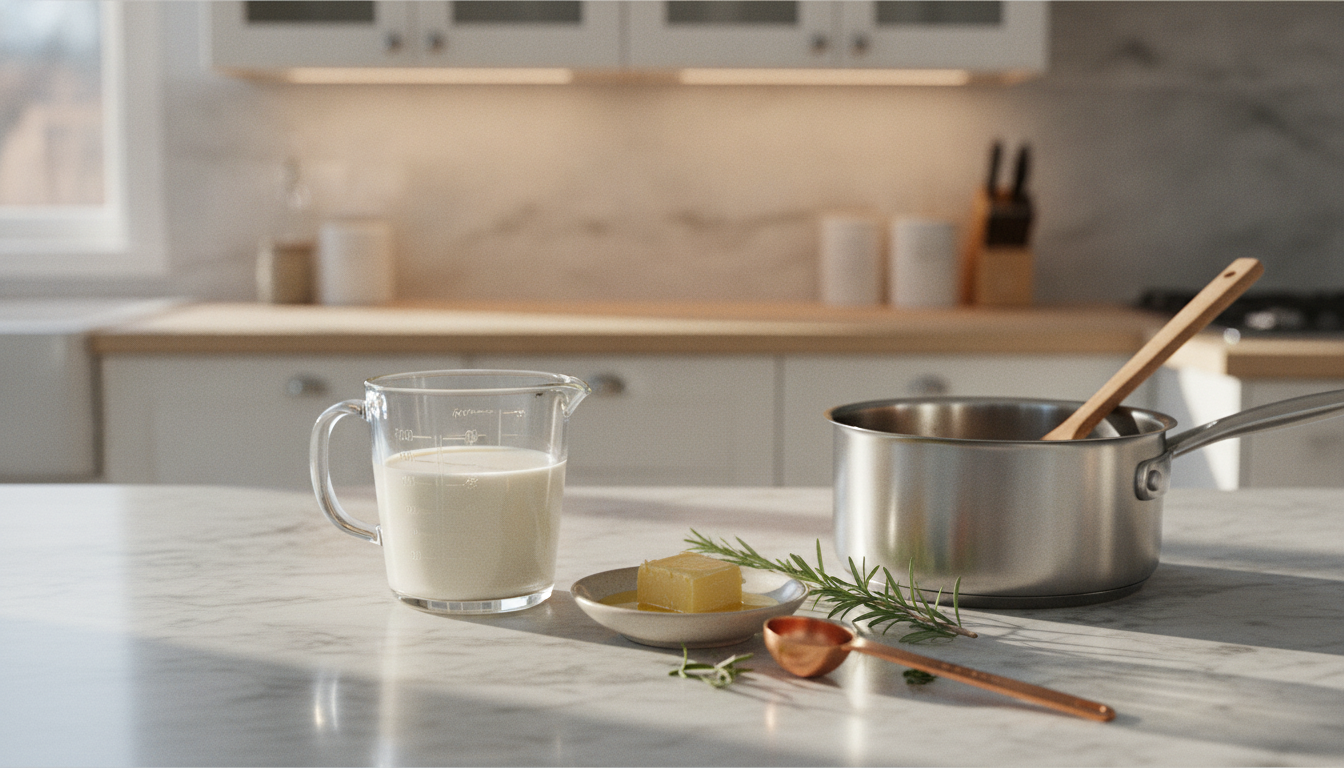
Learn how to calculate the true cost per cup of heavy cream versus five budget-friendly substitutes like milk-and-butter blends and evaporated milk. Choosing the right substitute for your cooking method saves money without sacrificing texture or flavor in sauces, soups, and baked goods.
Why Cost Matters When You're Out of Heavy Cream
Calculate the true cost per cup by dividing each ingredient's price by its total servings, then compare blended substitutes side by side to heavy cream.
Understanding the price difference between heavy cream and substitutes
Heavy cream costs more than most substitutes largely because of fat content. Cream must contain 36 to 38% butterfat to earn the "heavy" label, while whole milk tops out around 4% [1].
That concentration takes more raw milk and processing to produce, which pushes the price per cup higher than a jug of milk or a stick of butter. Substitutes like milk-and-butter or half-and-half-and-butter mixes work by pairing a cheaper, lower-fat dairy base with butter to reach a similar richness, without paying for pre-processed cream [2].
Since butter and milk are pantry staples most cooks already buy regularly, building your own cream substitute often costs less per cup than a dedicated pint of heavy cream sitting in the dairy case [3]. That price gap is the main reason substitutes matter for anyone cooking on a budget or trying to avoid an extra grocery run.
How to calculate cost-per-cup for your kitchen budget
To find true cost-per-cup, divide the price of a container by the number of cups it holds, not the sticker price of the whole package [6]. A 5-lb bag of flour priced at $2.67 works out to about $0.14 per cup once divided by its roughly 18.75 cups, and the same math applies directly to milk, cream, or butter [6]. Checking the nutrition label for stated servings, or measuring liquids yourself, gives an exact count to divide by [4]. For substitutes that blend two ingredients, like milk and butter, add each ingredient's per-cup cost together before comparing the total to a pint of heavy cream [5]. This step-by-step approach turns a vague sense of 'cream is expensive' into a real number you can compare side by side.
A quick reference for the math:
- Divide container price by total cups or servings.
- Check the label for serving size and count.
- Multiply per-cup cost by the amount a recipe needs.
- Add individual costs together for blended substitutes.
The Cost Breakdown: Heavy Cream vs 5 Substitutes (Price Per Cup Comparison)
Making cream from milk and butter costs less than buying a pint since you likely have both ingredients on hand already.
Milk + butter: The cheapest homemade option and how to make it work
Milk and butter make the cheapest do-it-yourself substitute since both are pantry staples most cooks already stock, avoiding a special trip for a pint of cream [1]. The standard ratio is 3/4 cup whole milk to 1/4 cup melted, cooled unsalted butter, which approximates the fat level of 1 cup of heavy cream [1]. Melt the butter first and let it cool to room temperature before whisking it into the milk, since adding hot butter directly to cold milk can cause the fat to separate instead of blending smoothly [1]. This version works in cooked dishes, sauces, and baked goods, but it will not whip into peaks, so skip it for whipped toppings [1]. A firmer version uses a 1:1 ratio of milk to butter, pushing fat content high enough to trap air and hold a whipped structure, though this uses more butter per batch and raises the cost [7]. For everyday cooking, the 3:1 milk-to-butter mix keeps costs lowest since it uses less butter, the pricier of the two ingredients per cup [7]. Either way, this method beats buying a dedicated pint of heavy cream just to use a few tablespoons.
- Melt 1/4 cup butter; cool to room temperature.
- Whisk with 3/4 cup whole milk.
- Use in sauces, soups, baked goods (not whipped cream).
- For whippable cream, use a 1:1 milk-to-butter ratio instead.
Half-and-half + butter: Mid-range cost with better results than straight milk
Half-and-half sits between milk and heavy cream on the fat scale, so it needs less added butter to reach cream-like richness, which keeps its cost in the middle of the pack rather than at the bottom [2]. The ratio here is 7/8 cup half-and-half to 1/8 cup melted butter, a smaller butter addition than the milk version requires, since half-and-half already carries more fat before you start. That smaller butter portion means this substitute usually costs a bit more per cup than milk-and-butter, but less than a dedicated pint of heavy cream, since you're still buying less butter than a full stick [2].
Texture-wise, this version comes closer to real cream in body and mouthfeel, making it a solid pick for casseroles, mashed potatoes, and sauces where straight milk-and-butter can taste thin [2]. As with the milk version, whipping is off the table. Half-and-half tops out around 10.5% to 18% milk fat, and even with butter added, it won't hit the fat level needed to trap air and hold peaks [2].
For everyday cooking where richness matters more than a whipped finish, half-and-half-and-butter offers a middle-cost option that beats straight milk for flavor and texture without the price tag of a full pint of heavy cream [1][2].
When Cost Savings Matter Most: Sauces, Soups, and Everyday Cooking
Swap heavy cream for Greek yogurt, broth, and milk to cut pasta sauce costs by 10-15% while keeping the creamy texture you want.
Budget-friendly substitutes for cream-based sauces and pasta dishes
Cream-based pasta sauces like alfredo often cost more per serving once heavy cream enters the recipe, but swapping in broth, low-fat milk, and plain Greek yogurt keeps a sauce creamy without the added cost or calories [8]. A basic swap replaces heavy cream and cream cheese with broth for flavor, skim milk for consistency, and nonfat Greek yogurt for body, thickened with a touch of cornstarch and finished with parmesan [8]. This version won't turn out as thick as a classic cream reduction, but it still delivers a creamy result at a fraction of the calories and cost per serving [8]. On the tomato-sauce side, a simple onion-and-butter tomato sauce runs about $1.06 per serving, while a from-scratch tuna pasta comes in around $1.24 per serving--both cheaper than a traditional fettuccine alfredo made with real cream and butter, which runs closer to $1.16 per serving [9]. For pasta dishes where a broth-based sauce fits the meal, skipping cream altogether cuts cost without leaving the plate feeling thin [8].
Cost per serving examples:
- Tomato sauce with onion and butter: $1.06/serving [9]
- Tuna pasta with capers: $1.24/serving [9]
- Classic fettuccine alfredo with cream: $1.16/serving [9]
Which substitutes save money without sacrificing texture or flavor
The substitutes that save the most money without losing texture are the ones that pair a lower-fat dairy with a small amount of fat, since that combination mimics heavy cream's mouthfeel using ingredients already sitting in the fridge [10]. Milk-and-butter and half-and-half-and-butter blends top this list because they cost less per cup than a fresh pint of cream while still working in soups, sauces, and casseroles [11]. Evaporated milk offers similar value: it's shelf-stable, thickens on its own, and blends into sauces without curdling, though it carries a faint caramelized taste worth noting before using it in delicate dishes [12]. Greek yogurt mixed with equal parts milk delivers a tangy, protein-rich stand-in for less than the price of cream, and holds up well in sauces and soups, though not in baking or whipped toppings [12]. For non-dairy substitutes for heavy cream, chilled coconut cream skimmed from a can of full-fat coconut milk matches cream's richness at a lower cost than most store-bought vegan creams, as long as the coconut flavor fits the recipe [11].
- Milk + butter: lowest cost, best for sauces and soups
- Evaporated milk: shelf-stable, slight caramel taste
- Greek yogurt + milk: added protein, tangy finish
- Coconut cream: dairy-free, richer than coconut milk
Choosing the Right Substitute Based on Your Budget and Recipe
Match your cream substitute to your cooking method and cookware to stretch your budget without sacrificing results.
Quick decision guide: Match your substitute to your cooking method and wallet
Matching your substitute to the cooking method saves money and avoids a wasted trip to the store. Cooked dishes, sauces, and baked goods tolerate milk-and-butter or half-and-half-and-butter blends without issue, since heat and mixing hide any minor texture gaps [1]. Whipped toppings are the exception: only substitutes with enough fat to trap air will hold peaks, which rules out plain milk, half-and-half, or evaporated milk on their own [10]. For that job, a 1:1 milk-to-butter ratio or chilled coconut cream are the budget-friendly options that still whip [1]. Shelf-stable evaporated milk is worth keeping on hand for soups and sauces since it needs no refrigeration until opened, giving it a cost edge over fresh dairy that spoils before you use it up [13].
A quick way to match wallet and method:
- Sauces, soups, casseroles: milk + butter (cheapest)
- Richer mouthfeel, still no whipping: half-and-half + butter
- Pantry staple, long shelf life: evaporated milk
- Needs to whip: 1:1 milk-butter or coconut cream
Once you know which category your recipe falls into, picking the least expensive substitute becomes a quick lookup instead of a guessing game.
Why investing in quality cookware matters more than cutting corners on ingredients
Saving money on a cream substitute means little if the pan underneath can't handle it. Unlined cast iron, copper, and aluminum react with acidic or dairy-based sauces, which can throw off both flavor and texture right when you're trying to stretch a budget [14]. A tri-ply stainless steel pan heats evenly and won't react with milk-and-butter blends or tomato-based sauces, so a homemade substitute reduces smoothly instead of scorching in a hot spot [14]. A seasoned carbon steel pan or cast iron skillet brings a similar payoff for high-heat searing: it holds heat well enough to brown meat and vegetables without the coating breakdown that eventually forces you to replace nonstick pans [15]. That durability changes the math on cost per use. A single well-maintained cast iron or stainless pan can stay in rotation for decades, while cheaper nonstick pans typically need replacing every few years as their surface wears down [15]. A little care goes a long way here--following the care & maintenance tips for your cookware keeps a quality pan performing for the long haul.
A few ways cookware choice protects ingredient savings:
- Nonreactive metals keep dairy and acidic swaps tasting right [14].
- Even heat distribution prevents scorched sauces and separated substitutes [14].
- Durable materials mean fewer replacement purchases over time [15].
- Proper pan choice reduces waste from burnt or curdled dishes [14].
Cutting corners on a pint of cream is a smart, low-risk swap. Cutting corners on cookware that can't distribute heat evenly or reacts with your substitute ingredients tends to cost more down the line, in both wasted food and replaced pans. So build your cream substitute from what's already in the fridge, cook it in a pan that holds up, and you get the savings without the trade-offs. Got questions about which pan fits your kitchen? Contact us--we're happy to help.
- Heavy cream costs more due to 36-38% butterfat content; substitutes use cheaper dairy with added butter.
- Milk-and-butter blend (3:1 ratio) is the cheapest substitute for sauces, soups, and baked goods.
- Calculate true cost-per-cup by dividing container price by total servings, not sticker price.
- Half-and-half-and-butter offers middle-ground cost with better texture than milk alone for everyday cooking.
- Evaporated milk is shelf-stable and thickens naturally, making it ideal for pantry-stocked budget cooking.
- Right cookware prevents waste: nonreactive stainless steel or carbon steel won't scorch substitutes or react with dairy.
- Only 1:1 milk-butter ratio or coconut cream can whip into peaks; other substitutes work only for cooked dishes.
- https://www.thekitchn.com/heavy-cream-substitute-23004405
- https://www.chowhound.com/1528603/heavy-cream-substitute-butter-half-and-half/
- https://www.kingarthurbaking.com/blog/2025/11/17/heavy-cream-substitute
- https://www.budgetbytes.com/how-to-calculate-recipe-costs/
- https://bepbackoffice.com/blog/recipe-costing-101/
- https://homecookedroots.com/how-to-calculate-recipe-costs/
- https://msshiandmrhe.com/how-to-make-heavy-cream/
- https://showmetheyummy.com/healthy-alfredo-sauce-recipe/
- http://www.frugal-mama.com/2009/10/3-super-fast-healthy-pasta-sauces-kids-love/
- https://food52.com/story/24344-best-heavy-cream-substitutes
- https://www.epicurious.com/expert-advice/heavy-cream-substitute
- https://domesticfits.com/heavy-cream-substitutes/
- https://www.tasteofhome.com/article/heavy-cream-substitute/
- https://www.nytimes.com/wirecutter/blog/how-to-choose-the-right-pan/
- https://www.gofoodservice.com/guides/why-use-a-cast-iron-skillet?srsltid=AfmBOoqDGKu-nKEtsSNLRiZPNLA5xLvPaKHK_KcfhVIOxS52zo84REjm