

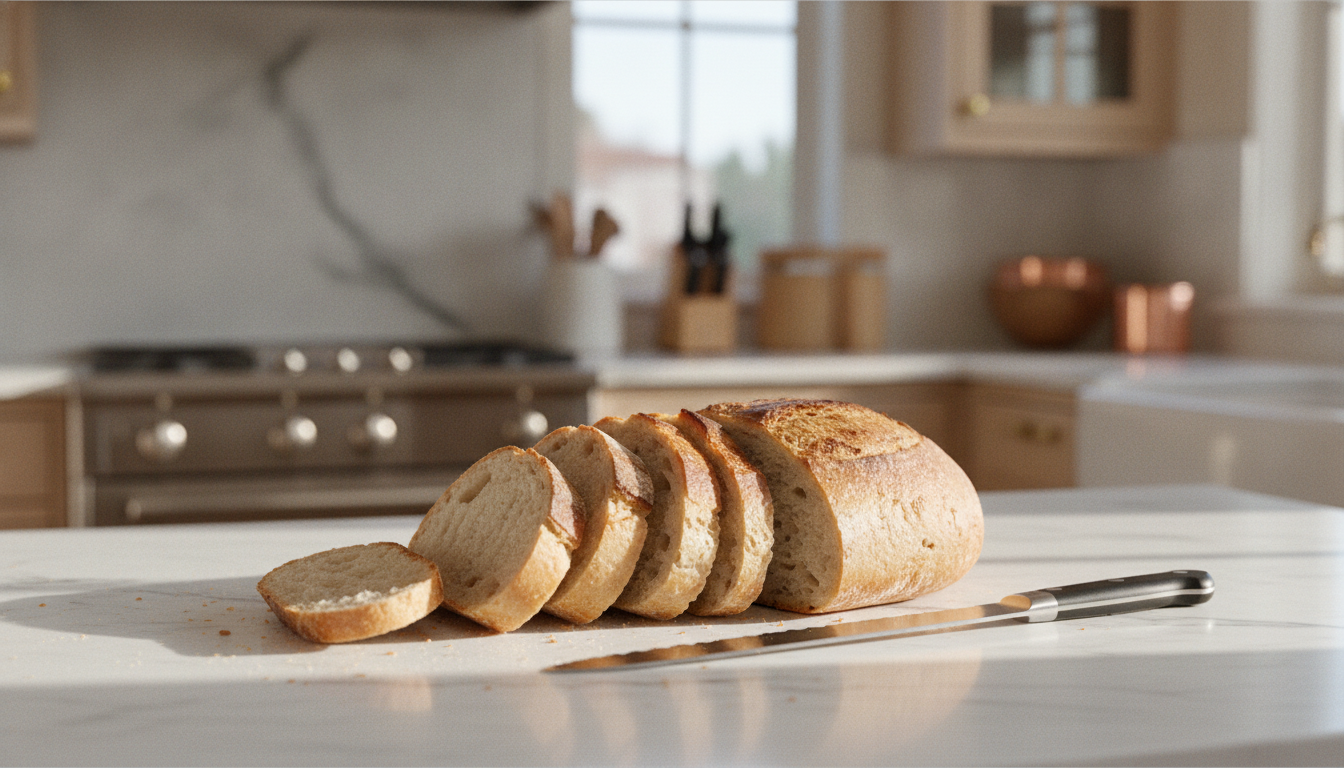
Steel hardness, serration geometry, and construction method drive bread knife pricing, with mid-range options ($40-$100) delivering the best value for home cooks. Most kitchens benefit more from a well-made stamped blade than premium forged models, since serrated edges rely on tooth design rather than a polished bevel to cut cleanly.
Why Bread Knife Price Varies: What You're Actually Paying For
Steel hardness and serration design--not branding--account for most of the price gap between budget and premium bread knives.
Steel Quality and Serration Design: The Core Cost Drivers
Steel hardness, measured on the Rockwell C scale, is the single biggest price driver in bread knives. Budget steels like 440A sit at HRC 55-58, trading edge retention for easy at-home sharpening and strong corrosion resistance [1]. Moving up in price typically means moving up in hardness and alloy complexity:
- 440A: HRC 55-58, forgiving to sharpen [1]
- 440C: HRC 60, better edge retention [1]
- German X50CrMoV15: HRC 55-58, tough and low-maintenance [2]
- Japanese VG-10: HRC 60-62, sharper and longer-lasting but pricier to maintain [2]
Serration geometry adds a second cost layer.
Fewer, sharper, hook-like teeth with wider gullets pierce crust with less sawing force and less crumb, while tightly packed scalloped edges need more back-and-forth motion [3]. Teeth-per-inch (TPI) also affects the cut: lower TPI means bigger gullets, smoother travel, and a rougher-looking but cleaner slice [3]. Manufacturers using precision-ground pointed serrations instead of stamped scallops typically charge more, since that tooth pattern takes tighter tolerances to produce [3].
Together, steel hardness and serration design account for most of the gap between a $20 bread knife and a $150 one -- not branding or country of origin [1].
Manufacturing Process: Forged vs Stamped Blades and Their Price Impact
Forged bread knives start as a single steel billet, heated until soft and hammered into shape--a process that refines the steel's internal grain structure and takes hours of individual, skilled labor per blade [4]. Stamped blades, by contrast, are cut from a flat sheet of pre-rolled steel with a die, the same way a cookie cutter works dough, letting a single press punch out thousands of blanks a day [4]. That labor gap explains most of the price difference: forged blades move through heating, hammering, heat treatment, grinding, and hand-finishing as separate steps, while stamped blades skip the grain-refining hammer work entirely [4][5].
Forging also typically adds a heavier bolster and full tang, where steel runs the entire length of the handle, which increases both rigidity and material cost [4]. Stamped construction trades that weight for a thinner, lighter profile, which some cooks prefer for repetitive slicing tasks since it reduces fatigue [5][6]. Neither process guarantees better performance by itself--steel selection and heat treatment still determine how well an edge holds up over time [5][6].
For bread knives specifically, this gap matters less than it does for chef's knives, since a serrated edge relies on tooth geometry to saw through crust rather than a polished bevel, meaning a well-made stamped bread knife can perform close to a forged one without commanding forged-knife pricing [5].
Budget Bread Knives Under $40: What Works and What Doesn't
Budget bread knives work best for occasional slicing, since their softer edges dull faster but cost little to replace rather than sharpen.
Performance Reality: Edge Retention and Serration Durability at Entry Level
At the budget tier, stamped blades typically test at the lower end of the hardness scale -- some stamped bread knives run HRC 53-54, while others land around HRC 56 [7]. That lower hardness means the edge dulls faster under repeated crust-cutting, but it also keeps the knife cheaper to replace when the time comes [7].
Serrated edges complicate maintenance further: because the teeth are ground on one side only, they can't be touched up with a standard sharpening steel the way a straight edge can [7]. Most home cooks skip resharpening entirely and just replace a budget bread knife once it stops slicing cleanly, since professional serrated-edge sharpening -- roughly $15-25 per knife -- often costs more than the knife itself [7].
Skipping tempering steps also leaves serrations more prone to rounding off or chipping with regular use, and wavy-edge tooth patterns common at this price point tend to tear soft crumb rather than glide through it cleanly [7][3]. Hardness alone doesn't fully predict edge life, though -- some ice-tempered stamped blades are built to resharpen well despite lower HRC numbers, so tempering process matters as much as the raw hardness spec [3].
When Budget Knives Make Sense: Best Use Cases and Limitations
Budget bread knives make the most sense for cooks who slice bread occasionally rather than daily, since infrequent use means the softer edge takes longer to show wear and the lower price justifies eventual replacement over resharpening [8]. A $20-26 stamped knife like the Dexter-Russell Basics still handles everyday tasks well -- testers found it dependable for crusty bread, tomatoes, and sandwich prep despite lacking full-tang construction [9][10].
Good use cases include:
- Occasional home bakers slicing bread a few times a month
- Backup knives for camping, picnics, or shared kitchens
- First-time buyers unsure if they'll use a bread knife often
- Budget-conscious replacements bought every five to ten years [8]
The tradeoff shows up with tougher, thick-crusted sourdough boules: budget serrations often need more sawing pressure and can compress the loaf rather than glide through it, especially compared to models with moderately shallow, rounded teeth [8][10]. Plastic or rubber handles on entry-level knives also feel less refined than wood or full-bolster designs, though testers noted they still felt stable enough for regular use [9].
For cooks who bake sourdough weekly or slice bread daily for a household, that extra sawing effort adds up -- a signal that it's time to consider a mid-range option built with tougher steel and more consistent serration geometry.
Mid-Range Bread Knives ($40-$100): The Sweet Spot for Most Home Cooks
Mid-range bread knives deliver the best value, offering precision-ground serrations and edge retention that match most home cooks' needs with minimal maintenance.
Comparison Table: 5 Key Performance Metrics Across 3 Price Points
Lining up five performance metrics side by side shows where the money actually goes at each price point. Budget knives cluster around HRC 52-58 with stamped, wavy-edge serrations that need touch-ups every 6-12 months or outright replacement [11]. Mid-range knives tighten that hardness band to roughly 55-58 HRC with more precisely ground scallops, and typically need only annual honing plus occasional professional sharpening [11][12]. Premium tiers push into 58-68 HRC territory, including powdered and Japanese steels that hold an edge far longer but demand gentler handling on suitable cutting surfaces [13].
| Metric | Budget ($20-40) | Mid-range ($40-100) | Premium ($100+) |
|---|---|---|---|
| Steel hardness (HRC) | 52-58 [11][13] | 55-58 [11][12] | 58-68 [13] |
| Serration style | Wavy, stamped scallops [11] | Finer, precision-ground scallops [11] | Fine serration patterns like Double-D edge designs [11] |
| Edge retention | Shortest before dulling [13] | Moderate, holds up to regular home use [12] | Longest, resists wear the most [13] |
| Maintenance frequency | Resharpen often or replace [11] | Annual honing, periodic professional sharpening [11][12] | Less frequent sharpening, careful handling required [13] |
| Typical retail price | $20-40 | $40-100 | $100-150+ [11] |
The pattern across all five metrics is consistent: hardness climbs, maintenance intervals stretch out, and serration precision improves as price rises, but the jump from mid-range to premium delivers smaller gains per dollar than the jump from budget to mid-range [11][13].
Why Mid-Range Delivers Better Value Than Budget or Premium for Typical Use
Serious Eats' testing shows this diminishing-returns pattern directly: the $88 Tojiro F-737 bread slicer beat the $102 premium Tojiro F-687 as the overall favorite, while the $26 budget Dexter-Russell still held its own for heavy sourdough work [8]. That extra $14 spent on the premium model bought a curved blade and slightly more leverage, but not enough improvement to unseat the mid-priced pick as the top choice overall [8].
A similar pattern shows up in chef's knives, where testers found a roughly $145 knife delivered the best long-term value because its harder steel outlasted a $60 budget blade's edge without requiring the added cost that premium options often carry [14]. Mid-priced bread knives also tend to correct the weak points found in cheaper stamped models -- inconsistent, overly deep serrations that produced rough cuts and torn crusts in testing -- without adding the cost of niche steels many home cooks never fully use [8].
For someone slicing bread a few times a week, that mix of adequate edge geometry, dependable performance, and a price below flagship models makes the mid-range tier the practical default rather than a compromise. That balance of quality and accessible pricing is exactly what our serrated knives are built for.
Premium Bread Knives ($100+): When the Extra Cost Justifies Itself
Premium bread knives earn their cost through full-tang construction, hand-finished serrations, and superior heat treatment that extend edge life under daily use.
Professional-Grade Serration and Steel: What Premium Buyers Get
Premium bread knives translate high hardness into construction details that budget and mid-range knives typically skip. Full tang construction, where the steel runs the entire length of the handle, adds rigidity and balance that improves control during repeated slicing motions [2]. Some premium makers hand-finish the serration using multi-step honing methods and vacuum heat treatment, locking in edge retention well beyond what stamped scallops achieve.
Heat treatment quality matters as much as the raw steel spec: one maker's proprietary process pushes hardness to 65 HRC while keeping the blade tough enough to resist chipping under regular use [16]. Serration geometry also gets more attention at this tier, with deeper, pointier teeth spaced farther apart cutting through crust with less sawing force than the tightly packed scallops common on cheaper blades.
NSF certification shows up on some premium models, verifying food-safe materials and construction built for heavy daily use [2]. Together, these details are what separates a premium buyer's knife from a budget one:
- Full tang steel for added rigidity and balance [2]
- Hand-finished, deeper serration needing less sawing force
- Heat treatment tuned for edge retention, not just hardness [16]
- NSF certification on some models for food-safe construction [2]
Is Premium Worth It? Decision Framework for Home vs Professional Cooks
Deciding between mid-range and premium comes down to how often the knife gets used and how much maintenance a cook wants to take on. A professional cook slicing bread daily benefits from harder steel that holds an edge longer between sharpenings, since heavier use wears down softer serrations faster [17]. Heat treatment also matters more at high volume: two knives with the same steel spec can perform very differently depending on how well that steel was hardened and tempered, so a premium price only pays off when the heat treatment actually delivers the harder steel's potential [17]. Forged construction adds rigidity and balance that some cooks notice only after repeated, high-volume slicing sessions, while occasional users may never feel the difference [18][19]. A simple self-check helps sort this out:
- Do you slice bread daily or run a professional kitchen? [17]
- Do you prefer minimal sharpening over convenience? [17]
- Would a heavier, full-tang blade improve your control? [18]
- Are you comfortable maintaining a harder, less forgiving edge? [17]
Answering yes to most of these points toward premium; answering no more often signals that a mid-range knife delivers enough performance without the added cost or maintenance demands of higher-hardness steel [17][18].
Whichever tier fits your kitchen, the right bread knife comes down to how often you slice and how much upkeep you're up for. Our serrated knives are built to hold a clean edge through regular use, and when the teeth finally slow down, our knife sharpening service can bring them back instead of sending a good knife to the junk drawer. Still weighing your options? Contact us -- we're glad to help you find the knife that fits how you cook.
- Steel hardness (HRC) and serration geometry drive 90% of bread knife price differences, not brand or origin.
- Budget knives under $40 work for occasional slicing but dull faster and cost more to sharpen than replace.
- Mid-range knives ($40-$100) deliver the best value: precise serrations, moderate hardness, and annual maintenance needs.
- Premium knives ($100+) justify cost only for daily professional use or if you prefer extended edge life over convenience.
- Forged blades offer better balance and rigidity, but well-made stamped bread knives perform nearly as well at lower cost.
- Serration tooth geometry matters more than construction method: shallow, spaced teeth cut cleaner than tightly packed scallops.
- Match your knife tier to usage: occasional bakers need budget options, daily home cooks need mid-range, professionals need premium.
- https://www.mymortuarycooler.com/blogs/news/the-complete-guide-to-comparing-440a-ss-bread-knives?srsltid=AfmBOoq8odW1aZKY-MkekOiuKxrzWotdTuXIlawKtFF-oN6jbA82CTdG
- https://www.cwchangwen.com/commercial-kitchen-knives-buying-guidesteel-performance/
- https://foodal.com/kitchen/knives-cutting-boards-kitchen-shears/things-that-cut/bread-knives-reviewed/
- https://www.steelportknife.com/blogs/articles/forged-vs-stamped-knives?srsltid=AfmBOopPqJWghN88oP8thVXFkb7tcyNJkSBWyhre81Xlyga3DEEEpybB
- https://www.chuboknives.com/blogs/news/what-is-forged-knife-vs-stamped-knife
- https://www.montanaknifecompany.com/blogs/news/forged-knives-vs-stamped-knives?srsltid=AfmBOopN1vJQXKIblgK8mztGIMS1RLoOALv1UKci7D5OIqDd_fROi_zL
- https://jayarrbread.com/blog/best-bread-knife-serrated-2026/
- https://www.seriouseats.com/best-bread-serrated-knives-equipment-review
- https://www.bonappetit.com/story/best-bread-knives?srsltid=AfmBOoqrg4eZybL-OWkx3LkAyHpi_LT1SVx6Ikjf-h6GqKcmhfBI1IqV
- https://www.foodrepublic.com/1833572/best-serrated-knives-to-buy/
- https://www.mymortuarycooler.com/blogs/news/the-complete-guide-to-comparing-440a-ss-bread-knives?srsltid=AfmBOopx8tBR5_UoTPpAJZtRVKfwh6MRfR35FjI15EA95MX6xFDoWS6U
- https://www.giesser.de/english/Service/Interesting-facts
- https://sharpedgeshop.com/blogs/knives-101/hardness-of-steel-according-to-the-rockwell-scale-hrc?srsltid=AfmBOoqTAKlYmE3DKDNl-ESzPnXyb3DLywbPpqYEn7K_2PFpM802n02s
- https://www.nytimes.com/wirecutter/reviews/the-best-chefs-knife-for-most-cooks/
- https://www.steelportknife.com/blogs/articles/high-carbon-steel-kitchen-knives?srsltid=AfmBOoraO7QPAoMjiil7JiToY2FpheMUje2Tf9H6RBuoSKX-ireeJ46i
- https://seidoknives.com/blogs/news/edge-retention-how-long-japanese-chef-knife-stays-sharp?srsltid=AfmBOopnHn-Yr9M4ug9L9jgS47cVkLbuBznsM13BD6GlPXcWck8473JD
- https://ergochef.com/how-to-choose-the-right-kitchen-knife/?srsltid=AfmBOopK0XemJLSW-hd8bXS-weZZL6p27LtOw9KElNYkcYF9hoESozEa
- https://www.solecookware.com/blogs/news/why-your-kitchen-knife-matters-the-secret-to-cooking-confidence?srsltid=AfmBOoq_Fhk1W50uQFWRYqfW3tKiMHUDhqwmMpOXW_QsoMQ9PDiy4SsG