

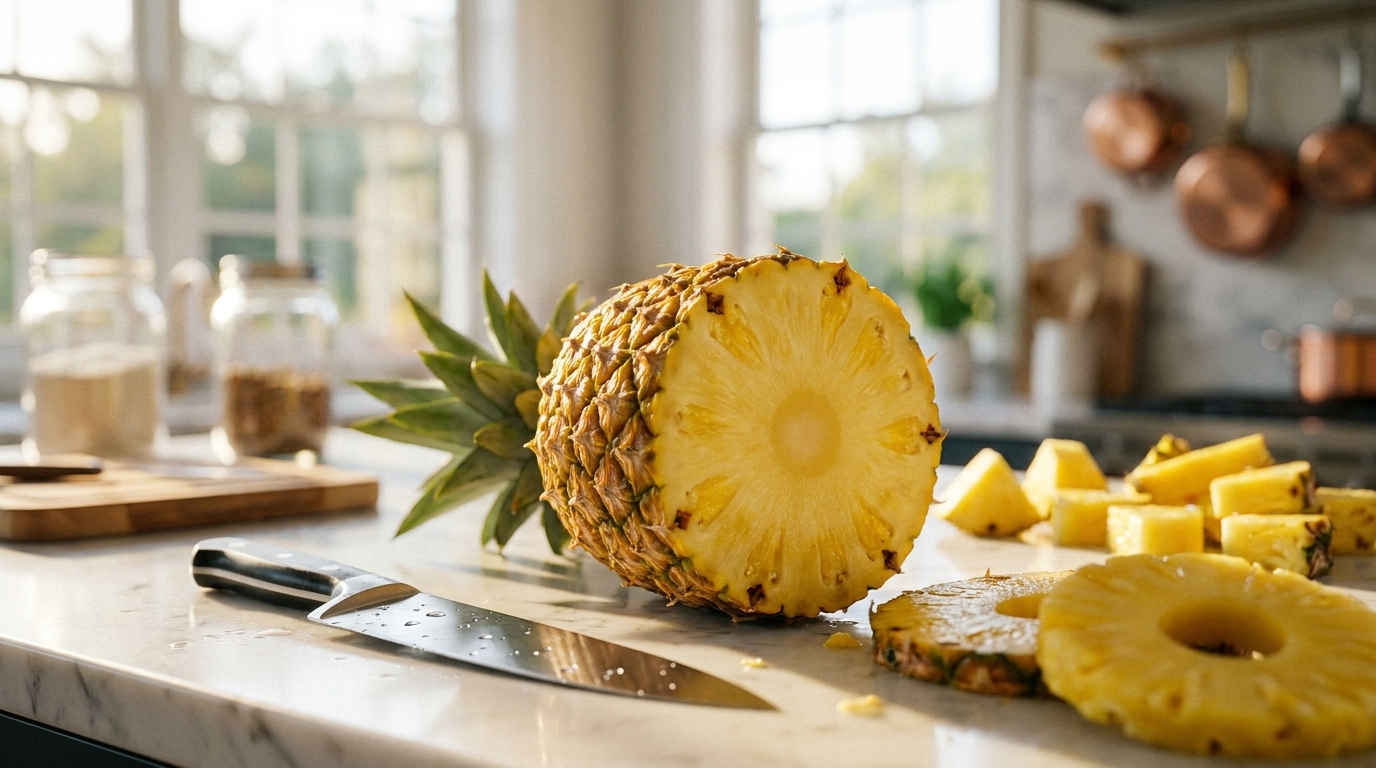
Learn to select a ripe pineapple and cut it safely using proper technique and the right knife. A sharp blade and correct preparation prevent slipping while maximizing usable fruit and keeping your fingers protected.
How to Pick a Ripe Pineapple Before You Cut
Golden yellow skin, a sweet aroma, and slight give under gentle pressure signal a pineapple ready to cut cleanly without blade slipping.
Visual and tactile signs of a ripe pineapple ready for cutting
Before you learn how to cut a pineapple, you need to start with the right fruit.
A ripe pineapple shows golden yellow skin beginning at the base -- some green near the crown is acceptable, but avoid fruit that's all green or shifting toward orange.[1] Press the skin gently: it should yield slightly under pressure but not feel soft or mushy, which signals overripeness.[2] Sniff the bottom -- a clear, sweet tropical aroma means the sugars have developed fully, while no scent at all likely means the fruit was picked too early.[1] Weigh it in your hand: a pineapple that feels heavy for its size contains more juice and is typically ready to prep.[3]
Why pineapple ripeness matters for knife work and safety
Ripeness directly affects how much force your knife needs to move through the flesh.
An underripe pineapple has denser, harder flesh -- requiring more downward pressure, which is the primary driver of blade slipping.[4] A sharp chef's knife reduces that required force significantly, but even a sharp blade struggles to track predictably through inconsistently hard or mushy flesh.[4] Overripe pineapple presents the opposite problem: soft spots cause the blade to sink unpredictably rather than cutting cleanly through.[4] Since pineapple stops ripening once picked, the selection you make at the store is the only opportunity to get the flesh density right before you cut.[4]
The 4-Step Method to Cut a Pineapple Safely and Efficiently
Flat surfaces on both ends let you stand the pineapple upright safely, and V-shaped cuts along the eye rows remove skin efficiently without wasting flesh.
Step 1: Remove the crown and base with a chef's knife
Lay the pineapple on its side on a stable cutting board and grip it firmly before making any cut.
Using a sharp chef's knife, slice off the leafy crown about half an inch to an inch from the top, then cut the base by the same amount to create two flat, even surfaces.[5] Those flat ends are what let you stand the pineapple upright for the peeling step -- without them, the fruit rolls and your blade path becomes unpredictable.[6] Curl your fingers away from the blade while holding the fruit steady, and make each cut in one deliberate downward motion rather than sawing; applying consistent knife safety habits here reduces the risk of slipping significantly.[7]
Step 2: Peel away the skin in vertical strips to minimize waste
With the flat base from Step 1 holding the pineapple steady, stand it upright and position your knife at the top edge where skin meets flesh.
Slice downward in one stroke, following the fruit's natural curve -- cut just deep enough to remove the tough outer skin without taking too much yellow flesh with it.[8] Rotate slightly and repeat until all the skin is gone.
Any remaining brown eyes form diagonal rows, so rather than digging each one out individually (which removes more flesh than necessary), make shallow V-shaped cuts along those diagonal lines to lift out entire rows at once.[8] A serrated knife is a solid option here if the dense, fibrous outer skin resists a straight blade.[8]
Three Popular Cutting Techniques for Different Pineapple Shapes
Different pineapple cuts suit different uses--quarters for chunks, rings for grilling or baking, and cored rounds for plating.
Lengthwise quarters with core removal: best for chunks and salads
After peeling, stand the pineapple upright and cut it in half lengthwise through the core, then cut each half again to produce four equal quarters.[6] Each quarter contains a firm, pale core running along its inner edge -- the core is less sweet than the surrounding flesh and noticeably tougher in texture, so removing it improves both bite and flavor.[9] To remove it, lay each quarter flat and make an angled cut along the core edge, trimming just enough to lift out the tough strip without taking excess flesh with it.[6] Slice each cored quarter into lengthwise slabs, then crosscut to produce even chunks -- ideal for fruit salads, skewers, or snacking.
Ring slices: the presentation-ready method for grilling and plating
Ring slices start the same way as any round -- lay the peeled pineapple on its side and cut crosswise into circles.
For grilling, target ¾ to 1-inch thickness so each slice holds together when flipped; thinner rounds around ½ inch work better for baking applications like pineapple upside-down cake.[10] If you're grilling, leave the core in until after cooking: a solid disc is far easier to flip with tongs than an open ring, and the core pops out cleanly once the slice comes off the heat.[10] For raw presentation or plating, use a 1½- to 2-inch round cookie cutter to punch out the core from each slice -- one clean press removes it without a knife.[10]
Pineapple Storage and Tool Care: Keeping Your Prep Fresh and Your Knives Sharp
Wash your knife immediately after cutting pineapple to prevent the fruit's acid from corroding the blade and causing rust.
How to store cut pineapple for maximum freshness and safety
Once pineapple is cut, it needs refrigeration -- exposed flesh and juice deteriorate quickly at room temperature.
Store pieces in an airtight glass or food-safe plastic container; avoid aluminum foil, since the fruit's natural acidity reacts with the metal and produces an off flavor.[11] Properly sealed in the fridge, cut pineapple stays fresh for five to seven days.[11] To extend that further, freeze chunks in a single layer on a baking sheet first, then transfer to a zip-top bag -- frozen pineapple holds for up to six months and works well in smoothies, baked goods, and marinades, though texture softens noticeably after thawing.[11]
Maintaining your cutting tools after acidic fruit prep
Pineapple's acidity reacts with blade steel and accelerates corrosion if juice is left on the knife, so wash the blade immediately after prep -- don't let it soak in a sink or air-dry in a rack.[12] Hand-wash with warm water and dish soap, rinse, then dry completely before storing; dishwashers dull edges and wear handles over time regardless of blade material.[13] Carbon steel knives need the most attention here: they react to moisture and acid faster than stainless options, so even brief exposure to acidic juice left on the blade can cause surface rust.[12] A light coat of food-grade oil applied periodically adds a protective layer -- a simple care & maintenance tip that meaningfully extends blade life.[12]
- Pick pineapples with golden-yellow skin, sweet aroma, and slight give when pressed--ripeness determines cut safety.
- Underripe pineapples require more knife force and cause blade slipping; overripe ones have soft spots that make cuts unpredictable.
- Create two flat ends first by removing crown and base, then stand the fruit upright for controlled peeling.
- Remove eyes using shallow V-shaped cuts along diagonal rows instead of digging individually to preserve more flesh.
- Wash your knife immediately after cutting pineapple--acidity corrodes steel and causes rust if juice dries on the blade.
- Store cut pineapple in airtight glass containers in the fridge for 5-7 days; freeze for up to 6 months.
- Hand-wash and dry knives completely after use; dishwashers dull edges and carbon steel needs extra protection from moisture.
- https://fullyhealthy.com/blogs/news/how-can-you-tell-if-a-pineapple-is-ripe?srsltid=AfmBOop2YVR0PXbnNRHI898Msdg1wbx3MiKqV6aRQT8uYfS6cxjnN-9X
- https://www.organicfacts.net/pineapple-ripe.html
- https://dna.strongeru.com/how-to-pick-a-ripe-pineapple/
- https://lifetips.alibaba.com/kitchen-hacks/knife-skills-how-to-cut-a-pineapple
- https://www.wikihow.com/Cut-a-Pineapple
- https://www.victorinox.com/en-US/How-to-Cut-a-Pineapple/cms/how-to-cut-a-pineapple-the-right-way/
- https://www.qspknife.com/blogs/news/quick-pineapple-slicing-guide?srsltid=AfmBOop0XmG8GSy6woy2Lrg5FOxCGw0pcp0Rn9B67z-33jIx9es1wtSe
- https://pipandebby.com/pip-ebby/how-to-cut-a-pineapple/
- https://www.themediterraneandish.com/how-to-cut-a-pineapple/
- https://www.foodnetwork.com/how-to/photos/how-to-cut-a-pineapple
- https://www.simplyrecipes.com/how-to-store-cut-pineapple-del-monte-11758796
- https://lucasforge.com/knife-care/using-high-carbon-knives-in-the-kitchen/
- https://www.thepioneerwoman.com/food-cooking/cooking-tips-tutorials/a63372822/how-to-care-for-kitchen-knives/