

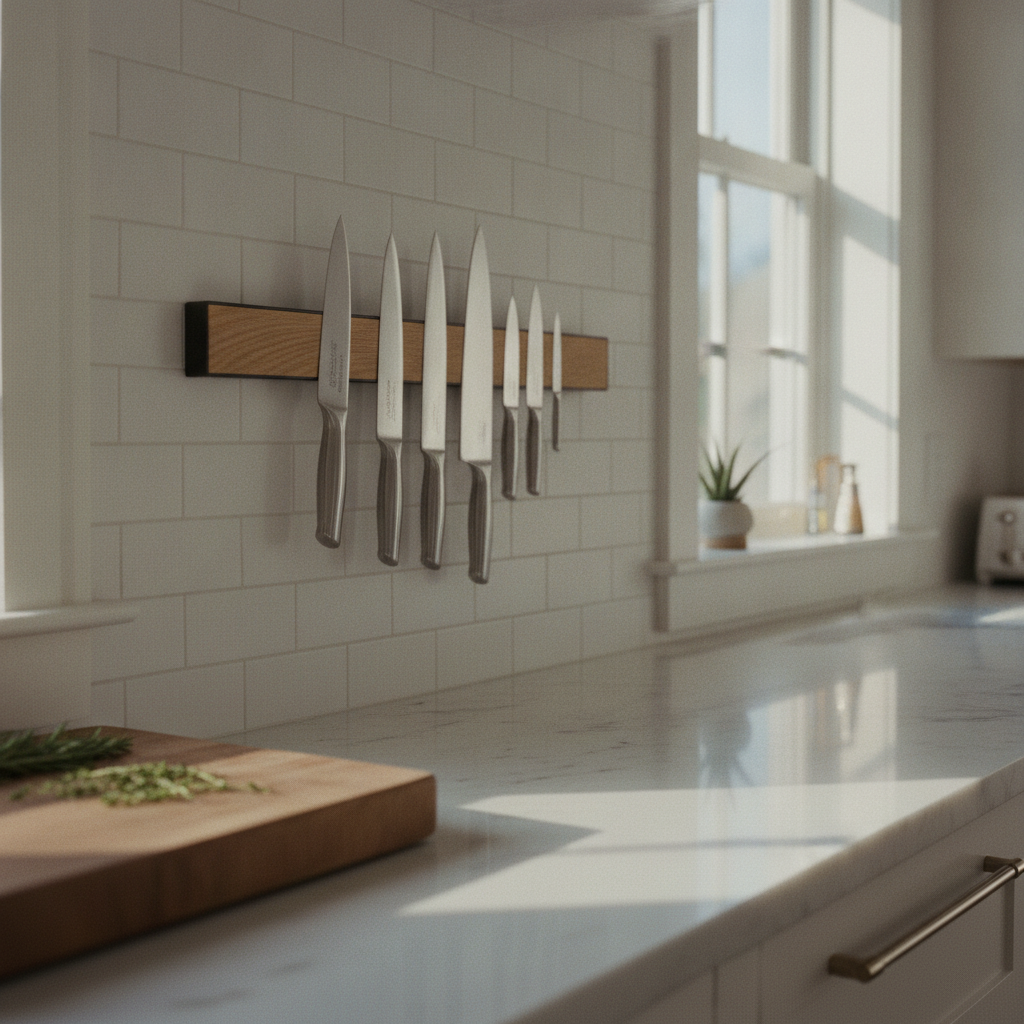
Proper knife storage protects your blades from dulling and damage while keeping your kitchen sanitary, and budget-friendly options under $50 like magnetic strips and drawer organizers fit any small kitchen. Keeping knives dry, separated, and edge-protected extends their lifespan and saves you money on replacements and sharpening over time.
Why Small Kitchen Knife Storage Matters More Than You Think
Proper knife storage keeps blades sharp longer, prevents injury, and eliminates cross-contamination--all while saving drawer space in a small kitchen.
How poor storage dulls your blades and wastes money
Tossing knives loosely into a drawer is one of the most common knife storage small kitchen mistakes, and it carries a real cost. Blades knocking against other utensils or the drawer walls chip and dull edges every time the drawer opens or closes, and improper storage can also lead to nicks and rust over time [1]. A dull edge doesn't just cut worse -- it forces you to sharpen more often, which wears down the blade faster and shortens the knife's usable life [2].
Loose storage also raises injury risk: reaching into a drawer without knowing which way an edge is facing is how fingers get cut, and it can create sanitation problems if blades touch other tools or food debris [3]. In a small kitchen, drawer space is already tight, so the instinct is to stack knives in with spatulas, can openers, and measuring spoons. That habit turns a one-time knife purchase into a recurring expense -- replacing a dulled edge, or replacing the knife entirely, costs more over the years than a drawer insert or sheath that keeps each blade separated from day one [1].
Even a basic slot organizer or blade guard solves most of this damage, since the goal is simply keeping the edge from touching anything harder than the food it's meant to cut [3]. Poor storage is a cost problem disguised as a space problem, and it's one of the cheapest fixes available for anyone working with limited counter or drawer room.
The sanitary case for contained knife storage in tight spaces
Contained knife storage isn't just about protecting the edge -- it's a sanitation requirement. Loose blades in a crowded drawer can touch other utensils, food debris, or moisture, creating the exact cross-contamination risk food safety guidance warns against [4]. Knives left wet or stored touching other tools also invite nicks and rust, and damaged spots on any kitchen tool are harder to clean and can hide bacteria [1].
The most sanitary way to store knives in a small kitchen is to keep each blade dry, separated, and in a designated slot -- whether that's an in-drawer organizer, a wall-mounted strip, or a sheath -- rather than piled loosely with spoons and can openers [1]. Standing water or lingering moisture on stored blades is a known bacterial growth risk, so knives should be fully dried before they go into any drawer, block, or under-cabinet unit [4]. This matters even more in tight kitchens, where a single drawer often holds knives alongside everyday utensils; a contained system keeps that shared space from turning into a cross-contamination point [5].
Treating knife storage as a hygiene decision, not just a tidiness one, gives small-kitchen cooks a clear standard to shop against: dry, separated, and edge-protected, no matter how little drawer or counter space is available.

Budget-Friendly Storage Solutions That Actually Fit Small Kitchens
In-drawer trays, universal blocks, and magnetic strips all keep knives organized and protected while fitting small kitchens on any budget.
In-drawer organizers and universal knife blocks under $50
In-drawer trays solve the space problem directly: they sit inside a drawer you already have, so no counter or wall space is needed, and one common tray holds up to nine knives for around $11 [6]. Bamboo in-drawer blocks step up capacity to 12 or 16 slots for roughly $30-$35, still under budget, and both styles keep blades separated and dry between uses [6]. Universal knife blocks work differently -- they use flexible rods or parallel slots instead of shape-specific cutouts, so any knife fits any slot regardless of brand [6].
A small universal block runs about $20, while a larger option with drain holes to keep blades dry sits closer to $37-$40 [6]. For a small kitchen, the choice usually comes down to drawer depth versus counter space: an in-drawer tray disappears when the drawer closes, while a universal block stays visible and accessible but claims counter real estate [6]. Either style beats loose storage, since both keep each blade in its own slot rather than jumbled with other utensils.
Our modular knife storage works on a similar principle, using magnetic, drawer-friendly pieces you can arrange to fit whatever knives you own.
Wall-mounted and magnetic options that save counter space
Wall space is often the most overlooked storage option in a small kitchen, and a magnetic strip turns that empty vertical stretch into knife storage without touching a single inch of counter or drawer space [7]. Standard strips run 15-16 inches and hold seven to eight knives, with 24-inch versions available for larger collections, and prices for a solid stainless steel or wood-backed bar land around $20 [7]. The single factor that matters most is magnet strength -- neodymium magnets hold significantly more weight than standard ones, so a cheap strip with sparse, thin magnet strips can slide right off the wall once loaded past a few ounces [6].
For renters or anyone avoiding drilling, adhesive-backed strips or 3M-style mounting squares let a rack attach to tile, glass, or painted drywall without permanent holes, though double-sided fridge-mount versions max out around 6-8 pounds of capacity [7] [6]. Wall mounting also solves the safety question drawer storage never fully answers: every blade faces the same direction, edges are visible at a glance, and there's no reaching blind into a pile of loose tools [7]. The tradeoff is exposure -- a wall rack keeps blades in the open, which isn't ideal in households with young kids reaching counter height.
For anyone comparing storage types side by side, a magnetic rack generally wins on cost-per-knife and space efficiency, since one $20-$40 strip holds as many blades as a $50 in-drawer tray while claiming zero drawer real estate [6]. Our magnetic knife strip works on that same principle, keeping every blade visible, separated, and off the counter.
Comparison Table: Storage Types, Space Requirements, and Best Uses
Pick storage that matches your space, knife count, and household--magnetic strips work for any collection size, while drawer organizers adapt to mismatched sets.
How to match storage style to your kitchen layout and knife collection
Matching storage to your kitchen starts with counter space, not knife count. If counter space is scarce, skip the knife block entirely -- a matched set rarely fits the pre-cut slots, and any knife bought outside that set has nowhere to go [8]. A magnetic strip solves this by holding whatever knives you own, in any number, without touching counter space at all, and it works whether you're storing three knives or fifteen [8].
Households with kids often lean toward drawer storage or a high-mounted strip instead, since blades stay out of reach compared to an open countertop block [9]. If your collection is a mismatched pile of hand-me-downs and impulse buys -- a chef's knife here, a paring knife there -- an in-drawer organizer with flexible dividers adapts better than any block with fixed slots [8]. For a kitchen with almost no drawer or wall space to spare, edge guards or a sheath let knives live safely in a drawer alongside other utensils without a dedicated storage piece at all [10].
The right choice ultimately depends on three things: how much space you have, how many knives you own, and who else has access to your kitchen [10]. Renters without drilling options should look to adhesive-mounted strips or in-drawer trays, since both skip permanent wall damage while still keeping blades separated and dry [9].
Cost-per-knife breakdown to maximize your $50 budget
Breaking down price by knife capacity shows which options deliver the most storage per dollar within a $50 budget. The Fomidao Magnetic Knife Block costs $44 and holds five or six knives per side, so a fully loaded block works out to roughly $4 per knife slot, the best per-knife value among tested options that stay under budget [11]. The Hoshanho Magnetic Knife Strip runs $38 and holds six chef's knives, landing closer to $6.33 per knife -- still budget-friendly but less efficient than the Fomidao on a per-slot basis [11]. The Knife Dock in-drawer organizer costs $30 and uses flexible cork dividers rather than fixed slots, so it doesn't lock you into a per-knife cost the way a magnetic strip does -- you can pack in as many blades as fit, regardless of size or shape [12]. One option that looks tempting on price but clears the $50 ceiling is the Benchcrafted Mag-Blok at $52 for nine knives on its 18-inch version, worth noting only if your budget has a little flex [11].
Quick cost-per-knife comparison:
- Fomidao Magnetic Block: ~$4 per knife slot, 10-12 knife capacity [11]
- Hoshanho Magnetic Strip: ~$6.33 per knife, 6-knife capacity [11]
- Knife Dock in-drawer: $30 flat, flexible knife count [12]


Maintaining Your Knives Once They're Properly Stored
Hand washing, immediate drying, weekly honing, and soft cutting boards are the daily habits that actually protect your knife's edge between sharpenings.
Quick care tips to extend blade life in any storage setup
Whatever storage setup you choose, a few habits keep blades sharp longer. Hand wash knives with warm water and a soft sponge instead of running them through a dishwasher, since heat, harsh detergents, and jostling against other dishes dull and nick the edge [13]. Dry each blade immediately with a clean cloth before it goes back into a drawer or onto a magnetic strip, since even stainless steel can rust if left wet [14]. Skip glass, stone, or granite cutting surfaces entirely, since hard boards dull an edge fast regardless of how well you store the knife afterward [15]. A honing rod used weekly, or after every two to three uses, realigns the edge between sharpenings and reduces how often you need a whetstone or electric sharpener [13]. Most kitchen knives need a full sharpening every 6-12 months depending on use, but honing in between stretches that timeline out [13]. If you'd rather leave sharpening to a pro, our mail-in knife sharpening service handles it for you.
A few quick habits to lock in:
- Wash by hand, dry immediately, never air-dry in a rack [14]
- Hone weekly to delay full sharpening [13]
- Use a cutting board, never glass or stone [15]
- Store each blade separated, never loose in a drawer [14]
None of this requires new gear beyond what you already picked for storage. It's the follow-through -- drying, honing, using the right cutting surface -- that actually protects the edge day to day [15].
When to upgrade storage as your knife collection grows
A storage upgrade makes sense once you notice specific friction points, not just because you bought a new knife. If a magnetic strip is packed edge-to-edge with blades touching each other, or an in-drawer tray no longer has an empty slot, that's the signal to size up rather than force one more knife into a crowded space [16]. Growing past roughly ten knives is a common threshold, since most compact organizers and short magnetic strips are built for six to nine blades before capacity becomes a real problem [12]. Anyone who preps at a second location or travels between kitchens should also consider a knife roll once their working set expands beyond what fits in a drawer, since rolls carry blades safely between locations rather than pack them into fixed slots [16].
Watch for these signals:
- Blades touching or overlapping on a strip or in a tray [16]
- No open slot left for a new knife [12]
- Mixed sizes no longer fit existing dividers [17]
- Knives now travel between kitchens or locations [16]
Upgrading at that point protects the edges you already paid to keep sharp, and it's a cheaper fix than replacing a knife that got dulled from being wedged into a full drawer [17]. Whatever setup fits your kitchen, keeping each blade dry, separated, and edge-protected is what makes both the storage and the knives last. Browse our knife storage collection to find an option sized to your space, and contact us if you want help matching a setup to the knives you already own.
- Loose knife storage dulls blades faster, shortens knife life, and creates safety and sanitation risks.
- In-drawer trays ($11-$35) and magnetic strips ($20-$40) keep blades separated and dry in small kitchens.
- Magnetic strips offer the best cost-per-knife value and use zero counter or drawer space.
- Hand wash and dry knives immediately before storage to prevent rust and cross-contamination.
- Hone weekly with a honing rod to delay full sharpening and extend blade life by 6-12 months.
- Upgrade storage when blades touch, no slots remain empty, or knives travel between locations.
- https://www.chuboknives.com/blogs/news/best-way-to-store-kitchen-knives
- https://www.honeyhone.com/blogs/news/how-to-store-japanese-knives-safely-without-a-traditional-block?srsltid=AfmBOorxH6WdW9fY4IINQ6wkw53t7GQRlmrouPnft-PrOrHd_n37JuXd
- https://www.webstaurantstore.com/blog/5088/how-to-store-knives.html?srsltid=AfmBOooNiZk1lt1yD2hWDhXaHOGT_ziXtCn4mYK6Cfrk3UnH2p6KzOTb
- https://trust20.co/blog/store-utensils-prevent-cross-contamination
- https://share.upmc.com/2025/12/prevent-kitchen-cross-contamination/
- https://therationalkitchen.com/knife-storage-for-kitchen-knives/
- https://www.nytimes.com/wirecutter/reviews/ikea-hultarp-magnetic-knife-holder-review/
- https://www.seriouseats.com/how-to-store-knives
- https://oishya.com/journal/top-3-ways-to-store-your-kitchen-knives-and-their-pros-and-cons/
- https://www.webstaurantstore.com/blog/5088/how-to-store-knives.html?srsltid=AfmBOooiFHYfLouMrHtI5DsYPEpS2yWKR_z3XjLbt3g_udbzD3P38CvO
- https://www.foodandwine.com/best-magnetic-knife-holders-6931047
- https://www.seriouseats.com/best-knife-blocks-7564808
- https://eliteprocutlery.com/extending-the-life-of-your-knives-best-practices/?srsltid=AfmBOorxj9GS4ClVxi0gTyKzWVaeDDAMq0X3Z0Tz8Cj859Of9pxCPuBK
- https://polk.ces.ncsu.edu/news/caring-for-kitchen-knives/
- https://www.restaurantware.com/blogs/advertising-and-marketing/knife-safety-sharpening-storage-and-maintenance-2?srsltid=AfmBOoqHYyxPS8ZNcawt7jsJLZN4wRxI-kqo_-sQ0qIHj9nMHCfaAgou
- https://www.webstaurantstore.com/blog/5088/how-to-store-knives.html?srsltid=AfmBOoon1lHK-XMefDwDu1qzwhNhWQlHr4D3xc0bxMAH9FJLjS9VQNl9
- https://heinnie.com/blog/how-to-care-for-and-display-your-knife-collection/