

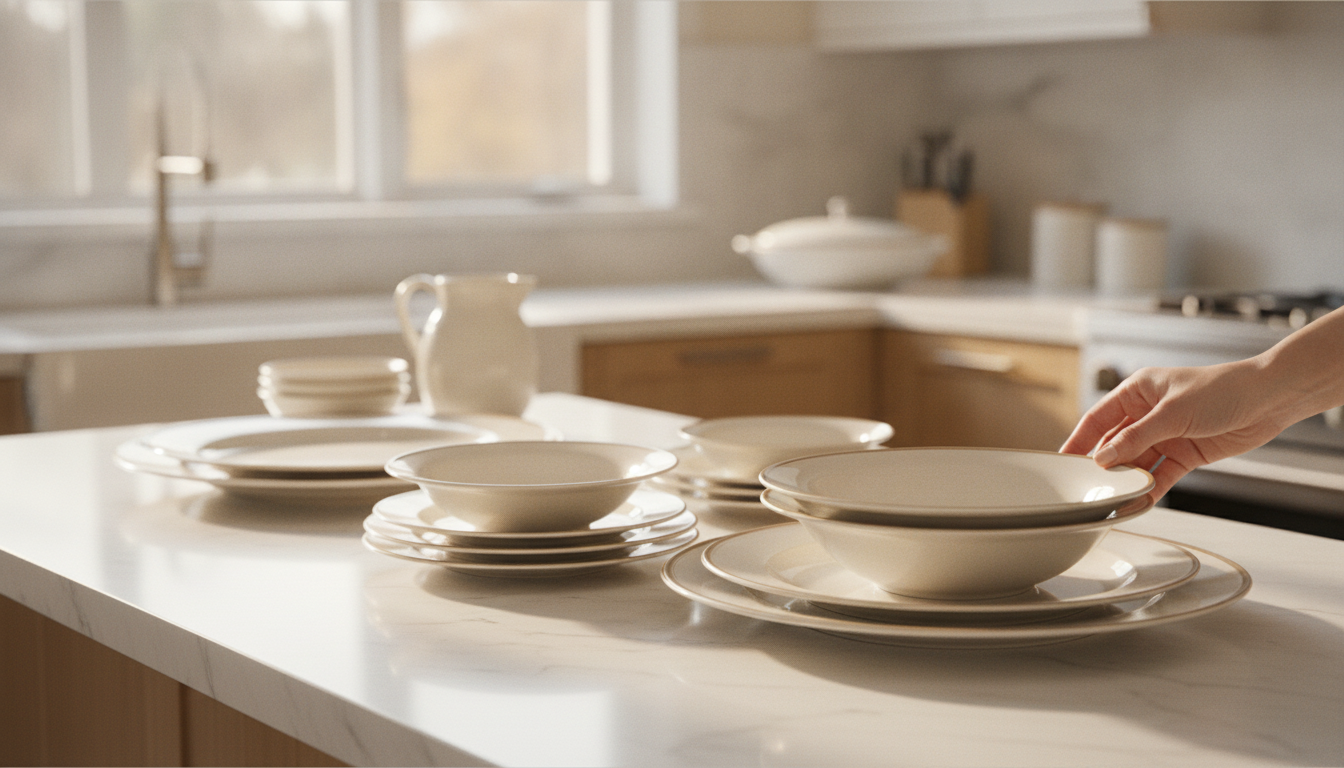
Choose dinnerware based on material durability, size needs, and your actual cooking habits rather than appearance alone. Porcelain resists stains, stoneware handles daily chips better, and checking manufacturer specs before use keeps your set looking new for years.
Dinnerware Materials Explained: Durability, Cost, and Everyday Performance
Porcelain resists stains best, stoneware handles everyday chips better, and bone china earns its heirloom reputation despite needing careful handling.
Ceramic vs. Porcelain vs. Stoneware: Which Material Resists Chipping and StainingCeramic is the umbrella term for all fired-clay dinnerware, including stoneware, porcelain, and general earthenware, so the real differences come down to firing temperature and clay refinement, not separate categories [1]. Porcelain uses refined kaolin clay fired at the highest kiln temperatures, producing a dense, vitrified body with very low absorption, which is why it resists stains and lingering odors better than other ceramics [2]. Stoneware also vitrifies at high heat but relies on sturdier clay bodies formed into thicker walls, giving it a weightier feel and better resistance to everyday chips [2]. General ceramic dinnerware, fired at lower temperatures, stays more porous and chips more easily if it isn't handled carefully [3].
Chip resistance tracks with rim design as much as material choice. Porcelain's thin, refined rims can chip against a hard countertop edge, while stoneware's thicker, rounded rims tend to absorb daily bumps at the table and sink [2]. For staining, porcelain's low-porosity surface holds up best against sauces, coffee, and turmeric, while lower-fired general ceramic can absorb color over repeated use [1][3]. In short: porcelain wins on stain resistance and elegance, stoneware wins on everyday chip resistance and durability, and basic ceramic trades some durability for a lower price point [1][3].
Bone China, Melamine, and Glass: When Each Material Makes Sense for Your Kitchen
Bone china earns its reputation for elegance because it's lightweight yet surprisingly strong, though it still calls for careful handling rather than daily dishwasher use [4]. One comparison of dinnerware materials found that while porcelain ranks as the hardest ceramic, bone china actually tests as the strongest overall, which explains why it survives generations as heirloom china even as it stays impractical for busy households with kids or frequent guests [5]. Melamine sits at the opposite end of the durability spectrum: it resists chipping, cracking, and breaking almost entirely, making it the standard pick for outdoor meals, picnics, and kids' plates [4][5].
That toughness comes with tradeoffs. Melamine can't go in the oven or microwave, and darker-colored pieces hide stains from tomato sauce and other pigmented foods better than light ones do [5]. Glass dinnerware, particularly vitrified glass, is fired at extremely high temperatures that make it non-porous and resistant to chipping even when dropped on a hard floor [5].
It's also thinner and lighter than porcelain or stoneware, so it takes up less cabinet space, and it runs dishwasher and microwave safe [5]. In practice, bone china suits formal, low-traffic tables, melamine covers kids and outdoor use, and glass gives chip resistance without the bulk of heavier ceramics [4][5].

Dinnerware Sizes and Place Settings: How to Choose the Right Count for Your Household
Multiply your place-setting count by two so you're never short on clean plates between dishwasher loads.
Standard Plate Sizes: Understanding Dinner, Salad, Bread, and Bowl Dimensions
Dinner plates anchor most place settings, and size shapes more than table appearance: swapping a 12-inch dinner plate for a 10-inch one naturally trims portions without making a meal feel skimpy [6]. Beyond the standard dinner plate, a full dinnerware lineup includes distinct formats built for specific courses, such as the bread and butter plate, the soup plate (also called a rimmed or deep plate), and the pasta bowl, sometimes labeled a coupe pasta plate [7]. Charger plates and cake plates round out the lineup as presentation pieces rather than everyday eating surfaces, so they're worth skipping if you're building a set for daily use [7].
Shape matters as much as diameter. Round rims with consistent width nest more efficiently in cabinets, while wide-rimmed or irregular shapes eat up dishwasher rack space and chip more easily against other dishes [6]. Bowl depth follows a similar logic to plate function: a soup plate's shallow, wide rim suits brothy dishes you eat with a spoon, while a true bowl shape holds cereal, pasta, or anything that needs more volume without spilling over the edge [7].
If you're comparing full sets rather than open stock, a 72-piece dinnerware and flatware set shows how dinner plates, salad plates, bread plates, and bowls typically get bundled together for a household serving eight.
Calculating Total Pieces: A Dinnerware Set Capacity Essentials for 2, 4, 6, 8, and 12 Diners
A place setting is the dinnerware needed for one person, typically a dinner plate, salad plate, bowl, and mug [8]. The standard math for sizing a set starts there: multiply your place-setting count by roughly two so you're not scrambling for clean plates between dishwasher loads [8]. That multiplier shifts depending on household size, since guests and stacked dishes both draw down a set faster than daily use alone [8]. A basic capacity breakdown looks like this:
- 2 diners: a single 4-place setting covers daily meals [8]
- 4 diners: an 8-place setting handles regular use plus overflow [8]
- 6 diners: two 4-place sets, or one 8-place set with backup pieces [8]
- 8 diners: two 6-to-8-place settings, totaling 12-16 place settings [8]
- 12 diners: pair an everyday 8-place set with a formal 12-place set [8]
Bowls and mugs follow the same multiplier as plates, so a household sized for 8 diners needs matching counts across every category, not just dinner plates, to avoid running short mid-meal [8].
What Makes Dinnerware Last: Quality Indicators That Predict Real-World Longevity
High-fired porcelain and stoneware resist thermal shock and daily wear when you check for full vitrification, reinforced rims, and manufacturer temperature ratings before purchase.
Glaze Thickness, Chip Resistance, and Thermal Shock: The Hidden Features That Matter
Glaze thickness and how completely a piece vitrifies determine whether dinnerware survives daily use or develops hairline cracks. Porcelain fired near 2,400 degreesF fuses clay particles into a dense, glass-like body, eliminating the tiny air pockets that create weak spots and reducing water absorption to roughly 0-1 percent [9]. Thicker rims and reinforced edges add resistance where plates are most likely to knock against a sink or countertop, without changing how the glaze itself performs [10].
Thermal shock resistance depends on that same density: high-fired porcelain made near or above 1,400 degreesC can typically tolerate a temperature swing of around 150 degrees before the glaze or body cracks, a threshold manufacturers refer to as maximum delta T [10]. Thin walls, recycled clay content, and metallic decoration all lower that tolerance, which is why a piece that survives the dishwasher can still fail going straight from the freezer to a hot oven [10]. Stoneware follows a related principle: fired above 2,200 degreesF, it becomes dense and non-porous enough to resist both shock and scratching, provided the glaze itself is described as non-porous rather than decorative [11].
Before buying, three checks matter more than marketing copy: confirm the piece is described as fully vitrified, check the manufacturer's stated oven temperature range rather than assuming "oven-safe" covers every use, and inspect rims and bases for extra thickness at load-bearing points [9][10][11].
Maintenance Practices That Extend Dinnerware Life by Years--and Common Mistakes That Don't
Checking a manufacturer's stated dishwasher-safe and microwave-safe ratings before daily use protects glaze and color better than guessing based on material alone, since a genuine dishwasher-safe label confirms the glaze and pigment resist fading through repeated wash cycles [12]. A microwave-safe rating confirms the body can take reheating heat without cracking or releasing anything into food, which matters more for households that reheat daily than for occasional use [12]. Uniform, consistent shapes stack more predictably in cabinets, cutting down on the rim-to-rim friction that causes chipping during storage [13].
Weight and material choice affect handling over time too, since a heavier stoneware body tolerates daily stacking and washing differently than a lighter, thinner piece [14]. Buyer complaints about scratches, chipped edges, and fading color often trace back to skipping these checks in favor of finish or color alone [14]. A few habits shorten dinnerware life faster than normal wear: assuming oven-safe also means microwave-safe, stacking mismatched shapes that knock rims together, and choosing a set based on looks without confirming the manufacturer's specs [12][13][14].
A handful of simple care & maintenance tips--washing gently, stacking matched shapes, and confirming ratings before daily use--can help keep a set looking new longer than material choice alone.


Choosing Dinnerware That Fits Your Cooking Style and Kitchen Workflow
Verify oven, microwave, and dishwasher safety separately for each dinnerware piece, since these are distinct claims that vary by material and glaze.
Oven-Safe, Microwave-Safe, and Dishwasher-Safe: Matching Dinnerware to Your Daily Routine
Checking a set's actual ratings prevents most damage, since oven-safe, microwave-safe, and dishwasher-safe are three separate claims, not one blanket label [15]. High-fire ceramic and stoneware can typically handle oven temperatures up to around 200 degreesC (400 degreesF) for warming or serving, but should be brought up to temperature gradually rather than moved straight from a cold fridge into a hot oven, which risks thermal shock [15]. Lower-fired earthenware is generally not oven safe at all [15]. Microwave safety depends on the glaze, not just the clay body: plain ceramic without metallic pigment is fine, but any gold, silver, or platinum rim will arc in the microwave, and stainless steel dinnerware cannot go in a microwave under any circumstance [15][16]. Melamine carries its own restriction, since acidic foods combined with heat can cause it to migrate into food, which is why melamine plates are not considered oven safe [16]. Dishwasher safety varies by finish as much as material: most high-fire ceramic tolerates repeated cycles, though matte glazes dull gradually over years of washing, while unglazed ceramic and wood dinnerware can be damaged by sustained dishwasher heat [15][16]. Before building a daily routine around a new set, confirm a few things:
- Oven temperature limit stated by the manufacturer [15]
- Whether any glaze or trim contains metallic pigment [15]
- Material-specific dishwasher guidance, especially for wood or earthenware [16]
Building a Cohesive Kitchen: How Dinnerware Pairs with Quality Cookware and Serving Tools
A cohesive kitchen isn't built from one matching set bought all at once, it's built by layering pieces that share a color, material, or finish over time [18]. Serveware often bridges the gap between cookware and dinnerware directly, since covered bowls, platters, and pie dishes move straight from oven to table and double as both a cooking vessel and a table decoration [18]. Starting with one anchor color pulled from a dinner plate or a serving bowl, then building outward with complementary napkins, platters, or accents, keeps a growing collection looking intentional instead of thrown together [18]. Open stock buying supports this kind of gradual system-building, since it lets a household add pasta bowls, a cake stand, or a butter dish as cooking habits change, rather than locking into a fixed boxed set upfront [17].
Mixing patterns and shapes across dinnerware and serveware doesn't require uniformity, a shared finish or material is enough to tie everything together while leaving room for pieces added over years [18]. For cooks who already prioritize dishwasher-safe, chip-resistant stainless cookware, applying that same durability checklist, oven safety, glaze quality, stackable shapes, when choosing dinnerware and serving tools keeps the entire kitchen functioning as one connected system rather than a patchwork of unrelated purchases [17][18]. We believe your dinnerware should last as long as the cookware you cook in, so hold your plates, bowls, and serveware to the same standards you already trust. Start with the material that fits how you actually eat, check the manufacturer's specs before daily use, and build outward one durable piece at a time.
Still deciding what works for your kitchen? Contact us and we're happy to help you sort through the options.
Frequently Asked Questions
-
How many dinnerware pieces do I actually need for my household size?
The article gives a basic capacity breakdown: 2 diners need one 4-place setting, 4 diners need an 8-place setting, 6 diners need two 4-place sets (or an 8-place set with backup pieces), 8 diners need 12-16 place settings total, and 12 diners can pair an everyday 8-place set with a formal 12-place set. Bowls and mugs should scale with the same multiplier as plates so you don't run short mid-meal.
-
Which material holds up best against chips and stains - porcelain, stoneware, or basic ceramic?
Porcelain has the lowest porosity, so it resists stains and odors best, but its thin rims can chip against hard countertop edges. Stoneware's thicker, rounded rims absorb everyday bumps better, making it the stronger pick for daily chip resistance. Basic ceramic, fired at lower temperatures, stays more porous and chips more easily, trading durability for a lower price point.
-
Can I put melamine or metallic-rimmed dinnerware in the microwave or oven?
No - the article states melamine is not oven safe because acidic foods combined with heat can cause it to migrate into food, and it should not be treated as oven safe under any circumstance. Any dinnerware with gold, silver, or platinum rim decoration will arc in a microwave, so plain ceramic without metallic pigment is the safer microwave choice.
-
What's included in the 72-piece dinnerware and flatware set, and does it cost less than buying pieces separately?
The featured 72-piece set bundles dinner plates, salad plates, bread plates, and bowls (plus flatware) for a household serving eight. The article doesn't list a price for this set or for buying pieces separately, so compare its actual contents and listed price against open-stock pieces to see which fits your needs and budget.
-
Is bone china a good choice for a household with kids or frequent guests?
Based on the article's durability comparison, bone china tests as the strongest material overall but still calls for careful handling rather than daily dishwasher use, so it's better suited to formal, low-traffic tables. For households with kids or frequent guests, the article points to melamine as the more practical design choice since it resists chipping, cracking, and breaking almost entirely.
- Porcelain resists stains and odors better than other ceramics due to low porosity, while stoneware's thicker rims absorb everyday bumps without chipping.
- Size matters more than aesthetics: swapping a 12-inch dinner plate for 10-inch naturally trims portions without feeling skimpy.
- Multiply your place-setting count by roughly two to avoid scrambling for clean dishes between dishwasher loads.
- Check manufacturer specs for oven, microwave, and dishwasher ratings separately, since oven-safe does not automatically mean microwave-safe.
- High-fired porcelain can tolerate about 150 degrees temperature swing before cracking, but thin walls and metallic decoration lower that tolerance significantly.
- Stacking matched shapes prevents rim-to-rim friction that causes chipping during storage more effectively than material choice alone.
- Build dinnerware collections gradually through open stock buying rather than locking into fixed boxed sets upfront.
- https://www.google.com/goto?url=CAES4wEB6zswFa2IsNoxRqSTQNwdhicrtsi-eH2ZGrLU_cxeITk0fYkdQVpzs9b2AeXmLX7KauuJiwt3zaC2qA1c3dWmQJ2MtTF5rCKEP1WaKmyAcezduaUKpaGldFpHyUFzJT8ODYmwIiLRKVWRvKZjQHBEeoYZ2-P1Q6bJLNCaOS5mkKNRUuSJUEOZNWLJGEjLQNNPmVgnNOmX9-lax6LPQR5gkxcfbCH6M0O82iYmtWfVsL47aq7ObyOiwBu2I74Yr595S9-pxfSemCNwpDa_-zlLEHEds4kIla26cUrYNoCXFizXSA
- https://www.google.com/goto?url=CAES2wEB6zswFbqSHharQDu8Ced0tpDIJGVRkgJgAye57lg-9nVMysQ4krczfVxUYSTBstTETAYsDdK1uwHRMH04HjpOAowKo32PvOLJxAEG_0_8gRTvTABAR9uypoN6GbigDfhSWX9WgfK_lnGtn9F7auOBTqgEIm7JQbmP9D190CKawmqCTWTyGW3I0f6i--I7YBOX0GLZuf04jWTVyA7pVb8J1tVplAz2h4HQuNXeV00lr9qgPl7uy9Lqi-X72sKLeC-u03TiaGow162sYTkfTzM68tkE4M3eRQW2Yfc
- https://www.google.com/goto?url=CAESeAHrOzAVJjZ1xYh0Fr2wzIuf_y0_8n79t6skbXEagPc9MriIfEnSEeJ-ZHaNFWfm73ZJ4JyJ4uToANYjjjkkB9HAjTnl_n3FkAVQC_UFX2Ekt3WOy7rcfOsN_GCXDsG1DJfGIail4b3WeudDSr9dER3cxanskK3nlg
- https://theventurecart.com/es/blogs/news/dinner-plate-size-guide-how-to-select-the-ideal-plate-for-any-occasion
- https://www.foodsharkmarfa.com/best-dinnerware-sets/
- https://malacasa.com/blogs/buying-guides/how-to-choose-dinnerware-buying-guide
- https://flordecarmim.com/en/blog/types-of-dinnerware
- https://www.vancassotableware.com/blogs/buying-guides/how-many-dinnerware-sets-do-you-need
- https://malacasa.com/it-it/blogs/journal/restaurant-porcelain-vs-home-dinnerware
- https://www.taohui.com/Choosing-the-Best-Porcelain-Dinner-Set-for-Your-Home
- https://www.joybuy.fr/blog/stoneware-dinner-service-buyers-guide/ayWr1jwV
- https://www.joybuy.de/blog/modern-stoneware-dinnerware-buyers-guide/gHcHT5KW
- https://m.joybuy.de/blog/dinnerware-set-for-4-buying-guide/5xOanY9s
- https://www.joybuy.de/blog/dinnerware-set-guide-avoid-mistakes/yVcK6Aiu
- https://www.decorlane.com/blogs/read/ceramic-plates-dinnerware-a-complete-guide-to-choosing-styling-caring-for-your-collection
- https://www.anchenggy.com/blog/safest-dinnerware-guide.html
- https://www.joyye.com/info-detail/tips-for-selecting-the-perfect-everyday-dinnerware-set
- https://coton-colors.com/blogs/toast-the-blog/everything-you-need-to-know-about-creating-stunning-table-settings
- Summary
- Dinnerware Materials Explained: Durability, Cost, and Everyday Performance
- Dinnerware Sizes and Place Settings: How to Choose the Right Count for Your Household
- What Makes Dinnerware Last: Quality Indicators That Predict Real-World Longevity
- Choosing Dinnerware That Fits Your Cooking Style and Kitchen Workflow
- Key Takeaways
- References