

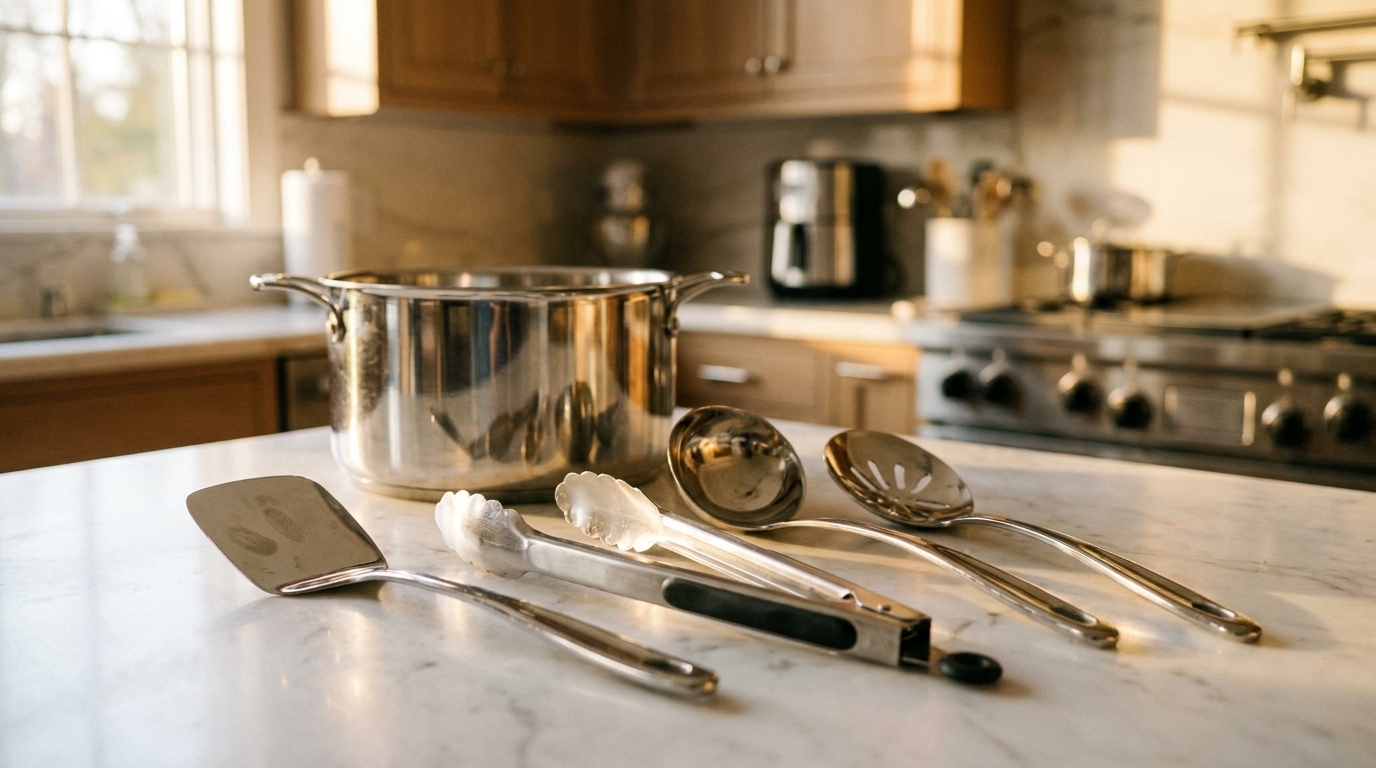
Stainless steel cookware excels at browning, searing, and handling acidic ingredients because its chromium oxide layer prevents rust and food reactivity. Start with a 5-6 piece set or individual pieces like tongs and a turner, then build your collection based on your actual cooking needs.
Why Stainless Steel Is the Smart First Choice for Your Kitchen
Stainless steel's chromium layer prevents rust and stops reactions with food, making it safe and reliable for browning, searing, and acidic dishes.
Are stainless steel utensils good for cooking?
The science behind durability and performanceStainless steel cooking utensils hold up in professional and home kitchens because of the material's core chemistry: iron alloyed with at least 10.5% chromium, plus nickel and other stabilizing elements.[1] The chromium reacts with oxygen to form an invisible passive layer on the surface--this is what prevents rust and stops the metal from reacting with your food.[2] Most utensils and cookware use 18/8 or 18/10 grade steel (also called 304 grade), meaning 18% chromium and 8-10% nickel, and both grades are classified as food-safe under FDA and international food-contact standards.[3] That non-porous surface also resists bacterial buildup, which makes stainless a reliable choice for non-toxic cooking across virtually every cooking task.[3]
How stainless steel compares to nonstick and cast iron for everyday cooking
Each material has a distinct role in the kitchen.
Stainless steel handles browning, searing, and acidic ingredients like tomato sauces without picking up off-flavors -- and it responds quickly to heat adjustments, so preventing scorching is straightforward.[4] Nonstick is the better call for delicate proteins, eggs, and breaded items that would tear on an uncoated surface. [4] Cast iron holds heat longer than either, which suits deep frying and sustained high-heat cooking, but that thermal mass also makes it slow to cool when you need to dial back fast.[4] For a closer look at how these two compare task by task, this cast iron vs. stainless steel breakdown goes deeper.

The Essential Stainless Steel Cooking Utensils Every Cook Needs
Choose 18/8 or 18/10 stainless steel utensils with heat-safe handles to match your cookware and ensure durability at high temperatures.
Start with these 5 core utensils: spatulas, spoons, tongs, and ladles that handle 90% of cooking tasks
What type of cooking utensils are best for stainless steel?
Material grades and heat-safe ratings explained Stainless cookware accepts all utensil materials -- stainless steel, silicone, wood, and nylon -- because the cooking surface won't degrade from contact the way nonstick coatings do.[8] Any scratches that metal utensils leave are cosmetic; they don't affect cooking performance or food safety, and the chromium oxide layer in the steel reforms on its own.[9] For the utensils themselves, look for 18/8 or 18/10 grade (SAE 304 stainless), which specifies 18% chromium and 8-10% nickel -- the combination that delivers corrosion resistance and safe food contact at high temperatures, and the same grade standard applies to the pots and pans you're cooking in.[10] One practical note: solid stainless handles conduct heat quickly, so extended contact with a hot pan will make them uncomfortable to grip; silicone or wood handles sidestep that entirely.[8]
What Should Not Be Cooked in Stainless Steel: Avoiding Common Mistakes
Acidic foods leach nickel and chromium from stainless steel, salt pitting damages the surface, and cooking sprays leave stubborn residue that requires careful cleaning.
Foods and techniques that damage stainless steel and how to protect your investment
A few foods and habits cause measurable damage to stainless steel.
Acidic foods -- tomato sauce in particular -- pull nickel and chromium from the steel during cooking, with concentrations increasing up to 26-fold after six hours in a new pan; leaching stabilizes after roughly six cooking cycles but never stops entirely, which makes glass pots a better choice for long-simmered acidic dishes.[12] Eggs, delicate fish, and thin batters stick and tear without proper preheating -- those tasks are better suited to nonstick or cast iron.[11] Always add salt after water reaches a full boil, not before, since salting cold water triggers surface pitting through a reaction between the salt, dissolved oxygen, and the steel's chromium.[13] Cooking sprays leave polymerized residue that bonds to the surface and requires abrasive scrubbing to remove, which scratches the pan and accelerates future wear.[11]
Maintenance tips that extend the life of your stainless utensils by years
Three habits protect stainless cookware long-term: let pans cool before rinsing to prevent thermal shock that can warp the base, wipe completely dry before storing to prevent surface corrosion, and avoid steel wool or harsh abrasive pads -- these leave embedded particles that eventually rust.[14] Deep cleaning every four to five uses catches invisible oil and residue buildup that affects heat distribution and causes food to stick even on a pan that looks clean.[16] For stubborn stains, a baking soda slurry handles moderate buildup, while Bar Keepers Friend tackles tougher marks and restores a like-new finish with less scrubbing effort.[15] Our guide to cleaning stainless steel pans covers each method step by step.


Building Your Stainless Steel Utensil Collection: A Prioritized Buying Guide with Comparison
Start with tongs and a turner if you cook proteins, or a ladle and slotted spoon for soups and stews, then add pieces as your actual cooking needs become clear.
Stainless steel cooking utensil sets vs. buying individual pieces: cost and quality breakdownBuying a set costs less per piece than sourcing individual stainless steel cooking utensils -- tested sets range from $70 to $215 for 4 to 15 pieces -- but sets regularly bundle tools you'll rarely use alongside the ones you'll reach for every day.[17] Building a collection piece by piece takes more time and costs more per item upfront, but nothing sits unused in the drawer.[6] The practical split is straightforward: if you're outfitting a new kitchen or replacing everything at once, a 5- to 6-piece set covers the core tasks without excess; if you already own a few solid pieces, buy individually to fill the specific gaps rather than duplicating what works.[17]
Decision checklist: Which stainless utensils to buy first based on your cooking style
Your cooking style is the clearest signal for which stainless steel cooking utensils to prioritize first.
Protein-focused cooks -- anyone regularly searing steaks, grilling chicken, or pan-frying fish -- should start with tongs and a turner, since both handle flipping and plating without tearing food.[18] Soup and stew regulars get the most immediate value from a ladle and slotted spoon, which cover portioning and draining in a single pass.[18] If your week spans proteins, pastas, and pan sauces, lead with tongs and a solid spoon for the widest task overlap, then add specific pieces -- a flexible fish spatula, a slotted spoon -- only as your actual cooking gaps become clear.[18]
- Stainless steel's chromium oxide layer prevents rust and resists food reactions, making it safe and durable for all cooking tasks.
- 18/8 or 18/10 grade stainless steel (304 grade) meets FDA food-safety standards and handles browning, searing, and acidic ingredients without picking up off-flavors.
- Salt cold water to avoid surface pitting; add salt only after water boils to prevent a reaction between salt, oxygen, and chromium.
- Long-simmered acidic dishes like tomato sauce leach nickel and chromium up to 26-fold in new pans; glass cookware is better for extended acidic cooking.
- Start with tongs and a turner for protein-focused cooking, or a ladle and slotted spoon for soups and stews--match utensils to your actual cooking style.
- Cool pans before rinsing, wipe dry before storage, and deep clean every 4-5 uses to prevent warping, corrosion, and heat distribution problems.
- A 5-6 piece stainless steel set ($70-$215) covers core tasks without excess; buy individual pieces later to fill specific gaps rather than duplicate what works.
- https://stahlkitchens.com/blogs/news/benefits-of-stainless-steel?srsltid=AfmBOooLKkn52uwnQ0KHKlZhRkYfy3_Ds4jceanyRacBGRAzi7xRqM46
- https://everti.com.au/blogs/news/is-stainless-steel-cookware-safe?srsltid=AfmBOoqe37kxFLmyc3rR-MKLXeXBvCl0uU90UymFRgfIXXExl_npJwoX
- https://www.azom.com/article.aspx?ArticleID=24472
- https://www.marthastewart.com/1541812/how-choose-between-stainless-steel-nonstick-cast-iron-cookware
- https://www.dioro.com/blogs/news/stainless-steel-utensil?srsltid=AfmBOorOQrQcctrUE7FD3Il2m3YcDzIPEuq5SuzsZouwPXq48jVoQoN7
- https://nymag.com/strategist/article/best-kitchen-utensil-set.html
- https://www.bonappetit.com/story/best-non-toxic-utensils?srsltid=AfmBOooVUoGM8jtgIDmiceyAVo4eJN5nifgPNLbSjGHpcp6SI0EU-qJ8
- https://lillyteak.com/what-is-the-best-material-for-cooking-utensils/
- https://www.centurylife.org/stainless-steel-inox/
- https://www.xometry.com/resources/materials/18-8-vs-18-10-vs-18-0-stainless-steel/
- https://www.realsimple.com/foods-you-shouldnt-cook-in-stainless-steel-skillets-7975827
- https://pmc.ncbi.nlm.nih.gov/articles/PMC4284091/
- https://traditionalcookingschool.com/food-preparation/the-scoop-on-stainless-steel-cookware/
- https://www.lecreuset.ca/en_CA/blog/stainless-steel-cookware-care-and-use-guide.html?srsltid=AfmBOorbGK-a-aLcnkBXpjrgKc-hmTzjOi9lIGykOUcLAbGESCKByBnu
- https://www.nytimes.com/wirecutter/guides/how-to-clean-stainless-steel-pans/
- https://www.bhg.com/how-often-clean-stainless-steel-11731650
- https://www.foodandwine.com/lifestyle/kitchen/best-utensil-sets
- https://therestaurantwarehouse.com/blogs/restaurant-equipment/stainless-steel-kitchen-tools?srsltid=AfmBOopq5Tyje5KGbVDGz9HFYG9OWmAy0W5Qs2TmqWsLiEvs4hPY3vak