

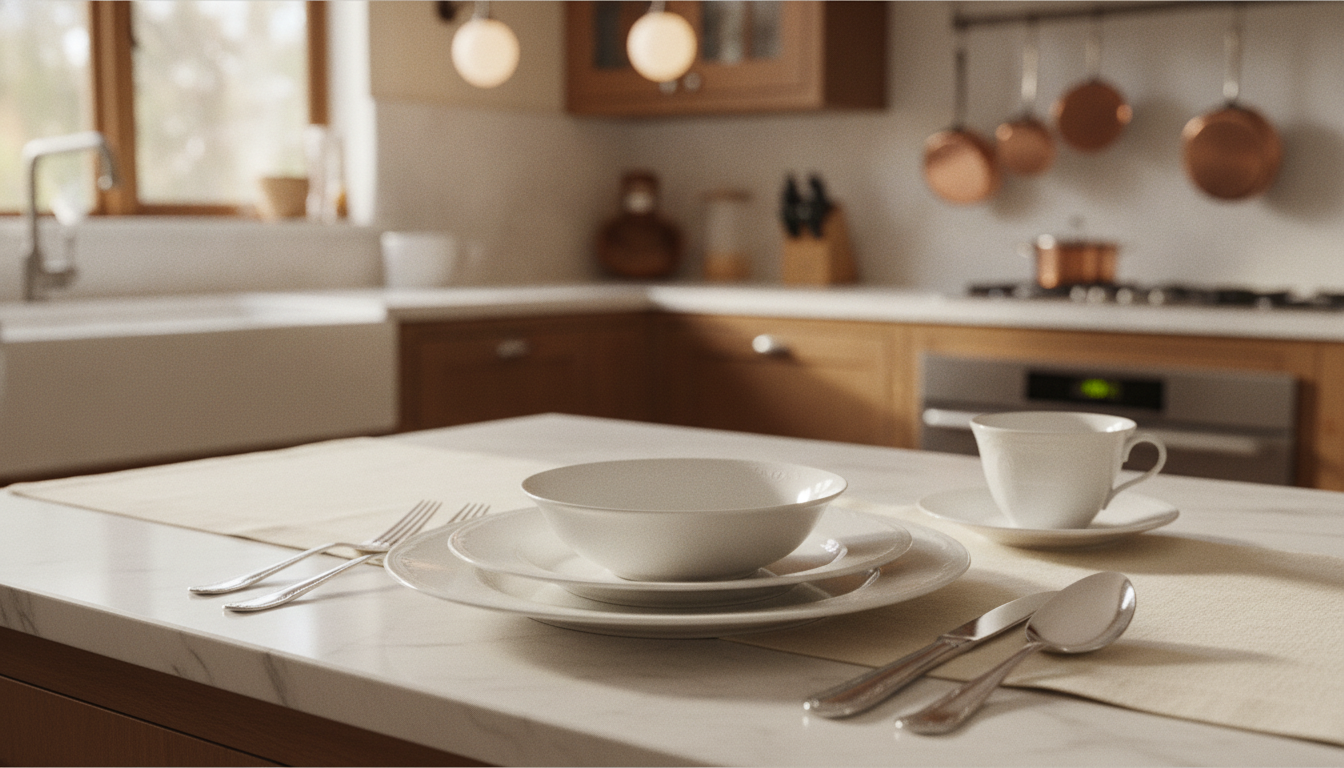
Learn how many place settings your household actually needs based on size and lifestyle, accounting for dishes in the wash, unexpected guests, and occasional breakage. The right count plus durable materials and simple care habits keeps your table ready for everyday meals and last-minute entertaining without constant rewashing.
What Is a Place Setting and Why the Count Matters
Buy one extra place setting beyond your household size to handle dishes in the wash, casual guests, and the occasional break.
The 5-piece standard: plate, bowl, cup, saucer, and flatware basics
A place setting is the number of pieces needed to set one spot at the table, and manufacturers typically sell it in three-, four-, or five-piece counts [1]. The five-piece version is the most common today: dinner plate, cup, saucer, a smaller plate, and a bowl for soup, cereal, or pasta [1]. A three-piece setting drops down to just the dinner plate, cup, and saucer, while a four-piece setting adds a salad plate but skips the bowl [1]. Some English dinnerware makers stretch the format to seven pieces by adding a bread-and-butter plate and a cream soup bowl with stand [1]. Retailers often package this five-piece bundle explicitly as a '5-piece place setting,' which is the direct answer to what a dinnerware set is called [2].
Breaking down the standard five-piece count:
- Dinner plate: largest plate, holds the main course [1]
- Salad or dessert plate: smaller plate, doubles for bread [1]
- Cup and saucer: matched pair, count as two pieces [1]
- Bowl: for soup, cereal, or pasta depending on the set [1]
Knowing this breakdown matters once you start counting settings per household, since a boxed set marketed for a certain number of people is really that many five-piece stacks, not that many individual plates [1].
Why owning more place settings than your household size solves real kitchen problems
Owning more place settings than your headcount solves a problem many households run into: dishes don't stay clean on a schedule that matches mealtimes. A single plate sits in the dishwasher, a bowl holds leftovers in the fridge, and another dish waits on a desk from lunch, so a two-person household that owns only two place settings ends up hand-washing before dinner even starts [3]. Dinnerware makers frame this as a math problem rather than a luxury: buy one step beyond your daily headcount if storage allows, so skipped dishwasher cycles, casual guests, and the occasional broken piece are less likely to leave you short a plate [4]. The same logic applies to flatware. A family of six that buys exactly six forks runs out mid-week the moment a fork is still in the dishwasher, which is why a cushion of at least two extra place settings beyond household size is a common recommendation [4]. That surplus covers a short list of recurring situations:
- Dishes still drying or sitting in the sink [4]
- Unannounced guests or a child's friend staying for dinner [4]
- Pieces chipped, lost, or mid-repair [4]
- Growing families that outpace last year's headcount [4]
The extra settings are not clutter. They are what keeps a kitchen running without a mid-meal scramble to wash a plate someone is waiting on.
Place Setting Counts by Household Size: A Quick Reference Chart
Buy place settings beyond your exact headcount so you always have clean dishes on hand, adjusting the count based on household size and entertaining habits.
| Household size | Recommended place settings | Replacement strategy |
|---|---|---|
| 1-2 people | 4 settings | Buy open-stock pieces to replace chips as they happen [6] |
| 3-4 people | 6 settings | Keep the standard four-person set plus two spares [5] |
| 5-6 people | 8 settings | Add settings in sets, not single pieces, for consistency [6] |
| 7-8+ people | 10-12 settings | Favor open-stock lines so broken pieces don't force a full reset [6] |
The 1.5x rule: why dinnerware experts recommend exceeding your household count
A simple way to translate general buy-more advice into a number is what's sometimes called the 1.5x rule: instead of matching place settings exactly to your headcount, aim for about half again that count, so a household of four works toward six settings rather than stopping at four. Amber Mayfield, founder of To Be Hosted, treats a 12-piece set, four full settings, as a reasonable starting point rather than a finished collection, since that count leaves no cushion once a dish chips or a guest joins the table [7].
Tom Mirabile, consumer trend analyst at the International Housewares Association, notes that 16-piece sets remain the most popular configuration because they deliver four complete settings of a dinner plate, salad plate, bowl, and mug, the standard unit most brands scale up or down from [7]. Treating that four-setting unit as a floor and adding roughly half again in extra pieces gives a household room to absorb wear without an immediate repurchase.
Sourcing that extra half-count in open stock, as Mirabile describes it, lets shoppers add exactly the pieces they're short rather than committing to another full boxed set [7]. This approach also suits growing households, since open-stock pieces can be added one at a time as the family expands instead of forcing a full reset to a larger set size [7].
Beyond Basic Count: Matching Place Settings to Your Cooking and Entertaining Style
Buy two smaller dinnerware sets instead of one large set to protect your good dishes while keeping everyday meals simple.
Daily use vs. special occasions: staggered dinnerware investment for different lifestylesStaggering dinnerware purchases by lifestyle solves a problem that a single household-size number can't: daily meals and special-occasion meals have different requirements for place settings dinnerware. A practical approach is to buy two smaller sets instead of one large one, a casual four- to six-piece place setting for everyday meals and a separate 12-piece set reserved for formal dinners [8]. This mirrors how many dinnerware lines are actually built, with lower piece counts like 16- or 20-piece sets aimed at daily use and larger 45-piece sets designed around serving platters, extra bowls, and utensils for entertaining groups of eight or more [9]. Splitting the investment this way also protects your good dishes from the wear of daily dishwasher cycles, since the everyday set absorbs the chips and scratches while the formal set stays in better condition for longer [9]. Before committing to either tier, it helps to set a budget first, since that number narrows the field faster than shopping by pattern or piece count alone [10]. A few signs you need a staggered approach:
- Daily meals happen with the same 2-4 people [8]
- Formal or holiday gatherings only occur a few times a year [9]
- Storage space allows two separate sets without crowding cabinets [10]
This two-tier strategy keeps your everyday routine simple while still giving you a complete setup when guests or holidays call for something more.
How oven-safe dinnerware changes your place-setting needs for cooking-to-table service
Oven-safe place settings dinnerware changes the math because one dish now covers two roles: it bakes the meal and serves it, so you skip the transfer step that usually adds a serving bowl or platter to your count [11]. Stoneware handles this shift well since it distributes heat evenly and holds up to the temperatures needed for casseroles, baked pasta, or bread, while porcelain brings a more refined look suited to oven-to-table presentation without sacrificing that same even heating [12]. Bakeware built for this dual purpose is also designed to survive high heat and keep food warm at the table longer, which matters if a household serves straight from the oven instead of plating in the kitchen [12]. The same thinking applies to oven-safe cookware. A stainless steel pan or roasting pan is generally designed to move from oven to table, so one durable piece can handle cooking and serving instead of adding another dish to the stack. Practically, this means a household that leans on oven-to-table pieces can get by with fewer standalone serving pieces, since the everyday setting doubles as the cooking vessel:
- Baked pasta or casserole dishes replace a separate serving bowl [12]
- Stoneware ramekins go from oven to table without a transfer plate [12]
- Porcelain bakers hold heat longer, reducing reheating trips [12]
Factoring oven-safe pieces into your place-setting count can trim the number of extra serving pieces you'd otherwise need to buy alongside your dinnerware.
Choosing Durable Place Settings That Survive Real Kitchen Life
Porcelain and bone china outlast stoneware because higher firing temperatures create a denser, nonporous surface that resists chips and stains through repeated dishwasher cycles.
Material durability and chip resistance: why some dinnerware outlasts others across 500+ dishwasher cycles
Material durability comes down largely to firing temperature and clay composition. Porcelain fired at higher temperatures produces a denser, nonporous body that resists chipping and scratching better than standard ceramic, though water absorption differs by type [13]. Stoneware is thicker and heavier, and while it holds up well to daily wear, it doesn't shed water as efficiently as porcelain [13]. Bone china, a porcelain variant reinforced with bone ash, adds extra strength and a chip-resistant edge while staying lighter than stoneware [15]. Comparing categories side by side helps explain why some place settings dinnerware lasts longer than others through repeated dishwasher cycles:
- Porcelain: high-fire, nonporous, resists chips and stains [13][15]
- Stoneware: thicker, heavier, more water absorption [13]
- Glass: more vulnerable to chipping than porcelain over time [15]
Firing temperature is the underlying driver: earthenware fires around 1,950 degreesF, stoneware between roughly 2,200 and 2,350 degreesF, and porcelain near 2,400 degreesF, with higher firing linked to a harder, more durable body [14]. Porcelain's flat, non-porous surface also sheds food particles and stains more easily, which keeps repeated dishwasher cycles from dulling its glaze or weakening its edges the way it can with less refined ceramic [15]. That combination of high firing heat and a tight, glassy body is why porcelain and bone china tend to outlast stoneware and standard ceramic across years of everyday washing and handling [13][15].
Building a maintenance routine that keeps your place settings looking new longer
A maintenance routine doesn't need to be complicated to work. Scrape food waste before loading dishes, since acidic leftovers like tomato sauce or citrus can affect the glaze if left sitting too long [16]. Space plates in the dishwasher rack instead of stacking them, and skip the heavy-duty cycle unless dishes are visibly soiled, since strong detergents and high heat contribute to dulling over time [16]. Air-drying instead of heat-drying cuts down on the prolonged heat exposure that wears at a glaze's shine [16]. For decorative or metallic-trimmed pieces, hand washing with warm water and a soft sponge protects finishes that dishwasher detergents can strip away [17][18]. The same care & maintenance tips carry over to your cookware: wooden or silicone utensils avoid the fine scratches metal leaves on glazed surfaces, and letting hot dishes cool before washing prevents the thermal shock that causes hairline cracks [17][18]. Gray marks from silverware use aren't scratches, they're metal residue, and a baking soda paste rubbed gently in circles can lift them without harming the glaze in most cases [16][18]. A few habits protect place settings dinnerware over years of regular use:
- Scrape food and rinse before loading or soaking [16]
- Space dishes, skip heavy cycles, air-dry when possible [16]
- Hand wash trimmed or hand-painted pieces separately [17][18]
- Use wood or silicone utensils, not metal, on plates [17][18]
Stick to this routine and your daily dinnerware keeps its shine and shape well past the point where careless washing would have dulled it [16][17]. Get the count right for your household, pick pieces built to last, and treat them well, and your table stays ready for everyday dinners and last-minute guests alike. Have a question about matching cookware to your setup or keeping it in good shape? Contact us.
Frequently Asked Questions
-
How many place settings do I need for a 4-person household?
The article's reference chart recommends 6 place settings for a 3-4 person household - keep the standard four-person set plus two spares. This matches the '1.5x rule' described in the article, where a household of four works toward six settings rather than stopping at exactly four.
-
What's the difference between a 3-piece, 4-piece, 5-piece, and 7-piece place setting?
A 3-piece setting is just a dinner plate, cup, and saucer. A 4-piece setting adds a salad plate but skips the bowl, while the standard 5-piece setting includes a dinner plate, salad/dessert plate, cup, saucer, and a bowl. Some English dinnerware makers extend this to 7 pieces by adding a bread-and-butter plate and a cream soup bowl with stand.
-
Should I buy a boxed dinnerware set or open-stock pieces?
The article notes that a boxed set marketed for a certain number of people is really that many five-piece stacks, and recommends open-stock lines for households that entertain often or run larger families, since it lets you replace a single chipped piece instead of repurchasing a whole set. A boxed kit may still cost less upfront, but compare its actual piece count and price against buying the specific open-stock pieces you need.
-
How many extra place settings should I buy beyond my household size?
The article recommends a cushion of at least two extra place settings beyond your household size to cover dishes still in the sink or dishwasher, unannounced guests, chipped or lost pieces, and growing families. For exact starting counts, its chart suggests 4 settings for 1-2 people, 6 for 3-4 people, 8 for 5-6 people, and 10-12 for 7-8+ people.
-
Is stoneware or porcelain dinnerware more durable for everyday use?
Per the article, porcelain is fired at a higher temperature (near 2,400°F) than stoneware (roughly 2,200-2,350°F), giving it a denser, nonporous body that resists chipping, scratching, and staining better over repeated dishwasher cycles. Stoneware is thicker and heavier and holds up well to daily wear, but it absorbs more water than porcelain and doesn't shed food particles as easily.
- A five-piece place setting includes a dinner plate, salad plate, bowl, cup, and saucer as the standard unit.
- Buy at least one to two extra place settings beyond your household size to cover dishes in the dishwasher, unexpected guests, and broken pieces.
- Open-stock dinnerware lets you replace individual chipped or broken pieces instead of repurchasing complete boxed sets.
- Porcelain and bone china resist chipping and staining better than stoneware because they fire at higher temperatures and have nonporous surfaces.
- Space plates in the dishwasher, skip heavy-duty cycles, and air-dry to protect glazes from dulling over repeated washing.
- Two smaller dinnerware sets, one for daily use and one for formal occasions, protects your good dishes from everyday wear while keeping entertaining covered.
- https://www.google.com/goto?url=CAESxwEB6zswFaG_FMxqWfreFUsqI1OPmubS7j5sJUyxOzBhLfmA6qT_x1PYDigJ-cPHW7v6m8xv3podAJ_BfOZsg39nkDstsy5gYnFPwxd3Igo5TbHtTaOY8DlJ6mlFLIgUrZVVt5ve3z8vwFLj29AaQ_x6DY2t9Zu_l_s5_u-eYHmQp26wtEnjkgeFD-RaytFngDgN6Jb0rhAvzpmPqvvyggSBFyFEVLMFcy5bVfkAHPPl3ISF8AigRoAa9sMKrz9BlFq_8cQj6KmV
- https://www.google.com/goto?url=CAES0QEB6zswFf37KIzG_ijELqhk6OlFjw-XIYyxlL85ed70P06akSNw8DbU__3v3BzgRxL1cPjBkv6KrCoCUu5OVKMTpT3LdMzA82ekDEVCM_NPvxJgtW-IYTlD6EvWjP6el2eIkkS47MN28MnsR4d6n-n_2tiNCDXUQBWd-NNfnj-Y_x4LIhpsxE3HbNKYZkrniaugVUx1qCDPkvOMmPbRhCXIHI03_3zWldArr7TKFLY6G2IF1tVo22zNlZp7RRyFpHICFPshx3xilZBZA9D2MI2Z_g
- https://www.vancassotableware.com/blogs/buying-guides/best-dinnerware-sets-couples-families-new-home
- https://www.lenox.com/blogs/buying-guide/best-flatware-sets-for-large-families
- https://www.royalwarechina.com/i-want-to-buy-a-new-dinnerware-set-what-should-i-buy/
- https://www.joyye.com/info-detail/choose-the-right-dinnerware-for-your-home
- https://www.cableacsgroup.es/blog/the-15-best-dinnerware-sets-of-2022/
- http://www.noritakeindia.com/how-many-place-settings-should-i-buy.html
- https://www.fareastcookware.com/blog/how-many-pieces-are-usually-in-a-dinnerware-set-1911622.html
- https://www.saltwire.com/nova-scotia/how-to-pick-out-everyday-dinnerware-302774
- https://www.vancassotableware.com/en-eu/blogs/news/how-to-choose-dinner-plates-ultimate-guide
- https://malacasa.com/de-fr/blogs/news/what-makes-good-bakeware-quality-essentials
- https://www.chinadkceramic.com/news/is-stoneware-or-porcelain-better.html
- https://www.vancassotableware.com/it/blogs/dining-decoded/ceramic-tableware-alternatives
- https://malacasa.com/blogs/news/family-dishwasher-safe-tableware
- https://www.vancassotableware.com/blogs/care-use-safety/dishwasher-vs-hand-wash-dinnerware-guide
- https://hfcoors.com/blogs/news/how-do-i-care-for-ceramic-dinnerware-to-prevent-chips-and-cracks
- https://wilmax.com/blogs/article/a-guide-to-caring-for-your-dinnerware-to-extend-its-lifespan