

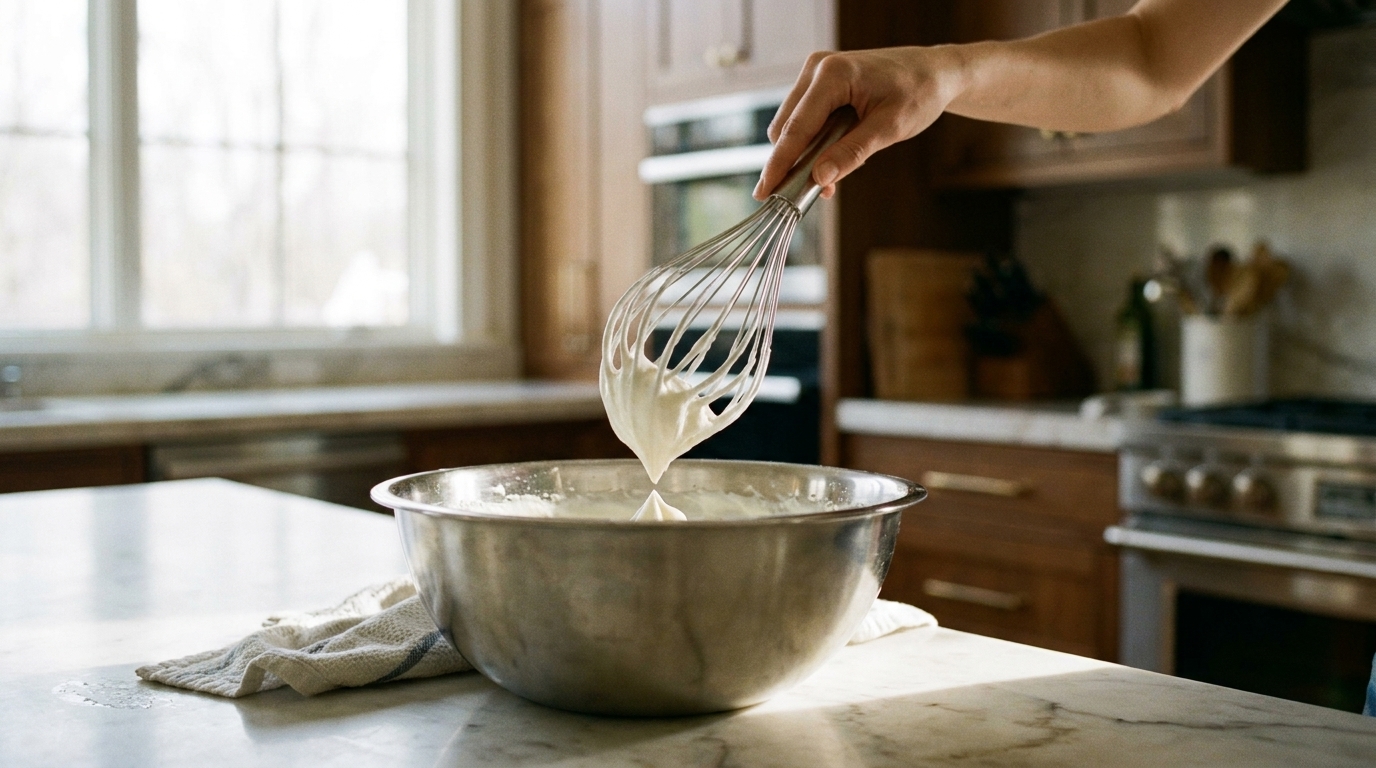
Master homemade whipped cream with just heavy cream and a whisk by understanding the science of how fat and air create stable peaks. The right technique, equipment, and temperature control transform a simple two-ingredient mixture into perfectly textured whipped cream in under three minutes.
What Happens When You Whisk Heavy Cream: The Science Behind Homemade Whipped Cream
Fat content and temperature control the texture of whipped cream, so understanding both ensures you get the peaks you want every time.
How agitation transforms liquid cream into fluffy peaks in 3-5 minutes
When you whisk heavy cream, you're doing two things simultaneously: forcing air into the liquid and breaking down the fat globules' protective phospholipid membranes. [1] Those damaged membranes expose water-fearing triglycerides, which cluster around nearby air pockets rather than contact the surrounding water in the cream. [1] Over 3-5 minutes of sustained agitation, this builds a stable network of fat-coated air bubbles -- the foam structure we recognize as whipped cream. [1] Knowing this is helpful when you first learn how to make whipping cream, since it explains why technique and timing aren't arbitrary.
Why temperature and fat content matter more than you think
Fat content sets the floor for what's possible: cream below 30% milk fat won't whip at all, because there aren't enough triglycerides exposed to build a stable foam. [1] Heavy cream at 36% or more produces firm, pipeable peaks, while whipping cream in the 30-35% range stays softer and less structured. [2] Temperature matters just as much -- research found that whipping between 7.5 degreesC and 12.5 degreesC produces the best texture, and going above 15 degreesC causes fat globules to aggregate too quickly, destabilizing the bubble surface before it can hold air. [3] Understanding how fat percentage shapes results also explains why swapping heavy cream for half and half rarely works for whipped applications.
The Simplest Method: Making Whipped Cream with Just Heavy Cream and a Whisk
Whisk cold heavy cream for 2 to 2.5 minutes, watching for medium or stiff peaks that hold their shape for piping and topping.
Step-by-step instructions for hand-whisking without electric mixers
Pour 1 cup of cold heavy cream into a large bowl, then set the bowl on a damp kitchen towel to keep it from sliding while you whisk. [4] Tilt the bowl slightly toward you and move the whisk in a back-and-forth motion rather than circular strokes -- this moves more cream through the wires with each pass and cuts down total whisking time. [4] Start with steady, moderate pressure until the cream begins to thicken, about 60 seconds, then increase speed as it builds body and starts to hold its shape. [5] For a 1-cup batch, expect roughly 2 to 2.5 minutes of active whisking to reach medium-stiff peaks, yielding about 2 cups of whipped cream total. [5]
How to recognize soft peaks, medium peaks, and stiff peaks--and when to stop
Each peak stage has a distinct visual cue when you lift the whisk. At soft peaks, the cream forms a point that immediately curls back down onto itself -- useful for dolloping but not for piping or holding shape under weight [6].
Medium peaks hold their tip for a moment before it bends over slightly, giving you enough structure for most toppings and folded applications [6]. Stiff peaks (also called firm peaks) stand straight up without any curl; the cream holds its shape when you tilt the bowl and leaves defined ridges that stay put [7].
Stop at stiff peaks -- past this stage, the cream turns grainy as fat and liquid separate, and the only fix is folding in fresh unwhipped cream before it goes too far [6].
Equipment That Changes Everything: Choosing the Right Whisk and Bowl for Faster Results
A balloon whisk paired with a large, lightweight bowl cuts your whisking time in half and reduces the arm effort needed to reach soft peaks.
Balloon whisks vs. coil whisks: which design whips cream fastestThe balloon whisk outperforms coil (spiral) whisks for whipping cream because of its bulbous shape and multiple thin wire tines, which trap air with each stroke and build volume faster with less effort. [8] A coil whisk -- also called a spiral whisk -- uses a single wire wound into tight angled coils designed to stay in contact with the base of a pan; that geometry works well for sauces and breaking up dry ingredient clumps in small bowls, but it moves far less air per stroke than a balloon whisk does. [9] Tested on the same half-cup of cream batch, the balloon whisk's rounded wire cage reaches soft peaks noticeably faster because its many flexible tines create more movement and surface contact with each pass. [8] A coil whisk will eventually whip cream -- it just takes more time and considerably more arm effort to get there. [8]
Why bowl material and size affect your whisking time and arm fatigue
Bowl size sets the practical floor for how efficiently you can whisk without splashing or shallow strokes.
Testing with 1-cup batches consistently used a large bowl because the cream needs room to travel through the full wire arc with each stroke -- anything smaller forces shorter, shallower passes, which means less air per stroke, more total time, and more cumulative effort from your arm. [10] Equipment weight compounds this directly: heavier tools require breaks during extended whisking sessions, and the same principle applies to a heavy ceramic or glass bowl you're actively tilting and stabilizing throughout. [11] A lightweight bowl that stays put -- set on a damp towel -- keeps the physical load concentrated on the whisking motion itself rather than splitting it between steadying and stirring. [10]
Beyond Plain Whipped Cream: Flavor Variations and Storage Tips for Homemade Batches
Timing when you add sugar and flavorings protects your whipped cream's structure, and proper storage with stabilizers keeps it fluffy for up to three days.
Adding vanilla, sugar, and other flavorings without deflating your peaks
Sugar and flavorings go in at different stages, and timing each correctly protects the structure you've already built.
Add powdered sugar when the cream has thickened but hasn't yet hit the soft peak stage -- too early and it slows whipping, too late and the granules won't dissolve fully. [12] Powdered sugar is the better choice over granulated because it contains cornstarch, which helps prevent the whipped cream from weeping liquid as it sits. [13] Liquid flavorings -- vanilla extract, almond extract, or a splash of liqueur -- go in during the final 30 to 60 seconds; adding them earlier introduces liquid that can partially deflate the foam before it's fully stable. [12]
How to store homemade whipped cream and keep it fresh for 2-3 days
Transfer freshly made whipped cream to an airtight container and place it in the coldest part of your refrigerator right away. [14] Never leave it at room temperature for more than two hours -- warmer conditions accelerate bacterial growth and cause the fat network to collapse. [16] A batch made with only powdered sugar stays fluffy for a few hours, while adding a tablespoon of dry instant pudding mix extends that to about 48 hours; a properly stabilized batch holds its texture for two to three days. [15] If the cream softens during storage, re-whip it briefly with a small splash of cold heavy cream to restore volume without starting over. [14]
- Heavy cream needs at least 36% milk fat to whip into firm peaks; lower fat content won't stabilize.
- Whisk between 7.5 degreesC and 12.5 degreesC for best results; temperatures above 15 degreesC cause fat to aggregate too quickly.
- A balloon whisk with multiple thin tines outperforms coil whisks by trapping more air per stroke.
- Use a large bowl on a damp towel to maintain proper whisking depth and reduce arm fatigue.
- Add powdered sugar at soft peak stage and liquid flavorings in the final 30-60 seconds to preserve structure.
- Properly stabilized whipped cream lasts 2-3 days refrigerated; re-whip briefly with cold cream if it softens.
- https://www.seriouseats.com/the-science-of-whipped-cream-butter-creme-fraiche
- https://pmf-tr.com/the-science-of-whipping-cream-fat-percentage-impact-on-quality-for-food-businesses/
- https://agriculture.institute/dairy-products-i/perfecting-whipping-cream-steps-tips/
- https://pastrychefonline.com/how-to-whip-cream-by-hand/
- https://www.foodandwine.com/best-method-for-whipping-cream-11853304
- https://umamigirl.com/how-to-whip-cream/
- https://bakestarters.com/blogs/education/soft-medium-firm-stiff-peaks
- https://gygi.com/blogs/create/the-gygi-guide-to-whisks?srsltid=AfmBOorIf2eoeeAQUsZMSS4LLgTdD-VdgTt5Op0JCuU3_4MpUgl9tkA9
- https://www.webstaurantstore.com/blog/2498/types-of-whisks.html?srsltid=AfmBOoqrpOGgd7eu919Wo5hC5rnVzekVgzIB9S3F57St3mCeerNjb1WD
- https://www.epicurious.com/expert-advice/the-best-whisks-for-soft-peaks-of-whipped-cream-and-silky-pan-sauce-article
- https://www.bbcgoodfood.com/review/best-whisks
- https://www.simplyrecipes.com/recipes/how_to_make_whipped_cream/
- https://www.allrecipes.com/article/how-to-make-whipped-cream/
- https://www.theslowroasteditalian.com/kitchen-hack-homemade-whipped-cream/
- https://www.createkidsclub.com/stabilized-whipped-cream/
- https://smartwhip.uk/2025/09/10/how-long-does-whipped-cream-last-tips-for-freshness-and-proper-storage/