

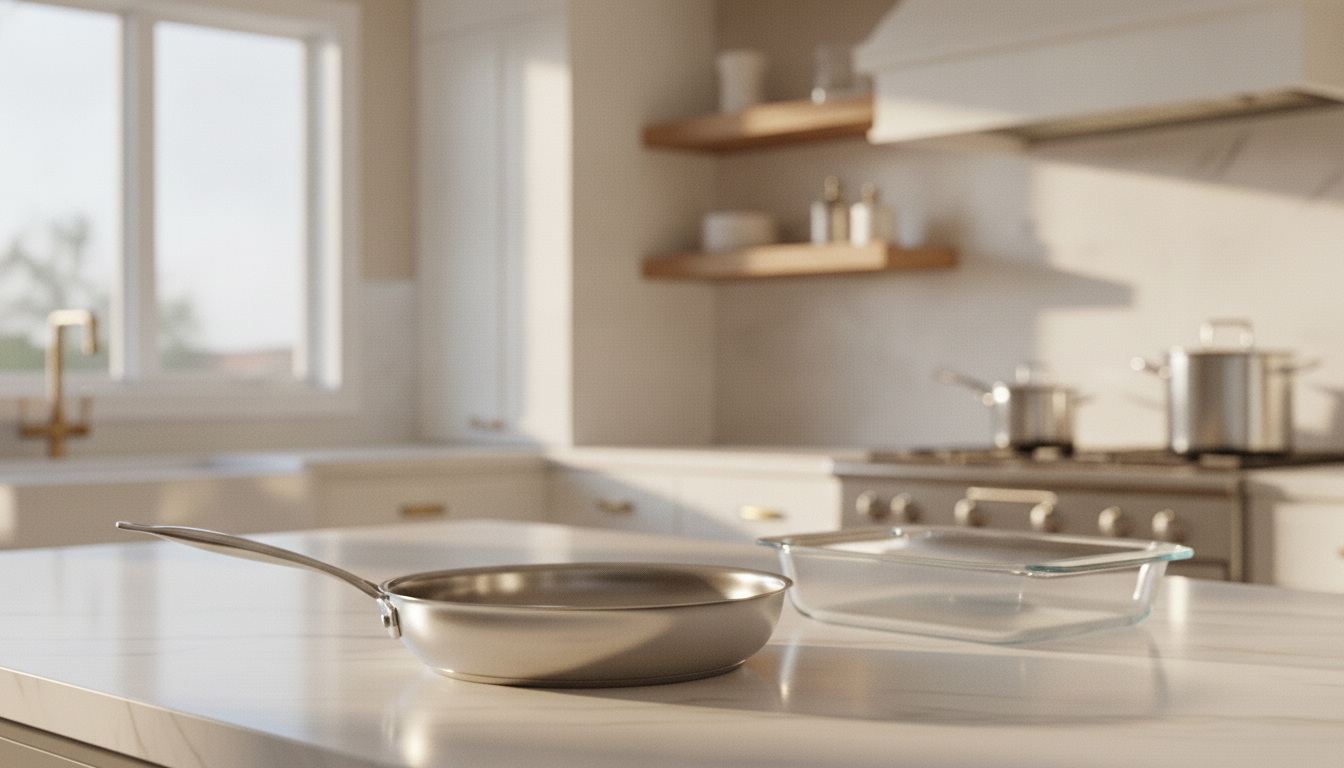
Borosilicate glass costs more than basic cookware but breaks more easily than stainless steel or cast iron, heats slowly, and demands gentle handling to avoid thermal shock and hidden stress fractures. Stainless steel and carbon steel outperform glass for everyday cooking, offering faster heat response, durability, and minimal maintenance.
Why Borosilicate Glass Isn't the Perfect Kitchen Material (And What to Consider Instead)
Stainless steel and cast iron handle high heat and temperature swings far better than tempered glass, making them smarter choices for most stovetop and oven cooking.
The Marketing Hype vs. Real-World Performance in Home KitchensMarketing copy often treats "borosilicate" as a guarantee of thermal shock resistance, but the real picture is more nuanced.
Corning itself distinguishes between laboratory-grade PYREX, which is genuine borosilicate 3.3, and consumer pyrex cookware now made from tempered soda-lime glass in some markets, including the United States [2].
Tempered glass can handle uniform heat well, but it is not inherently resistant to sudden temperature swings the way true borosilicate is, so a container labeled similarly to lab glass may not perform the same way on your stovetop or straight out of the freezer [1].
How Borosilicate Glass Compares to Cookware Materials You Already Trust
Stainless steel and cast iron conduct heat efficiently and respond quickly to temperature changes, making them better suited to browning and high-heat cooking than glass [5]. Metal bakeware heats faster and promotes surface color, while glass heats slowly and evenly, limiting scorching but also limiting browning [3].
Stainless steel also resists corrosion, warping, and aggressive scrubbing in ways tempered or borosilicate glass cannot match once stressed [4]. Cast iron tolerates high heat exceptionally well but still needs gradual cooling, much like glass, to avoid cracking or warping [5].
Each material trades off differently between heat response, durability, and handling.
Drawback #1: Higher Cost With Limited Cooking Versatility
Glass conducts heat poorly on stovetops, requiring nearly twice the energy to reach the same temperature as metal cookware.
Price Premium: What You're Actually Paying For
Borosilicate glass costs more to produce than ordinary soda-lime glass because of its chemical composition and lower thermal expansion rate, properties that make it genuinely more resistant to thermal shock [6].
That premium is supposed to buy you a wider margin for error when moving dishes between hot and cold conditions, but the benefit only applies if the product is actually true borosilicate rather than tempered soda-lime glass marketed loosely under the same name [7].
Buyers comparing cookware prices broadly see a similar pattern elsewhere: premium materials like stainless steel also carry higher upfront costs than budget alternatives like ceramic, with the payoff tied to longevity rather than immediate performance [7].
Why Glass Cookware Underperforms on Stovetops Compared to Metal Alternatives
Glass belongs to a category of materials scientists classify as insulators, alongside ceramics and earthenware, meaning it conducts heat inefficiently compared to metals [8]. That property makes glass workable in an oven, where heat surrounds the dish evenly, but a poor match for a stovetop burner, where metals like copper, aluminum, and cast iron rely on the free flow of electrons to move heat quickly across the cooking surface [8].
Lab comparisons confirm the gap: heating a glass pyrex vessel to the same temperature as a stainless steel and copper pan takes nearly twice the energy, since glass has a much higher specific heat and a far lower thermal conductivity [9]. That combination explains why borosilicate dishes heat slower and respond sluggishly to burner adjustments.
Drawback #2: Thermal Shock Risk--When Temperature Changes Cause Breakage
Sudden temperature swings crack glass dishes even when made from borosilicate--gradual cooling and warm water prevent most thermal shock failures.
How Rapid Temperature Shifts Damage Borosilicate Glass Dishes
Thermal shock happens when one part of a glass dish changes temperature faster than the rest, creating internal stress that can crack the vessel even though borosilicate resists this better than soda-lime glass [10].
Pulling a hot dish from the oven and setting it directly on a cold counter, or rinsing it under cold water right after baking, forces the outer surface to contract while the interior stays hot, and that mismatch is what causes sudden failure [11].
Borosilicate's lower thermal expansion raises the threshold before cracking starts, but it does not make the glass unbreakable; chips, scratches, and uneven heating all lower that threshold further [12].
Real Kitchen Scenarios Where Thermal Shock Happens (And How to Avoid Them)
Thermal shock in a real kitchen usually traces back to a handful of habits: rinsing a hot dish under cold water, setting a just-baked pan on a wet countertop, or pulling cookware straight from the freezer into a hot oven [13]. Consumer Reports' lab tests recreated this exact failure by baking glass dishes at 450 degreesF and then setting them on a wet granite countertop, a combination that broke soda-lime samples every time [14].
Borosilicate tolerates these swings far better because its low thermal expansion limits internal stress, but avoiding the trigger matters more than trusting the material alone [15]. Letting dishes cool gradually, using warm rather than cold water, and giving refrigerated food time to reach room temperature before baking all reduce the risk [13].
Drawback #3: Breakage and Durability Concerns Despite the 'Tough Glass' Reputation
Stainless steel outlasts glass and nonstick coatings because it resists scratching and warping without the risk of sudden thermal failure.
Why Borosilicate Glass Breaks More Easily Than Marketed--And What Happens When It Does
Comparing Longevity: Glass vs. Stainless Steel and Nonstick Alternatives Longevity favors metal over glass in most daily-use scenarios. Stainless steel resists scratching, corrosion, and warping, and can be scrubbed aggressively without damage, which lets it outlast glass even though glass itself resists staining and chemical wear well [18].
Nonstick pans sit at the opposite end, with coatings that typically wear out within 3 to 8 years depending on quality and handling, far short of what well-treated glass or stainless steel can offer [18]. Glass cookware's failure mode is different: it doesn't wear down gradually like a nonstick coating, it accumulates invisible stress from thermal cycling until it fails outright [18].
That makes stainless steel the more predictable long-term investment for everyday cooking.
Drawback #4: Limited Heat Distribution and Uneven Cooking Results
Borosilicate glass conducts heat slowly and unevenly, causing longer cook times and uneven browning compared to metal cookware.
Glass Doesn't Conduct Heat Like Metal--What This Means for Your Meals
Borosilicate's chemistry, roughly 80% silica with boron oxide added, prioritizes low thermal expansion and chemical resistance over fast heat transfer [20]. Measured thermal conductivity and diffusivity values for borosilicate glass-ceramic compositions stay low across a wide temperature range, confirming the material moves heat slowly compared to metals [19].
That sluggish heat movement means a glass dish sitting on a burner or under a broiler takes longer to reach cooking temperature, and heat spreads unevenly from the point of contact outward. For dishes depending on quick, direct heat transfer, like searing or rapid reductions, that lag translates into longer cook times and less predictable results than metal cookware delivers [19].
When Glass Bakeware Falls Short: Browning, Burning, and Hot Spots
Glass bakeware's slow, even heating creates its own baking problems: edges often brown faster than centers stay pale, since heat radiates inward unevenly rather than transferring quickly like metal [21]. Because glass retains heat after leaving the oven, cakes and bars keep cooking on the counter, which can overbake edges even after you've pulled the dish out [22].
Thin spots in a recipe's structure, like loaf cakes and pie crusts, are especially prone to dark, dry edges paired with underbaked, sunken centers [23]. Bakers typically compensate by lowering oven temperature roughly 25 degreesF and extending bake time, but that workaround doesn't fix the uneven hot-spot pattern glass produces in the first place [21].
Drawback #5: Maintenance Challenges and Hidden Damage You Can't See
Glass cookware develops invisible cracks from minor bumps and thermal stress that fail suddenly without warning, so inspect pieces regularly and retire any with chips or scratches.
Microscopic Cracks and Internal Stress: Why Borosilicate Glass Fails Without Warning
Glass fails through brittle fracture, meaning it holds steady until it suddenly breaks, with no bending or warning flex beforehand [24]. Most failures start at microscopic surface flaws, tiny scratches or chips invisible to the eye, where local stress can run 100 to 1,000 times higher than the average stress on the rest of the dish [24].
A borosilicate dish that survived a minor bump may carry a sub-critical crack that grows quietly with each wash or temperature swing until it reaches a critical length and fails outright [26]. Borosilicate's low thermal expansion raises the threshold for this kind of stress buildup, but repeated thermal cycling still accelerates microscopic crack formation over time [25].
Cleaning and Care Requirements That Go Beyond Standard Cookware
Glass cookware asks for gentler handling than metal pans tolerate. Baked-on food needs a soak in warm soapy water before scrubbing with a nylon or plastic pad, since abrasive scouring can scratch the surface and weaken it over time [27].
Dishwashers are fine, but loading matters: dishes need to avoid direct contact with heating elements and other items during the cycle [27]. Skip adding liquid to a dish that's already hot, and never set it on a wet or cold countertop, both trigger the same thermal stress that cracks glass [27].
Once a piece is chipped, cracked, or deeply scratched, stop using it, since the compromised strength can cause breakage later, even without an obvious impact [27].
Borosilicate vs. Cookware Materials: Comparison Chart
Stainless steel heats quickly and evenly while resisting rust and scratches, making it the more dependable choice for everyday cooking than glass or cast iron.
Side-by-Side Breakdown of Cost, Durability, Heat Performance, and Maintenance
Lined up side by side, the trade-offs become clear. Glass costs more upfront than basic cookware but resists breakage less reliably than stainless steel or cast iron, both of which tolerate scratching, aggressive scrubbing, and high heat without failing [28]. Stainless steel heats quickly and evenly; cast iron retains heat exceptionally well; glass lags on both counts, heating slowly and unevenly [28]. Maintenance also splits the field: stainless steel and cast iron shrug off daily wear, while glass needs gradual temperature changes and gentle cleaning to avoid stress fractures [28].| Material | Cost | Durability | Heat performance | Maintenance |
|---|---|---|---|---|
| Borosilicate glass | Moderate-high | Breaks on impact/thermal shock | Slow, uneven | Gentle washing, gradual temp changes |
| Stainless steel | Moderate-high | Scratch/corrosion resistant | Fast, even | Low upkeep |
| Cast iron | Moderate | Lasts decades | Excellent retention | Seasoning required |
Which Material Wins for Your Cooking Style: A Decision Guide
Your cooking habits should drive the decision, not marketing claims. If you sear, sauté, or need quick stovetop response, stainless steel wins: it resists rust and corrosion, handles aggressive scrubbing, and performs well with an aluminum or copper core that speeds up heat distribution [29].
If your cooking leans toward oven baking or storing leftovers without worrying about metal reacting with food, glass still has a place, though it demands gentler handling. For cooks prioritizing a long-term investment they can pass down, stainless steel's durability and versatility make it the more dependable everyday choice, with glass better suited to occasional, lower-stress tasks [29].
Why Professional and Home Cooks Are Choosing Metal Cookware Over Glass
Stainless steel and carbon steel heat fast and withstand aggressive cooking, while glass can't match the durability professional kitchens demand.
The Real Reasons Borosilicate Glass Remains Niche in Professional Kitchens
Professional kitchens run on speed and volume, and borosilicate glass simply can't keep pace with fully clad stainless steel, the material most commercial cookware brands build around for searing, sauces, and fond-building [30]. Chefs favor mismatched, task-specific tools like carbon steel and heavy-bottomed stainless over anything that heats slowly or needs gradual temperature changes, since a busy line has no patience for gentle handling [31].
Stainless steel's quick heat response and resistance to scratching, corrosion, and aggressive scrubbing make it the default for high-heat techniques glass can't match [32]. That combination of speed and durability, not aesthetics, is why glass bakeware rarely shows up where cooks are working under pressure.
How Stainless Steel, Carbon Steel, and Nonstick Pans Outperform Glass for Everyday Cooking
Everyday cooking favors materials that respond quickly to heat changes, and glass can't compete there. A stainless steel pan heats evenly once paired with a conductive aluminum core, resists acidic ingredients, and tolerates metal utensils and aggressive scrubbing with minimal wear [33].
A carbon steel pan runs lighter than cast iron, responds fast to temperature shifts, and builds a natural nonstick surface over time, though acidic dishes like tomato sauce still wear down its seasoning [34]. Nonstick pans trade some durability for effortless food release at moderate heat, filling the gap glass leaves for delicate proteins like eggs or fish [34].
Each material handles stovetop demands glass simply isn't built for [33].
Building a Durable Kitchen Without Borosilicate Glass
Stainless steel, cast iron, carbon steel, and nonstick each excel at different tasks, so match your cookware to what you're cooking.
Essential Cookware Materials That Deliver Better Performance and Longevity
Building a kitchen that lasts means matching materials to tasks rather than picking one do-it-all pan. Stainless steel handles searing, sauces, and everyday cooking without reacting to acidic ingredients, though it needs a multi-ply base for even heat [35]. Enameled cast iron keeps cast iron's heat retention without seasoning upkeep, making it suited for braises, stews, and slow-cooked tomato sauces [35].
Carbon steel heats faster than cast iron and builds a seasoned, naturally nonstick surface, favored for stir-frying and quick temperature changes [35]. Modern nonstick pans, free of older coatings like PFOA, fill the gap for eggs and delicate proteins [35]. And for oven work, a dedicated roasting pan handles big cuts and vegetables more effectively than a glass dish typically can.
Pairing these materials covers nearly everything glass struggles with.
Maintenance Tips and Support Resources to Keep Your Kitchen Investment Protected
Cookware lasts longer when you avoid the habits that stress it fastest: thermal shock, harsh detergents, and metal utensils all shorten lifespan across glass and metal alike [36]. Let pans and dishes cool before washing, hand-wash when possible, and use soft sponges instead of abrasive pads to protect surfaces [37].
Store items with protective layers between pieces, and keep glass lids separate from stacked pots to prevent chips [38]. If you want a deeper look at why borosilicate holds up the way it does chemically, our breakdown of borosilicate glass cookware non toxic properties covers the testing behind those claims.
For product-specific care & maintenance tips, or help picking the right pan for your kitchen, contact us anytime -- we're glad to help you build a setup that lasts.
Frequently Asked Questions
-
Is borosilicate glass actually more resistant to cracking than regular glass, or is that just marketing?
True borosilicate 3.3 does have a lower thermal expansion rate than soda-lime glass, which raises the threshold before thermal shock causes a crack. But the article notes that a lot of 'pyrex' sold today in the US is actually tempered soda-lime glass, not genuine borosilicate, so the resistance you're paying for may not apply unless you confirm the product is true borosilicate.
-
Why did my glass baking dish crack even though I didn't drop it?
The article explains this is usually thermal shock: setting a hot dish on a cold or wet counter, rinsing it under cold water right after baking, or going straight from freezer to hot oven all create a temperature mismatch between the surface and interior. Glass fails through brittle fracture with no warning flex, and existing chips or scratches lower the threshold further, so a dish can fail even from a routine temperature swing.
-
Is glass cookware or stainless steel the better long-term investment?
The article's comparison chart lists glass as moderate-high cost with durability that 'breaks on impact/thermal shock,' versus stainless steel at moderate-high cost with 'scratch/corrosion resistant' durability. For searing, sautéing, or quick stovetop response, the article recommends stainless steel; for oven baking or storing food without metal reacting, glass still has a place but needs gentler handling.
-
How should I clean borosilicate glass cookware to avoid hidden damage?
The article advises soaking baked-on food in warm soapy water before scrubbing with a nylon or plastic pad, since abrasive scouring can scratch and weaken the surface. It also warns against adding liquid to an already-hot dish or setting it on a wet or cold countertop, and says a chipped, cracked, or deeply scratched piece should be retired since the compromised strength can cause breakage later even without an obvious impact.
-
Does glass bakeware cost more than metal bakeware, and is the extra cost worth it?
The article says borosilicate glass costs more to produce than ordinary soda-lime glass due to its chemical composition and lower thermal expansion, and its comparison chart lists it at the same 'moderate-high' cost tier as stainless steel. Whether the premium is worth it depends on whether the product is genuine borosilicate and on your cooking style - the article frames stainless steel as the more dependable everyday investment, with glass better suited to occasional, lower-stress tasks like baking or food storage.
- Consumer pyrex cookware is often tempered soda-lime glass, not true borosilicate, despite similar marketing labels.
- Glass conducts heat roughly half as efficiently as stainless steel, requiring nearly twice the energy to reach the same temperature.
- Thermal shock cracks occur when outer surfaces contract faster than interiors, triggered by rinsing hot dishes under cold water or setting them on wet countertops.
- Glass cookware accumulates invisible stress from thermal cycling until it fails suddenly, unlike metals that wear gradually and predictably.
- Uneven heat distribution causes glass bakeware to brown edges faster than centers, often requiring a 25-degree temperature reduction and longer bake times.
- Microscopic scratches and chips invisible to the eye can grow into critical cracks with repeated washing and temperature swings.
- Stainless steel resists scratching, corrosion, and aggressive scrubbing far better than glass, making it the more durable everyday choice for most cooking tasks.
- https://www.roetell.com/borosilicate-glass-vs-tempered-glass/
- https://www.johnmorrisgroup.com/blog/what-is-borosilicate-glass-properties-types-lab-uses
- https://www.kitchenmarks.com/glass-cookware-heat-safety/
- https://ashtok.com/blogs/blog/best-cookware-materials-compared-health-durability-and-safety-guide-2025-update
- https://circulon.com/blogs/blog/what-is-thermal-shock
- https://thecalculatedchemist.com/blogs/news/exploring-the-world-of-glass-a-comprehensive-guide-to-borosilicate-soda-lime-and-quartz-glass
- https://razab.com/blogs/kitchen-tips/ceramic-vs-stainless-steel-cookware
- https://www.google.com/goto?url=CAESxQEB6zswFXn5SaO9FvIUAUPcGlK97YIeMddCBG2uLkbMeoe1i22bpsb4reLlKfgRKZScXRoE_Hm0Gj3mjYX6nQLvooLZ-8hH5ierOyqhTYlOycGe8PB2wU-5BrEAqfNinPjYb_caGG5RHKgEQpGhE4boBWijeBqqPfYtVeY_dmP9guKUmBndNfUbrIPsiGTj4GLMpEj5fGn-ioQ8aXrrw4GzAn83m129v51WN-9_KwXrIrAfJ9h6RQ0rbq98Y4Ne-vTXMO7pWA
- https://www.google.com/goto?url=CAES6QEB6zswFUo5aQ3Z_Cf5PpcJul7ld3lQA2fEq1AyiEBrl_gypIvqWVa8wm59YYBd_MH8aWIzCm_sUH3nHmobHAdsQZUXM8wP1eFCjLhQgzX5G70ZkxpGEQX-WN-krgr3p6sbYqHPiGeNk02afLBsCu_jEm8LFATP8JuOUMEWwjnyEkdfULqfPQc2FGSt_Qbuzafu28j0ODPehZa4pybgWaCWC_td8nlV6XovDOtJVD-JlQwIMlzxW1eM7OWBkN0fYK4JA4qN5wh2md13N7ZAaWvb2-mOc3DhKOuccQT60jt6MW7z-TDB7vNBVg
- https://foundation.ceramics.org/teacher-resources/free-lesson-plans/thermal-shock/
- https://www.ddpsinc.com/blog/what-is-thermal-shock-and-the-dos-and-donts-to-avoid-it
- https://labchoiceaustralia.com.au/thermal-shock-explained-simple-rules-to-prevent-glass-breakage-in-daily-lab-work/
- https://circulon.com/blogs/blog/what-is-thermal-shock
- https://www.consumerreports.org/media-room/press-releases/2010/12/hot-glassware-can-shatter-unexpectedly/
- https://jmborosilicate.com/blog/borosilicate-glass-vs-pyrex-understanding-key-differences/4427/
- https://ceramics.onlinelibrary.wiley.com/doi/10.1111/j.1551-2916.2007.01819.x
- https://www.sciencedirect.com/science/article/abs/pii/S0734743X08000754
- https://ashtok.com/blogs/blog/best-cookware-materials-compared-health-durability-and-safety-guide-2025-update
- https://ceramics.onlinelibrary.wiley.com/doi/10.1111/jace.12792
- https://www.azom.com/article.aspx?ArticleID=22375
- https://www.google.com/goto?url=CAESkQEB6zswFUf14k_FO_ktPDEayQcK4qhneMi63uwsbcv9QQW5S4AJXwLyxfg5sy4AOOK3YYIIaTk-7xEsWvMRz31tF-t6hmJ91_8vG4QWM3KOqTnYWY7J3Y6kU-NLfPBkgKEmcTZ1-Vhcz5wC-E3zIIVL3FJiNLRN8ut-oymwuGrUws_gts4j3jfJ-KNuTT55X-Il
- https://www.google.com/goto?url=CAESxwEB6zswFZPzIX86_D4iggG4MagFP5lI06aLNHj9RrBlhfqVx3xGOg1QNN4WCpuEk01QHeYszjW0wNMBEV13xt6EsmV4CM2kZI9W4WJSr39KPVbAxDvo4cjmEEWsPe0BkALUtD51aKHLTuoep3RBHt_9SDtCMFTT7cQ6X10hSEl8ZDnCIx9iqTDEoCFumkAXy_el5FdUJMi6FUhs1Q2Igz2ocHiKCkaZDjprOQBwenlCyNfkODK3fALSAAtI-xeueIWtgiIN9QTJ
- https://www.google.com/goto?url=CAESfwHrOzAVPSIfmNFRvJvWfKbVoc7Cmp4CJqRUsj2AVJXtDShe8xmjahbW49g295jIsoC2kWBuA5PKr6qhzV7pR64StaI8JfgqcIRyUUYPHp0T7iO25kBxk1oj2e_PK3usFjIbtCJo-G219XHVnNSMGaoaNhG3Ff64mOMLF0CiODw
- https://jxlampshade.com/glassware-breakage/
- https://i-lumistar.com/technical-articles-why-do-sight-glasses-break/
- https://medilabexports.com/laboratory-glassware-breakage/
- https://pyrexhome.com/pages/frequently-asked-questions
- https://ashtok.com/blogs/blog/best-cookware-materials-compared-health-durability-and-safety-guide-2025-update
- https://www.thehonestconsumer.com/blog/stainless-steel-cookware-brands
- https://williamsfoodequipment.com/blog/7-reasons-why-stainless-steel-cookware-is-a-kitchen-musthave/
- https://www.solamexhome.com/blog/what-cookware-do-professional-chefs-use-at-home
- https://destudiohome.com/blogs/news/why-do-chefs-prefer-stainless-steel-discover-top-reasons
- https://www.google.com/goto?url=CAESxQEB6zswFdjm80StcSHlCXigxr_muqBFkLFIFtDZiaq02PnylqsLr2Rh3kGnYf-KJkxHaejShKr461ZM0zac9RAqtP3q5XrYtcFt2RWJnLnY_9PGSqXJ6MJGKHwkTf4w0qjj3okAiRyregxJ_kb0lXAYNtYm_xJSUvskSWdaFv2vyPQbTOlKJfdZkC3qoO4Qc_dO8KL1b7NeN40M-pjfIbp4cFaksG5rjxvmMQoROGgAZVJhZAQpXq5EHchq3DDpF5F4k0Jt7Q
- https://www.google.com/goto?url=CAESwQEB6zswFZavKkgTefqDr6rdJ_buu3oMYMsDmmQBTzyttQS_XJfbLVJ8XILwGLKKS-x1iNDeBbYUlPDOrrysfZO097BSIwyWglP5qt6UYuTR7xtTXGCEmNDMnvFRKkDt8XOrLuKUGJR79I0r_Enq8R-bBdqqZUc0yuKRcqX4Ngr3kX_gSnSCrZ8Nu1m755ru8kGCJZuSu59KBNr_56y8hu8ZztlBOS1VTE4gfL1LaJtD2KfmU098uOoRRXApr8fJsChv
- https://gatherkitchenmercantile.com/blogs/helpful-tips/choosing-the-right-cookware-stainless-cast-iron-carbon-steel-enamel-non-stick-compared
- https://www.vikingculinaryproducts.com/blogs/articles/guide-to-how-long-should-cookware-last
- https://salter.com/blog/6-ways-you-could-be-damaging-and-shortening-the-life-of-your-cookware/
- https://www.debuyer.com/en/blog/post/comment-entretenir-sa-casserole-en-inox.html
- Summary
- Why Borosilicate Glass Isn't the Perfect Kitchen Material (And What to Consider Instead)
- Drawback #1: Higher Cost With Limited Cooking Versatility
- Drawback #2: Thermal Shock Risk--When Temperature Changes Cause Breakage
- Drawback #3: Breakage and Durability Concerns Despite the 'Tough Glass' Reputation
- Drawback #4: Limited Heat Distribution and Uneven Cooking Results
- Drawback #5: Maintenance Challenges and Hidden Damage You Can't See
- Borosilicate vs. Cookware Materials: Comparison Chart
- Why Professional and Home Cooks Are Choosing Metal Cookware Over Glass
- Building a Durable Kitchen Without Borosilicate Glass
- Key Takeaways
- References