

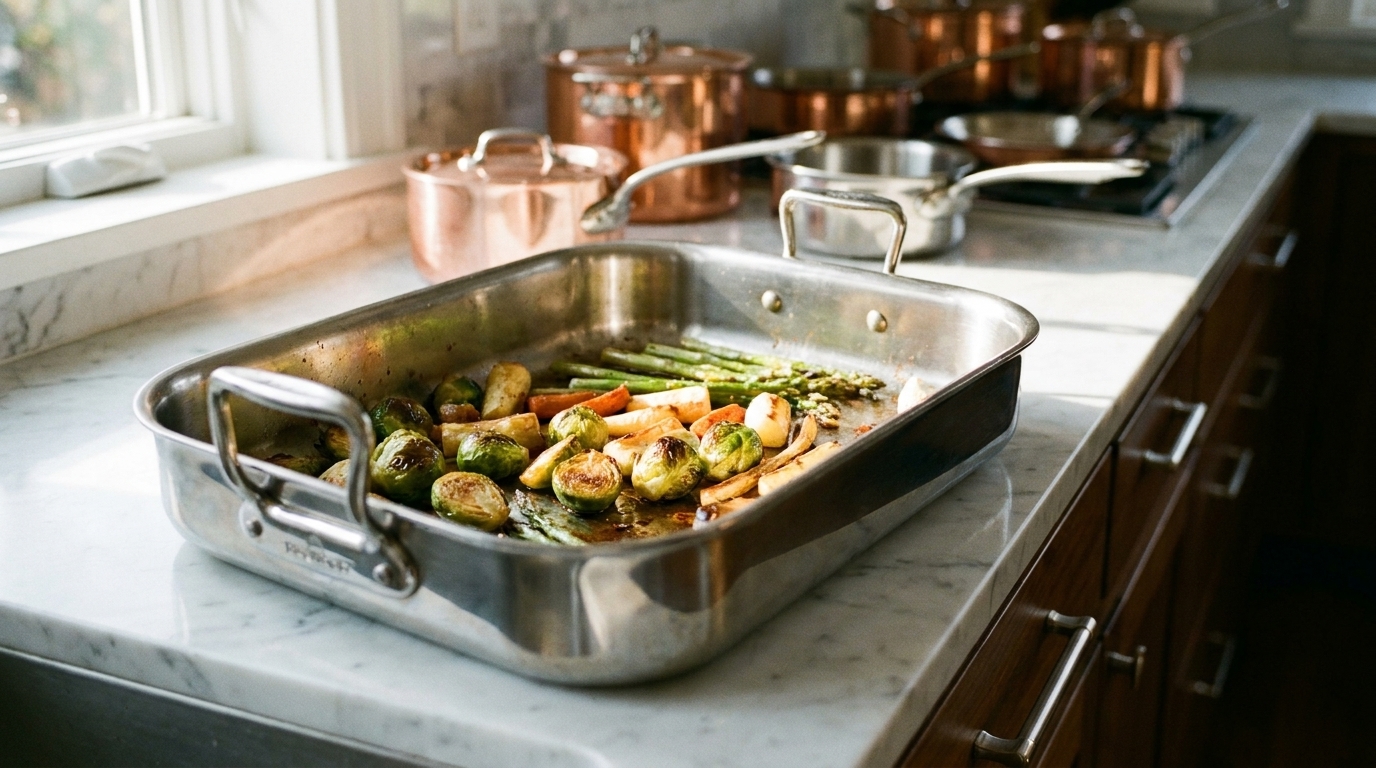
Roasting directly on bare stainless steel without parchment creates superior browning through the Maillard reaction while eliminating synthetic chemicals and single-use waste. One durable pan handles decades of chemical-free roasting, delivering better flavor and health benefits than parchment-lined alternatives.
Why chemical‑free roasting without parchment matters
Direct roasting on bare stainless steel builds deeper flavor through the Maillard reaction while generating fewer carcinogens and producing zero waste compared to parchment.
Health benefits and flavor boost from parchment‑free cooking
Roasting directly on bare metal -- no parchment, no coatings -- puts food in full contact with the hot pan surface, which drives the Maillard reaction and builds the deep color and layered flavor that other cooking methods can't replicate. This non-enzymatic browning occurs when amino acids and reducing sugars react under heat, producing aromatic compounds and brown pigments that define roasted food [1].
Oven roasting also generates far fewer heterocyclic amines (HCAs) than pan-frying or grilling -- HCAs are linked to increased cancer risk in multiple studies, making cooking method a real variable in long-term health [1]. The melanoidins created during browning carry antioxidant properties, and since bare stainless steel adds no synthetic chemicals to the process, chemical-free roasting without parchment offers a genuine advantage on both flavor and health [2].
Environmental impact: cutting waste and chemicals
Most parchment paper is coated with silicone, which prevents it from being composted or recycled cleanly -- the silicone and paper fibers won't separate in standard recycling systems [3].
Oil-soaked sheets can't be composted either, so most end up in landfill after a single use, and single-use products carry a consistently higher environmental footprint than reusable alternatives [3]. Stainless steel pans used for direct roasting have no consumables, no chemical coatings breaking down into waste, and no silicone entering the recycling stream [4].
One pan can handle decades of chemical-free roasting without parchment and without generating any of that disposal friction.
Assemble a durable, parchment‑free roasting setup with Misen
Heavy-gauge stainless steel pans with rimmed sides and proper fat coating give you even browning and reliable crusts without parchment or synthetic coatings.
Choosing the right Misen stainless‑steel pan for direct heat
For chemical-free roasting without parchment, pan gauge and rim height are the two specs that matter most. Stainless steel distributes heat evenly and won't react with acidic ingredients like wine-based marinades or citrus, keeping browning consistent and the pan surface intact over repeated high-heat use [5][6].
Heavier-gauge pans maintain stable surface temperature under a full load and resist buckling above 220 degreesC, where thinner alternatives typically warp [5]. Rimmed sides contain rendered fat and juices while still letting food sit in direct contact with the metal -- which is what builds the crust.
Our stainless steel pans are oven safe well beyond standard roasting temperatures, so they fit this kind of work without any workarounds.
Essential accessories: rack, silicone mat, and natural fats
A roasting rack is the simplest upgrade to bare-metal chemical-free roasting without parchment -- elevating food lets hot air reach all sides, which builds more even browning than pan-only contact allows. [7] Silicone mats are reusable and hold up to around 480 degreesF, but they create a layer of insulation between food and pan, trap moisture rather than releasing it, and produce noticeably less crust than direct metal contact. [7][8] Natural fats -- rendered animal fats, avocado oil, or other high-smoke-point options -- prevent sticking on bare stainless without synthetic coatings; tossing food thoroughly in fat before it hits the pan is what makes parchment-free roasting practical at high heat. [7] Racks suit whole cuts where airflow all around matters, while direct pan contact works better for flat vegetables or fish where a single-surface crust is the goal.
Step‑by‑step guide to chemical‑free roasting without parchment
Proper pan temperature, spacing, and oven airflow control are what separate golden-brown roasts from pale, steamed results.
Preparing the pan, oil, and moisture for optimal browning
Proper pan prep is where chemical-free roasting without parchment either succeeds or stalls.
Preheat the bare pan over medium-high before adding oil -- test it with a few water drops; when they bead and slide rather than splatter and steam, the surface is hot enough. [9] Stainless steel gets very hot, so use a high-smoke-point oil like avocado oil to keep the fat stable at roasting temperatures. [9] Once food hits the pan, leave it alone -- stainless releases food naturally when a proper crust has formed, and moving it prematurely tears the surface and stalls browning. [9]
Managing temperature, timing, and airflow for perfect results
Temperature and airflow work together to build the browning that direct-metal roasting makes possible. If your oven has convection, drop the recipe temperature by 25 degreesF and cut timing by roughly 20% -- the circulating fan strips surface moisture faster and drives browning more aggressively, so standard recipe times will overcook [10].
Space food with room around each piece; crowded pans trap steam and stall the Maillard reaction, particularly with high-moisture vegetables like zucchini or mushrooms [11]. Rotate the pan once halfway through to compensate for uneven airflow across the oven cavity, and keep the door closed -- each opening drops the internal temperature by up to 50 degreesF and forces food through an extended recovery window that throws off your timing [11][12].
Caring for your Misen roasting tools to last a lifetime
Basic care--deglazing with hot water, gentle scrubbing, and proper drying before storage--keeps your stainless steel roasting tools functional for decades.
Cleaning techniques that preserve chemical‑free performance
After direct roasting on bare stainless, deglaze by adding hot water to the still-warm pan -- this loosens the fond without the thermal shock that comes from plunging a hot pan straight into cold water. [13] For routine cleanup, dish soap and a Scotch-Brite scouring pad worked in circular motions removes most post-roast residue without scratching. [14] Stubborn baked-on fat or scorch marks respond well to Bar Keepers Friend: apply a thick paste, let it sit for 15 minutes, scrub, then rinse -- it restores the silver finish and keeps your chemical-free roasting without parchment workflow intact.[13][15] Avoid degreasing agents, which can work into the pan's rivets and compromise structural integrity over time.[15] Our step-by-step guide to cleaning stainless steel pans covers more care & maintenance tips for tackling heavy roasting residue.
Storage and maintenance tips to reduce landfill waste
Storing stainless steel pans correctly extends their service life and keeps them out of the landfill -- a real consideration given that most discarded cookware can't be recycled cleanly and ends up sitting in landfills indefinitely. [17] Dry each pan completely before stacking, and place a folded cloth or pan protector between pieces to prevent surface scratching that shortens the pan's usable life. [18] Because stainless steel has no coating to degrade, there's nothing to peel or flake into the waste stream -- the metal stays fully functional through decades of direct roasting with basic care. [16] Our stainless steel cookware care tips cover the full storage routine, from drying habits to stacking methods that preserve the surface year after year.
- Direct bare-metal roasting creates superior browning through the Maillard reaction without synthetic chemicals.
- Oven roasting generates far fewer cancer-linked HCAs than pan-frying or grilling methods.
- Parchment paper with silicone coating ends up in landfills and cannot be recycled cleanly.
- Heavy-gauge stainless steel pans resist warping above 220 degreesC and maintain even heat distribution.
- Proper pan preheating and high-smoke-point oils eliminate sticking without parchment or coatings.
- Crowded pans trap steam and stall browning; spacing food with airflow is critical.
- Basic care with dish soap and Bar Keepers Friend keeps stainless steel pans functional for decades.
- https://pmc.ncbi.nlm.nih.gov/articles/PMC4745522/
- https://pmc.ncbi.nlm.nih.gov/articles/PMC12154226/
- https://www.forkintheroad.co/is-parchment-paper-eco-friendly/
- https://gippslandunwrapped.com/2015/11/27/replace-disposable-baking-paper-and-aluminium-foil/
- https://www.telegraph.co.uk/recommended/home/kitchen/best-baking-trays/
- https://www.davidlebovitz.com/what-is-nonreactive-reactive-cookware/
- https://www.pastemagazine.com/food/baking/silpat-parchment-naked-pan-which-works-best
- https://www.seriouseats.com/parchment-paper-vs-silicone-baking-mats-8761072
- https://jenneatsgoood.substack.com/p/how-to-use-clean-and-maintain-your
- https://lifetips.alibaba.com/kitchen-hacks/roasting-guides
- https://www.aol.com/articles/13-biggest-mistakes-convection-oven-120200000.html
- https://www.thetakeout.com/1843263/oven-mistakes-ruining-food-and-oven/
- https://www.nytimes.com/wirecutter/guides/how-to-clean-stainless-steel-pans/
- https://girlandthekitchen.com/blog/how-to-clean-stainless-steel-pans-and-make-them-shine-like-new/
- https://www.architecturaldigest.com/story/how-to-clean-stainless-steel-pans
- https://www.lagostina.ca/en/blog/why-stainless-steel-cookware-last-for-years?srsltid=AfmBOooDbtji356LJskCnJb2xvCUSuoJb6ZUmQSaZ3tMUdIq0ndN1ffn
- https://www.debuyer-usa.com/blogs/news/the-secret-to-longevity-how-long-do-pots-and-pans-last?srsltid=AfmBOoo70euR-la2XE3mPkg5yCnm5ccvO-eINjd_BhqDyWf93DztUdyE
- https://www.restaurantware.com/blogs/cooking-equipment/how-to-extend-the-lifespan-of-your-kitchen-equipment?srsltid=AfmBOooMxiB0lif6ZwQraXJdQQofRNY-ibGDUyRRSawUbmIJl3Tw32pz