

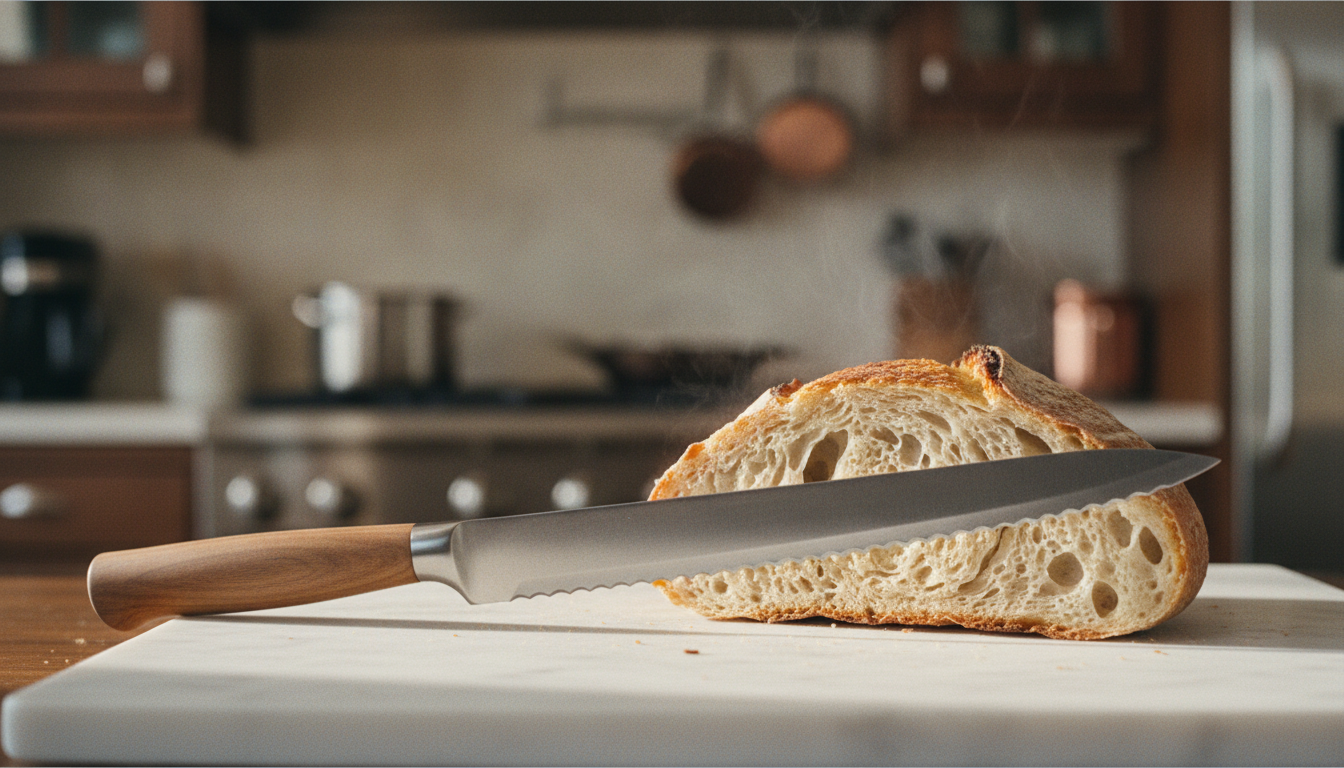
Manual serrated knives excel at slicing crusty, delicate bread without collapsing the crumb, while electric knives speed up batch slicing of soft loaves. Match your knife to the bread type--manual for control on artisan loaves, electric for volume on sandwich bread.
Why Bread Knives Must Be Serrated: The Physics of Clean Slicing
Serrated teeth grip and anchor the blade while shear motion cuts cleanly through bread crust without collapsing the soft crumb inside.
How serrated edges grip and tear without crushing the crumb structure
Serrated edges work through a grip-and-tear mechanism rather than straight-line pressure, which explains why bread knives are serrated in the first place. Each pointed tooth bites into the crust and anchors the blade, while the scalloped gaps between teeth cut with a shear motion instead of pushing straight down through the loaf.
Slicing soft, non-crusty bread depends on minimizing that downward push while maximizing shear action, since force applied before the blade actually cuts collapses the gluten network and air cells inside the crumb [1]. A smooth edge lacks these anchor points and tends to tear rather than cleanly cleave through a crust, which is exactly the failure mode serration is built to prevent [2].
Why straight-edge knives fail on soft, airy bread (and when they work)
Straight-edge knives excel at push cuts, where a keen, unbroken apex slices cleanly through uniform, dense material--which is exactly why testers found that even a mediocre straight-edge blade cut meat better than a top-tier serrated one [4]. That same push-cut action becomes a liability on soft, airy bread, because a smooth edge concentrates force along its entire length instead of at isolated points, so it needs sustained downward pressure just to bite through the crust [3].
Meat fibers compress and release cleanly under that pressure, but bread's open, air-filled crumb collapses permanently once squeezed, leaving a squashed slice instead of a clean one. Straight edges do work fine on denser, tighter-crumbed loaves, semi-frozen bread, or proteins, where less force is needed before crumb collapse becomes a real risk [3].
Manual Serrated Knives: Control, Precision, and Crumb Integrity
Sawing motion, blade length between nine and ten inches, and high-carbon steel construction preserve crumb integrity while delivering clean, effortless slices.
The sawing motion that preserves your loaf's interior without compression
The sawing motion works because it lets serrations make successive small bites instead of one continuous push, spreading pressure across each tooth rather than the whole blade edge. Drawing the knife toward you in a long, smooth stroke lets the teeth bite into the crust with almost zero downward force, so the weight of the blade does the cutting instead of your arm [5].
A gentle back-and-forth motion keeps the crumb intact, since pressing down instead of sawing is what causes the loaf to collapse before the cut finishes [6]. Resting the loaf on a stable, non-slip surface and holding it lightly also matters, because gripping too hard or forcing the blade is what makes bread collapse before it's fully cut [6].
Blade length, serration spacing, and steel quality that matter for hand-slicing
Blade length matters most for full-loaf slices: models under nine inches often can't clear a wide boule in one pass, while blades between nine and ten inches handle bakery-style loaves without multiple stops [7]. Serration spacing follows a similar sweet spot--too many teeth spread force thin and fail to bite, while widely spaced, moderately sized points grip crust firmly without shredding delicate crumb [8].
Steel quality determines how long that edge lasts, since serrations are difficult to resharpen at home and high-carbon stainless steel resists dulling far longer than softer alloys [7]. A full-tang construction, where the blade extends through the handle, also adds the stability you need for consistent hand-slicing pressure [9].
These are the details worth checking before you buy--our serrated knife pairs a full tang with high-carbon steel for exactly this reason.
Electric Bread Knives: Speed Gains vs Hidden Crumb Loss
Electric knives excel at slicing soft breads quickly, but manual serrated blades give you better control on crusty, artisan loaves.
How oscillating blades create micro-tears that affect crumb appearance
Electric knives use a motorized blade that oscillates back and forth at high speed, replacing the hand-controlled sawing rhythm with constant, rapid motion.
That speed removes the natural pause between each tooth's bite, and a fast-moving edge that isn't matched to the material tends to drag and fray it instead of cutting cleanly, a pattern well documented on blades used against fibrous materials where mismatched motion causes ragged, uneven edges [11].
Bread crumb responds the same way under that vibration: rapid oscillation can catch delicate cell walls before the points fully sever them, leaving small tears across the slice face instead of the clean line a wide, evenly spaced serration is built to produce [10].
When electric knives make sense (and when they compromise your bread's structure)
Electric knives make sense when you need speed and uniformity across many soft slices, like prepping a stack of sandwiches from a brioche or challah loaf, since the motorized blade takes the arm fatigue out of manual sawing [12]. That speed advantage disappears on crusty, artisan-style bread: testing found that most electric models struggled to break through crusty loaves, particularly at the bottom crust, and only the priciest unit in one lineup cut cleanly through both the top and bottom crust of a sourdough boule [12].
So if your bread is mostly soft sandwich loaves, an electric knife saves time. If you're slicing dense, crusty sourdough, a manual serrated blade still gives you more control over the cut [12].
Choose Your Knife: Decision Framework for Sourdough, Sandwich Loaves, and Pastries
Match your knife to the bread: manual serrated knives excel with crusty loaves, while electric models handle batch slicing of soft sandwich bread faster.
Comparison table: manual vs electric across bread types, loaf density, and kitchen workflow
Choosing between a manual and electric bread knife comes down to matching the tool to the loaf, since crust thickness and crumb density dictate how much force a blade needs to apply. A crusty sourdough boule needs the grip-and-tear action of hand sawing to avoid crushing the crumb, while soft sandwich loaves tolerate the constant motion of a motorized blade because there's less structure to compress in the first place [13]. Forum bakers who slice large batches for the freezer often reach for an electric knife specifically because it doesn't tear the slices when the bread is soft and uniform [14]. The table below breaks down which knife style fits which bread type, based on crust toughness and how each tool handles repeated cuts during meal prep.| Bread type | Loaf density/crust | Manual serrated knife | Electric knife | Best kitchen workflow |
|---|---|---|---|---|
| Crusty sourdough boule | Thick crust, open airy crumb | Saws cleanly through crust without collapsing crumb [7] | Struggles most often on the bottom crust | Single loaves, weekend baking |
| Soft sandwich loaf (brioche, challah) | Soft, uniform crumb | Works, but requires a steady hand | Fast, consistent slices with less arm fatigue [14] | Batch sandwich prep |
| Bagels and chewy crusts | Dense, chewy exterior | Teeth bite into crust for a clean cut [13] | Not commonly used for this texture | Everyday slicing |
| Pastries and cakes | Delicate, layered | Serrations glide through without crushing layers [13] | Oscillation can tear soft layers | Special-occasion serving |
Maintenance, sharpening, and longevity--why manual serrated knives outlast electric models
Manual serrated knives need sharpening far less often than most kitchen blades, since the flat spine and rounded valleys keep cutting-board contact limited to the tooth tips, protecting the inner curves where the actual cutting happens [15]. A properly maintained manual blade can go a year or more between sharpenings for casual bakers, while daily bread-slicers might need a touch-up every few months [16]. Electric knife blades wear differently: manufacturers often push full blade replacement over sharpening, and low-quality electric sharpeners can shave off up to 0.2mm of metal per pass, shortening blade life with each session [16]. A high-carbon steel manual knife holds a working edge for years, making it the better long-term choice if you slice bread regularly [16]. When your serrated edge finally needs a refresh, our knife sharpening service handles the tooth-by-tooth work most home setups aren't built for.
To sort it out simply, pick your knife by the bread you cut most. Reach for a manual serrated blade on crusty, open-crumbed loaves where control keeps the interior intact, and save the electric knife for high-volume slicing of soft, uniform bread. Match the tool to the loaf and you'll get clean slices with far less crushed crumb. Questions about care, sharpening, or which blade fits your kitchen? Contact us.
- Serrated edges grip and tear crust without collapsing the crumb through shear motion instead of downward pressure.
- Manual serrated knives require a sawing motion with minimal downward force to keep bread intact and prevent crushing.
- Electric knives excel at slicing soft, uniform bread quickly but struggle with thick crusts on artisan loaves.
- Blade length between 9-10 inches handles full bakery-style loaves without multiple stops.
- High-carbon stainless steel serrated knives hold their edge for a year or more with minimal maintenance.
- Match your knife to the bread type: manual for crusty sourdough, electric for batch sandwich prep.
- https://world.taobao.com/lang/en-us/shopping-guide/2002292386817900544.htm
- https://lifetips.alibaba.com/kitchen-hacks/should-you-slice-bagels-like-a-loaf-of-bread
- https://shun.kaiusa.com/shun-cutlery-blog-cutting-edge-of-serration
- https://blog.knife-depot.com/page/4/
- https://www.klausmeyerknife.com/blogs/know-your-knife/how-to-cut-bread-with-a-bread-knife
- https://www.thetakeout.com/2060954/best-way-slice-bread-prevent-crushing/
- https://www.seriouseats.com/best-bread-serrated-knives-equipment-review
- https://www.nytimes.com/wirecutter/reviews/best-serrated-knife/
- https://skwarehome.com/blogs/knife-education/what-is-the-best-bread-knife-the-buyer-s-guide
- https://knifeworks.com/kershaw-5063-pure-komachi-2-series-bagel-sandwich-knife-6-420j2-ss-serrated-blade-molded-resin-handle/
- https://www.razorbladeco.com/blog
- https://www.foodandwine.com/lifestyle/kitchen/best-electric-knives
- https://www.theperfectloaf.com/the-best-bread-knife-for-sourdough/
- https://www.thefreshloaf.com/node/18242/electric-bread-knife-do-you-use-it
- https://www.foodandwine.com/how-to-sharpen-a-serrated-knife-7152177
- https://seidoknives.com/blogs/news/how-to-sharpen-serrated-bread-knives
- https://santokuknives.co.uk/blogs/blog/how-to-sharpen-electric-knife-blades