

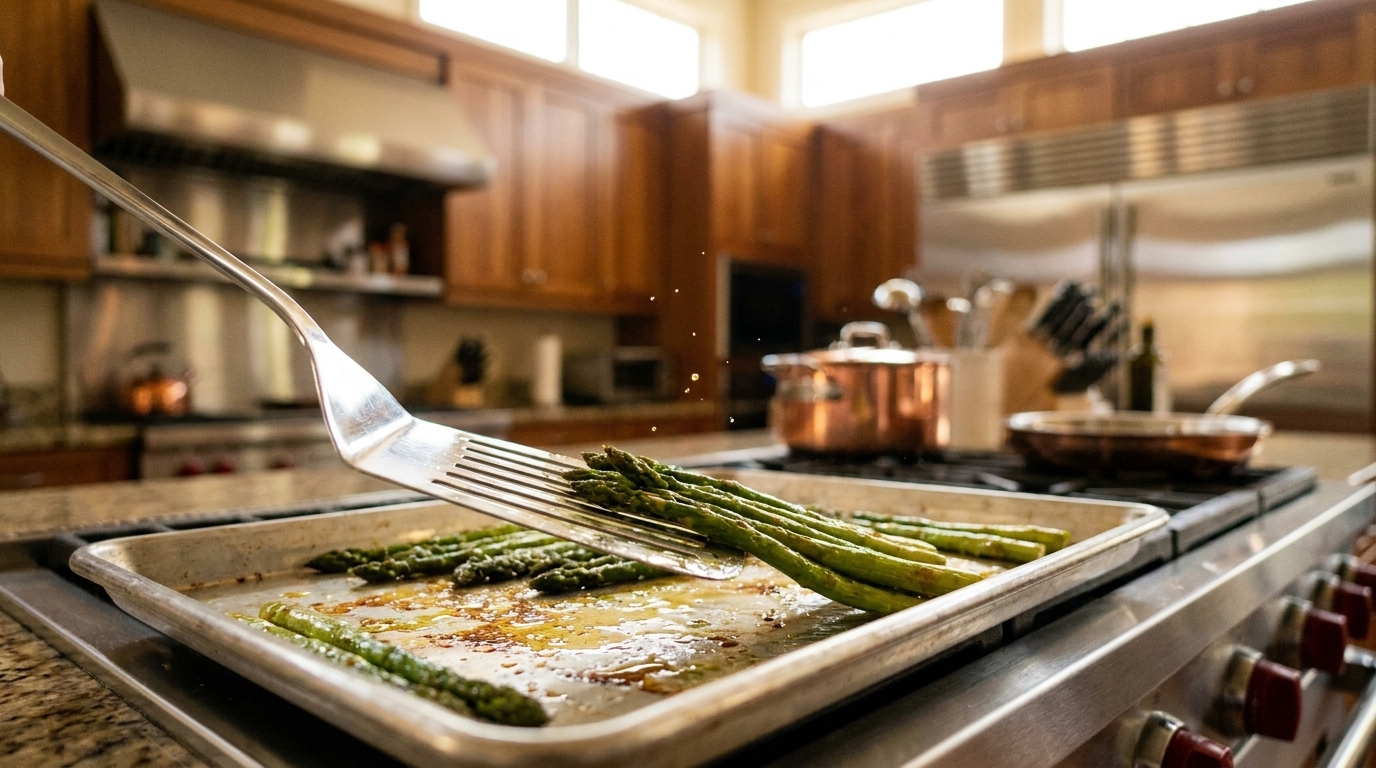
A fish spatula's angled blade and thin, flexible design let you flip roasted asparagus without breaking the delicate spears, unlike standard turners that push rather than lift. The tool's low entry angle slides under food with minimal force, distributing support across multiple spears instead of concentrating pressure on weak points.
Why a Fish Spatula Is the Secret Tool for Roasted Vegetables (Not Just Fish)
A fish spatula's angled blade and thin, flexible design slide under roasted vegetables without breaking them or disrupting their caramelization.
The design difference: why angled edges and thin blades outperform standard spatulas
The blade angle is the most important design variable between a fish spatula and a standard turner.
Spatulas with blade angles around 72 to 74 degrees slide under food by gently cupping it from below, while straighter blades at 79 to 80 degrees require you to push at an awkward upward angle just to get underneath. [1] A thin, flexible blade sharpens this advantage further -- it enters the narrow gap between food and pan surface with far less resistance than a thick, rigid one. [2] That physical difference explains why standard turners disrupt caramelized or slightly stuck foods like roasted asparagus, while a fish spatula's angled entry applies almost no upward force during the initial slide. [1]
How a fish spatula prevents breaking delicate roasted asparagus spears
Asparagus spears break at their thinnest points -- typically near the tips -- when a spatula applies lateral force during entry rather than lifting cleanly from below.
A fish spatula's thin, flexible blade distributes lift across multiple spears at once instead of concentrating pressure on one or two contact points, which is what causes snapping. [3] That distributed support matters most when caramelization has created light adhesion between the spear and the roasting pan -- the blade's low entry angle releases that bond gradually rather than tearing through it. [4] Standard turners, being thicker and more rigid, tend to push into that adhesion point and snap the spear before it can lift free.

The Roasted Asparagus Flip Technique: Step-by-Step Method
A fish spatula's slotted, angled blade slides under delicate asparagus without tearing, while a standard turner's rigid design will crush or snap them.
Timing your flip: when to turn asparagus for even browning and crispy edges
The flip timing depends on oven temperature and spear thickness.
At 425 degreesF, turn spears once halfway through the 12-to-15-minute cook time -- when the underside shows light color and the tips begin to crisp. [6] At 450 degreesF, that window arrives closer to the 10-minute mark; a subsequent 3-to-5-minute broil then crisps the freshly exposed side. [5] Before flipping, check that the pan-contact side shows visible color and a slight crispness -- if it doesn't, let the spears cook another minute or two rather than forcing an early turn. [7]
The under-and-lift motion: proper hand positioning and pressure to avoid damage
The motion starts with sliding the blade flat against the pan surface and under the trailing edge of the spears -- never curling the tip upward, since that creates shear force that snaps thin spears before they leave the pan. [9] Hold the handle with your thumb on top and fingers underneath, keeping your wrist neutral; a bent wrist shifts the blade angle and drives its edge into the spears rather than beneath them. [9] Once the blade seats under several spears, apply upward pressure evenly across its full length, then complete the flip with a slight forward tilt rather than a straight vertical lift. [9] Some blade flex works in your favor here -- it lets the spatula hug the pan surface on entry while still carrying multiple spears cleanly through the turn. [8] Fish Spatula vs. Standard Turner: Why This Tool Matters for Delicate Foods
What makes a fish spatula different from a regular spatula or turner
A fish spatula differs from a standard turner in three distinct ways: its blade is slotted to let grease and liquid drain through, offset to clear the pan's rim, and angled sharply enough to slip under food rather than push into it. [1] Standard turners use a single unslotted metal sheet -- practical for smashing burgers or portioning casseroles, but too rigid and flat-edged to slide under delicate foods without tearing them. [1] A well-built fish spatula also balances blade flexibility with enough structure to support heavier items, a range that compact nonstick turner heads can't cover. [10]
Best fish spatula materials for nonstick pans and roasting sheets
Material choice matters most when pairing a fish spatula with nonstick pans and roasting sheets.
Metal blades work on stainless steel, cast iron, and carbon steel, but scratch nonstick coatings -- those surfaces require a spatula with a silicone edge or full silicone blade. [2] Silicone stiffness is the variable that separates useful from frustrating: ultra-flexible silicone mashes against the pan and can't generate the lift needed to turn a salmon fillet, while stiffer silicone holds its shape and moves food cleanly. [1] For uncoated roasting sheets, a thin stainless steel blade works fine, but if your sheet pan has a nonstick finish, a silicone-edged fish spatula keeps the coating and the food intact. [11]


Beyond Asparagus: 6 Other Delicate Foods That Benefit From a Fish Spatula (Suitability Essentials)
A fish spatula's thin, slotted blade works beautifully for delicate fillets, fried eggs, roasted vegetables, pancakes, and fresh-baked cookies.
Eggs, fish fillets, and roasted vegetables: when to reach for your fish spatula
The fish spatula's thin, slotted blade makes it practical for any food that releases liquid or clings lightly to a hot surface.
Delicate fillets -- cod, haddock, and flounder -- are the clearest examples, since their flesh splits along natural seams when a rigid tool pushes instead of lifts. [1] Fried eggs present the same challenge: the whites bond to the pan and need a thin blade to slide underneath without tearing. [12] Roasted vegetables benefit too -- the slots let drippings fall away while the blade moves food off the pan cleanly, without the moisture pooling underneath and softening the crust you just built. [1] Pancakes, grilled cheese sandwiches, and cookies fresh from a hot baking sheet extend the list further, which is why most cooks who own a fish spatula end up reaching for it well beyond fish. [13]
How to maintain and care for your fish spatula for long-term kitchen reliability
Rinse your fish spatula right after each use -- food particles that dry in the slots require more aggressive scrubbing, which wears down the blade faster. [14] Hand washing with warm, soapy water preserves blade flexibility better than the dishwasher, and drying immediately prevents corrosion; our guide on hand-washing vs. dishwasher care covers this trade-off in full. [14] A crowded utensil drawer bends the blade and dulls the edge, so store the spatula in a crock, on a magnetic strip, or in a dedicated organizer that keeps it separated from other tools. [14] Watch for blade nicks or developing corrosion spots -- either signals the tool needs replacing rather than continued use. [15]
- A fish spatula's 72-74 degree blade angle slides under food with minimal upward force, unlike rigid turners that require awkward pushing.
- Thin, flexible blades enter the gap between food and pan with far less resistance, preventing caramelized asparagus from breaking or tearing.
- Distributed lift across multiple spears prevents snapping at thin points; rigid tools concentrate pressure on single contact points and snap tips.
- Flip roasted asparagus at 425 degreesF halfway through 12-15 minutes when the underside shows light color; at 450 degreesF, turn closer to 10 minutes.
- Keep your wrist neutral and slide the blade flat under the trailing edge--never curl the tip upward, as that creates shear force that breaks spears.
- Use a silicone-edged fish spatula on nonstick pans to protect the coating; metal blades work on stainless steel, cast iron, and carbon steel.
- Fish spatulas work beyond fish: delicate fillets, fried eggs, roasted vegetables, pancakes, grilled cheese, and fresh-baked cookies all benefit from the angled blade.
- https://www.seriouseats.com/best-fish-spatula-slotted-offset-spatula
- https://www.nytimes.com/wirecutter/reviews/best-spatula/
- https://www.dioro.com/blogs/news/best-fish-spatula?srsltid=AfmBOoqWL-zb836-jIrgZfFJRmtxN6JinXhQz6G7z5gCqolEz57euOh-
- https://www.dioro.com/blogs/news/long-slotted-spatula-for-frying-and-flipping?srsltid=AfmBOoq5SSJLTCoYar3Kk5wIm6qIIN14b9m2aHqwzVSzWIAg6YgEB9pW
- https://www.bowlofdelicious.com/crispy-roasted-asparagus/
- https://www.theseasonedmom.com/oven-roasted-asparagus/
- https://mycuratedtastes.com/roasted-asparagus/
- https://therestaurantwarehouse.com/blogs/restaurant-equipment/stainless-steel-spatulas-your-guide-to-flipping-scraping-and-sauteing?srsltid=AfmBOorf75IzefBUgGuLLrbvJjO9EqAPrzGPH6XwjVavuQC4NlxWhsnW
- https://lifetips.alibaba.com/kitchen-hacks/properly-flip-food-in-a-frying-pan-with-a-back-and-fort
- https://www.dalstrong.co.uk/blogs/chef-blog/fish-spatula
- https://www.foodnetwork.com/how-to/packages/shopping/product-reviews/best-fish-spatulas
- https://www.americastestkitchen.com/articles/1931-spat-fight
- https://www.thebetterfish.com/cooking/do-you-need-a-fish-spatula/
- https://www.dioro.com/blogs/news/best-fish-spatula?srsltid=AfmBOoqUP7ShPYTDXM8TLxqh_O37GWLhqwYpS9QnSTcDYAjAPW6XjrXv
- https://therestaurantwarehouse.com/blogs/restaurant-equipment/stainless-steel-spatulas-your-guide-to-flipping-scraping-and-sauteing?srsltid=AfmBOooAPHHw-W2oPIEBwipeAUGIriDSb8JiGIi0CRA7keFVSEX0GFBX