

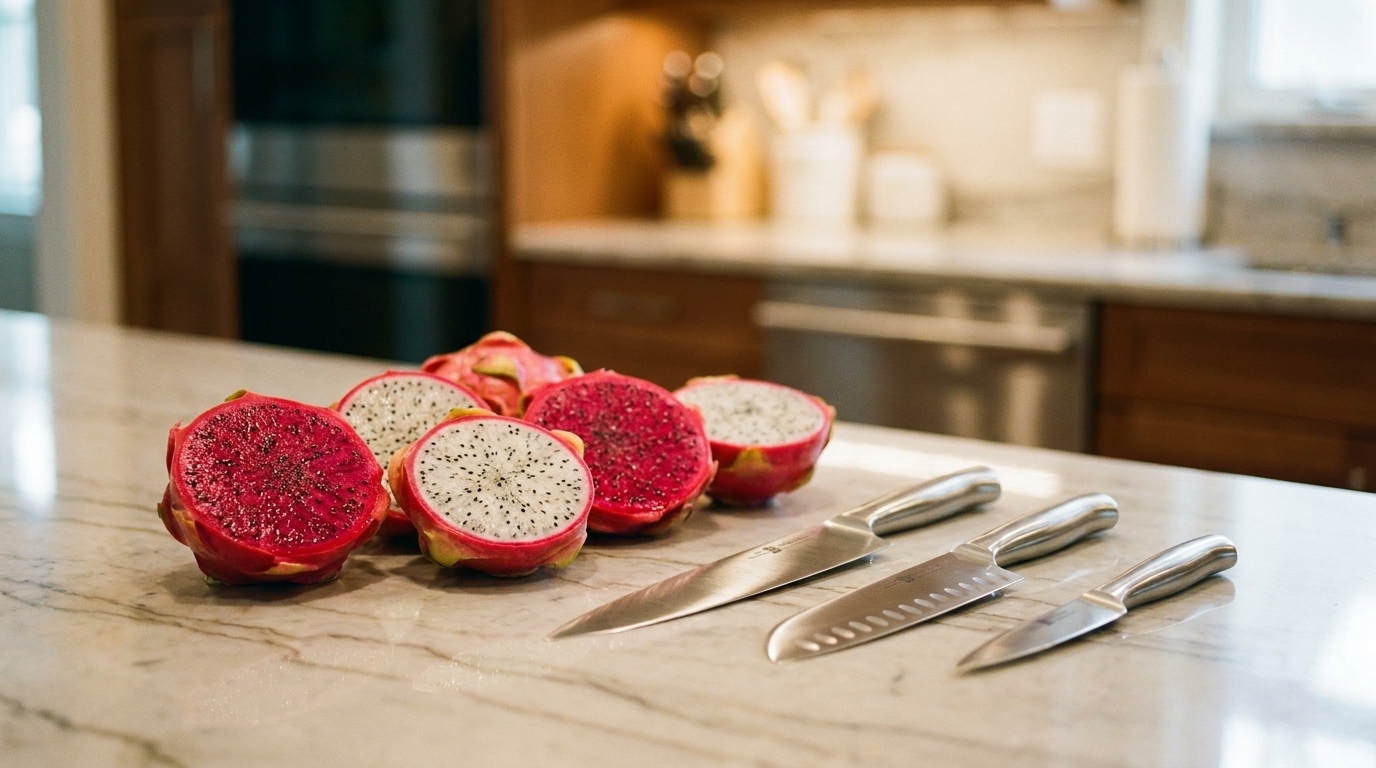
Learn which knife works best for each stage of dragon fruit prep, from splitting the tough skin to precision trimming, and master cutting techniques that minimize waste and bruising. Sharp blades and proper technique keep more usable flesh on your board and less oxidation in your storage container.
Why the Right Knife Matters: 3 Cutting Tools Compared
A sharp blade separates cells cleanly rather than crushing them, preserving texture and color while reducing juice loss during prep.
Chef's Knife vs. Santoku vs. Paring Knife: Which One to Use and WhyEach knife brings something different to dragon fruit prep. A chef's knife (8-12 inches) handles the initial split through the thick outer skin -- its curved blade and weight give you the control needed for a clean first cut [2].
A santoku (5-7.9 inches) excels at straight-down slicing into the exposed flesh; its flat edge profile and shorter blade produce more uniform cuts without excessive wrist movement, which matters during repetitive prep [1]. A paring knife (3.25-4 inches) is best reserved for precision tasks like releasing skin from smaller pieces or trimming uneven edges, where nimble control outweighs cutting power [3].
How Blade Length and Sharpness Reduce Waste and Bruising
Blade sharpness directly affects how much flesh you lose and how clean the cut looks. A dull blade forces the soft interior flesh to compress before the cut completes, causing bruising that discolors the flesh and degrades its texture [4].
Sharp blades separate cells cleanly rather than tearing them, which limits juice loss and oxidation at the cut surface -- you can test your knife's sharpness before starting prep to avoid this entirely. Blade length also plays a role: longer blades distribute cutting force across the full stroke, reducing the localized pressure that crushes flesh, while a serrated edge handles dragon fruit's tough outer skin while minimizing bruising to the interior [4].
Step-by-Step: How to Cut Dragon Fruit Without Waste
Choosing a ripe dragon fruit with bright skin and slightly yielding flesh ensures you get the most usable interior when you cut it.
Step 1: Select a Ripe Dragon Fruit and Inspect for Damage
Before you cut dragon fruit, selecting the right fruit determines how much edible flesh you end up with. A ripe dragon fruit has bright pink or yellow skin -- avoid green fruit, which is underripe, and fruit covered in dark blotches, which is overripe [5].
Press the skin gently with your thumb: it should give slightly, like a ripe avocado, but not feel mushy [6]. The leafy "wings" extending from the fruit are another reliable indicator -- browning, withered wings signal ripeness, while colorful wings mean the fruit needs more time [7].
Skip any fruit with cracks, bruising, or a shriveled stem, since damaged skin leads to moisture loss and drier interior flesh [6].
Step 2: Halve the Fruit Lengthwise Using Your Chosen Knife
Place the fruit stem-side down on a cutting board and position your knife at the center of the fruit's top. Drive the blade straight through in one continuous stroke -- starting at the top and moving toward the stem -- rather than sawing back and forth, which compresses the flesh and disrupts the cut surface [8].
The two halves should lie flat with the pink or white interior fully exposed; at this point, you can scoop the flesh directly from the skin with a spoon, or keep the halves intact for slicing and dicing within the shell [9]. If your cut veers off-center, the flesh is still fully usable -- just trim any uneven edges before proceeding.
Cutting Techniques for Different Serving Styles
Uniform cube, slice, and sphere cuts ensure consistent texture and flavor distribution across fruit salads, bowls, and platters.
Cubes for Fruit Salads and Bowls: The Most Efficient Cut
Cubing is the most practical cut for fruit salads, grain bowls, and smoothie bowl toppings because uniform pieces distribute evenly and hold their shape when mixed with other ingredients. With the fruit already halved, score the exposed flesh in a grid pattern -- both lengthwise and crosswise -- stopping just before the skin, then use a spoon to scoop the cubes out cleanly in one pass [10].
Aim for ½-inch cubes: small enough to eat in one bite, large enough to keep the flesh's texture intact when dressed or combined with acidic fruits [10]. The same chopped vs. diced logic that applies to vegetables holds here -- consistent size means consistent texture and more even flavor distribution throughout the bowl.
Slices and Spheres for Platters and Presentation
For slices, cut peeled flesh into thin half-moons using one downward stroke per cut -- fanning them on a platter highlights the fruit's color contrast with minimal effort [11]. Leaving the peel on and slicing through both skin and flesh in orange-style wedges works well on fruit boards and cheese platters, where the peel acts as a natural handle and keeps pieces from sliding [12].
For spheres, press a melon baller into the halved fruit while the skin is still intact -- this produces more uniform rounds than scooping from already-separated flesh, and takes less time [11]. Sphere cuts hold their shape on skewers or as bowl toppings better than slices do, since their compact form doesn't collapse when layered with other ingredients [12].
Storage and Maintenance: Keeping Your Tools and Fruit Fresh
Proper storage keeps cut dragon fruit fresh for two days, and a quick honing before each use maintains your knife's edge between sharpenings.
How to Store Cut Dragon Fruit Without Browning or Drying
Cut dragon fruit oxidizes quickly once exposed to air, so how you store it determines whether it's still usable the next day. Transfer pieces to an airtight container and refrigerate immediately -- cut flesh stays fresh for up to 2 days before texture and color degrade noticeably [13].
A light squeeze of lemon juice over the surface slows oxidation further, extending usability closer to that 2-day limit [13]. For longer storage, freeze cubes in a single layer on a sheet pan overnight, then transfer to a sealed bag with the air pressed out -- they keep for up to 3 months and can go directly into smoothies from frozen without thawing [13].
Caring for Your Knives After Prep Work to Maintain Sharpness
Dragon fruit's mild acidity means rinsing your knife immediately after prep matters -- residual juice left on the blade accelerates edge degradation the same way citrus does [14]. Hand-wash with warm water and mild soap, then dry completely before storing, since moisture sitting on the blade promotes rust, particularly on higher-carbon steels [15].
Store in a block, magnetic strip, or in-drawer tray rather than loose in a drawer, where contact with other utensils chips and dulls the edge [14]. Running the blade along a honing rod before each use takes about 10 seconds and realigns the microscopic teeth that shift during cutting, which extends the interval between full sharpenings noticeably [14].
- A sharp chef's knife cuts cleanly through dragon fruit's thick skin; dull blades compress flesh and cause bruising.
- Select ripe dragon fruit with bright skin that yields slightly to pressure and has browning, withered wings.
- Cut the fruit in one continuous downward stroke rather than sawing to avoid compressing the interior flesh.
- Score halved fruit in a grid pattern and scoop cubes out cleanly for uniform pieces that hold texture.
- Store cut dragon fruit in an airtight container for up to 2 days, or freeze cubes for 3 months.
- Rinse your knife immediately after prep and hand-wash with warm water to prevent edge degradation from fruit acids.
- Use a honing rod before each cut to realign the blade's edge and extend the interval between sharpenings.
- https://lifebymikeg.com/blogs/all/when-to-use-santoku-vs-chef-knife-a-home-cooks-guide
- https://dalstrong.ca/blogs/news/chefs-santoku-knives?srsltid=AfmBOoqGUngQl3rDryJVCIPqmHGdwVvkAFcsNH5koC2pomSSWUwB0EjV
- https://www.seriouseats.com/the-best-paring-knives
- https://www.westlondonliving.co.uk/food-drink/news/how-to-choose-the-best-knife-for-fruits-and-vegetables/
- https://www.google.com/goto?url=CAESugEB7keqTS8CAAVWe86-6BCfbQtPvJ3CDwbNo2wosTCX84AYe4B6umM9MumBEuK61ByGg2Bz1h5geuc24lluxwbOFZwixDr4fVe7NXSohFcgEQcXwb_E9LXK_pOHMolfeOTu0xOoRZP9Vaqi5ElgQAtYt9fAbvSwhgglspN19_6YnIIs_z68kCJknpPM-Qd5c8_n_UktTvpJLBJGCfIQ9c5ou-GGU_STWGpPXO-MVURWjgryMeY7GeVwD4c=
- https://www.google.com/goto?url=CAESbgHuR6pNImURpF05-tE87dyGVsP4-Kh_rzlRkNhyYx3T5zrKy-Q9RAmOQ4dsDtQS7aPO2fQt_rYKcrijSc9O_w15ZsaF97x9JsiCaoXCzoDaUTObT2qceCRC2f73GHG8xBp-bzcwwhZLDB31GNVQ
- https://www.google.com/goto?url=CAESkQEB7keqTZo-VYnaHTdkPgqZta3Ev5JTOCbOsOF3L8o4O-TIb31Ck1q8FcvU2Pf0AuC05KE_q_snizSe3fUr5cADvqHDZqwcmM8oVEa8ckOGqgz6HiOcMCBQASReA7nNPR4MTWyeix2ZTy-lpbuwltXZW9RVU_UVW1oy-QUcpJ5D2V9K2wpI-oLppTtqTZPgJDfE
- https://shouldit.com/blog/how-to-cut-dragon-fruit/
- https://www.foodrepublic.com/1480095/how-to-cut-dragon-fruit-shell/
- https://www.dioro.com/blogs/news/how-to-cut-up-a-dragon-fruit?srsltid=AfmBOoqE-Ka4MPF10y9TI8WZdC7iK9mhmJ71sxppIvw3PZy0hTABbBvF
- https://www.runningtothekitchen.com/how-to-cut-dragon-fruit/
- https://www.jessicagavin.com/how-to-cut-dragon-fruit/
- https://www.theproducemoms.com/produce/dragon-fruit/
- https://www.nytimes.com/wirecutter/guides/how-to-care-for-kitchen-knives/
- https://shun.kaiusa.com/use-care?srsltid=AfmBOopXsL_LYUQ8LSoZGEEZOEN9dnskJmAT-TnNL9jusL3mN_0MOp9k