

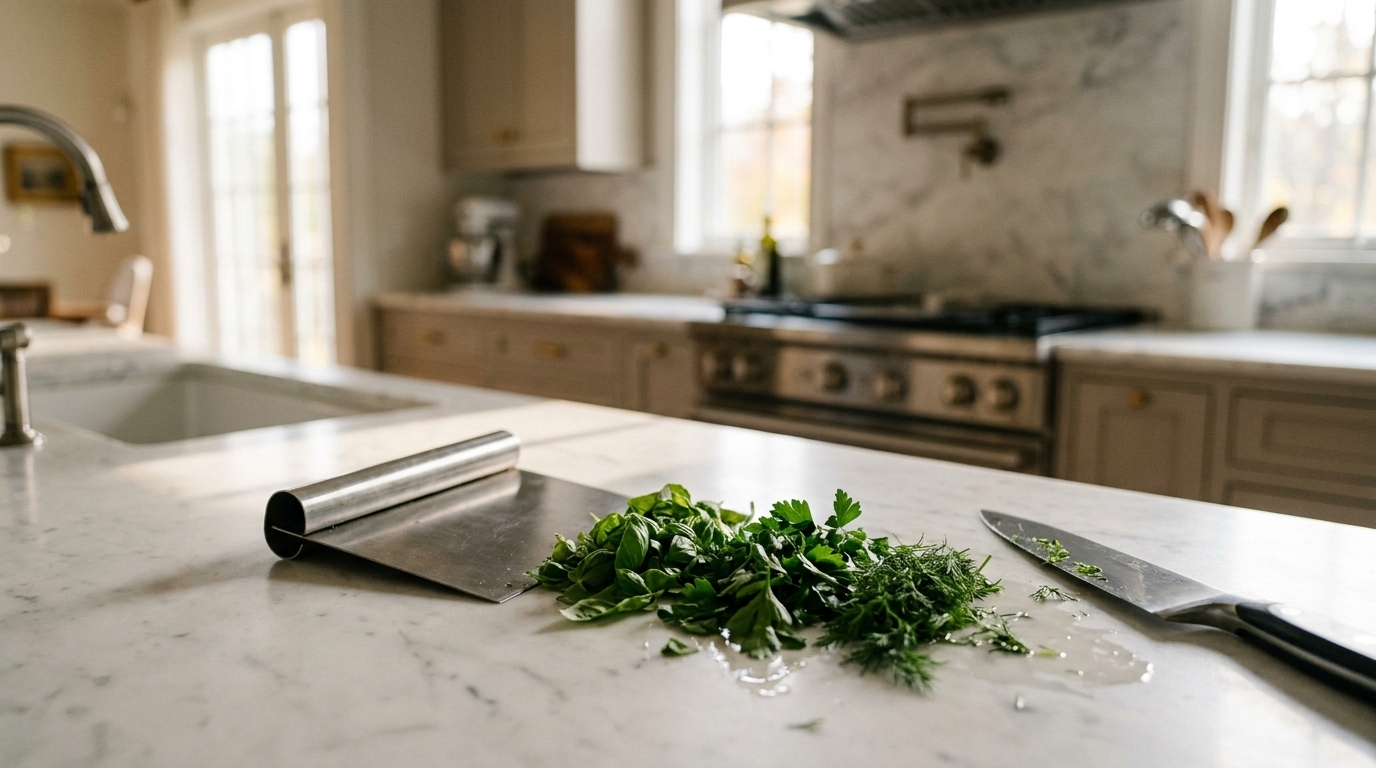
A bench scraper gathers and transfers chopped herbs faster than a knife while protecting delicate leaves from bruising and your blade from dulling. Pairing it with a sharp chef's knife creates an efficient prep workflow where each tool handles what it does best.
What Does a Bench Scraper Actually Do (And Why It's Not Just for Dough)
A bench scraper gathers chopped herbs and vegetables in one motion without dulling your knife or requiring multiple passes across the board.
The Real Purpose: Scraping, Gathering, and Chopping in One Motion
A bench scraper handles three tasks in a single pass: scrape the board clean, gather loose cuttings into a pile, and use the straight edge to roughly chop herbs or garlic with a pressing motion.[1] That combination matters because a chef's knife can gather ingredients, but scraping the blade across the board repeatedly dulls the edge -- a non-issue with the already-blunt bench scraper edge.[2] In professional kitchens, this workflow -- chop, gather, transfer to the pan -- happens in one continuous motion without putting down a single tool.[3] For a fuller look at how this plays out across everyday prep tasks, the bench scraper uses guide covers eight specific situations where it outperforms a spatula.
Why Chefs Reach for Bench Scrapers Over Knives for Delicate Herbs
For delicate herbs, the bench scraper's wide, rigid rectangular blade is built to lift and scoop entire piles in one motion -- something a knife blade, with its sharper edge and smaller surface area, can't match efficiently. [6] Because the bench scraper's edge isn't sharp, it doesn't catch or tear herb leaves the way a knife tip can when used to gather and transfer. [5] The wider blade also means fewer passes across the board to collect a full portion, which keeps prep moving without repositioning. [4] For recipes where precise cuts matter -- like the chiffonade herbs technique -- the bench scraper handles transfer while your knife stays focused on cutting.

Bench Scraper vs Chef's Knife: Speed and Technique Comparison
A bench scraper's flat edge gathers tender herbs without bruising delicate cell walls, keeping them fresh and flavorful longer than repeated knife scraping.
Testing Herb-Chopping Performance: Which Tool Wins on Time
When comparing raw chopping speed, a chef's knife cuts faster on hardy herbs -- the sharp edge handles woody stems efficiently.
The gap closes on tender herbs like basil, parsley, or chives, where repeatedly scraping a knife blade across the board risks torquing blade alignment and dulling the edge over time. [1] A bench scraper recovers that time in the gather-and-transfer stage, moving a full pile of chopped herbs from board to pan in one pass rather than the multiple repositioning moves a knife requires. [7] For back-to-back prep of several herbs in a row, the bench scraper's ability to clear the board completely between cuts keeps the overall workflow consistently faster. [8]
Blade Design Matters: Why Flat Edges Beat Sharp Edges for Tender Herbs
Edge geometry explains the performance difference between these two tools.
A knife's sharpened bevel is designed to split cell walls on contact -- right for intentional cuts, but counterproductive when sweeping herbs across the board. [9] Tender herbs like basil, cilantro, and parsley have delicate cell walls packed with aromatic oils; unintended pressure from a sharp edge during gathering bruises the leaves, accelerates oxidation, and browns them within minutes. [9] The bench scraper's flat, unsharpened edge distributes contact force across a wider surface, lifting herb piles without triggering that cell-damage chain -- something worth pairing with a properly sharp knife to get clean cuts first. [10]
The Difference Between a Bench Scraper and a Dough Scraper (And Why It Matters for Herbs)
A straight-edged bench scraper with a thin, flexible blade and squared corners is designed to gather herbs cleanly without pushing them across the board.
Bench Scrapers Have Straighter Edges; Dough Scrapers Curve for Folding
A bench scraper has a rigid, rectangular metal blade with a straight edge designed to sit flat against a countertop or cutting board. [11] A dough scraper uses a flexible, curved edge -- typically D-shaped rubber or plastic -- built to follow the inside of a mixing bowl for folding wet dough and scraping batter cleanly. [11] That curved profile is exactly what makes a dough scraper the wrong tool for herb work: it can't make full contact with a flat board, so it rolls over loose piles rather than collecting them. [12] For herb chopping and gathering, the straight edge wins by design. [11]
Choosing the Right Tool Shape for Your Herb-Chopping Needs
For herb work specifically, blade geometry matters more than brand.
A thin, slightly flexible stainless steel blade -- not a rigid, thick one -- slides cleanly under small herb cuttings without pushing them forward. [13] Squared-off corners ensure the full blade edge contacts the board, so you're not losing pieces at the sides during a gather pass. [1] A slightly beveled edge handles rough chopping tasks like mincing garlic or smashing herbs without knife-level sharpness -- the bevel provides enough bite for soft material while keeping the edge safe for repeated board scraping. [11] A blade around 6 inches wide covers enough surface area to transfer a full herb portion in one pass. [13]


Building Your Herb-Prep Toolkit: Bench Scraper, Knife, and the Misen Approach
A sharp chef's knife handles precision cuts while your bench scraper gathers, portions, and clears the board--each tool doing what it was built for.
When to Use Each Tool--A Practical Decision Framework
The clearest rule: use your chef's knife for any cut where precision matters -- mincing, slicing, or chiffonade -- and reach for the bench scraper for everything that follows.
Gathering scattered herbs into a pile, transferring chopped ingredients to a pan, and clearing the board between batches are all faster with the bench scraper's wide flat edge than with a knife blade. [14] Using a knife blade to scoop ingredients dulls the edge and creates unnecessary safety risk -- both problems a bench scraper avoids entirely. [7] For rough tasks like smashing garlic or roughly portioning herbs, the bench scraper's blunt edge handles those without putting a sharp blade at risk. [15]
Pairing Your Bench Scraper with Quality Kitchen Prep Tools for Faster Prep Work
A bench scraper performs best as part of a coordinated prep setup rather than a standalone tool.
Pairing it with a large, flat cutting board gives the blade full contact across the surface -- a warped or thin board creates gaps that let small herb pieces slip underneath during a gather pass. [13] A sharp chef's knife handles precision cuts while the bench scraper covers everything after: gathering, portioning, and board clearing, so each tool does the work it was built for without overlap. [16] For cooks who want that divided workflow built into their kit, our bench scraper is designed to complement quality knives and boards as part of a complete prep system. [17]
- Bench scrapers gather herb piles in one motion without dulling edges like knife blades do.
- Tender herbs like basil bruise easily when sharp knife edges scrape them during gathering.
- A bench scraper's flat edge distributes force evenly, preventing cell damage and oxidation in delicate leaves.
- Use knives for precision cuts; use bench scrapers for gathering, portioning, and board clearing.
- Bench scrapers work best paired with a sharp knife and flat cutting board as a coordinated system.
- A 6-inch wide blade with squared corners transfers full herb portions in a single pass.
- https://www.allrecipes.com/best-bench-scrapers-8584399
- https://lifehacker.com/kitchen-tool-school-the-ever-scrappy-bench-scraper-1690931383
- https://www.chefapprovedtools.com/reviews/oxo-good-grips-bench-scraper
- https://www.americastestkitchen.com/articles/5259-the-bench-scraper-is-no-one-trick-pony
- https://www.yahoo.com/lifestyle/stop-using-knife-scraper-else-224014045.html
- https://www.thedailymeal.com/1285932/difference-between-bench-scraper-bowl-scraper/
- https://www.seriouseats.com/pro-cooking-equipment-for-home-kitchens
- https://ontheroadeats.com/best-kitchen-gadgets/
- https://www.chefapprovedtools.com/blog/cutting-storing-fresh-herbs
- https://chopchopusa.com/blogs/cooking-tips/knife-skills-for-beginners-cooking-how-to-cut-vegetables-and-more?srsltid=AfmBOoocvKXiHBiOA38_lDC5z_fmFx5fVlrh4e1o6y82jrQ-3xqjDDl3
- https://www.foodandwine.com/best-bench-scrapers-7498492
- https://www.thespruceeats.com/definition-bench-scraper-908878
- https://www.seriouseats.com/best-bench-scrapers-6341995
- https://www.dioro.com/blogs/news/bench-scraper?srsltid=AfmBOopntqxVisX09u5f06R7kILhH-72AslEIflkkbmW2OH6UlRN8oWJ
- https://www.parisgourmet.com/blog/what-every-professional-kitchen-needs
- https://www.dioro.com/blogs/news/bench-scraper?srsltid=AfmBOoqNAcGLFwQ8_B7ja5SQ35HQ2p0co_vGUMlws8hk-T3iiElhRGWm
- https://www.thelazygeniuscollective.com/blog/kitchentools