

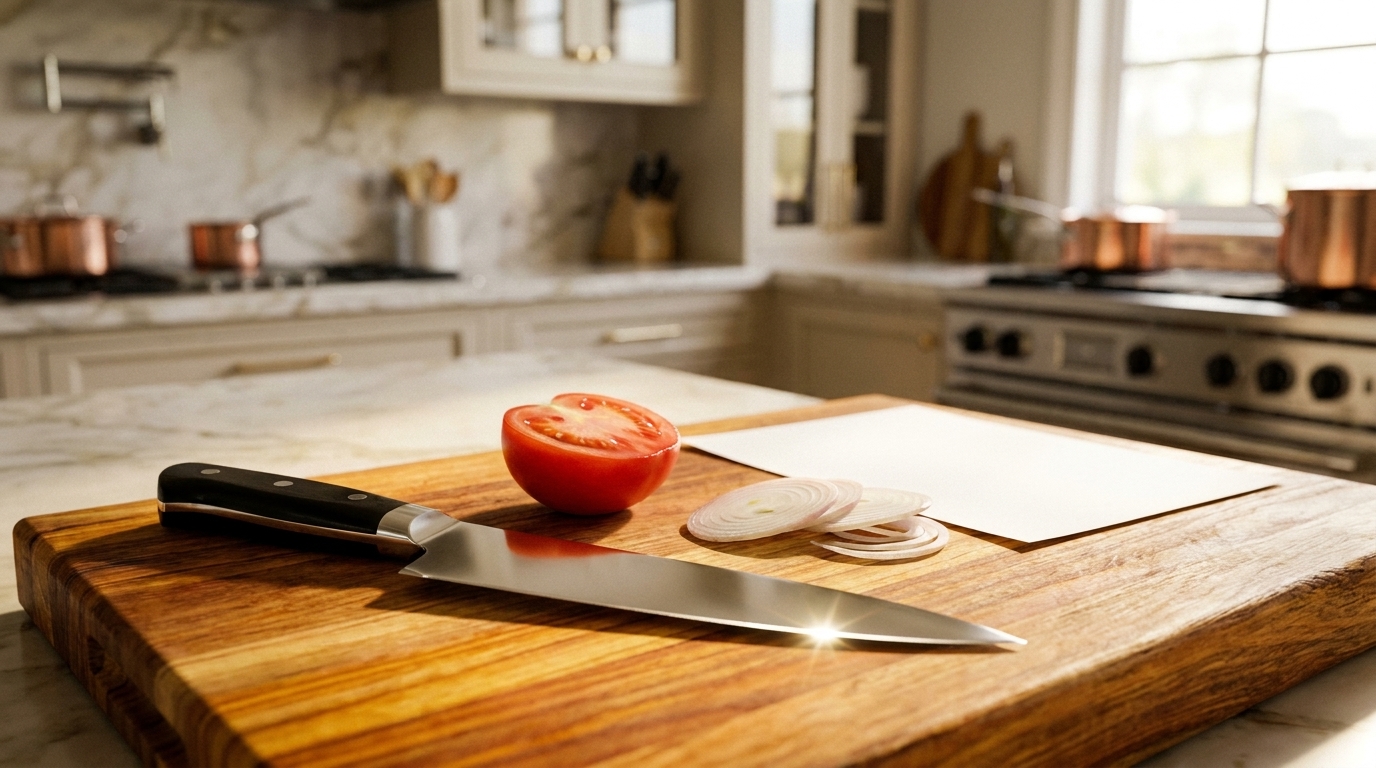
Learn to test your chef knife's sharpness using three simple methods--paper, tomato, and onion--that reveal whether your blade is truly ready for prep work. A sharp knife is safer, more efficient, and produces better results, making these quick tests essential for any cook.
Why Knife Sharpness Matters More Than You Think
A sharp knife lets proper technique work--grip, angle, and motion all depend on the blade doing the cutting, not you forcing it through.
How dull knives compromise safety and food quality
A dull chef knife is more dangerous than a sharp one -- and most home cooks have this backwards.
When your blade can't cut cleanly, you compensate with force, and that added pressure is what causes slips.[1] Injuries from dull blades also tend to be more serious: a sharp edge produces a clean cut, while a dull one tears skin rather than slicing through it.[2] Food quality suffers too -- a mashed tomato or bruised herbs lose moisture and structure, affecting texture and how evenly things cook.[1] Delicate ingredients like herbs deteriorate faster when crushed, so understanding knife anatomy and edge geometry makes clear why sharpness matters beyond convenience.[1]
The connection between sharpness and proper cutting technique
Proper cutting technique assumes the blade will do the work -- grip, angle, and motion all break down when the edge can't follow through.
Professional chefs use a pincer grip, resting the thumb and index finger directly on the blade just above the handle, which delivers control only when the knife is sharp enough to slice without resistance.[3] For most prep tasks, the motion is a smooth forward-and-down rock with the tip anchored on the board -- a principle that applies whether you're doing a rough chop or a precise chiffonade cut.[3] The moment you start pushing to get through an ingredient rather than slicing through it, you've lost both efficiency and accuracy.[4] Sharpness is what lets technique actually function, rather than compensating for a blade that can't cut.[3]

The 3-Test Method to Check Your Chef Knife Sharpness Right Now
Run three simple tests--paper, tomato, and onion--to verify your chef knife's sharpness before you start prepping.
Test 1: The paper cut test and what results mean
The paper test is one of the fastest ways to check your chef knife's edge without any special equipment.
Hold a sheet of printer or newspaper paper upright by one edge, place the heel of your knife against it at a 45-degree angle, and slice diagonally downward from heel to tip in a single motion.[5] A sharp knife cuts cleanly through the paper; a dull blade catches, tears, or stops mid-cut.[5] The test takes under 10 seconds and works for most knife types, including serrated bread knives -- so you can run the same check across your whole knife block before any prep session.[5]
Test 2: The tomato skin test for everyday cooking readiness
The tomato skin test gives you a quick read on whether your chef knife is ready for everyday prep -- place the blade lightly on the skin of a ripe tomato and apply no downward pressure.
A sharp knife will pierce and glide through cleanly on its own weight; if you have to push or saw to break through, the edge needs sharpening.[6] One caveat worth knowing: this test measures surface grit as much as true sharpness -- an unfinished blade will bite into tomato skin easily but dull faster than one with a properly buffed edge.[6] The test is also less reliable for flat-tipped knives like a Santoku or Nakiri, which are designed for chopping rather than slicing; for regular tomato work, a serrated knife performs more consistently regardless of edge condition.[6]
Test 3: The onion slice test for professional-level performance
The onion slice test distinguishes a truly sharp chef knife from one that's merely adequate -- and it reveals something the paper and tomato tests can't: how your blade handles thin, layered structure under actual prep conditions.
Place a halved, peeled onion flat-side down and attempt a thin freehand slice, applying only the weight of the blade.[7] A sharp knife glides through without compressing the layers; a dull one crushes the cells instead of slicing them, which releases more sulfurous compounds -- meaning more eye irritation and a harsher, waterier result in the finished dish.[8] If your slices are uneven or the onion shifts while you cut, the issue is almost always edge sharpness, not technique.[7]
What Dulls a Chef Knife the Fastest and How to Prevent It
Switching to a wood cutting board, hand-washing immediately after use, and honing before each use are the three habits that most effectively prevent your chef knife from dulling.
Common kitchen mistakes that accelerate blade dulling
The habits that dull a chef knife fastest are usually the most routine ones -- cutting on glass, stone, or ceramic surfaces, using the blade edge rather than the spine to scrape food across the board, and running knives through the dishwasher.[9] Glass and stone are harder than most knife steel, so every contact micro-chips the edge; dishwasher detergents contain lye, a caustic alkaline that degrades carbon steel structure with repeated exposure. [10] Storing knives loose in a drawer compounds the damage -- each time it opens, blades knock against other utensils, creating invisible nicks that accumulate well before you notice any dulling.[9] Switching to a wood cutting board and hand-washing immediately after use eliminates three of the most common sources of edge damage at once.[10]
Best practices for maintaining edge retention between sharpenings
Honing before each use is the single most effective habit for extending time between sharpenings -- it realigns the microscopic edge that folds over during cutting without removing any metal.[11] Use a smooth ceramic or smooth steel rod, not a ribbed butcher steel, which is more aggressive and shortens blade life with frequent use.[11] Hold the rod vertically with the tip resting on a folded towel, draw the blade down at 15-20 degrees (flatter for Japanese-style knives), and alternate sides with 4-6 passes each.[12] For storage, a wall-mounted magnetic strip or a knife block with blades inserted spine-first keeps edges isolated from the impact and contact that undoes the honing.[12]


What a Good Chef Knife Should Do and How to Know You Have One
Quality comes down to blade material, construction, and balance--test your knife with paper or an onion to confirm it holds a sharp edge.
Key characteristics of a quality chef knife for home and professional use
A quality chef knife comes down to three structural factors: blade material, construction method, and balance.
High-carbon steel holds an edge longer than standard stainless but needs prompt drying to prevent corrosion; stainless blends trade some edge retention for easier maintenance.[13] Full-tang construction -- where the blade steel runs the full length of the handle -- adds balance and durability over partial-tang designs.[13] Blade length typically falls between 7 and 10 inches, with 8 inches suiting the widest range of tasks for most cooks.[14] Edge bevel angle is the last key variable: Japanese-style knives grind to roughly 15 degrees per side, Western knives closer to 20, which explains why each suits different cutting motions and hand pressures.[14]
How sharpness relates to overall knife quality and value
A chef knife's real-world value comes down to how long it holds a usable edge between sharpenings -- determined by steel, heat treatment quality, and edge geometry working together rather than price alone.
Edge geometry has the largest measurable impact: sharpening at 10 degrees per side can deliver up to five times the edge retention of sharpening at 25 degrees on the same steel.[15] A knife with mid-range steel and a well-executed heat treatment will often outlast an expensive one that was improperly heat treated -- and that gap shows up every time you run a paper or onion test.[16] When a chef knife consistently passes those checks without constant resharpening, that's a reliable signal of genuine quality.
- Dull knives are more dangerous than sharp ones--they force compensatory pressure that causes slips and serious injuries.
- Use the paper test, tomato skin test, or onion slice test to check sharpness in under 10 seconds without equipment.
- Glass, stone, and dishwashers dull blades fastest; switch to wood boards and hand-wash to prevent edge damage.
- Honing before each use realigns the microscopic edge and extends time between sharpenings without removing metal.
- Edge geometry matters most: sharpening at 10 degrees per side delivers five times better edge retention than 25 degrees.
- A quality chef knife holds a usable edge longer based on steel quality, heat treatment, and blade angle--not price alone.
- https://www.cozzinibros.com/blog/dull-knife-dangers-the-importance-of-regular-knife-sharpening/
- https://www.safetyandhealthmagazine.com/25102-the-dos-and-donts-of-kitchen-safety/
- https://bacher.tools/en/blogs/bacher-blog/5-tricks-of-the-master-chef-the-art-of-cutting-that-transforms-cooking
- https://www.knifesharpening.sg/blog/the-science-behind-knife-sharpening-why-sharp-knifes-are-safer
- https://knifeaid.com/blogs/knife-mastery/how-to-test-the-sharpness-of-a-knife?srsltid=AfmBOop3tfr5FoW4TNdOb58snx1tPD4mRQJSiO1MgLevnzXy8i8BgzCi
- https://sketchplanations.com/the-tomato-test
- https://www.webstaurantstore.com/blog/4168/knife-sharpness-test.html?srsltid=AfmBOoqHuX0LWsgcZ19W9X1AJzugbQthU6X0suoKNds4LAuIl4v8fvSL
- https://www.foodandwine.com/how-chefs-cut-onion-11812694
- https://www.eatingwell.com/8-mistakes-that-ruin-your-knives-and-what-to-do-instead-11881755
- https://vocal.media/feast/8-kitchen-knife-mistakes-that-are-ruining-your-cooking
- https://seriouslyfastsharpening.com/guides/how-to-maintain-kitchen-knives-between-sharpenings
- https://www.nytimes.com/wirecutter/guides/how-to-care-for-kitchen-knives/
- https://salamanderstoves.com/how-can-you-tell-if-a-kitchen-knife-is-well-made/
- https://www.chuboknives.com/blogs/news/what-is-a-chef-knife
- https://knifesteelnerds.com/2021/10/19/knife-steels-rated-by-a-metallurgist-toughness-edge-retention-and-corrosion-resistance/
- https://dauntlessmanufacturing.com/blogs/news/best-steel-for-knives?srsltid=AfmBOoqGDKPIsqAOBB9gYn1QIKyF3FXRbQ4Z34G-0-QERADGc8aBXIGQ