

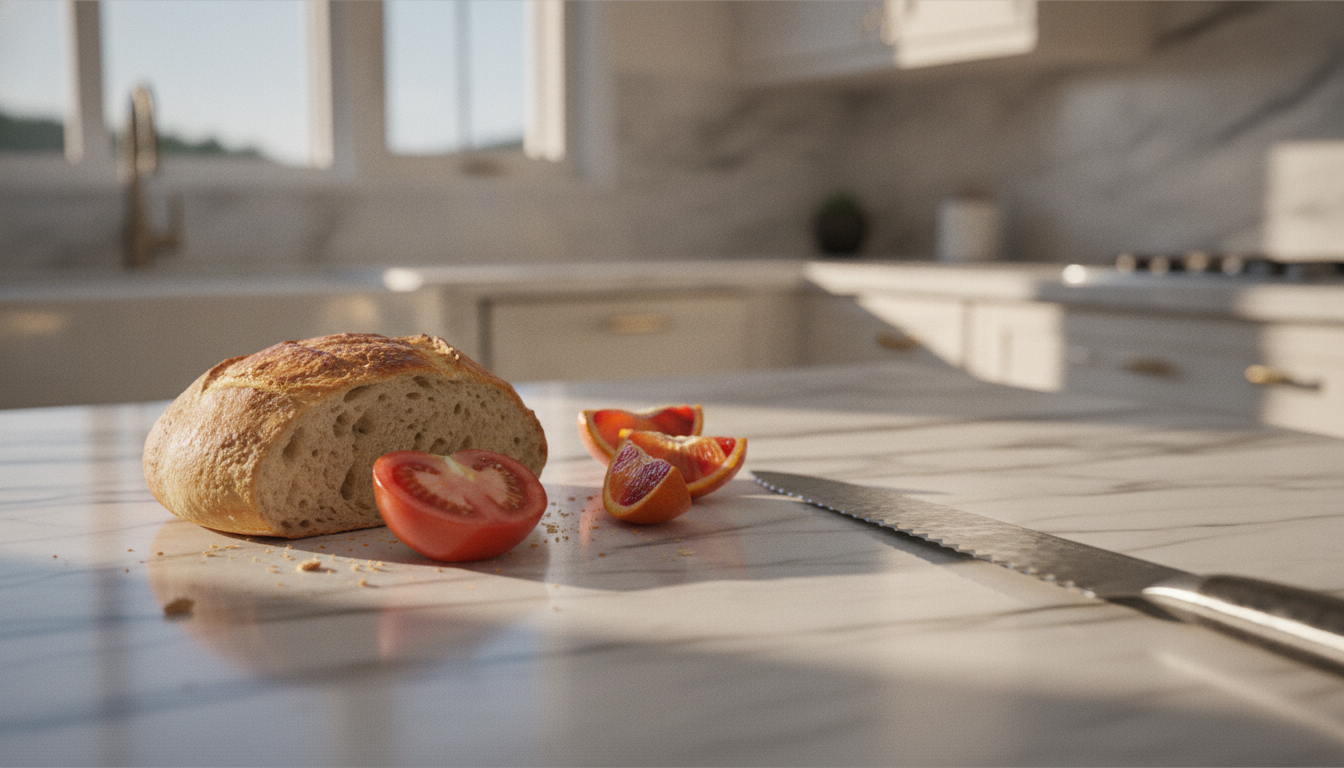
Serrated knives cut differently than straight blades, using a sawing motion that grips tough exteriors without crushing delicate interiors, making them ideal for bread, tomatoes, and citrus. Tooth sharpness and proper maintenance matter more than serration pattern alone, and choosing between pointed and wavy designs depends on your specific cutting tasks and comfort.
What Makes a Serrated Knife Different: Teeth Design and Cutting Mechanics
Wavy or scalloped teeth grip delicate skin without snagging, while pointed serrations bite fast into firm crusts--tooth sharpness matters more than shape alone.
How serrated edges cut versus straight blades: why teeth matter for delicate foods
A serrated knife cuts with a sawing motion instead of a straight push cut. The pointed teeth concentrate pressure onto small contact points, letting the blade puncture a tough surface before the rest of the edge saws through [1]. That's why teeth matter for delicate foods: a straight edge relies on even downward force, which can crush a tomato or flatten a crusty loaf before the blade finishes the cut [2].
A serrated edge grips the skin first, so it slices through the exterior without mashing the softer interior underneath [3]. This makes serration useful for anything with a firm outside and a delicate inside, like citrus, tomatoes, and bread [1]. Straight blades still cut cleaner on uniform, soft-to-firm foods such as herbs or fillets, because their smooth edge shears rather than tears [2].
The tradeoff: serrated teeth need less force to start a cut, which also means they stay effective even when the edge isn't razor-sharp [3].
Wavy vs pointed serration patterns: which design handles bread, tomatoes, and citrus best
Serration patterns fall into two main camps: pointed teeth and wavy, scalloped teeth. Pointed serrations have sharp, aggressive tips that bite fast into firm crusts, but that same sharpness can snag and tear on tomato flesh or bread crumb if the teeth are too pointy [4]. Wavy or scalloped teeth are rounded and less aggressive, which sounds like a downgrade, but testing across dozens of bread knives found this shape often produced cleaner cuts on tomatoes and sourdough alike, since the gentler curve grips waxy skin without snagging [4].
Double-serrated designs split the difference: mini teeth nested within larger scallops grab slick surfaces like tomato skin or watermelon rind while distributing wear across more contact points, so the edge stays sharp longer [4]. For citrus specifically, a knife with fine, closely-spaced teeth tends to pierce the pith without shredding the membrane. The takeaway from side-by-side testing is that tooth sharpness matters more than tooth shape alone.
A pointed edge is not automatically better for tough crusts, and a scalloped edge is not automatically gentler on delicate interiors. What matters is whether the individual teeth are sharp and evenly spaced [4]. That's worth remembering when comparing a Kai Pro's wavy pattern to Misen's ACUTO serration, since neither pointed nor wavy wins outright across bread, tomatoes, and citrus.

Kai Pro vs Misen ACUTO: Head-to-Head Comparison Table with Real-World Performance
Higher-carbon stainless steel and lighter blade weight reduce fatigue during extended prep work, making them worth prioritizing over price alone.
Blade material, edge retention, and price: detailed specs comparison
Blade material and edge retention go hand in hand: most serrated knives, from budget bread knives to premium utility blades, are made from stainless steel because it resists rust and holds up against acidic foods like tomatoes and citrus [5]. Steel quality within that stainless category still varies a lot -- testing across dozens of serrated blades found that higher-carbon stainless blends keep their teeth sharp longer, though that durability comes with a higher price tag and a greater need for careful drying to avoid corrosion [6]. Price, in turn, tends to track steel quality and construction more than blade length alone; models under $50 typically use simpler stainless alloys, while options past $100 usually add denser steel or more refined tooth geometry [5]. Before comparing a Kai Pro to Misen's ACUTO serrated knife, the categories below are worth checking against the actual product listing for each, since steel spec and price can shift between model years.
| Category | What to check |
|---|---|
| Blade material | Stainless vs. higher-carbon stainless blend [6] |
| Edge retention | How long teeth stay sharp before snagging [6] |
| Serration type | Pointed, wavy, or double-serrated pattern [5] |
| Tooth sharpness | More predictive of clean cuts than pattern alone [5] |
| Blade flex | Thinner blades saw with less effort but flex more [5] |
| Handle material | Wood, rubber, or plastic affects grip and price [5] |
| Full tang vs. partial | Affects balance and long-term stability [5] |
| Price | Reflects steel quality and construction, not just length [5][6] |
Handling and comfort in the kitchen: which knife feels better during extended prep work
Extended prep work makes weight and balance matter more than they do for quick tasks, since a knife that feels fine for ten cuts can turn tiring after fifty. Testing across bread and serrated knives has found that lighter blades with thinner spines take less effort to saw through repeated cuts, while heavier, curved blades ask more of your wrist over time [7]. Handle material plays into that fatigue factor too: an ergonomic grip made from rubber or plastic can feel stable through a long prep session even without full-tang construction backing it up [7].
Kai Pro's serrated knife leans on a different comfort strategy, pairing full-tang construction with a riveted POM handle designed to stay secure even when hands get wet from produce juice or a damp cutting board [8]. Its hammered blade finish also reduces drag as the teeth move through food, which translates to less resistance pulling back against your hand stroke after stroke [8]. Misen's ACUTO serrated knife should be checked against these same handling factors before assuming comfort translates equally: handle material, full-tang versus partial-tang balance, and overall blade weight all shift how a knife feels an hour into slicing bread, tomatoes, or citrus for a crowd [7].
Neither brand's marketing copy substitutes for holding the knife through an actual prep session, since grip comfort is personal and tied to hand size as much as spec sheet details [7].
When to Use a Serrated Knife and When to Reach for Something Else
Serrated knives excel at slicing crusty bread, tomatoes, citrus, and cakes without crushing or tearing delicate interiors.
Best uses for serrated knives: crusty bread, soft fruits, tomatoes, and pastries
A serrated knife performs best on foods with a tough exterior and a soft interior, think crusty bread, tomatoes, citrus, melons, and pastries [9]. On an artisan loaf, the teeth grip the crust first and saw through it before reaching the crumb, so the slice holds together instead of collapsing under a straight edge [11]. Tomatoes and citrus work the same way: the teeth pierce the skin without pressing down, keeping juice inside the fruit rather than pooling on the cutting board [11]. Cakes and pastries hold their shape too, since the sawing motion moves through delicate sponge without dragging or tearing the crumb [9]. A few everyday tasks where a serrated knife tends to outperform a straight blade:
- Slicing crusty artisan bread without crushing the crumb [9]
- Cutting tomatoes cleanly without mashing the flesh [10]
- Segmenting citrus without tearing the membrane [9]
- Portioning cakes and pastries in one smooth pass [9]
- Cutting melons or thick-skinned squash safely [11]
Thick-skinned produce like melon or squash can actually trap a straight blade, forcing more pressure and raising the risk of the knife slipping, which is another reason the sawing action of a serrated edge offers more control on tougher skins [11].
Tasks where serrated knives underperform: hard vegetables, precise cuts, and boneless proteins
Hard vegetables like carrots and winter squash respond better to a push cut, where a smooth, polished plain edge drives straight through dense flesh instead of catching on it [12]. A serrated blade's teeth need a sawing motion to work, and that motion doesn't translate well to a firm, uniform vegetable that a straight edge slices through in one controlled stroke [12]. Recipes that call for equal-sized pieces compound the problem, since serration makes it harder to land a clean, repeatable cut on carrots or potatoes the way a vegetable-specific blade can [13]. Fine, detailed work runs into the same limitation: serrated edges aren't built for mincing, peeling, or other small, controlled cuts on delicate ingredients [14]. Boneless proteins present a third weak spot. Soft, flexible cuts of meat or fish can snag on the teeth instead of shearing cleanly, which tears the surface rather than producing the smooth slice a straight edge delivers [12]. Serration performs better against dense, fibrous tissue where the teeth have something to bite into, but on a boneless chicken breast or a delicate fillet, that same bite can shred the exterior [12][14]. A few tasks where reaching for a straight-edge knife instead makes sense:
- Dicing carrots, potatoes, or squash into uniform pieces [13]
- Mincing garlic, herbs, or other small ingredients [14]
- Peeling produce that needs a smooth, controlled edge [14]
- Slicing boneless fillets where torn edges matter [12]
Each of these tasks depends on steady, even pressure rather than a sawing motion, which is exactly where a plain edge outperforms a serrated one.


Maintaining Your Serrated Knife: Sharpening, Storage, and Longevity
Serrated knives need sharpening far less often than straight blades, but require a tapered rod worked into each valley individually to stay sharp.
Why serrated knives need different care than straight-edge blades: honing and sharpening strategies
Serrated knives don't dull the way straight blades do, so their care follows different rules. Because the pointed teeth absorb most of the cutting force while the scalloped valleys trail behind, the edge overall endures less friction, meaning it needs sharpening far less often than a chef's knife [15]. That same design makes standard honing steels ineffective: a honing rod straightens a smooth edge, but on a serrated blade it skips across the points while leaving the valleys, where the actual cutting happens, untouched [15]. Serration-specific electric sharpeners have also underperformed in independent testing, since many still can't reach into those valleys [15].
The workaround is a tapered ceramic or diamond rod sized to fit the gullet, worked into each valley individually instead of dragged flat across the blade [16][17]. It takes patience, but it keeps those teeth doing their job. Most serrated knives are chisel ground, with one beveled side and one flat side, so sharpening should target the beveled side while the flat side only gets a light deburring pass afterward [16]. This runs opposite to straight-blade maintenance, where honing evens out microscopic grooves across the whole edge; on a serrated knife, keeping those grooves distinct matters more than polishing them uniformly smooth [17].
For a full gullet-by-gullet walkthrough, see how to sharpen a serrated knife. If sharpening at home feels like more than you want to take on, our mail-in knife sharpening service handles it for you.
Proper storage and handling to keep serration sharp: avoiding common mistakes that dull teeth
Storage habits affect a serrated edge as much as cutting technique does. Loose drawer storage dulls blades by letting the teeth knock against other utensils, chipping or bending the fragile tips that do the actual cutting [18]. A knife block with a slot sized for the blade, an edge guard, or a magnetic strip keeps the serration protected between uses [19]. Hand wash immediately after use with mild soap and dry completely before storing, since trapped moisture near the teeth invites rust that pits the metal and rounds off the points [18][19]. Dishwashers compound the problem: hot water, harsh detergent, and contact with other items in the rack bend teeth and dull edges faster than normal use [19]. Cutting on hard surfaces like glass, stone, or ceramic also rounds off serration tips over repeated contact, so a wood or plastic board protects the edge better than a bare countertop [18].
A few habits to avoid:
- Tossing the knife loose in a drawer [19]
- Running it through the dishwasher [18][19]
- Prying open packaging or frozen food with the blade [18]
- Cutting on glass, stone, or ceramic surfaces [18]
Treat a serrated knife well and it can slice cleanly for years. Whether you are working through crusty loaves, ripe tomatoes, or a stack of citrus, the right blade paired with good care & maintenance habits makes all the difference. Looking for a serrated knife built to last? Take a look at the Misen serrated knife, and if you have questions about sharpening or everyday care, contact us anytime.
- Serrated teeth grip tough exteriors without crushing delicate interiors, making them ideal for bread, tomatoes, and citrus.
- Tooth sharpness matters more than tooth shape--pointed or wavy serration both work well if teeth are sharp and evenly spaced.
- Lighter blades with thinner spines reduce fatigue during extended prep work like slicing bread or tomatoes for a crowd.
- Serrated knives need tapered ceramic or diamond rods to sharpen properly, not standard honing steels or flat sharpeners.
- Store serrated knives in blocks, on magnetic strips, or with edge guards to prevent tooth damage from drawer contact.
- Straight-edge knives outperform serrated blades for dicing carrots, mincing herbs, and slicing boneless proteins cleanly.
- https://www.insight-kitchenknife.com/serrated-vs-straight-edge-kitchen-knife-which-cuts-better.html
- https://www.saafiknife.com/serrated-vs-straight-edge-kitchen-knives-pros-and-cons.html
- https://amazingribs.com/technique-and-science/science-of-knives/
- https://www.bonappetit.com/story/best-bread-knives?srsltid=AfmBOoow77cFz3S2JyQroC-PfE_sJ8AH2zc6SsxY7W0-6VEfJfM9GoHt
- https://www.bonappetit.com/story/best-bread-knives?srsltid=AfmBOopCtTrI7DCSPoQTIbxLEtQdQLArnfpfPUtACERDiM451txf6_V8
- https://www.americastestkitchen.com/equipment_reviews/2145-serrated-utility-knives
- https://www.bonappetit.com/story/best-bread-knives?srsltid=AfmBOoowfMTRqFCIinD9qV8k_T7g9YEbgiFP5MKCr-exSC_eYaZOsI_N
- https://www.amazon.com.au/Kai-Serrations-Comfortable-Conditions-High-Quality/dp/B084ZYC2ZG
- https://www.moellecollection.com/blogs/guides/the-indispensable-kitchen-essential-the-professional-serrated-knife?srsltid=AfmBOoq2miimP42vem4hCBOK0qxMxoZo-THStTWekC_M0EWJlOax7KHP
- https://www.dalstrong.co.uk/blogs/chef-blog/serrated-knife
- https://fnsharp.com/blogs/fns/bread-knife-uses?srsltid=AfmBOopZacszOrKH9UOTBwchgVwPOj-A0Oy6fTW9sMB0yn01iZdHVN7T
- https://www.knifeart.com/plainbyjoeta.html
- https://en.goyon-chazeau.com/what-type-of-knives-should-i-use-to-cut-vegetables/
- https://seidoknives.com/blogs/news/what-is-a-serrated-knife-used-for?srsltid=AfmBOooRXo3-zhKKnBRC9B_09rFJpgYyiZY8bKNNfC9b6H1qnP78vA-i
- https://www.americastestkitchen.com/articles/3321-the-best-way-to-sharpen-a-serrated-knife
- https://www.sharpeningsupplies.com/blogs/articles/using-the-dmt-serrated-knife-sharpener?srsltid=AfmBOopoyx1sH7EZxAZGa92HyGrMGXD6TAOMobLS9zru5yWnwgOfDosQ
- https://hexclad.ca/blogs/posts/how-to-sharpen-a-serrated-knife?srsltid=AfmBOoqUgalBrgB5T9AwvLpLrtStH0GSBG0vxGqbUgCoay5ayMzPjZgc
- https://seidoknives.com/blogs/news/how-to-sharpen-serrated-bread-knives?srsltid=AfmBOor8atAq9ic_Z5dbrBdIUQvedRbb7lbGJP3IopnraKymQl28lj18
- https://kyokuknives.com/blogs/kyoku-chef-blog/why-does-serrated-knives-have-teeth?srsltid=AfmBOoqd0KBBq8MnZ01hYEYwISHnq7yx4-H1ueGRiZlFZfqlDNmdelob
- Summary
- What Makes a Serrated Knife Different: Teeth Design and Cutting Mechanics
- Kai Pro vs Misen ACUTO: Head-to-Head Comparison Table with Real-World Performance
- When to Use a Serrated Knife and When to Reach for Something Else
- Maintaining Your Serrated Knife: Sharpening, Storage, and Longevity
- Key Takeaways
- References