

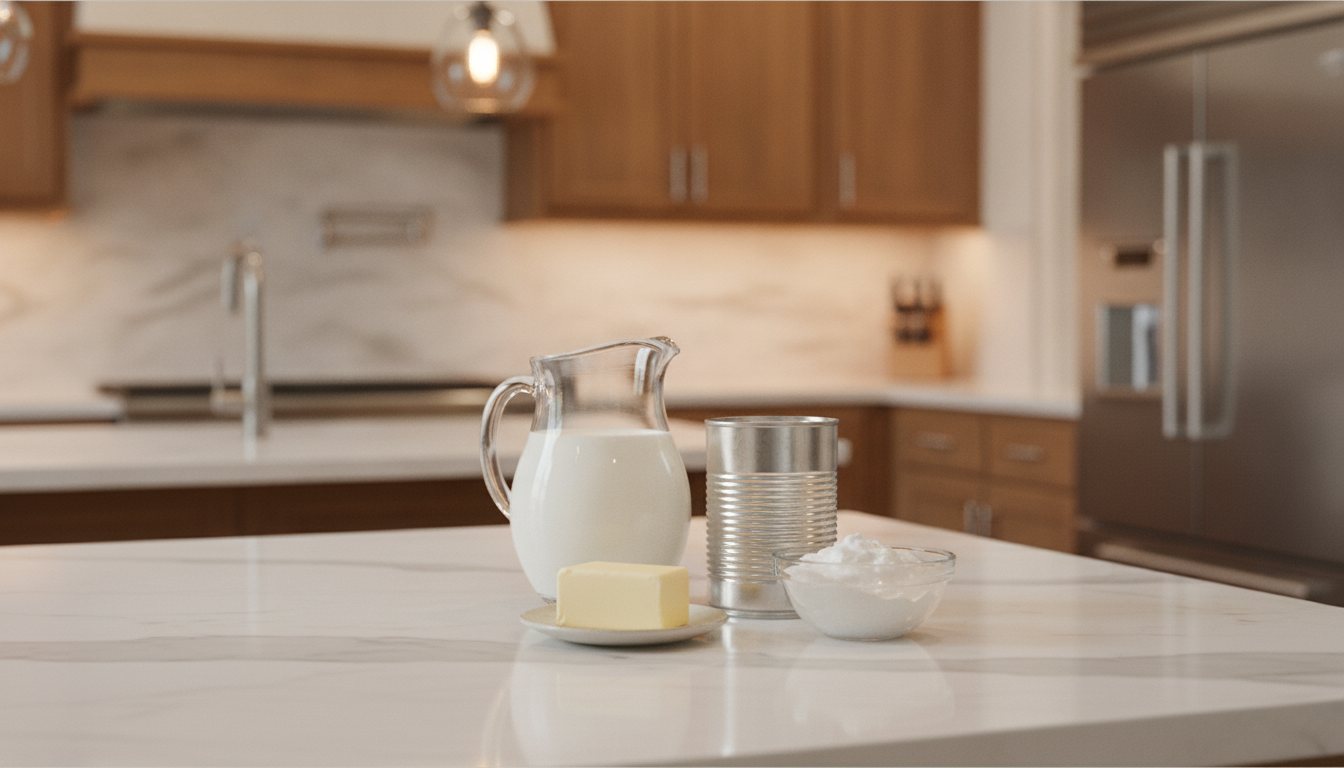
Learn which pantry staples and dairy alternatives work best for different recipes, from sauces to soups to whipped toppings. The right substitute paired with proper technique--gradual addition, gentle heat, and the right cookware--delivers smooth, silky results every time.
What Can I Use If I Don't Have Heavy Cream? The 5 Best Substitutes by Kitchen Scenario
Milk mixed with melted butter works beautifully for sauces and baking, but you'll need heavy cream or coconut cream if your recipe calls for whipped peaks.
Direct Answer: Your Best Heavy Cream Swap Depends on What You're Making
If you're missing heavy cream, the right swap depends on what the recipe needs from it: richness, structure, or the ability to hold air. Heavy cream contains 36 to 38% butterfat, well above whole milk's 4% ceiling, which is why simply pouring in milk leaves sauces thin and baked goods flat [1]. For most stovetop cooking and baking, melting butter into whole milk closes that fat gap and mimics heavy cream's richness in everything from mashed potatoes to ganache and pudding [1][2]. The one job this DIY blend can't do is whip. Milk and melted butter won't trap air into peaks, so recipes built around whipped texture need a different fix [1][2]. Quick answers by scenario:
- Sauces, soups, mashed potatoes: milk + melted butter, whisked together [1]
- Baking (scones, biscuits, puddings, icing): same milk-butter blend, reduced slightly by weight for tighter recipes like ganache [2]
- Whipped cream, mousse, ice cream: skip the DIY version and reach for real heavy cream or canned coconut cream, which whips like dairy cream [2]
- Dairy-free needs: unsweetened coconut cream is the closest match for both thickness and whippability [2]
Matching the substitute to the job matters more than finding one universal swap, since a mixture that works beautifully in a pan sauce can fall apart the moment a recipe calls for stiff peaks [1][2].
Why Heavy Cream Matters in Cooking--and When Substitutes Truly Work
Heavy cream's kitchen power comes down to fat content. At 36% or higher, cream packs enough fat globules to coat and stabilize proteins, which is why it resists curdling in hot or acidic dishes where milk would break [3]. That same fat structure is what allows cream to trap air when whipped, since the globules link together around air bubbles to build a stable foam.
Fat content around 30% is the minimum needed for this network to form, which is why substitutes need to hit that threshold to whip successfully [4]. A milk-and-butter blend can replicate cream's fat percentage for sauces and baking, since the fat still enriches the liquid and resists breaking under heat. But whipping requires those fat globules to be intact and properly distributed, not just present, so a substitute can match cream's fat math and still fail to hold peaks.
This is the line that separates a substitute that "works" in one context from one that fails in another: richness and heat stability depend on total fat, while whippability depends on how that fat is packaged and structured within the liquid [3][4].
Heavy Cream Substitute Decision Guide: Find Your Match in 3 Questions
Match your substitute to what the recipe demands--whipping needs full-fat coconut cream, sauces work with milk and butter, and baking tolerates a thinner blend.
Step 1: What's Your End Goal? Whipping, Saucing, Baking, or Dairy-Free
Before picking a substitute, identify the one job the cream needs to do, since whipping, saucing, baking, and dairy-free swaps each demand different fat structures. If a recipe calls for stiff peaks--whipped topping, mousse, or ice cream base--only options with intact fat globules will work, which rules out any DIY milk-and-butter blend no matter how closely it matches cream's fat percentage [5]. For sauces, soups, and most baking, the goal is richness and heat stability, so a substitute just needs enough fat to resist breaking under heat or acid, making milk-and-butter or half-and-half solid choices [5]. Dairy-free cooks have a separate set of priorities, since coconut cream and cashew cream need to deliver both richness and, in some cases, whippability without any dairy fat at all [5][6]. Sorting by goal first narrows the field fast:
- Whipping: full-fat coconut cream or standard heavy cream only [5]
- Saucing: milk + butter, half-and-half, or cashew cream [5][6]
- Baking: milk + butter blend, reduced slightly for tight recipes [5]
- Dairy-free: coconut cream, cashew cream, or nondairy milk + oil [5][6]
Knowing the end goal before opening the fridge saves a ruined batch of whipped topping or a sauce that never thickens.
Step 2: What Ingredients Do You Already Have? The Pantry-First Approach
A pantry check often reveals a substitute before a store run does. Evaporated milk sits shelf-stable in many cabinets and swaps in for heavy cream at a 1:1 ratio, cutting fat and calories while keeping a texture close to half-and-half [7]. Greek yogurt thinned with milk delivers a tangy, creamy result suited to dips, dressings, and mousse, with a lower fat content than cream [8]. Cream cheese whisked into warm milk works well for pasta sauces, since any leftover knots of cheese dissolve as the dish cooks [8]. Sour cream, though it won't whip, brings a similar thickness and a tangy edge that fits savory dishes like stroganoff or baked potato soup [8]. Checking what's already open in the fridge saves a special trip and often produces a better flavor match than a straight milk swap:
- Evaporated milk: 1:1 ratio, slightly sweet, caramelized note [7]
- Greek yogurt + milk: tangy, best for dips and mousse [8]
- Cream cheese + milk: smooths into pasta sauces as it cooks [8]
- Sour cream: won't whip, works in savory dishes [8]
None of these options will hold stiff peaks, so any recipe built around whipped texture still needs real cream or a dedicated dairy-free whip [8]. Scanning the fridge door and pantry shelf first, before assuming a grocery trip is necessary, is often the fastest route to a working substitute.
Heavy Cream Substitutes by Recipe Type: Sauces, Soups, Baking, and Whipped Toppings
Whisk cream substitutes into your sauce gradually over gentle heat, and a roux or pasta water starch will help keep everything silky instead of broken.
Creamy Sauces and Pasta Dishes: Which Substitutes Maintain Richness Without Breaking
Pasta sauces built on cream depend on fat content to survive heat, so the swap matters more here than almost anywhere else in cooking. Half-and-half or a blend of equal parts whole milk and heavy cream works as a lighter Alfredo base, but skip lower-fat options entirely since they raise the risk of the sauce separating before it ever hits the noodles [9]. A roux -- flour cooked into butter before any liquid goes in -- gives lower-fat substitutes a fighting chance, since the starch helps bind fat and liquid together instead of letting them split under heat [10][9].
A heavy stainless steel pan helps here too: its even heat spreads gently across the surface, so you avoid the hot spots that can trigger a break. Add any cream substitute in small increments, whisking constantly, rather than pouring it all in at once, which keeps the sauce from seizing as it heats [11][9]. If using milk instead of cream, warm it first, whisk it into the roux gradually, and stir in a few tablespoons of reserved pasta water, since the starch in that water helps hold everything together as the sauce cools and thickens [9].
Heavy cream itself can take a full simmer without breaking thanks to its high fat content, but once you're subbing in something lighter, gentle heat and constant whisking replace fat as the thing standing between a silky sauce and a broken one [10].
Soups and Braised Dishes: Substitutes That Blend Seamlessly Without Separating
Soup and braised dishes pose a different challenge than sauces, since the dairy simmers alongside acidic ingredients like wine, tomatoes, or stock for much longer stretches. Heat and acidity cause the proteins and water in dairy to separate, clumping into unwanted lumps and thinning the broth around them [12]. Heavy cream resists this thanks to its high fat content, but even cream can curdle a bit when combined with high-acid additions like tomatoes or wine, so add it toward the end rather than at the start of a long simmer [10][12].
Lower-fat substitutes--milk, half-and-half, sour cream--are far more vulnerable, and should never go into a boiling pot; drop the heat to a simmer first, then stir them in [12][10]. Tempering helps bridge the temperature gap: whisk a few spoonfuls of the hot broth into the cold substitute before adding it back to the pot, which prevents the shock that triggers curdling [12]. A small amount of flour or a cornstarch slurry stabilizes the mixture further, binding fat and liquid so the substitute holds together as the dish reduces [12][10].
This is the same technique used in scratch-made cream soups, where a butter-flour base is whisked with milk and cream, then simmered gently and stirred often until it thickens without breaking [13]. Many braises start with a good sear -- say, in a carbon steel pan -- so build that base of flavor first. Then add lower-fat substitutes only in the final stretch of cooking, keep the heat low, and stir regularly rather than letting the pot sit untouched.
How to Use Each Substitute Successfully: Ratios, Timing, and What to Watch For
Whisk melted, cooled butter into whole milk at a 1:1 ratio, then blend for two minutes to create a heavy cream substitute that works in almost any recipe.
Milk + Butter Combination: The DIY Heavy Cream Method with Exact Proportions
Milk and butter combine to answer a common question directly: yes, you can make heavy cream from milk by adding enough fat to close the gap between whole milk's butterfat and cream's [1]. The standard ratio is 3/4 cup whole milk whisked with 1/4 cup melted, cooled unsalted butter, yielding roughly 1 cup of substitute for almost any recipe calling for heavy cream [1].
A slightly different version scales to 1 cup whole milk paired with a full stick of butter, since a stick carries 80 to 90 grams of fat, close to what's in a cup of heavy cream [2]. Melting the butter and letting it cool before whisking, rather than pouring it in hot, keeps the fat from seizing against the cold milk, and blending the mixture at high speed for about two minutes emulsifies it so the fat stays suspended instead of floating free [2].
For the question of what replaces 1 cup of heavy whipping cream, this milk-and-butter blend is the direct answer, though it needs to rest in the fridge and get re-whisked if it thickens in spots over the next day [2]. Two limits apply no matter how carefully it's made: the mixture won't hold whipped peaks, and reducing it by about 25 percent by weight tightens the texture for structure-dependent bakes like ganache or scones [2].
Evaporated Milk, Coconut Cream, and Cashew-Based Options: Substitution Ratios and Technique Tips
Evaporated milk substitutes at a straight 1:1 ratio in sauces and soups, though the canning process leaves a slightly caramelized, sweet edge that works better in savory dishes than delicate baked goods [14]. Stirring in about 1 teaspoon of cornstarch per cup, dissolved first in a small amount of cold evaporated milk, thickens the texture closer to true heavy cream before it goes into a hot pan [15]. Coconut cream swaps in 1:1 as well, but for the closest match to cream's body, skip shaking the can and scoop only the thick solid layer off the top, leaving the watery liquid behind [14][15].
Chilling that can first makes the solid part whip up into soft peaks much like dairy cream, though it needs a stable folding motion rather than aggressive beating to hold its shape [15]. Cashew cream needs no soaking before blending, since cashews are naturally softer than almonds and puree smooth in any high-speed blender [16]. The ratio of water to cashews controls thickness: about 1 cup of water per cup of cashews for cheesecake-style density, 1/2 cup for a pourable sauce or sour cream base, and up to 1 1/2 cups for a thinner, dressing-friendly consistency [16].
Cashew cream substitutes 1:1 with a neutral, slightly sweet flavor that reads closer to dairy than coconut does, and it holds up well under heat in pasta sauces and creamy soups [15][16]. None of these three swap in cleanly for whipped applications requiring stiff peaks except coconut cream, which is the only one of the group with the fat structure to hold that shape [14][15].
Wrapping Up: Match the Swap to the Job
Matching your substitute to the task is what separates a rich sauce from a broken one. Mind your heat, add dairy (or its stand-ins) gradually, and you can pull off a silky soup, a smooth pan sauce, or a dairy-free dessert without a carton of heavy cream on hand.
Keep the right cookware within reach -- a stainless steel pan for gentle sauces, a carbon steel pan for the sear that starts a braise -- and your swaps come out smooth instead of split. Questions about which pan fits your recipe?
Contact us and we'll help you sort it out.
- Evaporated milk, Greek yogurt, cream cheese, and sour cream swap 1:1 for heavy cream in most savory dishes.
- Pasta sauces need fat stability--use half-and-half or milk-butter blend with a roux to prevent separation under heat.
- Make heavy cream substitute by whisking 3/4 cup whole milk with 1/4 cup melted butter, then chill and re-whisk.
- Lower-fat substitutes curdle in acidic soups and braises--temper them with hot broth first, add near the end, and keep heat low.
- Coconut cream is the only dairy-free substitute that whips to stiff peaks; cashew cream works well in sauces and soups.
- Gradual whisking and constant stirring replace fat as your protection against broken sauces when using lighter substitutes.
- Stainless steel pans distribute heat evenly for delicate sauces; carbon steel pans sear meat before braising with cream swaps.
- https://www.thekitchn.com/heavy-cream-substitute-23004405
- https://www.kingarthurbaking.com/blog/2025/11/17/heavy-cream-substitute
- https://scifood.blog/2025/05/01/everything-you-ever-wanted-to-know-about-cream-the-food-not-the-band/
- https://www.thekitchn.com/food-science-how-whipped-cream-81751
- https://www.bonappetit.com/story/heavy-cream-substitute?srsltid=AfmBOoooAtXwz6ZMhAY9Iqo-0xhM1RkdCbtAr7L8cNpHuSjwWEF-YP3s
- https://www.medicalnewstoday.com/articles/323822
- https://www.foodnetwork.com/how-to/packages/food-network-essentials/evaporated-milk-substitute
- https://www.spiceandlife.com/heavy-cream-substitute/
- https://theforkedspoon.com/alfredo-sauce-recipe/
- https://www.allrecipes.com/article/rules-for-heating-dairy-ingredients/
- https://www.garlicandzest.com/garlic-parmesan-cheese-sauce/
- https://www.tastingtable.com/1156653/the-essential-step-to-prevent-cream-from-curdling-in-soup/
- https://www.budgetbytes.com/cream-of-chicken-replacement/
- https://food52.com/story/24344-best-heavy-cream-substitutes
- https://foodess.com/article/heavy-cream-substitute/
- https://thebananadiaries.com/cashew-cream-recipe/
- Summary
- What Can I Use If I Don't Have Heavy Cream? The 5 Best Substitutes by Kitchen Scenario
- Heavy Cream Substitute Decision Guide: Find Your Match in 3 Questions
- Heavy Cream Substitutes by Recipe Type: Sauces, Soups, Baking, and Whipped Toppings
- How to Use Each Substitute Successfully: Ratios, Timing, and What to Watch For
- Wrapping Up: Match the Swap to the Job
- Key Takeaways
- References