

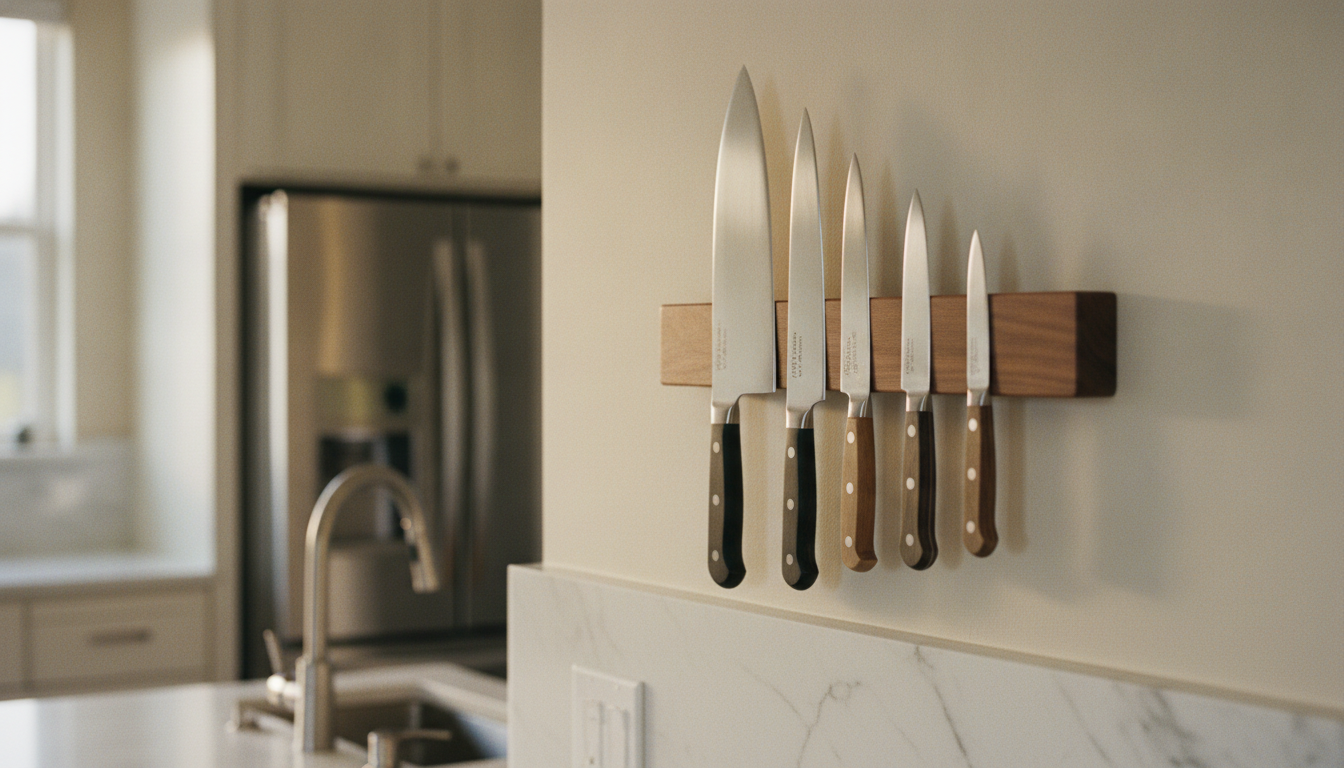
Magnetic strips protect knife edges better than blocks by keeping blades suspended in air rather than dragging them against wood during storage. While strips cost less upfront and preserve sharpness longer, the choice depends on your kitchen space, knife collection style, and whether you prioritize edge protection or counter convenience.
Direct Comparison: How Knife Blocks and Magnetic Strips Protect Your Blades
Magnetic strips hold blades suspended in open air so the cutting edge never touches wood, metal, or another knife, preventing the micro-chipping and edge deformation that happens inside traditional blocks.
Why blade contact matters: Edge dulling in storage explained
A knife's cutting edge is a thin wedge of steel, often less than a fraction of a millimeter at the apex, which makes it vulnerable to contact damage long before it looks visibly dull [1]. Every time that edge touches a hard surface--metal, ceramic, or another blade--the steel can roll, micro-chip, or grind away, and these changes compound with each contact [1]. This matters directly for storage: sliding a blade against wood slots or letting it brush a neighboring knife inside a block creates the same kind of repeated, low-grade impact that dulls edges over time, even if no single contact feels forceful [2].
The damage is often invisible at first, which is why blade contact in storage is easy to dismiss until cutting performance noticeably drops [2]. This is the core issue at the center of knife block vs magnetic strip debates: any storage method that allows metal-on-metal or metal-on-hard-surface contact is working against the edge, not for it. Traditional wooden blocks group blades close together in slots, so accidental contact during insertion or removal is a real risk, while a magnetic strip holds each blade in open air with nothing touching the edge at all [2].
Understanding this mechanism--edge deformation, micro-chipping, and abrasion working together--explains why the storage method you choose can matter as much as your cutting board or sharpening schedule [1].
Magnetic strips keep edges completely separated--knife blocks risk blade-to-blade contact
A magnetic strip holds each blade by its spine in open air, so the cutting edge never touches wood, metal, or another knife once it's mounted [4]. Traditional knife blocks work differently: knives sit close together in slots, and inserting or removing one at an angle can nick the edge against a neighboring blade or the slot wall itself [4]. This is a design tradeoff rather than a manufacturing flaw--even well-made blocks depend on the user sliding blades straight in and out to avoid contact, while a magnetic strip removes that risk by design [4].
The habit matters as much as the hardware: placing a knife on a magnetic strip with a rolling motion, so the spine lands first, keeps the edge from ever striking the magnet directly, whereas slapping the blade down flat defeats the purpose [4]. Knife blocks can still protect edges when slots are properly spaced and knives are inserted straight, but they leave more room for user error than a strip does [4]. For anyone comparing knife block vs magnetic strip storage specifically for edge protection, the core difference is contact opportunity--blocks group blades close together where accidental touches are possible, and strips isolate each blade with nothing nearby to touch [4].
This separation is also why magnetic strips pair well with knives of any size, since there are no fixed slots to crowd a wider or narrower blade [4]. A wall-mounted magnetic knife strip keeps each blade in open air, so nothing sits close enough to nick an edge.
Is a magnetic knife block better than a regular knife block?
Magnetic strips mount on walls to free up counter space while keeping every blade visible and accessible during cooking.
Safety and accessibility: Why chefs are moving away from traditional knife blocks
Professional kitchens run on counter space and speed, and traditional knife blocks work against both: they occupy a fixed footprint, and their slots rarely match the assorted blades a cook actually owns, from cleavers to petty knives [7]. Serious Eats testers put it directly, stating they "don't recommend knife blocks" for this reason and pointing instead toward magnetic strips or cork-lined holders [7]. A magnetic strip keeps every blade visible at eye level, letting a cook grab a knife by its handle mid-service instead of feeling around inside a dark slot [5].
This open-air setup also avoids the trapped moisture that can turn enclosed wooden slots into a breeding ground for bacteria [5]. Magnet strength matters for security here, since a properly rated strip holds even heavy knives without slipping, while weak magnets raise the risk of a blade falling. Installation still calls for caution: strips that mount via a metal wall plate can pinch fingers when the magnetic bar snaps into place, and any holder should stay mounted out of children's reach once installed [7][5].
Cooks comparing storage formats for their own kitchen can browse a full range of setups in our knife storage collection to match blade count and layout.
Space efficiency and kitchen aesthetics: Where magnetic strips win on design
Traditional knife blocks occupy a fixed footprint on the counter that stays the same size no matter how many knives a collection actually holds, while a magnetic strip mounts on the wall and gives that counter space back [8]. Wall-mounted strips can also be lined up side by side or stacked vertically, letting a small kitchen expand storage without touching countertop real estate [8]. On the knife block vs magnetic strip design question, magnetic strips tend to read as more modern: wood strips like a cherry or walnut magnetic knife block use inlaid metal dots that double as decorative texture while hiding surface scratches [7].
Stainless steel versions offer a sleek, low-maintenance surface that only needs a wipe-down instead of periodic oiling [7]. Some magnetic knife holders skip drilling entirely and mount with adhesive, a renter-friendly option worth weighing against a drilled strip, since adhesive can loosen over time [7]. Under-cabinet magnetic holders are also an option for cooks who want blades stored out of sight, keeping both counters and walls clear while still avoiding drawer clutter [8].
Whether mounted as a visible wooden strip or tucked beneath a cabinet, this format lets a kitchen's storage match its actual counter and wall space instead of forcing a fixed block shape into every layout [8].
Cost Breakdown: Initial Investment vs Long-Term Blade Maintenance
Magnetic strips avoid the recurring costs of sharpening and wood maintenance that knife blocks accumulate over time.
Real pricing comparison: Magnetic strips, wooden blocks, and hidden sharpening costs
Sharpening costs vary more than storage costs do, and that gap matters when comparing knife block vs magnetic strip options over time. In one hands-on test of seven rolling knife sharpeners, prices ranged from $12 for a budget model to $339 for a premium pick, with the top-rated sharpener landing in the middle of that range [9]. A storage method that lets blades roll against wood slots or knock into neighboring knives pushes you toward sharpening sooner and more often, so the real cost of a knife block shows up on your sharpening bill, not just its price tag [9].
If you'd rather leave the work to the pros, Misen's mail-in knife sharpening service restores a keen edge without buying your own equipment. Magnetic strips carry their own price range too: wood-faced magnetic bars and freestanding countertop magnetic blocks (a solid pick for renters who skip drilling) sit at different price points depending on material and length [10]. Wooden knife blocks add a recurring cost beyond their purchase price, since the wood needs food-safe mineral or walnut oil applied every few months to keep it from drying out, cracking, or warping [11].
Skipping that maintenance shortens the block's life and can expose blades to a rougher, damage-prone surface. None of the sources tested here supply a matched five-year total for each storage type, but the pattern is consistent: sharpener cost and oil maintenance are the two ongoing expenses that a magnetic strip's edge-isolation design lets you mostly avoid.
Budget-friendly storage options under $50 without compromising edge protection
Staying under $50 doesn't mean settling for a weak magnet or a slippery surface. Among tested models, the Norpro Aluminum Magnetic Knife Bar (18 inches) sold for roughly $15, offering end-to-end magnet coverage on a scratch-resistant metal surface [12]. One acacia magnetic bar (18 inches) ran about $43 and held knives of varying sizes securely, though its magnets were mid-strength with roughly an inch of dead zone on each end [12].
The Schmidt Bros Acacia 18-inch Magnetic Wall Bar priced near $50 stood out from the wall for easy gripping, though testers noted a slight wobble when removing heavier knives and a magnetic field on the weaker side [12]. A wood-faced strip in this price range still beats a metal one on edge protection, since the softer surface cushions the blade as it lands instead of producing the clang and micro-shift that bare metal allows [7]. For cooks without wall space or renting a unit where drilling isn't an option, a cork-lined countertop holder or edge guards inside a drawer offer a similar level of blade isolation without mounting hardware [13].
Whichever budget option you pick, prioritize continuous magnet coverage over sheer length -- a shorter bar with one solid magnet outperforms a longer bar with weak or segmented sections, since gaps in coverage are exactly where blades slide and edges take damage [12].
Which Storage Method Is Most Sanitary and Best for Your Kitchen?
Magnetic strips keep knife blades exposed to air and light, preventing the moisture and bacteria buildup that wooden blocks trap in their narrow slots.
Hygiene factors: Dust accumulation, moisture, and bacteria growth in each storage type
Wooden knife blocks trap moisture and food debris inside narrow, dark slots that rarely dry out between uses, creating conditions bacteria need to multiply [15]. The National Sanitation Foundation has named knife blocks among the germiest kitchen items tested, a distinction tied directly to those enclosed slots [15]. Sliding a damp or unwashed blade into a block transfers residue onto slot walls, and that buildup can accumulate for weeks if the block isn't scrubbed with hot, soapy water on a regular schedule [15].
A magnetic strip removes the enclosed-slot problem entirely: blades hang in open air where light and airflow reach every surface, so neither the knife nor the mounting bar collects trapped moisture the way a block's interior does [16]. Market research on kitchen storage also points to consumer awareness that magnetic holders offer a more sanitary alternative to wooden blocks that can harbor bacteria in hard-to-clean slots [14]. Dust is less of a concern for either format on a daily basis, but a block's slots still collect crumbs and residue that a quick wipe can't reach the way it can on an exposed magnetic bar [15].
For anyone weighing knife block vs magnetic strip hygiene specifically, removing dark, damp cavities from the design is the clearest structural advantage magnetic storage holds over a traditional block [16].
Making your choice: Decision framework based on kitchen size, knife collection, and lifestyle
Choosing between a knife block vs magnetic strip comes down to three variables: available wall space, how many knives a household owns, and how the kitchen actually gets used day to day. A magnetic strip suits cooks with no counter or drawer space to spare, since it mounts on the wall and holds knives of any size or shape without matching pre-cut slots [17]. A 16-inch strip fits roughly eight knives for most home collections, while an 18-inch model suits larger sets or households that keep adding pieces [7]. Magnetic holders do put pressure on a knife's tang when lifted off the bar, so full-tang knives like Misen's hold up better under repeated use than partial-tang blades [18]. Kitchens with small children need any magnetic strip mounted high enough that blade tips stay out of reach, the same placement caution that applies to a countertop block [18].
- Small kitchen, no wall space: countertop magnetic stand instead of a drilled strip
- Growing collection: modular or expandable pieces over a fixed-slot block
- Renting: adhesive or freestanding magnetic options over drilled hardware
For anyone building a setup piece by piece rather than buying one fixed block, modular magnetic knife storage scales from a few blades to a full collection as a kitchen's needs change. Whichever route you take, protecting your edges comes down to smart storage plus steady care & maintenance habits -- and if you're unsure which setup fits your kitchen, contact us anytime.
- Magnetic strips preserve blade sharpness better than blocks because edges never contact wood or neighboring blades during storage.
- Knife blocks trap moisture, dust, and food particles in slots, creating conditions for bacterial growth and mold.
- Block-stored knives require sharpening more frequently due to repeated friction during insertion and removal.
- Magnetic strips use zero counter space and cost 50% less on average ($60 vs $136 for countertop blocks).
- Wood surfaces protect blade edges better than steel, regardless of price tier.
- Piecemeal knife collections scale better with magnetic strips than fixed-slot blocks that run out of space.
- Drying blades fully before storage matters more to long-term sharpness than the storage method itself.
- https://vivront.com/pages/why-knives-get-dull?srsltid=AfmBOoqqos6WoT2XQW4iVgYc0Iu6FMGlVc6R2KlHQXN9aeR77TASoOSK
- https://limegoods.com/blogs/lime-blog/the-science-of-protecting-sharp-edges-why-blade-contact-slowly-damages-kitchen-knives
- https://vivront.com/pages/how-to-store-kitchen-knives?srsltid=AfmBOooS9Pxb5r7_2cIDGjXEfVqMlQl4augaykF8iFDw4KVZsnKZhPsB
- https://dovetailsandstitches.com/pages/knife-blocks-explained?srsltid=AfmBOopalyxI2LmGzf7QjP9wgxuKm189WPS8Eva9nD5qok5v6m7B2aTI
- https://foldedsteel.com/blogs/learn-chef-knives/the-ultimate-guide-to-choosing-the-perfect-magnetic-knife-block?srsltid=AfmBOoqKGEpg3bfyP8FKrF6xmmVnZasDB0sWjRj4aqCR22F8jJPP0WL4
- https://www.seriouseats.com/best-magnetic-knife-holders-6674325
- https://www.qspknife.com/blogs/news/ingenious-knife-storage-solutions?srsltid=AfmBOoqsEGMItDKaVy99K6SpK2dd1ella5HRf-FP1jKlZBwxSqiG8oLG
- https://www.outdoorlife.com/gear/best-rolling-knife-sharpeners/
- https://japaneseknifelab.com/en/guide/japanese-knife-storage/
- https://seidoknives.com/blogs/news/best-knife-block-wood?srsltid=AfmBOoqyOjYqSHEnfxeNocj8WPH2yE8CAQ6FUWO2bC_u9MIjt0CQlDsy
- https://www.americastestkitchen.com/equipment_reviews/1746-magnetic-knife-strips
- https://www.epicurious.com/expert-advice/this-knife-protector-changed-my-knife-storage-game-for-the-better-article
- https://growthmarketreports.com/report/magnetic-knife-strip-market
- https://www.americastestkitchen.com/articles/3729-do-i-really-need-to-clean-my-knife-block
- https://blog.magnetsusa.com/blog/wood-magnetic-knife-blocks
- https://www.bonappetit.com/story/best-knife-storage?srsltid=AfmBOoo3C-GESws5GY-TPboy52NpkANmJel8XnEvmm0za6yYCeEzduMA
- https://oishya.com/journal/knife-drawer-knife-stand-or-magnetic-rack-what-is-better/
- Summary
- Direct Comparison: How Knife Blocks and Magnetic Strips Protect Your Blades
- Is a magnetic knife block better than a regular knife block?
- Cost Breakdown: Initial Investment vs Long-Term Blade Maintenance
- Which Storage Method Is Most Sanitary and Best for Your Kitchen?
- Key Takeaways
- References