

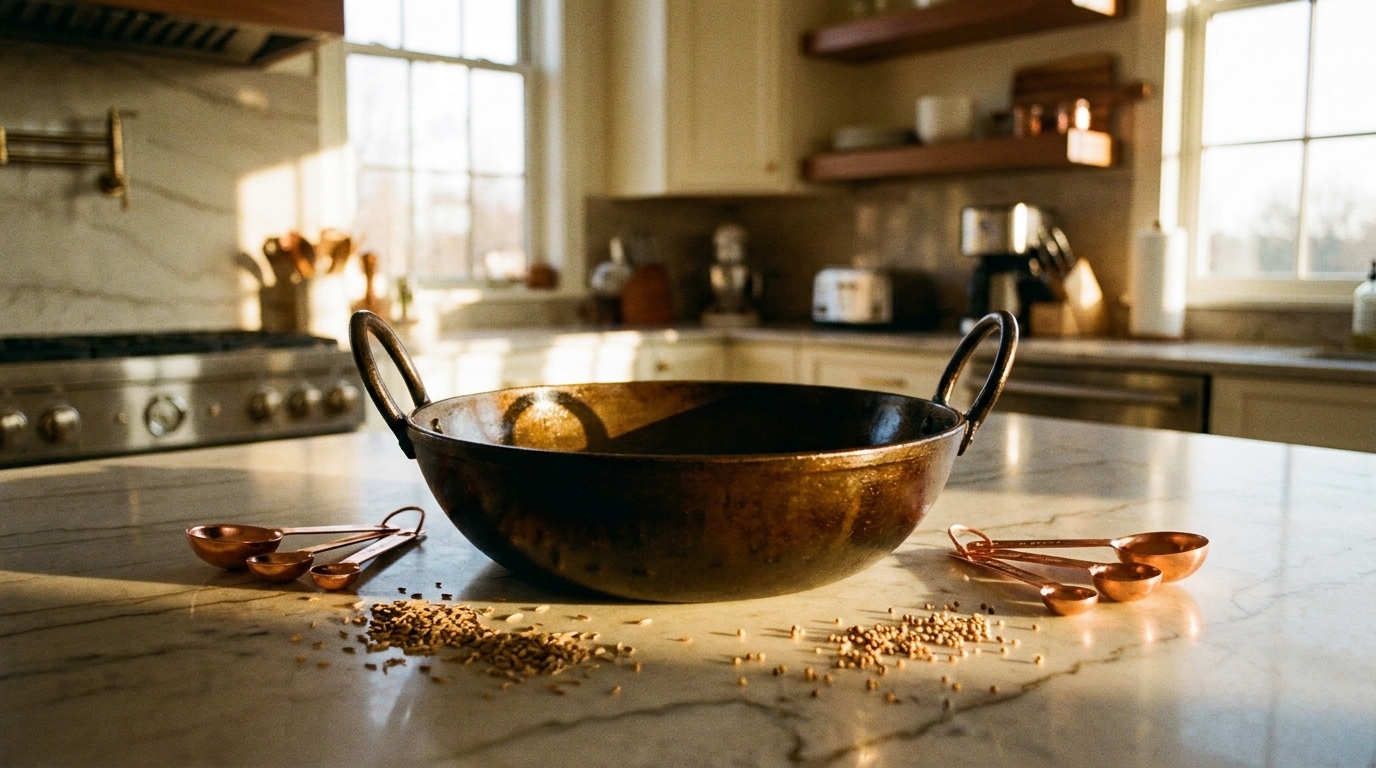
Understand how a kadhai's unique curved shape and inward-sloping walls make it distinctly suited for deep frying, simmering curries, and tempering--tasks where a wok or skillet fall short. Choose the right material and size for your stovetop and cooking style to unlock this versatile vessel's full potential.
What Is a Kadhai in English: The Direct Answer
A kadhai's round bowl, curved walls, and centered heat concentration make it distinct from Western cookware, even though no single English name captures its full identity.
Kadhai Defined: Wok, Pot, or Cauldron?
A kadhai in English doesn't map cleanly to any single cookware category -- it's not quite a wok, not quite a pot, and not quite a skillet. It has a round, deep bowl shape with steep curved walls and two small loop handles on opposite sides, which immediately sets it apart from the long-handled wok of East Asian cooking.
The closest Western parallel is a deep sauté pan, but even that misses the kadhai's pronounced concave base, which concentrates heat at the center and naturally pulls oil or sauce up the sides during cooking. If you want a fuller picture of how those design choices translate into real kitchen use, the complete kadai guide covers types and techniques in detail.
Why English Cookware Terminology Falls Short
Part of the difficulty is that the kadhai doesn't belong to any single English cookware tradition -- and the name itself resists translation.
In English romanization alone, it appears as karahi, kadai, kerahi, kadhi, kadahi, and cheena chatti, among others, reflecting the pot's reach across Indian, Pakistani, Bangladeshi, Nepali, and Afghan cuisines. [1] The word traces back to the Sanskrit "Kataha," referenced in texts as early as the Ramayana, which means there's no English equivalent that carries the same cultural or culinary weight. [1] The name also does double duty: it refers to both the vessel and the dishes cooked in it -- a concept English cookware vocabulary simply doesn't accommodate. [1]
The Kadhai's Anatomy: Why Shape and Material Matter More Than Name
A kadhai's inward-curving walls and low handles are engineered to contain oil during frying and concentrate flavors during simmering.
Distinctive Design Features That Define a Kadhai
Unlike a wok -- whose sides slope outward and typically reach 4 to 6 inches in depth -- the kadhai's walls curve inward, creating a vessel that's narrower at the top than at its widest point [2]. This geometry keeps oil contained during high-heat frying and redirects steam back into the pan during simmering, concentrating flavors more than a straight-sided pan would.
The two short loop handles sit low on the rim rather than projecting outward, making the kadhai easier to grip and hold steady when it's full of oil or braising liquid. For a practical look at how these design details play out in a specific dish, the chicken karahi guide shows the kadhai's geometry directly in context.
Material Variations: Cast Iron, Steel, and Aluminum Explained
Cast iron kadhais retain heat well once at temperature, which suits deep frying or slow-simmered curries that need sustained heat -- the tradeoff is significantly more weight compared to other materials. [5] Carbon steel and stainless steel kadhais heat up faster and respond more quickly to temperature changes, an advantage during high-heat tempering where timing matters; if you season a carbon steel kadhai, the oil you choose directly affects how the surface builds over time. [5] Aluminum kadhais are the most affordable and lightest option, but plain aluminum reacts with acidic ingredients like tomatoes or tamarind; anodized aluminum solves this with a sealed, non-reactive surface. [4] For most home cooks handling a mix of frying, tempering, and simmering, a steel kadhai offers better all-around handling without sacrificing cooking performance. [5]
What You Actually Cook in a Kadhai: Beyond the Translation
Each pan's shape and heat behavior suit different dishes--use a kadhai for deep frying and simmered curries, a wok for stir-fries, and a skillet for searing.
Deep Frying, Tempering, and Simmering: The Core Uses
Comparison Table: Kadhai vs. Wok vs. Skillet for Common Dishes Choosing the right pan for a specific dish comes down to how each vessel handles heat and liquid. The kadhai's depth and inward-curving walls make it strongest for deep frying and long-simmered gravies; the wok's sloped sides and rapid heat transfer suit high-speed stir-frying; and the flat skillet excels at surface-contact tasks like searing, where even browning across a wide, flat base matters most. [8] The table below maps common dishes to the pan that handles each task best, based on these geometric and thermal differences. [9]
| Dish | Kadhai | Wok | Skillet |
|---|---|---|---|
| Deep frying (pakoras, samosas) | **Best** -- depth contains oil; steep walls reduce splatter [8] | Works, but shallower base limits oil depth | Not ideal -- too shallow for submersion frying |
| Curry / gravy (dal makhani, chana masala) | **Best** -- retains heat and reduces sauce efficiently [8] | Too open; heat and moisture escape quickly | Loses moisture too fast; sauce reduces unevenly |
| Stir-fry (chow mein, fried rice) | Possible, but curved base limits tossing range | **Best** -- sloped sides designed for tossing and rapid evaporation [8] | Acceptable on flat surface; less airflow for crisping |
| Tadka / tempering (cumin, mustard seeds) | **Best** -- concentrates heat at center; contains blooming oil [8] | Works; wide base spreads heat thin | Works, but heat disperses across flat surface |
| Searing (steak, chicken thigh) | Not ideal -- curved base reduces surface contact | Not ideal -- sloped sides create uneven contact | **Best** -- flat base maximizes browning contact |
| Scrambled eggs / shallow pan fry | Possible but deep walls make monitoring harder | Possible; long handle aids maneuvering | **Best** -- easy to monitor and flip with flat base |
Choosing and Caring for Your Kadhai: A Practical Owner's Guide
Match your kadhai to your stovetop type and cooking style, then season cast iron or carbon steel consistently to build a durable non-stick surface.
Finding the Right Kadhai for Your Cooking Style and Stovetop
Stovetop type and cooking frequency are the two factors that narrow your selection.
On induction, the kadhai's base must be magnetic -- cast iron qualifies automatically, while stainless steel and tri-ply require a quick magnet test before buying; round-bottom kadhais perform better on gas burners, while flat bases suit electric and glass surfaces -- how gas and glass burners affect pan performance explains the heat differences in detail. [10] Size follows household volume: a 2-3 liter kadhai covers everyday meals for two to three people, while a 5-liter or larger vessel suits families or batch cooking. [10] If you deep-fry regularly, cast iron's heat stability is worth the extra weight; for everyday curries, dal, and tempering, tri-ply offers consistent performance without the maintenance routine cast iron requires. [11]
Maintenance and Seasoning: Keeping Your Kadhai Kitchen-Ready
Care routines for cast iron and carbon steel kadhais follow the same steps: wash, dry completely, apply a thin coat of high-smoke-point oil, and heat briefly on the stovetop to bond the layer. [13] Cast iron has tiny pores that open when heated -- oil fills those pores and builds a non-stick surface that strengthens with regular use, so consistent cooking matters more than any single seasoning session. [12] If rust appears from moisture or storage gaps, scrub with a paste of cooking oil and salt, then dry, heat, and re-oil to restore the surface. [12] Hold off on tamarind and lemon-based dishes until the seasoning has built up over several months of use, as high acidity can degrade the layer. [12]
- A kadhai's inward-curved walls and concave base concentrate heat and contain oil better than woks or skillets for deep frying.
- Cast iron kadhais retain heat well for slow-simmered curries; stainless steel and carbon steel heat faster for tempering and high-heat cooking.
- Kadhai geometry makes it best for deep frying, curries, and tempering--woks excel at stir-frying, skillets at searing.
- Stovetop type matters: induction requires magnetic bases, gas burners suit round bottoms, flat bases work on electric and glass.
- Season cast iron and carbon steel kadhais by washing, drying completely, applying high-smoke-point oil, and heating briefly to bond the layer.
- A 2-3 liter kadhai handles everyday meals for two to three people; avoid acidic dishes like tamarind until seasoning builds over months.
- https://languagelog.ldc.upenn.edu/nll/?p=60996
- https://circulon.com/blogs/blog/the-types-of-pans?srsltid=AfmBOoowsH3wlKU1ouhsEVPObOGH5gTAsFmb5u7t7uNEKdOxDRK9Rdtx
- https://dynamiccookwares.com/blogs/recipes/cast-iron-vs-carbon-steel-cookware-choosing-the-right-option-for-your-kitchen?srsltid=AfmBOop-1w0N3vQpN09Z6kHhM56fHqtA-IoNH6m1wPiBKGeLFIsVvZYo
- https://stahlkitchens.com/blogs/news/which-metals-are-best-for-cooking?srsltid=AfmBOopmQIPHA7skmdw6aWzmgXfJZcC70sT87yrb7WQ7LAkrCiPOxfuB
- https://visalamcookware.com/light-vs-heavy-cookware-best-for-everyday-cooking/
- https://ratatouie.co.uk/what-is-kadai/
- https://blog.pureindianfoods.com/basic-techniques-of-indian-cooking/
- https://food.ndtv.com/food-drinks/kadhai-vs-wok-what-is-the-difference-which-one-should-you-buy-8079895
- https://www.wakefit.co/selections/kitchen/7-key-differences-between-wok-and-kadai-you-must-know?srsltid=AfmBOopgDm89XlKBnZQF-QwmKRfPNzTJRGgyT81iV2CSZKxPwb2OC_B7
- https://shop.ttkprestige.com/blog/post/buying-guides/how-to-choose-the-perfect-kadai?srsltid=AfmBOorKF9mFvqNLF86ZeX5ItPA4s0DJyhquZhMTzO9qNFhBKu9Zcd9k
- https://vistayastore.com/the-ultimate-guide-to-choosing-the-best-kadhai-cast-iron-vs-stainless-steel-vs-tri-ply/?srsltid=AfmBOooLcQdAUSF2IbugZoofKazDne0RARFYUxmskK46CmrHbrnaj7zj
- https://zishta.com/blogs/bodha/dos-donts-of-iron-cast-iron-cookware?srsltid=AfmBOoof5SCXCv0L2GCvQ4-WSsSW6QVgDQ7zYC8r1jdJrm5JwGcbIhUL
- https://www.potsandpans.in/blogs/articles/how-to-maintain-and-season-your-cast-iron-kadai-in-2025?srsltid=AfmBOoqQ40pZxEFtgoqoM4LQ96kzs5BV3UZCpEQy-DtBewsbYqoeKMqg