

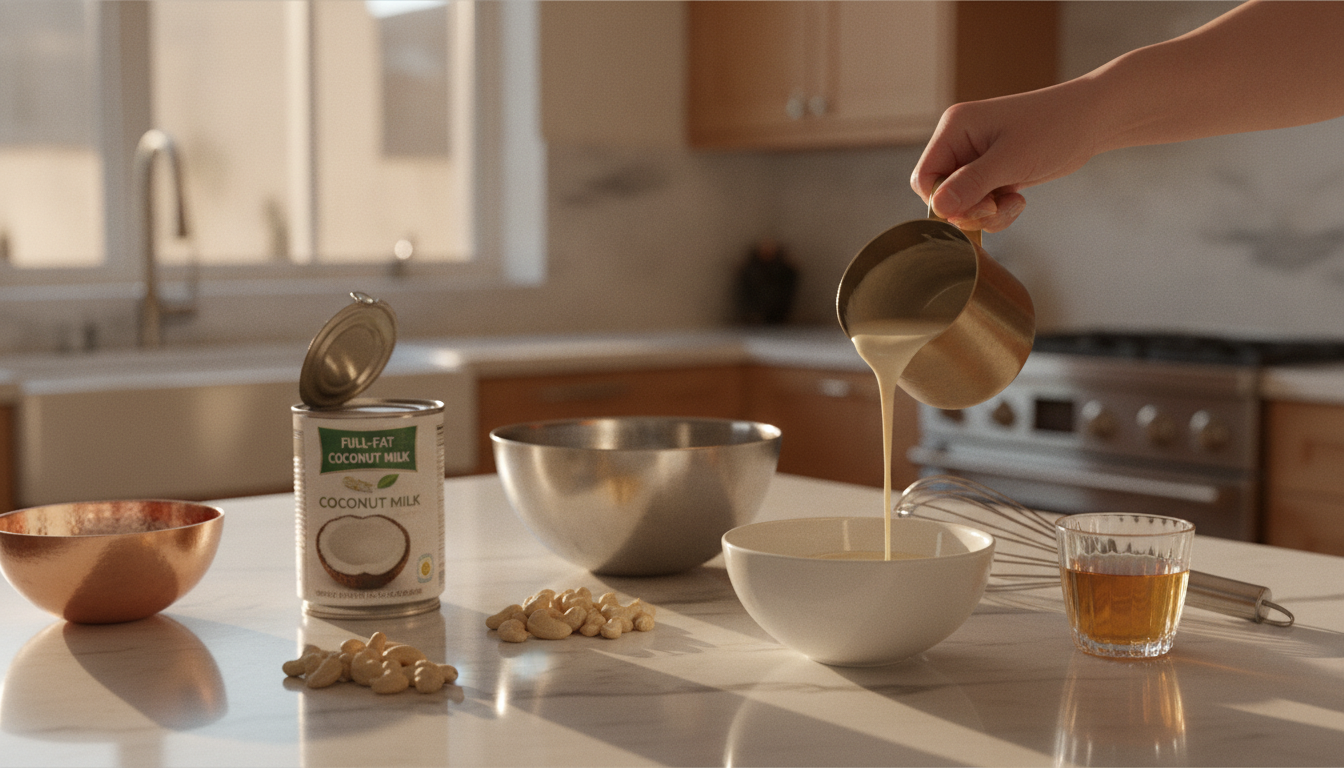
Learn which non-dairy cream swaps work best for sauces, soups, and whipped toppings, and master the techniques that prevent separation and splitting. Success with plant-based creams comes down to matching the right base to your cooking method and respecting heat control and stirring.
Why Non-Dairy Swaps Matter in Plant-Based Cooking
Plant-based cream fails most often because of technique--tempering cold cream before adding it to heat and stirring frequently prevents the separation that mimics dairy curdling.
The texture and fat challenge: What heavy cream does that dairy-free options must replicate
Heavy cream works because fat, not just liquid, does the heavy lifting. Its 36%+ milkfat lets it whip into stable peaks, thicken sauces through reduction, and resist curdling when simmered near acidic ingredients or high heat [1]. That heat stability comes from a low protein-to-fat ratio: more fat and less protein means fewer proteins available to seize up and curdle when cream hits a hot pan or a splash of wine [1].
Dairy-free swaps have to recreate this same fat-driven behavior without milk proteins to fall back on. Plant-based creams are technically oil-in-water emulsions, just like dairy cream, and their performance depends on how well fat droplets stay suspended in the water phase [2]. Coconut and almond creams behave as gel-like matrices with a pronounced elastic structure, which is part of why full-fat coconut cream can mimic heavy cream's body in a simmered sauce [2].
But without milk's natural emulsifiers, casein and whey, plant-based versions rely on their own fat content, natural proteins, or added stabilizers like guar gum to keep that structure from collapsing under heat or prolonged cooking [2]. This explains why some substitutes whip beautifully but split in a hot pan, while others hold up in soups but never aerate. Matching heavy cream's dual job, structure when cold and stability when hot, is the real benchmark for any non-dairy swap.
Common vegan cooking mistakes when substituting without the right tools or technique
Most non-dairy substitution failures trace back to technique, not the swap itself. Cooks often add cold plant-based cream directly to a hot pan without tempering it first, which shocks the fat structure and triggers separation the same way dairy splits under high heat [5]. Skipping frequent stirring is another common misstep. Plant milks and creams separate in heat just like dairy, and walking away from a simmering sauce gives fat and water time to break apart [5]. Temperature mismatches cause similar problems in baking. Vegan butter carries more moisture than dairy butter, and adding it too cold or too warm throws off the emulsion in frostings and creams, leading to a curdled, soupy mess [4]. Choosing the wrong plant milk base is a less obvious mistake. Low-protein milks like some almond varieties are more prone to splitting than soy, since protein content affects how well the emulsion holds together under heat or acid [5]. A few habits prevent most of these issues:
- Bring cold dairy-free cream to room temperature before adding it to hot liquid.
- Stir plant-based sauces more often than you would dairy ones.
- Add acidic ingredients like tomatoes or wine near the end of cooking, not the start.
- Match your milk base to the recipe: soy for buttermilk, coconut for simmered sauces.
Skipping these steps is often what turns a good substitute into a broken sauce, not the substitute itself [5].
5 Non-Dairy Heavy Cream Substitutes That Actually Work in Sauces and Soups
Coconut cream swaps 1:1 for heavy cream in sauces and soups, holding steady through simmering without the stirring other substitutes demand.
Coconut cream: Ratio, heat handling, and when to use it instead of dairy
Coconut cream swaps into most recipes at a 1:1 ratio for heavy cream, and full-fat canned coconut milk works the same way once you skip the shaking and scoop only the thick layer that rises to the top [6]. That solid portion, sometimes sold separately as coconut cream, carries the fat concentration needed to hold up in a simmered sauce, while the leftover watery liquid is better saved for rice or smoothies [6]. Chilling the can overnight makes separation easier and is also the step that lets coconut cream whip into soft peaks for a dairy-free topping, something thinner plant milks can't do [7].
In heat, it behaves like a gel-like matrix that resists breaking, so it holds together in curries, braises, and simmered soups without the stirring babysitting other substitutes need [8]. A well-seasoned carbon steel pan handles these longer simmers nicely, holding steady heat for the curries and braises where coconut cream performs best. The tradeoff is flavor: coconut cream brings a mild coconut taste that blends into curries and many desserts but can clash with delicate cream sauces or dishes like alfredo.
Save it for recipes where a little coconut flavor fits naturally, or where the dish is bold enough to mask it, and reach for a neutral option when the coconut taste would compete with the main ingredients.
Cashew cream, oat milk blends, and aquafaba: Which works best for your dish type
Cashew cream fits sauces and soups needing a neutral, savory backdrop since soaked and blended cashews turn creamy without any coconut aftertaste and hold up under heat [6]. It swaps in at a 1:1 ratio for heavy cream, and a high-speed blender gets the smoothest result, though boiling the cashews first lets a food processor work too [9]. Oat milk blends handle simmered dishes reasonably well but struggle in whipped applications, since oat milk tends to separate overnight in the fridge even when paired with coconut oil for structure [10]. Aquafaba, the liquid drained from canned chickpeas, whips into stable peaks on its own and works as a base for dairy-free whipped toppings [10]. Matching the swap to the job matters more than picking a single favorite:
- Cashew cream: pasta sauces, soups, dishes needing neutral flavor
- Oat milk blends: simmered sauces, not whipped toppings
- Aquafaba: whipped toppings, meringues, aerated desserts
Non-Dairy Substitutes by Cooking Method: Whipping, Simmering, and Baking
Coconut cream and cashew-coconut oil blends whip reliably, while oat and almond bases work better in simmered dishes where aeration doesn't matter.
Comparison table: Whippability, heat stability, and flavor profile of 6 plant-based options
Lab and kitchen testing point to consistent patterns across six common plant-based creams, letting you match the swap to whether you're whipping, simmering, or baking. Coconut cream and cashew-based blends whip most reliably, while oat and almond bases tend to separate or refuse to aerate at all [11]. Heat stability tracks closely with fat content and gel structure, and flavor neutrality varies from nearly undetectable to distinctly coconut-forward [11].
| Option | Whippability | Heat stability | Flavor profile |
|---|---|---|---|
| Coconut cream | Whips to soft peaks when chilled [11] | High; gel-like structure resists breaking [11] | Mild coconut taste [11] |
| Cashew + coconut oil blend | Whips to stiff peaks [11] | Moderate to high | Neutral |
| Almond cream | Struggles to reach soft peaks [11] | Moderate; gel-forming but less pronounced than coconut [11] | Mild nutty |
| Oat cream | Poor; tends to solidify or separate [11] | Lower viscoelasticity than nut and coconut creams [11] | Neutral, slightly grainy |
| Aquafaba | Whips to stable peaks [11] | Not suited for simmered dishes | Neutral, faintly beany |
| Soy milk + coconut oil | Whips to firm peaks unheated [11] | Moderate | Neutral |
The takeaway: reach for coconut cream or a cashew-coconut oil blend when whipping matters, and save oat and almond bases for simmered dishes where aeration isn't the goal [11].
Why your cookware and utensil choice affects how well non-dairy creams perform
Cookware and tools shape whether a non-dairy cream holds up as much as the substitute itself. Whipping performance improves when the metal bowl and beaters are chilled beforehand, since keeping the fat cold slows the same breakdown that ruins dairy whipped cream once it warms too fast [12]. A stand mixer with a whisk attachment also reaches stiffer peaks than a basic hand mixer, since steady high speed keeps the fat aerating before it separates [12].
When a whip starts to break anyway, straining the liquid through a fine-mesh sieve and folding the solids with a rubber spatula rescues the fat, letting it re-whip into stiff peaks instead of a soupy mess [12]. Heat source matters just as much: microwaving a coconut-based cream to melt it for a ganache caused it to turn clear and separate, while gentle stovetop heat with steady stirring kept the same product smooth in coffee and sauces [12]. A heavy, even-heating pan gives you the control that steady stirring needs, and a stainless steel skillet spreads heat evenly enough to keep delicate plant-based creams from scorching or splitting.
Slow cookers carry a specific risk, since canned coconut milk and coconut cream tend to curdle when added at the start of a long cook and hold together far better when stirred in near the end instead [13]. None of these substitutes behave like dairy cream by default, so matching the right pan, heat level, and mixing tool to the substitute often decides whether a dish separates or stays smooth.
How to Make Your Own Non-Dairy Heavy Cream in Minutes
Cashew cream keeps up to a week refrigerated or six months frozen, giving you flexibility to make it ahead for any recipe.
DIY coconut and cashew cream recipes with exact measurements and blending technique
Cashew cream is the simplest homemade version to build from scratch, needing just cashews, water, and a pinch of salt. Soak raw cashews overnight in the fridge, or boil them for about 15 minutes if short on time, then drain before blending [16]. Add the soaked cashews to a blender or food processor with fresh water, enough to bring the mixture into a pourable cream, plus a pinch of salt, and blend until smooth [14].
If using a food processor, stop periodically to scrape down the sides so no gritty cashew pieces get left behind [14]. A high-speed blender produces the silkiest results, while a food processor works but leaves a slightly less smooth texture [16]. Adjust the ratio of cashews to water depending on the job: less water keeps the cream thick enough to stand in for heavy cream in sauces, while more water thins it toward cashew milk for lighter uses [15].
Coconut cream needs no blending at all by comparison: chilling a can of full-fat coconut milk separates the fat naturally, so the only technique required is scooping the solid layer off the top once it's cold.
Storage tips and shelf life for homemade non-dairy cream alternatives
Homemade cashew cream holds in the fridge for up to a week, though some makers estimate a shorter three-to-four-day window since blending introduces water that whole cashews never had, speeding spoilage compared to raw nuts [17][9]. Cashew cream cheese, which includes acid from lemon juice, keeps about five days refrigerated [18]. For longer storage, freeze cashew cream in ice cube trays at roughly 2 tablespoons per portion, then transfer the frozen cubes to an airtight container once solid; this keeps portions ready for recipes calling for a set amount, like four cubes for a half cup [17]. Frozen cashew cream lasts up to six months, while frozen cream cheese keeps for about three months [17][18]. Some sources estimate a shorter one-month freezer window, so check texture and smell before use regardless of timeline [9]. Freezing can cause slight separation, but a quick stir or shake restores the texture before adding it to a hot pan or sauce [9]. Portioning before freezing saves time later, since frozen cubes thaw quickly once added to simmering liquid [17]. Coconut cream, unlike blended nut creams, keeps closer to canned coconut milk's shelf life once opened and refrigerated, since it skips the added water that speeds spoilage in cashew-based versions.
Dairy-free swaps really come down to matching the right base to the job and giving it the same respect you'd give dairy: steady heat, frequent stirring, and cookware that holds temperature evenly. Get those pieces right, and coconut, cashew, oat, and aquafaba can each pull their weight across sauces, soups, and whipped toppings. For more care & maintenance tips, or help choosing cookware that keeps plant-based creams smooth from pan to plate, explore our collection or contact us.
- Plant-based creams need 36%+ fat content and stable emulsions to match dairy cream's heat resistance and whipping ability.
- Most failures come from technique: tempering cold cream, frequent stirring, and adding acids late prevent separation.
- Coconut cream works 1:1 in sauces and soups; cashew cream suits neutral dishes; aquafaba handles whipped toppings.
- Cookware matters: heavy, even-heating pans and chilled bowls for whipping prevent scorching and splitting.
- Homemade cashew cream keeps 3-7 days refrigerated or up to 6 months frozen in portioned cubes.
- Match the substitute to the job--whipping, simmering, or baking--rather than picking one favorite for all uses.
- https://agriculture.institute/dairy-products-i/uses-of-cream-in-cooking-food-industry/
- https://pmc.ncbi.nlm.nih.gov/articles/PMC11049096/
- https://www.infarrantlycreative.net/will-cream-curdle-in-a-slow-cooker-alternatives/
- https://www.gretchensveganbakery.com/save-curdled-buttercream/
- https://simpleveganblog.com/vegan-buttermilk/
- https://foodess.com/article/heavy-cream-substitute/
- https://www.epicurious.com/expert-advice/heavy-cream-substitute
- https://thegourmethost.com/heavy-cream-substitutes-for-sauces-soups-and-bakes/
- https://minimalistbaker.com/how-to-make-cashew-cream/
- https://www.noracooks.com/heavy-whipping-cream-substitution/
- https://kitchenprojects.substack.com/p/kitchen-project-120-all-about-whipped
- https://cookingoncaffeine.com/silk-vegan-heavy-whipping-cream-review/
- https://thefitcookie.com/how-to-replace-dairy-in-cooking/
- https://www.thefullhelping.com/purpose-cashew-cream-recipe/
- https://www.resplendentkitchen.com/cashew-cream-recipe/
- https://elavegan.com/cashew-cream/
- https://detoxinista.com/cashew-cream/
- https://www.connoisseurusveg.com/cashew-cream-cheese/