

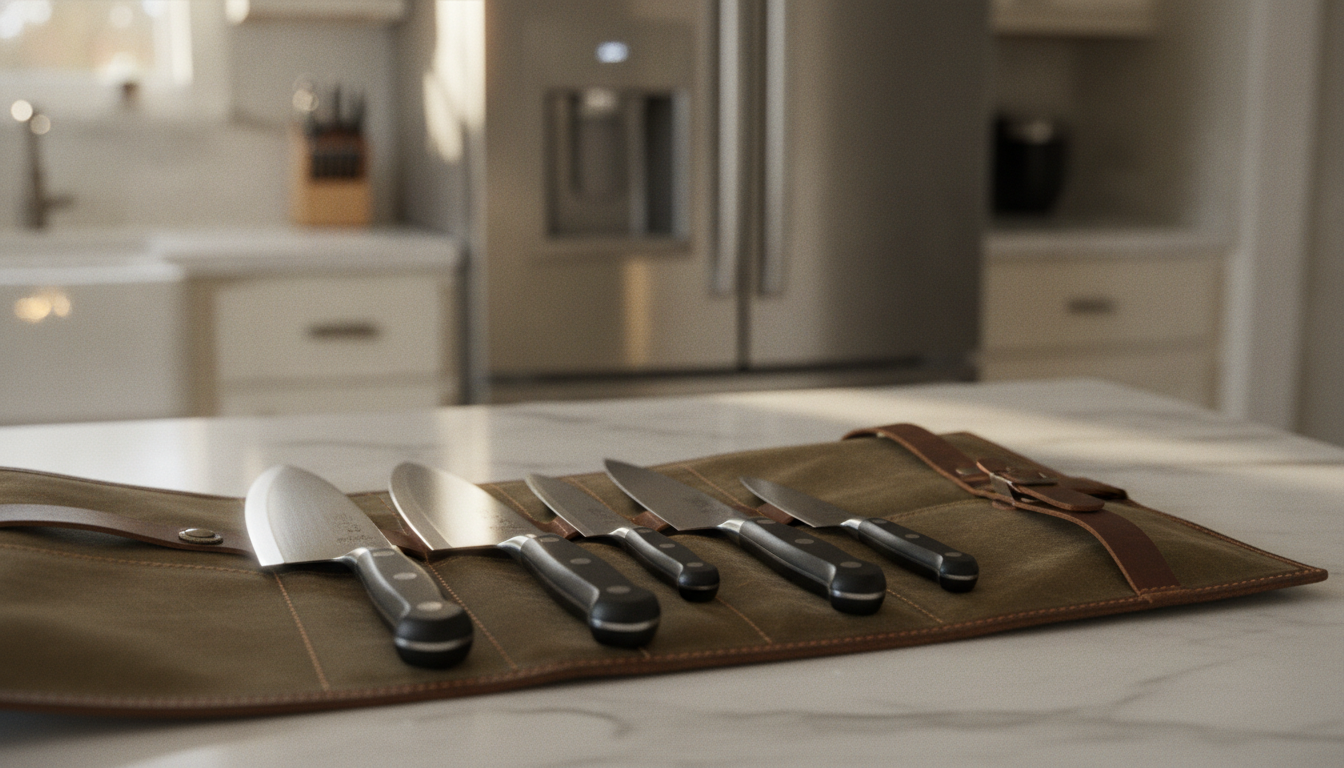
Knife rolls and hard cases each protect your blades differently depending on how often you travel and where you cook. Canvas rolls offer lightweight portability for daily commutes and competitions, while rigid cases absorb impact better for checked baggage and frequent relocations.
Why Travel Knife Storage Matters: Protection and Performance on the Road
Proper blade separation and padded compartments prevent edge damage and chipping during travel, extending the life of your knives.
How blade damage during travel affects cutting performance and longevity
When knives shift around during transit, blade edges take the brunt of contact against other tools, hard case interiors, or bag contents. This kind of impact produces two distinct failure modes: apex rounding, where the edge wears smooth and pushes through food instead of slicing it, and chipping or rolling, where pieces break out or the apex bends sideways [3].
Harder steels tend to chip under sudden impact, while softer stainless steels are more likely to roll [3]. Micro-chipping in particular results from hard steel striking hard surfaces or taking a hit at an incorrect angle, which describes exactly what happens when a blade knocks around loose in a bag [2].
Edge geometry has a stronger effect on cutting performance than almost any other variable, so even a small, travel-induced change in edge angle or thickness can measurably cut into how many cuts a blade delivers before it needs resharpening [1]. Repeated exposure to this kind of contact speeds up the sharpening schedule and shortens the practical lifespan of the edge overall, since every repair removes a small amount of steel for good [1].
What professional cooks need from portable knife storage systems
Professional cooks moving knives between kitchens, classes, or catering jobs need a system built around three core requirements: individual blade protection, sufficient capacity, and secure closure. Individual slots that keep each blade separated prevent the edge-on-edge contact that causes chipping and dulling in transit [4]. A working storage system also has to hold what a cook actually carries day to day--typically eight to twelve knives plus room for tools like tweezers or thermometers--without cramming the collection into a bag never designed for it [5][6].
Beyond raw capacity, cooks need padded compartments and dependable closures such as buckles or zippers, since a loose blade bouncing against fabric or a hard interior creates both damage and a safety hazard [5]. Reinforced stitching and quality materials matter here too, since daily handling and constant travel separate a working kit from something meant for occasional use [5]. These aren't aesthetic preferences--they're the baseline for keeping an edge sharp and a cook's hands safe between jobs [6].
If you're piecing together a travel setup, our knife storage options are built around these same priorities.
Knife Rolls: Flexibility, Weight, and Everyday Portability
Canvas breathes moisture away while leather blocks it, so match your material to how you store your knives to prevent rust and corrosion.
Canvas and leather construction: breathability vs. moisture protection for blade edgesCanvas and leather solve the moisture problem in opposite ways, and picking the wrong one undercuts the whole point of a knife roll travel case. Canvas is lightweight, flexible, and breathable, which lets trapped moisture escape instead of pooling against blade steel, so it's a solid pick against rust and mold on a knife roll storage travel case you're using daily [7].
The tradeoff: canvas stains easily, absorbs oils and debris, and offers only moderate cushioning, so it protects against corrosion better than it protects against impact [7]. Leather takes the opposite approach: it's durable, develops a protective patina, and provides firmer padding, but that same density traps moisture against a blade if you roll up a knife before it's fully dry [7].
Both materials still need a dry-before-storage habit, since carbon steel corrodes fast in an enclosed pocket regardless of what the case is made from [8]. Whichever you choose, wipe the exterior with mild soap and warm water, and keep the case away from radiators and direct sunlight so the material doesn't crack or warp [8][9].
Capacity and organization: fitting full knife sets into compact travel formats
Slot count on a knife roll storage travel case doesn't always match how many knives it holds--a 14-slot roll might reserve several slots for cutlery, a cleaver pouch, or a utility pocket, so the actual knife capacity runs lower than the number printed on the label [10]. Before buying, measure every blade you plan to carry, including the handle, since a roll rated for 16-inch knives won't close properly around an 18-inch chef's knife, and specialty pockets like angled cleaver pouches don't always roll flat at their stated max size [10].
Measure each knife from tip to handle end--a full-size chef's knife needs more room than the slot count alone suggests. Popular formats illustrate the range: a 14-slot canvas-and-leather roll can fit 10 full-size knives in elastic pouches plus three smaller leather slots for paring knives or tasting spoons, while a compact 7-pocket design trades overall capacity for a smaller footprint without shrinking the knife slots themselves [10].
A 10-slot waxed canvas and leather roll with three additional utility loops offers a similar split--main compartments sized for chef's and utility knives, smaller loops for peelers or spoons [11]. The takeaway: count actual knife-sized slots, not total pockets, and match the roll's dimensions to your longest blade before assuming it fits your set [10].
Hard Cases: Maximum Protection and Durability for Frequent Travel
Hard cases protect your knives during checked baggage handling while meeting TSA requirements for sheathed blades and inspector safety.
Rigid construction materials: how ABS, polycarbonate, and aluminum shield blades from impact
TSA compliance and airport travel: what you need to know about checked vs. carry-on knife cases All knives, regardless of blade length or type, travel in checked luggage only--TSA prohibits knives of any kind in carry-on bags, and one found at the checkpoint means you'll be asked to check it, discard it, or risk confiscation [16]. Checked bags go through more handling than an overhead bin, which raises the stakes for whichever storage system holds your blades: TSA requires that sharp objects be sheathed or securely wrapped to prevent injury to baggage handlers and inspectors, and that rule applies equally to knife rolls and hard cases [14][15].
A hard case's rigid shell does double duty here, absorbing impact from conveyor belts and stacked luggage while keeping every edge fully enclosed for inspector safety, whereas a knife roll needs individually sheathed or buckled slots to meet that same standard [14]. TSA officers retain final say over what passes through screening, so even a properly wrapped set can trigger a manual bag check if it sets off an alarm or looks tampered with [15].
Building extra time into your travel schedule covers that possibility without derailing your trip.
Knife Roll vs Hard Case Comparison: Choose Based on Your Travel Style and Knife Collection
Choose a knife roll for quick access and light travel, or a hard case when your blades need protection during checked baggage or equipment stacking.
Decision matrix: weight, protection level, capacity, and cost across 8 real-world travel scenarios
Matching storage to the job means weighing portability against impact protection, since knife rolls favor compact, lightweight carry while hard cases and bulkier bags trade size for durability and capacity [17]. Cost tracks the same pattern: rolls cost less and weigh less, while hard cases command a higher price for the added shell protection [18].
| Travel scenario | Better pick | Why |
|---|---|---|
| Weekend culinary competition | Knife roll | Fast access, light carry between stations [18] |
| Food truck setup | Knife roll | Compact footprint in tight galley space [17] |
| Catering job | Hard case | Shields blades when stacked with other equipment in a van [17] |
| Cooking class instruction | Knife roll | Unrolls flat, easy to display tools for students [18] |
| Restaurant stage (trial shift) | Knife roll | Professional look, minimal bulk to carry in [18] |
| Vacation cooking | Hard case | Withstands checked-baggage handling [19] |
| Relocation move | Hard case | Rigid shell protects blades during long-haul shipping [17] |
| Daily commute to commercial kitchen | Knife roll | Lightweight design reduces fatigue on repeat trips [18] |
For cooks who split time between roles, capacity settles the tiebreaker, since a roll's fixed slots cap out around ten to sixteen knives while a bag or case scales up for additional tools, uniforms, or shared equipment [17][18].
Maintenance and care tips for extending the life of your chosen storage system
Both storage systems last longer with the same core habit: never roll up or latch away a wet knife. Wipe blades dry before returning them to slots, since trapped moisture is what turns a knife roll storage travel case into a rust incubator overnight [21]. Canvas and synthetic knife rolls only need a damp cloth with mild soap for the exterior; skip the washing machine entirely, since agitation strips the wax coating, deforms padding, and loosens stitching at stress points [20]. Leather panels need occasional conditioning to stay supple, but avoid soaking the material, since excess moisture causes warping and cracking over time [20].
Hard cases ask for less frequent attention: check latches, hinges, and foam inserts periodically for looseness, and wipe the shell down the same way you would any piece of luggage. For either system, storage location matters as much as cleaning. Keep the case or roll in a cool, dry spot away from radiators, direct sun, or damp basements, since heat and humidity degrade materials and invite mold [20][21]. If a bag or case gets soaked, empty it immediately, blot excess water, and let it air dry fully before packing knives back in.
Building this routine into your knife storage system, whether a roll or a rigid case, keeps the protection working the way it's meant to and saves you from replacing gear or resharpening edges more often than necessary. Want more care & maintenance tips for your knives? Contact us anytime--we're glad to help you keep your kit in working shape.
- Impact damage like chipping and apex rounding dulls blades faster and shortens edge lifespan between sharpenings.
- Knife rolls work best for lightweight daily commutes and competitions; hard cases protect better during checked baggage travel.
- Canvas breathes and prevents rust; leather provides cushioning but traps moisture--both require dry storage habits.
- Count actual knife-sized slots, not total pockets, and measure your longest blade before buying a roll.
- TSA requires all knives in checked luggage only, with blades sheathed or wrapped for handler safety.
- Never store wet knives; wipe blades dry before rolling or latching, since trapped moisture causes rust overnight.
- Canvas rolls need only mild soap on exterior; skip the washing machine to preserve wax coating and stitching.
- https://knifesteelnerds.com/2018/06/18/maximizing-edge-retention/
- https://precisionsharpening.net/blogs/articles/the-science-of-sharpness-how-metal-hardness-edge-geometry-affect-your-tools?srsltid=AfmBOopfH0V5-Q_DOQAoiGqKxI8vCKiE-hECPZWElUnqleZ92JA3ylVi
- https://japaneseknifelab.com/en/guide/knife-edge-retention/
- https://kyokuknives.com/blogs/kyoku-chef-blog/best-knife-roll-bag?srsltid=AfmBOoo_32alLKpfH1jvsF1r9k2Ns7mYiVkwZ93_OM27BSqG_ZcvuBOi
- https://hospitalityconnect.com.au/blogs/news/how-to-store-your-knife-safely-at-tafe-a-guide-for-culinary-students?srsltid=AfmBOorlghd5p9pdDp5lGUj95wh47R7A5XH_QpERzOdDM6vx9Y2CX7hb
- https://szoneierleather.com/what-are-leather-knife-rolls/
- https://pikore.shop/blogs/news/clean-and-maintain-knife-roll?srsltid=AfmBOopm-I21HiNTcBTIs-VYEnDjnGXja9kw_6RQK81GZKNyCgyh2f4I
- https://coloringdog.com/maintaining-a-knife-roll/
- https://seidoknives.com/blogs/news/how-to-pack-a-knife-roll?srsltid=AfmBOopmMbV4OYYV_Wj4L994nm3w5v5cDiaE1x0Lj7qaoAoxGfO_5fD4
- https://manyeats.com/best-knife-roll/
- https://kyokuknives.com/blogs/kyoku-chef-blog/best-knife-roll-bag?srsltid=AfmBOorJXeRB5Rk28mplFDuBzovEriHAXzTlL28_AZTewbwE680lEBth
- https://www.carlfriedrik.com/magazine/polycarbonate-luggage?srsltid=AfmBOorSRw9b6qQWx9_F7SOLhP2VQiCSlqWKKE2N5S1lEBvkQyp53lSZ
- https://www.level8cases.com/blogs/blog/abs-vs-polycarbonate-luggage?srsltid=AfmBOoqnkYAGCv0wG3wO4kClQr9Oj3duYVIoK6fusib2wwkhq6tjwDBU
- https://www.tsa.gov/travel/security-screening/whatcanibring/items/knives
- https://www.tsa.gov/travel/security-screening/whatcanibring/sharp-objects
- https://mysekkin.com/blogs/journal/how-to-travel-with-kitchen-knives-without-breaking-the-rules?srsltid=AfmBOoom8A-Iq8unbVomUR3AclHkuv9XLOt57JROXXs2mYh-CUr4VaYU
- https://frontierleatherco.com/knife-roll-vs-knife-bag/?srsltid=AfmBOoqDj5fxNy1kdnITnl89Lkeq89OlPI_gcchjBjeoXX6ZzKJEjlEk
- https://dalstrong.ca/blogs/news/best-knife-roll?srsltid=AfmBOoq2yH-rPt5EyvEWA3J77l3srZxUrmP7PuloXaZBDhHeNuu1r0R7
- https://oishya.com/journal/kitchen-knives-101-buying-storage-cutting-techniques-and-more/
- https://seidoknives.com/blogs/news/knife-roll-bag-ultimate-care-guide?srsltid=AfmBOopcKEl15y7dCjpUnrfs79dG-z3VWxR1KfLhFu70BSIr8tB7fo-Z
- https://pikore.shop/blogs/news/clean-and-maintain-knife-roll?srsltid=AfmBOoqTQ1f_IjVXSkjUWSt8Zu62_B0R_0yTRM5lOz83wkziw6WzPbr7
- Summary
- Why Travel Knife Storage Matters: Protection and Performance on the Road
- Knife Rolls: Flexibility, Weight, and Everyday Portability
- Hard Cases: Maximum Protection and Durability for Frequent Travel
- Knife Roll vs Hard Case Comparison: Choose Based on Your Travel Style and Knife Collection
- Key Takeaways
- References