

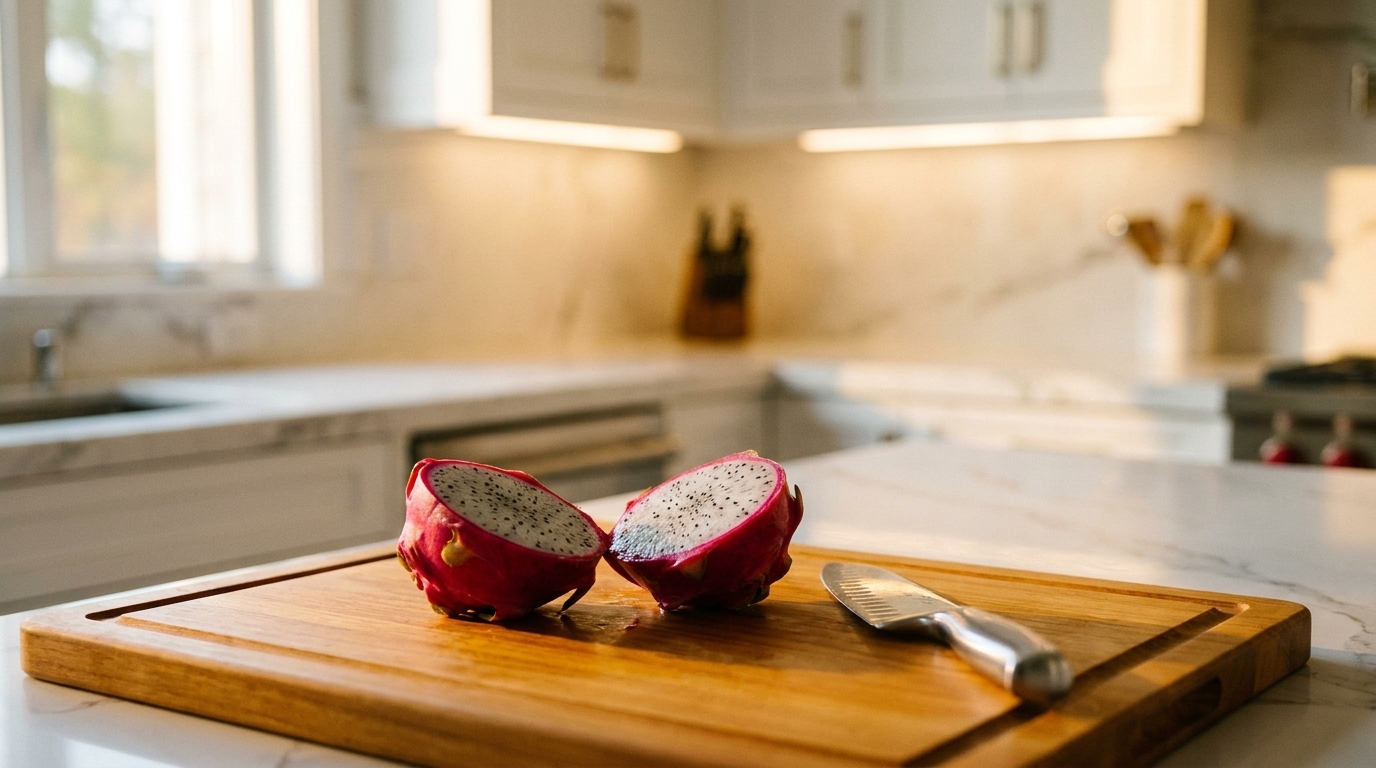
Master the technique for selecting ripe dragon fruit and cutting it cleanly using the right knife and method for your serving style. A sharp chef's knife, proper preparation, and knowledge of three distinct cutting techniques ensure perfect slices every time.
Select and Prepare Your Dragon Fruit: The Foundation for Clean Cuts
Drying your dragon fruit completely before cutting prevents slips and keeps your knife, board, and hands stable throughout the process.
How to identify a ripe dragon fruit by color, firmness, and weight
A ripe dragon fruit gives clear signals before you pick up a knife.
Look for deep, even magenta or pink skin -- green patches indicate the fruit was harvested too early, while large brown spots or wrinkled skin mean it's past its prime. [1] The scales should be plump with green tips; dried or fully browned scales mean the fruit has been sitting too long. [1] Press gently with your thumb -- a ripe fruit yields slightly and springs back, like a ripe kiwi; rock hard means under-ripe, and mushy means overripe. [2] Weight is the final check: a fruit that feels heavier than its size has dense, juicy flesh inside -- light or spongy weight means the moisture has already evaporated. [3]
Why rinsing and drying your fruit prevents slipping and ensures safety with sharp tools
Rinsing dragon fruit under cool water removes surface residue and any bacteria transferred during handling -- but it's the drying step that directly affects your safety.
A wet fruit surface acts like a lubricant between your hand and the skin, making it far harder to stabilize while you cut. [4] The same logic applies to your cutting board and knife handle: moisture on any of these surfaces raises the chance of a slip with a sharp blade. [4] Pat the fruit dry with a clean kitchen towel, wipe down your board, and make sure your knife handle is completely dry before you make the first cut. [5]
The Right Tools Make Perfect Cuts Easier: Why Your Knife Matters
A sharp chef's knife requires less pressure and gives you cleaner cuts through dragon fruit's soft flesh, while honing every few uses keeps the edge performing at its best.
Chef's knife vs. paring knife: which blade handles dragon fruit bestA chef's knife handles dragon fruit better than a paring knife for most cuts.
The chef's knife's longer blade gives you enough length to halve the fruit in a single downward stroke, while its weight helps push cleanly through the thick skin without tearing or crushing the flesh underneath. [6] A paring knife -- designed for smaller, detail-focused tasks like coring tomatoes or trimming on compact surfaces -- can manage scoring or touch-up work, but its short blade requires multiple passes on a fruit this size and gives you less control over the cut line. [7] If you only have one knife on the board, a sharp chef's knife is the better choice for dragon fruit from start to finish. [6]
Why a sharp, well-maintained blade prevents crushing delicate flesh and reduces prep time
Dragon fruit flesh is extremely soft and water-rich, so a dull blade compresses the cells before the edge cuts through -- leaving ragged, wet slices instead of clean ones. [8] A sharp knife requires less downward pressure, which gives you better control and reduces the chance of the blade skidding across the waxy skin. [9] For routine care, run your blade along a honing steel every few uses -- honing realigns the microscopic edge that bends with regular use, without removing material from the blade. [10] When honing stops restoring performance, a whetstone or professional sharpening service will restore the edge; for home cooks, sharpening every three to six months is usually enough depending on use frequency. [10]
Three Cutting Methods for Every Serving Style: Step-by-Step Techniques
Match each cut shape to your serving style--half-moons for casual bowls, cubes for uniform salads, and spheres for plated desserts.
Method 1: Lengthwise halves with scoop-and-slice for casual serving
To halve dragon fruit lengthwise, place it on a stable cutting board and draw your chef's knife straight through the center from tip to stem -- the skin cuts through with minimal resistance. [11] Once you have two halves, use a large serving spoon to scoop the flesh out in one smooth motion, running it along the inner curve of the skin the same way you'd work an avocado. [11] If the fruit is properly ripe, the flesh releases cleanly in one piece; underripe fruit tends to cling, leaving edible flesh stuck to the skin and making the scoop uneven. [12] With the flesh free, place it flat-side down and slice crosswise into half-moons -- a low-effort presentation that works well for smoothie bowls, breakfast plates, or snacking straight from the board. [11]
Method 2: Cubes and spheres for plating and fruit salads--plus a comparison chart of cutting shapes and their best uses
For cubes, peel the flesh completely first -- either by scooping it from the skin or sliding your knife between flesh and skin -- then place it flat on the board and make a grid of parallel cuts to produce even blocks; trim the rounded ends and set them aside for smoothies rather than the plate. [12] For spheres, press a melon baller into the open half before removing the flesh, rotating firmly to pull clean rounds; this works best on fully ripe fruit where the flesh yields without tearing. [13] Both shapes suit fruit salads, salsas, and composed platters where uniform sizing affects both presentation and texture. [12] The chart below maps each cut shape to its strongest use so you can decide your prep before you pick up the knife.
| Cut shape | Best use | Notes |
|---|---|---|
| Half-moons | Smoothie bowls, casual serving | Fastest method; requires only a scoop and crosswise slice |
| Cubes | Fruit salads, salsas, poke bowls | Uniform size improves texture consistency across each bite |
| Spheres (melon balls) | Composed dessert plates, elegant fruit platters | Requires a melon baller; works only on ripe flesh |
| Wedges | Fruit platters, handheld snacking | Skin-on option makes pieces easier to pick up and hold |
| Thin rounds | Poke towers, layered presentations | Requires a very sharp blade to hold clean edges |
Store and Maintain Your Cut Dragon Fruit: Keeping Quality Fresh
Keep cut dragon fruit fresh for up to two days by refrigerating it immediately in an airtight container with a squeeze of lemon juice.
Proper storage containers and refrigeration to extend freshness without browning
Cut dragon fruit kept in an airtight container in the refrigerator stays fresh for up to two days -- sealed containers also prevent the flesh from absorbing odors from other foods stored nearby. [14] Before sealing, squeeze a small amount of lemon or citrus juice directly over the cut surfaces; the acid slows oxidation, which is the primary cause of browning and texture softening. [15] Refrigerating immediately after cutting matters: cold temperatures reduce both oxidation and microbial activity, so leaving cut pieces at room temperature even briefly accelerates decline faster than most people expect. [15] Borosilicate glass containers are a practical choice for storage -- non-reactive and resistant to staining from the fruit's pigment, unlike plastic containers that absorb color over repeated use. [14]
Why tool maintenance matters: keeping your cutting equipment ready for the next prep session
After each dragon fruit prep session, wash your knife immediately to remove the fruit's pigment and residual acidity from the blade -- both can stain or pit the steel if left on the surface. [16] Hand wash with warm water and mild dish soap, then dry with a clean towel right away; air-drying leaves water spots that develop into rust. [16] For storage, a magnetic wall strip or slotted knife block protects the edge between uses -- loose knives in a drawer knock against other utensils and dull the blade faster. [16] Wooden boards are the best surface for preserving your knife edge; keeping them oiled prevents the cracking that forces early replacement -- restoring a dry board takes only a few minutes. [17]
- Select ripe dragon fruit by checking for deep magenta skin, plump green-tipped scales, and gentle give when pressed.
- A sharp chef's knife cuts cleanly through soft flesh; dull blades compress cells and create ragged, wet slices.
- Pat the fruit and knife dry before cutting--moisture acts as a lubricant and increases slip risk with sharp blades.
- Half-moons work best for smoothie bowls, cubes suit fruit salads, and melon balls create elegant plated presentations.
- Store cut dragon fruit in airtight containers with lemon juice squeezed over the flesh to slow browning for up to two days.
- Hand wash your knife immediately after use and dry it right away to prevent staining and rust from the fruit's pigment.
- https://greatfarmer.com.vn/how-to-choose-high-quality-dragon-fruit/
- https://dna.strongeru.com/how-to-tell-if-dragon-fruit-is-ripe/
- https://www.singaporeatriumsale.com.sg/post/guide-to-selecting-juicy-and-delicious-dragon-fruit
- https://www.healthpartners.com/blog/kitchen-knife-safety-prevent-hand-cuts/
- https://extension.umaine.edu/publications/3108e/
- https://www.seriouseats.com/the-best-essential-knives
- https://dalstrong.ca/blogs/news/cooking-knives?srsltid=AfmBOopbNYUshHzTytjScx0CDbzF9xb32MaPDP04193TYM3a3Y5O1qc_
- https://yakushiknives.com/blogs/yakushi-blog-all-thing-knives/sharp-knives-why-they-are-essential-in-every-kitchen?srsltid=AfmBOopkP3H4zdyF0OcR7lyJwohtsynPpL1ByrRXvJuE85wpsuai1pV0
- https://www.urmc.rochester.edu/encyclopedia/content?contentid=263&contenttypeid=1
- https://bpsknives.com/how-to-test-the-sharpness-of-a-knife-safely/?srsltid=AfmBOopIvuIpEWUaG8VV0JP_xqIqc8TU6PWcktVSeSZCp4Ad39YNzT20
- https://www.runningtothekitchen.com/how-to-cut-dragon-fruit/
- https://poppyswildkitchen.com/how-to-cut-dragon-fruit/
- https://www.lemon8-app.com/@skyjackwong/7330904655624569346?region=sg
- https://www.theproducemoms.com/produce/dragon-fruit/
- https://salagrifruit.com/blog/10-expert-tips-to-keep-fruit-fresh/
- https://www.nytimes.com/wirecutter/guides/how-to-care-for-kitchen-knives/
- https://www.grit.com/food/kitchen-techniques/kitchen-knife-care-zm0z18jazmcg/