

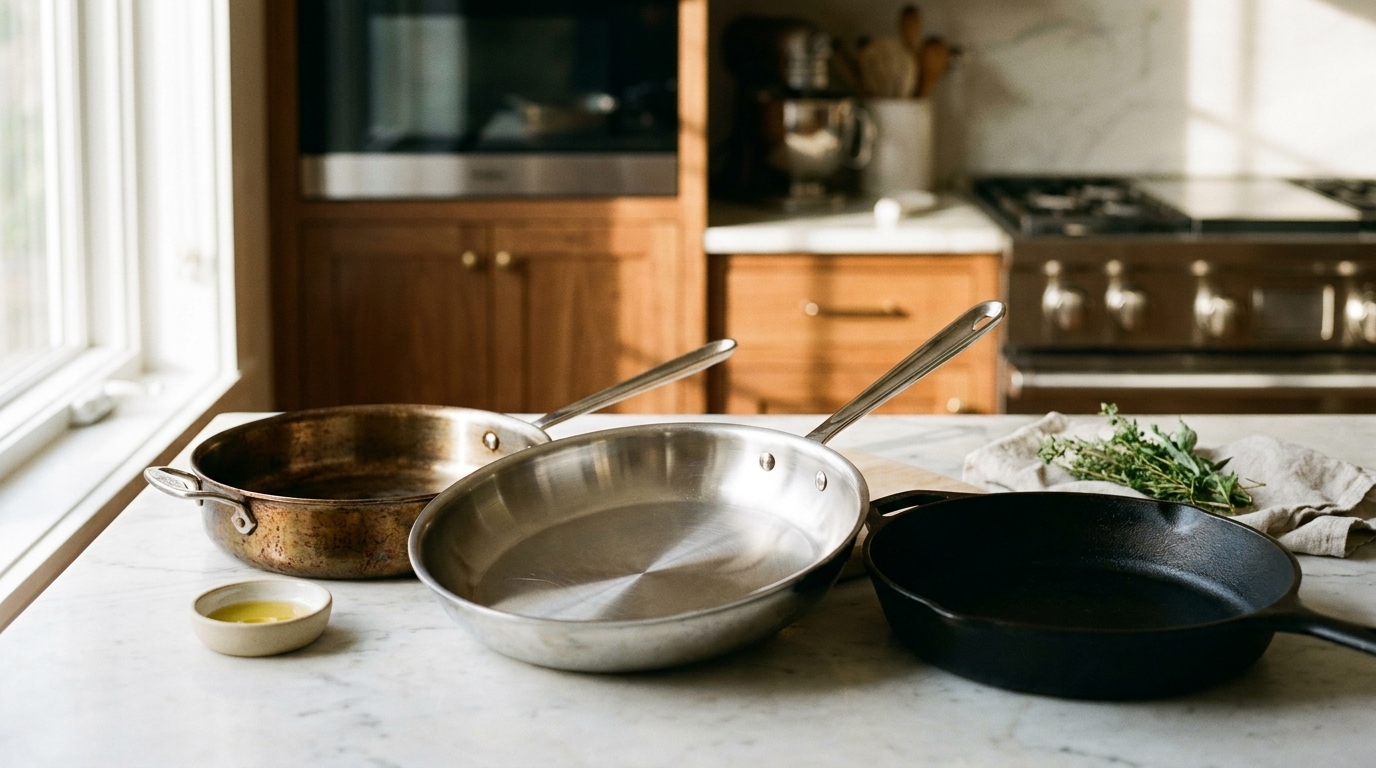
Learn how to assemble a chemical-free cookware set using stainless steel, cast iron, carbon steel, and ceramic without paying inflated retail markups. Coating-free materials eliminate PFAS exposure while lasting decades with proper care and maintenance.
Why Go Coating‑Free? The Health and Environmental Edge
PTFE coatings leach toxic PFAS into your food and persist in the environment for centuries, contaminating water and soil across entire regions.
Understanding chemical leaching and health risks
The coating on most non-stick pans is PTFE--a PFAS compound--and it migrates into food at higher rates with heat, fat, acid, or added salt. [1] Exposure to PFAS like PFOA and PFOS has been linked to kidney and testicular cancer, thyroid disease, reduced immune response, and developmental toxicity in children. [2] PTFE also begins releasing toxic fumes above 500 degreesF, and scratched surfaces shed micro- and nanoplastic particles directly into food. [3] One study found that PFOS levels in acidic, salted food more than tripled after 10 uses of the same non-stick pan versus the first use. [1]
Environmental impact of non‑stick coatings
The environmental cost of non-stick cookware extends well beyond the kitchen.
PFAS persist in the environment for hundreds of years, showing up in water, soil, and air across the globe -- partly because production facilities discharge them through wastewater and air emissions that spread far beyond plant boundaries. [4] One supply chain investigation traced a single American-made non-stick pan to PFAS contamination across three states, including groundwater contamination affecting more than 4,000 residential properties near a North Carolina manufacturing site. [5] Disposal offers no clean exit: landfill burial leaches PFAS into surrounding soil and groundwater, incineration releases fluorinated greenhouse gases, and recycling requires temperatures high enough to trigger additional PFAS emissions. [4]

Choosing the Best Chemical‑Free Cookware Set
5-ply construction distributes heat more evenly than 3-ply, and budget-friendly options deliver the same performance as premium brands once you master the right technique.
Key materials: stainless steel, cast iron, carbon steel, ceramic
Each of the four coating-free materials plays a different role in a chemical-free cookware set.
Stainless steel is the most versatile -- corrosion-resistant, induction-compatible, and non-reactive for most tasks, though trace nickel and chromium can leach into acidic dishes cooked for long periods. [6] Cast iron builds a natural nonstick surface through seasoning, retains heat well, and adds small amounts of dietary iron to food -- a benefit for most cooks. [7] Carbon steel behaves like cast iron but weighs roughly half as much and responds faster to heat changes, making it ideal for wok cooking and high-heat sears. [8] Solid ceramic is the only option with zero food interaction of any kind, though ceramic-coated pans -- which carry a metal core -- typically degrade within one to three years. [8]
Features to look for: durability, heat distribution, price point
The three features that most affect long-term value in a chemical-free cookware set are construction quality, heat distribution, and how much of the price reflects actual materials versus retail markup.
For stainless steel, 5-ply construction -- alternating layers of steel and aluminum bonded across the full pan surface -- distributes heat more evenly than 3-ply, which can leave hot spots that scorch food unevenly.[9] Fully clad pans bond those layers edge-to-edge rather than just at the base, which prevents delamination over years of repeated heating and cooling.[10] Budget-conscious cooks can find solid 5-ply performance in the $100-$130 range through direct-to-consumer brands; once you learn how to cook with stainless steel at the right preheat, that construction difference becomes immediately noticeable regardless of price tier.[9]
Building Your Set: Essential Pieces and Smart Savings
Four essential pans--a 12-inch skillet, 3- to 4-quart saucepan, deep sauté pan, and stockpot--handle most cooking without redundancy, and bundle pricing saves money when every piece gets regular use.
Core pieces: skillet, saucepan, stockpot, sauté pan
A chemical-free cookware set built around four pieces covers most cooking situations without redundancy.
A 12-inch skillet handles searing, browning, and pan roasting -- a bigger surface works for two or six people, and you can always cook less in a larger pan. [11] A 3- to 4-quart saucepan goes beyond sauces: it steams rice, boils eggs, warms soups, and reduces liquids without a vessel switch mid-cook. [11] A deep sauté pan adds vertical clearance for batch cooking and shallow braises, while a stockpot earns its cabinet space for stock or large pasta batches -- and if storage is tight, a Dutch oven covers most of the same ground. [12]
Cost‑effective strategies: buying in bundles, caring to extend life
Bundle pricing makes sense when every piece earns regular use -- four- or five-piece sets cost less per item than assembling the same pieces individually, and many brands sell components separately so you can verify the lineup before committing to a full set. [11] Extending the life of coating-free cookware comes down to consistent habits: dry carbon steel and cast iron thoroughly after each wash, apply a thin oil coat before storing, and avoid soaking any uncoated pan overnight. [7] For stainless steel, the right approach to cleaning stainless steel pans -- warm water, gentle scrubbing, and thorough drying -- prevents surface damage that shortens a pan's life; a well-maintained stainless or cast iron piece can last decades, compared to ceramic-coated pans that typically need replacing within one to three years. [7]


Maintaining a Coating‑Free Kitchen for Longevity
Proper cooling, gentle cleaning, and smart storage prevent warping and rust, keeping your cast iron and carbon steel performing for decades.
Proper cleaning and seasoning techniques
To build seasoning on cast iron or carbon steel, coat the entire pan in a thin layer of neutral oil -- canola, grapeseed, or sunflower work well; butter doesn't polymerize reliably -- wipe off the excess until the surface looks nearly dry, and bake it inverted at 450-500 degreesF for one hour. [13] Modern dish soaps are safe for routine cleaning since they no longer contain lye, the ingredient that once stripped seasoning, so a gentle scrub with hot water handles most days. [14] For stuck food, add a quarter-cup of kosher salt and a few drops of warm water while the pan is still warm, scrub lightly, then rinse and dry -- the salt dissolves as you work and won't damage the seasoning layer. [14] Avoid acidic ingredients like tomatoes or wine until the seasoning is well established, as acidity strips the polymerized oil and can leave food tasting metallic. [15]
Storage, usage tips, and troubleshooting common issues
Stacking pans directly on each other scratches cast iron and carbon steel surfaces, creating spots that resist seasoning and promote rust -- the most reliable fix is separating stored pieces with pot protectors, a hanging rack, or hooks so they never contact each other. [16] Before washing, let every pan cool on a trivet or unused burner; running cold water into a hot pan causes outer metal layers to contract faster than interior ones, which warps the base permanently and creates uneven heat distribution. [17] For stuck food, add a splash of warm water while the pan is still warm and scrape with a wooden spatula -- the residue lifts without stripping the seasoning layer. [17] Rust is fixable: scrub the affected area with coarse salt or steel wool, dry the pan completely, then apply a thin oil coat and re-season before your next cook. [17]
- PTFE non-stick coatings shed microplastics and release toxic fumes above 500 degreesF, with PFAS exposure linked to cancer, thyroid disease, and immune damage.
- PFAS chemicals persist in soil and water for hundreds of years; a single American-made non-stick pan traced to PFAS contamination across three states.
- A four-piece chemical-free set (12-inch skillet, 3-4 quart saucepan, deep sauté pan, stockpot) covers most cooking without redundancy.
- 5-ply fully clad stainless steel distributes heat evenly and prevents delamination; quality construction costs $100-$130 through direct-to-consumer brands.
- Cast iron and carbon steel develop natural non-stick surfaces through seasoning with neutral oil at 450-500 degreesF for one hour.
- Proper maintenance extends coating-free cookware life to decades: dry uncoated pans immediately, separate stored pieces to prevent scratching, cool on trivets before washing.
- Rust on cast iron or carbon steel is fixable--scrub with coarse salt or steel wool, dry completely, then re-season before cooking.
- https://pmc.ncbi.nlm.nih.gov/articles/PMC8306913/
- https://www.sfenvironment.org/should-i-be-concerned-about-using-non-stick-cookware
- https://www.nrdc.org/stories/why-nonstick-pans-are-hot-mess
- https://pfasfree.org.uk/uncategorised/non-stick-cookware-a-sticky-situation
- https://www.ecocenter.org/cooking-chemicals-toxic-lifecycle-pfas-used-nonstick-kitchen-products
- https://www.healthierhomes.com/post/what-is-the-healthiest-material-for-cookware?srsltid=AfmBOopkg0LYBsd2hkQWYCjcpTb0bOVpfZrMT0CFQbpK00VrR8EJK7XS
- https://nephcure.org/safe-kitchen-choices-a-comprehensive-guide-to-non-toxic-cookware/
- https://plasticdetox.org/articles/cast-iron-vs-stainless-steel-vs-ceramic-cookware.html
- https://www.organicauthority.com/guide/best-stainless-steel-cookware
- https://betterlivingeveryday.com/best-non-toxic-cookware/
- https://www.consumerreports.org/home-garden/cookware/skip-the-cookware-set-here-are-the-5-pieces-you-really-need-a3107165716/
- https://www.seriouseats.com/most-essential-pots-and-pans
- https://www.seriouseats.com/how-to-buy-season-clean-maintain-cast-iron-pans
- https://www.nytimes.com/wirecutter/guides/how-to-clean-cast-iron-skillet/
- https://mylescooks.substack.com/p/the-cast-ironcarbon-steel-guide
- https://www.debuyer-usa.com/blogs/how-to/the-art-of-maintenance-how-to-clean-carbon-steel-pans?srsltid=AfmBOorDjabube63b16w69LeOU-jyRXzWkx_ORbUcbA4mM71ae-ONLbb
- https://www.mashed.com/163411/this-is-how-youre-ruining-your-frying-pans/