

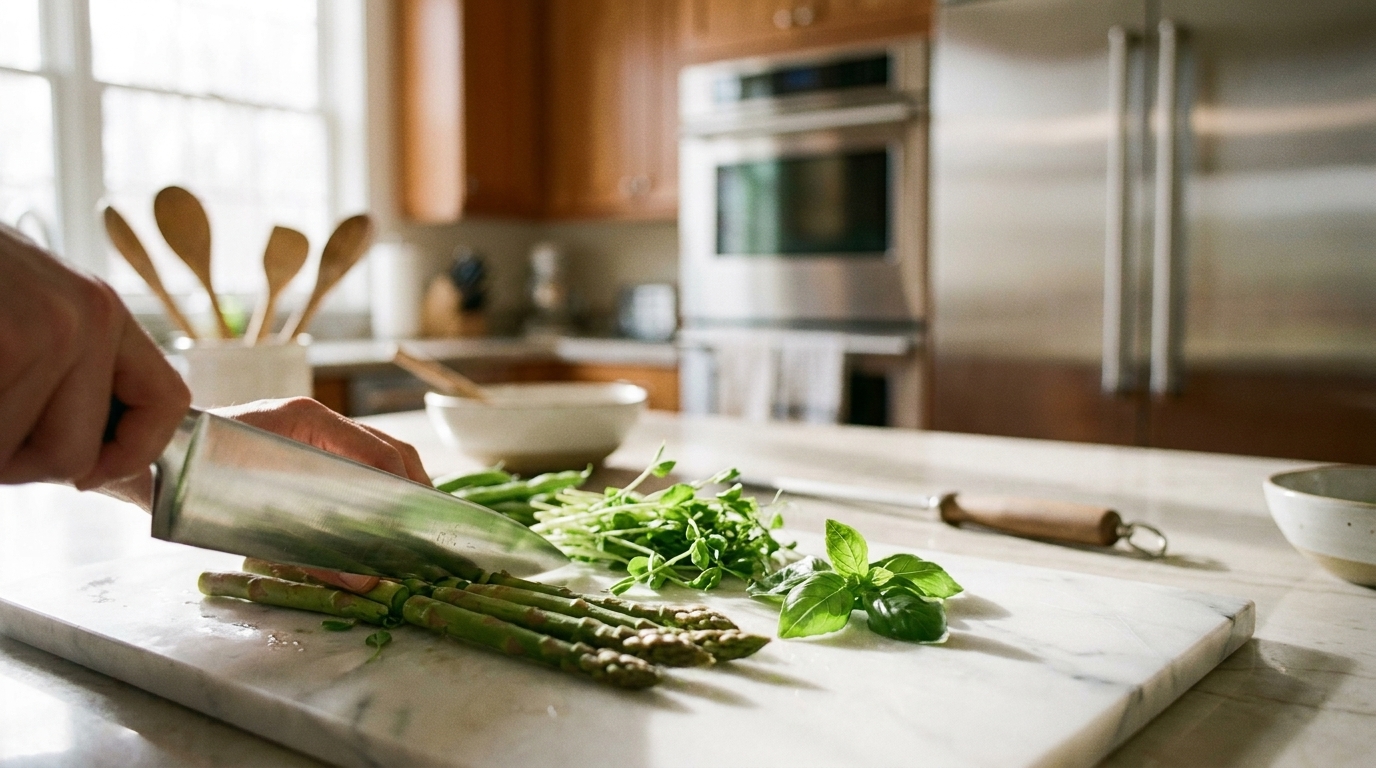
Master the four essential knife cuts--julienne, batonnet, and chiffonade--plus maintenance techniques that keep spring produce fresh and prevent browning. A sharp blade and proper technique minimize cell damage, preserving the delicate flavor and color of seasonal vegetables and herbs.
Why Spring Produce Demands Different Knife Techniques
A sharp blade slices cleanly through spring produce instead of crushing cells, which prevents browning and preserves flavor and texture.
The Delicate Nature of Spring Vegetables and Herbs
Spring vegetables and fresh herbs -- pea shoots, asparagus, tender lettuces, and basil -- have thin primary cell walls that hold high moisture under internal pressure, making them structurally vulnerable to rough handling [1]. When a knife crushes rather than slices cleanly through those cells, it triggers enzymatic browning almost immediately -- the same reaction that turns a cut apple brown at the counter [2].
Basil is a clear example: tearing rather than chopping damages fewer cells, which means lower enzyme release and less discoloration and flavor loss [2]. A sharp knife working cleanly is the first practical defense against bruised, wilted spring produce [2].
How the Right Knife Prevents Bruising and Oxidation
The difference between a sharp and a dull knife, at the cell level, is the difference between slicing and crushing.
A narrower blade angle -- Japanese-style knives run around 15 degrees versus the 25 degrees typical of Western blades -- requires less force to pass through tissue, which limits cell rupture and the enzyme release that causes browning. [3] Spring produce like asparagus, pea shoots, and tender lettuces loses moisture and color quickly when cut surfaces are ragged rather than clean. [4] Before spring prep starts, confirm your blade is actually sharp enough to work this way -- the 3-test method for chef knife sharpness gives you a fast, practical way to check.
The Four Essential Knife Cuts Every Home Cook Should Master
A sharp chef's knife that slices cleanly rather than drags is essential for producing consistent strips and preventing bruising in delicate spring vegetables.
The Julienne: Creating Uniform Matchsticks for Spring Salads
The julienne produces matchstick-shaped strips -- typically 2 to 3 inches long and 1/8 inch thick -- that add texture to spring salads without bulk. [5] The standard method squares off the vegetable into a rectangle, slices it into even planks, then cuts those planks into strips; for rounded spring produce like carrots or radishes, slicing thinly on a diagonal first and cross-cutting achieves the same result with less setup. [5][6] A sharp chef's knife is the most important tool here: consistent strip width depends on a blade that slices cleanly rather than drags, which also prevents bruising in moisture-rich spring vegetables. [5] If you need a chunkier cut for roasting or stir-fries, the batonnet cut follows the same method but lands closer to 1/4 inch wide.
The Chiffonade: Slicing Leafy Greens and Herbs Without Bruising
The chiffonade cuts leafy herbs and greens into thin ribbons by minimizing the total number of strokes -- stack 4 to 5 leaves concave-side up from largest to smallest, roll them lengthwise into a tight cylinder, then slice crosswise with a sharp knife. [7] The concave stack keeps leaves from bending during the roll, reducing bruising before the blade makes contact, while the rolling technique means fewer total cuts and less enzyme release that causes browning. [7][8] Dragging the knife rather than using clean, single strokes tears rather than cuts, producing browned edges across every ribbon. [7] Slice chiffonade right before using it, since exposed cut surfaces oxidize and darken within minutes. [7] For applying this technique to a wider range of spring greens, the chiffonade herbs technique covers the same method across multiple leaf types.
Choosing the Right Knife for Spring Produce: A Decision Framework
A chef's knife handles most spring prep work, while a paring knife gives you better control for precision tasks like hulling strawberries or coring tomatoes.
Chef's Knife vs. Paring Knife: When to Use Each
The chef's knife handles the bulk of spring prep -- slicing asparagus, chopping herbs, and mincing shallots -- because its curved blade supports a rocking motion across a cutting board. [10] The paring knife takes over when precision matters more than speed: hulling strawberries, segmenting citrus, or coring cherry tomatoes are tasks where a 3-to-4-inch straight blade gives you better control than a longer knife can. [9][11] Reach for the paring knife any time you're holding the ingredient in your hand rather than working flat on a board -- that's the cut it's built for, and where a chef's knife becomes more hindrance than help. [9] If you're deciding which knife to prioritize first, the chef knife buying guide breaks down size and steel options in practical terms.
Blade Material and Edge Retention for Precision Cutting
Carbon steel (0.6%-1.5% carbon content) achieves higher hardness than stainless, producing a finer, longer-lasting edge -- useful for the precise slicing spring produce requires. [12] Stainless steel trades some of that edge retention for corrosion resistance: chromium content above 10.5% means the blade handles acidic spring ingredients like citrus and tomatoes without reacting, though it may need sharpening more often to stay at peak performance. [14] For a closer look at how a specific high-performance stainless alloy balances hardness and corrosion resistance, the ACUTO 440 steel properties guide covers composition in practical terms.
Edge geometry affects retention as much as material -- sharpening at a finer bevel angle can extend how long any knife holds its edge significantly, regardless of which steel you choose. [13]
Knife Maintenance and Safety: Keep Your Blade Spring-Ready Year-Round
Hand wash and dry your knife immediately, store it in a block or on a magnetic strip, and hone every few uses to keep the edge sharp and ready.
Honing vs. Sharpening: The Critical Difference
Honing and sharpening serve different purposes.
Honing realigns the knife's edge microscopically -- the edge bends with use, and a honing rod pushes it back into alignment without removing any metal. [15] Sharpening grinds away material to form a new edge, and should only happen when honing no longer restores cutting performance. [16] For most home cooks, honing every few uses keeps a blade sharp day-to-day, while sharpening every three months to a year is typically enough. [17] A quick test: if your knife still tears through a tomato after honing rather than slicing cleanly, it's time to sharpen -- or send it to a mail-in knife sharpening service if you'd rather skip the whetstone.
Storage and Care to Prevent Rust and Dullness
How you clean and store your knife after each use directly affects how long the edge stays sharp.
Dishwashers expose blades to high heat, harsh detergents, and contact with other utensils -- all of which dull edges and accelerate corrosion -- so hand washing with mild soap and drying immediately with a cloth is the standard approach. [18] Carbon steel blades need one additional step: a light coat of food-safe oil after drying prevents the rust that develops quickly on high-carbon steel, especially in humid kitchens. [19] For storage, a knife block, magnetic strip, or in-drawer blade guards keep edges from contacting other surfaces -- one of the fastest ways to introduce nicks between uses. [20]
- Sharp knives slice spring produce cleanly; dull knives crush cells and trigger browning.
- Julienne and chiffonade cuts require sharp blades and proper technique to prevent bruising.
- Chef's knives handle bulk prep work; paring knives give better control for hand-held tasks.
- Carbon steel holds a finer edge longer; stainless steel resists corrosion from acidic ingredients.
- Hone every few uses to realign the edge; sharpen every 3-12 months when honing fails.
- Hand wash and dry immediately; store in a block or on a magnetic strip to protect edges.
- https://pmc.ncbi.nlm.nih.gov/articles/PMC11062476/
- https://www.npr.org/sections/thesalt/2018/01/25/580056584/can-chopping-your-vegetables-boost-their-nutrients
- https://www.newswire.com/news/top-damascus-chef-knife-of-2025-shinzo-blade-review-reveals-why-this-22608023
- https://thedeliciouslife.com/how-to-prep-some-vegetables-for-crudite/
- https://www.foodnetwork.com/how-to/packages/food-network-essentials/how-to-julienne-cut
- https://smittenkitchen.com/2016/08/how-to-julienne/
- https://www.jessicagavin.com/how-to-cut-basil/
- https://mysekkin.com/blogs/journal/essential-knife-skills-home-cooks?srsltid=AfmBOoogkZhr6ZxZcEW6LdEymgSMppQZuzQGGO51bLV2lVmmiP6ycbiC
- https://www.seriouseats.com/the-best-paring-knives
- https://www.everythingkitchens.com/knife-education-guide.html?srsltid=AfmBOopzAh4OywKDVA9XYkYy5eezIaT2gsQgikhCczqk-5LOXRPgtmll
- https://www.foodandwine.com/best-vegetable-knives-8400300
- https://www.opinel-usa.com/blogs/news/stainless-steel-vs-carbon-steel-knives
- https://knifesteelnerds.com/2021/10/19/knife-steels-rated-by-a-metallurgist-toughness-edge-retention-and-corrosion-resistance/
- https://www.seriouseats.com/why-buy-carbon-steel-knives-best-kitchen-tools
- https://seidoknives.com/blogs/news/honing-vs-sharpening-knives?srsltid=AfmBOopTDCrecs8s5J1EZGsRXpV7_d7FmenA4Jmk4JRr1T8GY2KZHvcm
- https://www.musashihamono.com/blogs/care-maintenance/honing-vs-sharpening-the-key-to-keeping-your-knives-razor-sharp?srsltid=AfmBOoqZ_GAbji7QyyXFZTGXxkKPHTGlkS-nwqfmlkEhvo0qh966hppL
- https://www.messermeister.com/blogs/news/how-often-should-you-sharpen-and-hone-your-knives?srsltid=AfmBOopDzkxH_wyGgwtQwn7ntgI-CXsPkltPgj2MQh4YkHyHH4NLMzM7
- https://eliteprocutlery.com/extending-the-life-of-your-knives-best-practices/?srsltid=AfmBOooOhu0kEskZSgP2bSrjGTz89-I94CSOsspFM9teK9Q0hL4E9Nd5
- https://wickedhandy.net/kitchen-knife-care-and-maintenance/
- https://www.dalstrong.co.uk/blogs/chef-blog/heres-the-best-way-to-prevent-dull-knives