

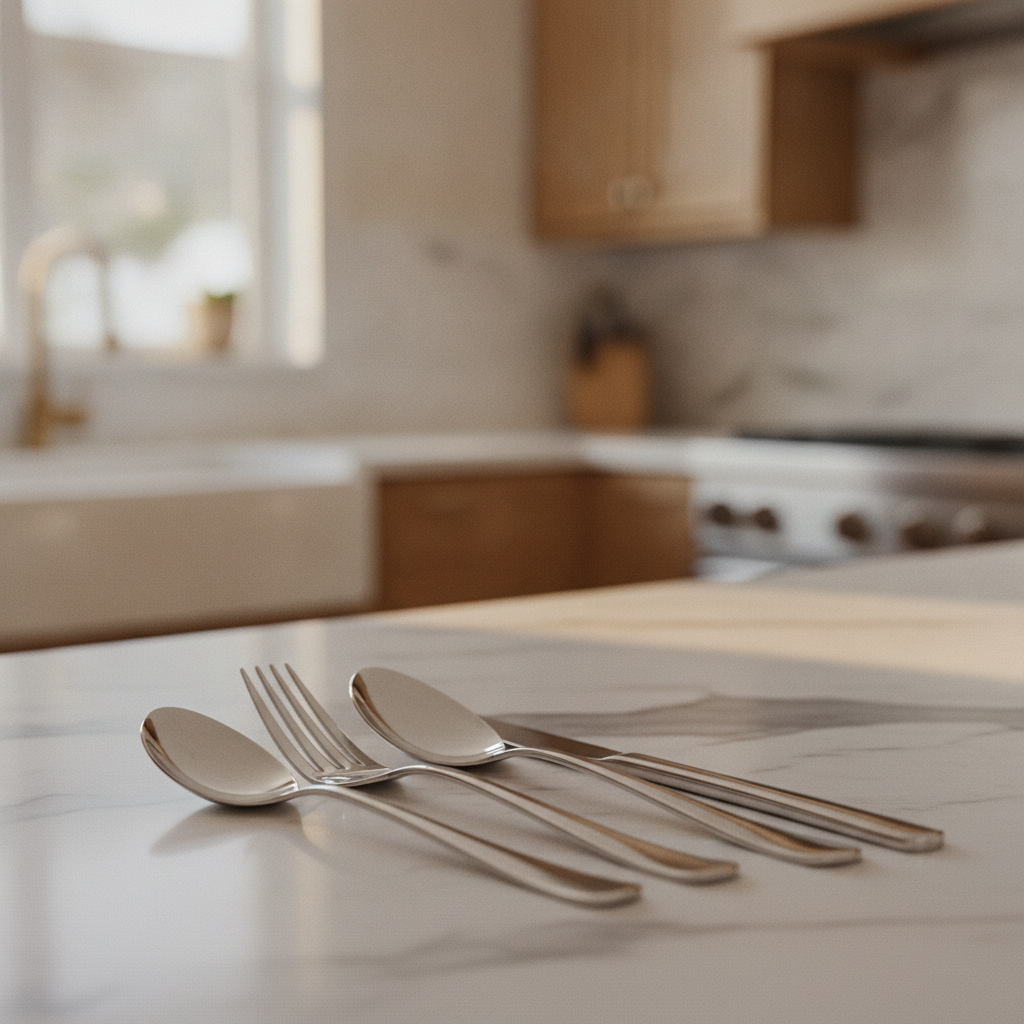
Material and construction determine how long flatware actually lasts--solid 18/10 or 18/8 stainless steel outperforms cheaper alternatives over years of daily use. Simple care habits like rinsing before washing and drying immediately prevent pitting and spotting, so your investment stays sharp and functional.
What Is Flatware and Why Material Matters for Durability
Stainless steel flatware resists rust and pitting better than silver-plated or carbon steel, making it the most durable choice for everyday use.
Flatware vs. Dinnerware: Understanding Your Table Setting HierarchyFlatware refers to the knives, forks, and spoons used to eat a meal, a term that covers everything from a basic dinner fork to specialized pieces like fish forks and demitasse spoons [1]. Silverware technically means the same utensils made from sterling silver or silver plate, but many home cooks use the term interchangeably with flatware regardless of material, which is where confusion starts [1]. Cutlery is the broader category that sometimes includes flatware plus kitchen knives, though in table-setting contexts it usually means the same thing as flatware [2]. Dinnerware, by contrast, refers to the plates, bowls, and serving dishes food sits on, not the utensils you eat with, so the two categories solve different problems in your table setting [2].
A standard place setting builds a hierarchy around the plate: dinnerware anchors the center, glassware sits to the upper right, and flatware flanks both sides based on course order, forks left, knives and spoons right [1]. Basic five-piece settings include a dinner fork, salad fork, dinner knife, teaspoon, and soup spoon, while formal settings add fish forks, cocktail forks, or bouillon spoons depending on the menu [1]. Understanding this hierarchy matters before you shop, since a dinnerware buying guide and a flatware guide solve separate parts of your table, and pairing them well starts with knowing which piece does which job.
How Material Choice Determines Longevity, Maintenance, and Cost Per Piece Over 10 Years
Material choice determines flatware's lifespan because it dictates how the metal resists rust, pitting, and wear from daily washing. Stainless steel dominates the market because it balances hardness, corrosion resistance, and cleanability better than silver-plated or carbon steel alternatives [4]. Silver-plated pieces look upscale but need hand care and periodic buffing to stay bright, while carbon steel blades cut well but discolor over time, which adds maintenance work most households want to avoid [4].
Stainless flatware, by contrast, resists rust and corrosion through repeated dishwasher cycles when washed with neutral detergents and dried properly, which is the main reason it holds value over a decade of regular use [4]. Higher-priced stainless patterns also get more attention during manufacturing, with better-polished tines and rounder handles that hold up to years of use without feeling rough in the hand [3]. Cost per piece over time depends less on the sticker price and more on how often you replace worn pieces.
A cheap set with stamped, sharp-edged handles or poorly finished tines tends to wear uncomfortably and gets swapped out sooner, while a well-finished stainless set purchased once can outlast several cheaper replacements [3]. Buying individual pieces as needed, rather than a full boxed set, can also extend a set's working life since you replace only what's lost or damaged instead of starting over [3]. Weighing upfront cost against expected years of service, rather than price alone, gives a clearer picture of what a set actually costs per year of use.

Stainless Steel Grades Explained: Why 18/10 and 18/8 Are Not Interchangeable
Nickel content determines how well flatware resists rust and spotting over years of dishwasher use, not the sticker price.
Decoding the Numbers: Chromium and Nickel Percentages That Prevent Corrosion and Pitting
The numbers stamped on flatware boxes, 18/10, 18/8, and 18/0, spell out exact percentages of chromium and nickel blended into the steel [5]. The first number is chromium, which forms a passive oxide layer that blocks rust and staining [5].
The second is nickel, which adds shine and extra resistance to pitting and acid exposure [5]. 18/10 stainless carries 18% chromium and 10% nickel, plus trace molybdenum, giving it the highest corrosion resistance of the three common grades [5]. 18/8 keeps the same 18% chromium but drops nickel to 8%, landing in the middle for both rust resistance and cost [5]. 18/0 skips nickel almost entirely and relies on chromium alone, which keeps the price lower but leaves it noticeably more prone to spotting and pitting after years of dishwasher cycles [5]. None of the three grades contain lead, so food-contact safety isn't what separates them, corrosion resistance is [5].
For anyone who has dealt with spotted or rust-flecked utensils, understanding why stainless steel rusts and how to prevent it makes it clearer why nickel content, not sticker price, drives how long a set actually lasts.
Comparison Table: Grade Performance, Price Range, and Best-Use Scenarios Across Misen and Industry Standards
A quick side-by-side makes grade differences concrete instead of abstract. Chromium sets rust resistance and nickel sets shine plus added corrosion protection, and the two numbers stamped on a box tell you exactly how much of each an alloy contains [7]. One source treats 18/8 and 18/10 as functionally identical, calling the nickel gap a labeling technicality since mills often produce Grade 304 steel right at the 8.2% threshold needed to qualify for the '18/10' name [6]. Other industry guidance draws a sharper line, describing 18/10 as the more lustrous, more corrosion-resistant option suited to fine dining, with 18/8 positioned as the value-minded alternative that still performs well day to day [7][8]. 18/0 and 13/0 sit below both: 18/0 skips nickel and turns magnetic, which suits settings where loss or theft is a concern, while 13/0 is reserved mostly for knife blades because its lower chromium content forges into a sharp, durable edge [7].| Grade | Chromium / Nickel | Corrosion resistance | Best-use scenario |
|---|---|---|---|
| 18/10 | 18% / 10% | Highest shine and rust resistance [7][8] | Fine dining, everyday sets meant to last [8] |
| 18/8 | 18% / 8% | Comparable to 18/10 in practice [6] | Value-focused households and casual dining [6][7] |
| 18/0 | 18% / 0% | Lower shine, more prone to staining [7][8] | High-turnover settings, magnetic retrieval [7] |
| 13/0 | 13% / 0% | Lowest, but forges to a sharp edge [7] | Knife blades, not full utensil sets [7] |
The Three Main Types of Flatware: Solid, Plated, and Hollow Handle
Solid stainless steel flatware costs more upfront but lasts five to twenty years, making the price per year lower than replacing cheaper sets repeatedly.
Solid Stainless Steel: What You Pay Upfront vs. What You Save on ReplacementSolid stainless steel flatware is forged or stamped from one continuous piece of metal rather than a handle bonded onto a separate blade, which is what lets it survive years of dishwasher cycles without loosening or delaminating [9]. Forged pieces carry the pattern through the entire handle instead of stamping it only on the surface, and that extra material costs more per set upfront but stands up to the heaviest daily use [9].
That higher price buys real payback over time: stainless cutlery can last anywhere from five to twenty years depending on grade, finishing, and maintenance, with well-maintained 18/10 pieces kept under disciplined care routines exceeding fifteen years of service [10]. Thinner, lower-grade stamped pieces wear out and need replacing sooner, so the gap between a cheap set and a solid one narrows once you count how many replacement sets a household buys over the same stretch of years [10].
Solid construction also resists the bent tines and loose handles that show up first in hybrid pieces built from weaker fillers, a warning sign that a set is failing well before the metal itself gives out [10]. Weighing a heavier price today against a decade or two of daily use, rather than comparing box prices side by side, gives a clearer read on what solid stainless actually costs per year at the table [9][10].
Plated and Hollow-Handle Flatware: When Budget Constraints Make Sense and When They Don't
Hollow-handle knives pair a stamped blade with a separate handle shell, a construction that can deliver a lighter, more balanced feel than a solid-handle knife in well-built examples [11]. That construction also lets a set chase a sterling-silver look at a lower price point, offering what can be an elegant stainless alternative to sterling silver without the upkeep silver demands [11].
Budget constraints make sense here when the goal is formal-table styling on a stainless budget, since a well-built hollow-handle set can feel comfortable in the hand and stay durable despite the lighter build. They make less sense for households prioritizing pure daily-use durability over looks, where a fully solid set, or a budget solid option built from 18/8 stainless and sold as individual pieces, may serve better since you replace only what wears out rather than buying a whole new boxed set.
Choosing between the two comes down to whether your priority is formal appearance or long-term daily wear.


How to Choose Flatware That Outlasts Dishwashers, Hard Water, and Daily Use
Check weight, edge finish, handle balance, stainless grade, and warranty coverage before buying flatware that will survive years of dishwasher cycles.
Five Essential Criteria: Weight, Edge Finish, Handle Design, Stainless Grade, and Warranty Coverage
Weight, edge finish, handle design, stainless grade, and warranty coverage give you a checklist for judging flatware before it reaches the table, not after it starts bending. Weight feels like an easy quality signal, but it's actually a byproduct of design and manufacturing choices, not a guarantee of durability [14]. Forged pieces run heaviest because the pattern is worked through a single piece of metal, while medium-weight or 'economy' flatware is the lightest option and the most prone to bending in the hand [13]. Edge finish matters just as much: smooth, consistently polished edges point to careful manufacturing and safer handling, while rough or uneven tines signal shortcuts taken during production [14]. Handle design should let the utensil disappear in your grip, with a balanced knife that won't tip, a comfortable fork shoulder, and a spoon bowl smooth on the lip [12]. Stainless grade still sets the ceiling on how well a set resists pitting and staining over years of washing, so grade and weight need to be weighed together rather than judged separately [13]. Warranty coverage is worth confirming directly with the seller before buying, since a written guarantee gives you recourse if handles loosen or finishes fail sooner than expected.
Five criteria to check before buying:
- Weight: heavier isn't automatically more durable [14]
- Edge finish: smooth, even polishing signals quality manufacturing [14]
- Handle design: balanced grip that resists finger fatigue [12]
- Stainless grade: sets the ceiling on corrosion resistance [13]
- Warranty coverage: confirm terms with the seller before purchase
Maintenance Essentials: Preventing Pitting, Spotting, and Staining Before They Start
Preventing pitting and spotting starts well before the dishwasher door closes, not after the spots show up. Rinse off salty or acidic residue, like vinaigrette or tomato sauce, before loading, since chloride left sitting against metal through a full wash cycle is a common trigger for pitting [15]. Keep flatware from resting against aluminum cookware or mixed lower-grade alloys in the rack, because contact between dissimilar metals can cause galvanic corrosion that no stainless grade prevents on its own [15]. Skip extended heat-dry or sanitize settings when you can, and towel-dry handles and tines as soon as the cycle ends, since standing water left on the surface is what turns into spotting overnight [15]. Store pieces dry in a lined drawer or upright caddy rather than piled wet in a rack, since trapped moisture between stacked pieces is where staining tends to start. The same drying and stacking habits that protect dishwasher-washed tableware from chipping and staining apply just as directly to flatware.
Quick prevention checklist:
- Rinse salty, acidic residue before loading [15]
- Keep flatware separate from aluminum or mixed metals [15]
- Dry pieces right after the cycle ends [15]
- Store flatware dry, not stacked wet in a rack
Choosing flatware that lasts comes down to matching material and construction to how you actually cook and clean. Solid 18/10 or 18/8 stainless, smooth edge finishing, and a balanced handle can carry a set through years of daily use, and a few simple care habits keep it looking sharp. We believe good tools should work better and last longer without costing a fortune. For more care & maintenance tips on your stainless steel tools, explore our collection, and contact us if you have questions.
Frequently Asked Questions
-
What's the actual difference between 18/10 and 18/8 stainless flatware?
Both have 18% chromium, but 18/10 has 10% nickel while 18/8 has 8%. The article notes one source treats them as functionally identical since mills often hit the 8.2% nickel threshold for the '18/10' label, while other industry guidance says 18/10 is more lustrous and corrosion-resistant, positioning 18/8 as the value-minded alternative that still performs well daily.
-
How long does stainless steel flatware actually last?
The article states stainless cutlery can last anywhere from five to twenty years depending on grade, finishing, and maintenance, with well-maintained 18/10 pieces under disciplined care routines exceeding fifteen years. Lower-grade stamped pieces wear out and need replacing sooner, so the gap versus a solid set narrows once you count replacement sets over time.
-
Is lower-grade flatware (like 18/0) unsafe because it has less nickel?
No - the article specifies that none of the three common grades (18/10, 18/8, 18/0) contain lead, so food-contact safety isn't what separates them. The nickel difference affects corrosion resistance and shine, not food safety; 18/0 is simply more prone to spotting and pitting after years of dishwasher use.
-
Is it cheaper to buy a boxed flatware set or individual pieces?
The article doesn't give fixed prices for sets versus individual pieces, but it notes that buying individual pieces as needed, rather than a full boxed set, can extend a set's working life since you only replace what's lost or damaged instead of starting over. A boxed set may look cheaper upfront - compare its actual per-piece construction and grade against buying replacements individually before deciding.
-
How many flatware pieces do I need for a basic place setting?
According to the article, a basic five-piece setting includes a dinner fork, salad fork, dinner knife, teaspoon, and soup spoon. Formal settings add more specialized pieces like fish forks, cocktail forks, or bouillon spoons depending on the menu.
-
How do I keep flatware from rusting, pitting, or spotting?
The article's checklist recommends rinsing salty or acidic residue (like vinaigrette or tomato sauce) before loading the dishwasher, keeping flatware separate from aluminum or mixed lower-grade alloys to avoid galvanic corrosion, skipping extended heat-dry or sanitize settings, towel-drying pieces right after the cycle, and storing them dry in a lined drawer or upright caddy rather than piled wet in a rack.
- Stainless steel dominates flatware because it resists rust and corrosion through repeated dishwasher cycles better than silver-plated or carbon steel.
- 18/10 stainless carries the highest corrosion resistance, while 18/8 performs comparably at lower cost, and 18/0 is more prone to spotting and pitting.
- Solid stainless flatware lasts five to twenty years depending on grade and care, making the cost per year lower than cheaper sets replaced multiple times.
- Smooth, even edge finishing and balanced handle design signal careful manufacturing and safer handling during daily use.
- Rinse salty or acidic residue before loading, keep flatware separate from aluminum, and towel-dry immediately after washing to prevent pitting and staining.
- Forged pieces carry the pattern through the entire handle and resist bending better than stamped alternatives, though weight alone doesn't guarantee durability.
- https://www.tigerchef.com/flatware-guide-tigerchef.html
- https://www.borgodelletovaglie.com/en/blog/guides-and-tips/how-to-choose-and-buy-the-right-cutlery-service-for-your-home
- https://www.silversuperstore.com/faq/quality_differences.asp
- https://kaimeihousewares.com/news/silverware-set-buying-guide-stainless-steel-flatware-sets-that-elevate-every-table/
- https://www.xometry.com/resources/materials/18-8-vs-18-10-vs-18-0-stainless-steel/
- https://www.silversuperstore.com/stainless_quality.asp
- https://www.webstaurantstore.com/guide/585/different-types-of-flatware.html
- https://grunwerg.co.uk/blogs/news/flatware-buying-guide-18-10-18-0-forged-stamped-and-buffed
- https://www.samtell.com/blog/what-to-look-for-in-quality-flatware
- https://www.niceflatware.com/how-long-does-stainless-steel-cutlery-last/
- https://ideal.house/th/community/news/the-best-flatware-of-2026-reviews-by-wirecutter
- https://www.google.com/goto?url=CAESsAEB6zswFQsR9GGJSnOMBlDiHp1vjNux6_CE-BXuxK6YeHve8cZktMzFdDbJzpNCNJfkfCrvwxptVS_nqIHF0VgzcD4o6caayzwmfgrJJb0dBvnLSdzalFZ__g_uKujolCtQJ74R_m4RSiucdmaEeh69IxdkUCj0SmIXsLsqvclPlKuoZ54dbW2dSfUzTAVma5BOzSmKCxGcHS6KfseugHqan-pIqozdo1CfeDmmLo7SDw
- https://www.google.com/goto?url=CAESyAEB6zswFTiaY90SKZc4vpbXy3qu4Zvxx1p8Qghcxj_u9v0zFl6_AKqXoy405UffKZrI-I6mCyns6jUnlmwh6LTpvUGg9sOz5XMbnXPqVd4j--aN_F-Yi9Ks7vKi37tC07c35Cso7OVzuK1MFZr6Zb80Xp3uV4lHhYdoUFFT1cj0X9ImAQKTHFcPaakREvv8tii6Gaw13Uj-Y19mVvJ_hXI7yk9PCzNWn41AXPLg7v8HZUEPgE9-qNUF_1ODr3k6TZMu1G1qZwQgDQ
- https://www.google.com/goto?url=CAESfQHrOzAV78fI924TZr3IvmEDKry-Leo6O_mL8FZ5nk2NooKC3N-U9ls2evDcs_P9h2VG1wNsTQtBxuRDysbw9JJhl1M23HKPN14gPgc5rp91EBLoOG3IdXYZU3IIxwsdwGi4ThtxfmVFSk-uiM0m4NB9KWPHG608zM2bC-CI
- https://world.taobao.com/lang/en-us/shopping-guide/2014483145037971456.htm
- Summary
- What Is Flatware and Why Material Matters for Durability
- Stainless Steel Grades Explained: Why 18/10 and 18/8 Are Not Interchangeable
- The Three Main Types of Flatware: Solid, Plated, and Hollow Handle
- How to Choose Flatware That Outlasts Dishwashers, Hard Water, and Daily Use
- Key Takeaways
- References